Posted in Uncategorized

THE BEST EXOTIC MARIGOLD HOTEL: Expansiveness

When I saw the preview for The Best Exotic Marigold Hotel, I knew I wanted to see it. Judi Dench, Maggie Smith, and a whole slew of other British actors who I was sure I’d seen in something and who, in the trailer, made me laugh at least once? Oh, yeah. Plus, India. For years, since reading Rumer Godden’s kids books, then finding her memoirs, A Time to Dance, No Time to Weep and A House with Four Rooms, when I grew up, I’ve been intrigued with that country. It’s a place I’d love to visit, and a place–honestly–I’m a bit afraid to visit, for various reasons. Obviously, it’s completely different to fall in love with a place on the page than to actually step into the streets and interact with people. I don’t typically do well with loud, crowded, and seriously bright, and I know the poverty would get to me. Someday, I hope I reach the point where I can let the worries go, then make the trip and somehow manage to just experience it all.

Which brings me to what I loved about The Best Exotic Marigold Hotel. It’s what I love about the idea of growing older and doing it the “right” way. It’s what I’ve always loved about books with “older” women (as in, not THAT much older than me now) who have loosened their own reins, the ones they’ve spent years holding tightly onto, the ones they’ve finally learned to relax. I read books like these when I was a teen, when I was in my twenties, and I still do. (For a light, but wonderful representation of this feeling, read Dorothy Gilman’s first Mrs. Pollifax mystery, The Unexpected Mrs. Pollifax. I love the whole series, but this first book, especially the first few, choice-making chapters, totally hits it for me.) They represent a goal, a dream, the person I want to grow up to be. And, yes, I think the person I am growing up to be.

It’s about expansiveness.

It’s about, as I said, loosening the demands and expectations and restrictions we place on ourselves, or that we let others place on us. It’s about looking for opportunities to change, to change one’s life and/or attitude. It’s about welcoming those opportunities when they come, even if you do it nervously and with baby steps and with one hand on the door behind you in case you decide to step back through. It’s about stretching past those fears, like the ones I have about traveling to India, and taking a chance that there will be bad stuff as part of an experience, but that there will also be good stuff, and the one will make the other worthwhile, even okay.

You have to go see the movie. I am not going to give you any spoilers. But it was just beautiful to watch these people, all at some different place along this path, at an age when expectations might tell them to just sit still and quit moving, to just accept the parts of the world that cometo them and ignore any of the parts they have to get to themselves. And it was wonderful to remember which way I want to do this life, from now until the time I absolutely can’t. And even then, to keep trying.

Posted in Uncategorized

> Five Friday

Okay, I admit it. Sometimes when I can’t think of a good blog topic of my own, I scan the internet for other people’s thoughts to share with you. BUT…this morning, I had just barely opened up my Google Reader when fantastic posts started jumping out at me. So today, be glad you’re getting links to other blogs! And that I let myself cheat on the Friday Five and not bother counting!

  • A few things Jennifer Hubbard was thinking about that, as usual, I spend time thinking about, too.
    Older and Younger
  • Beth Revis interviews Robin LaFevers, whose newest book Grave Mercy I have been raving about since I read it.
    Robin LaFevers interview
  • Alex Villasante talks about how easy (NOT!) it is being out on submission. For the first time. Go, read, sympathize!
    What I Know about Being on Submission
  • Jo Knowles has a wonderful post about actually knowing, truly, where your manuscript is–even if that “where” isn’t yet Done.
    A Little More Work to be Done
  • Ramona DeFelice Long has started a new series of How-To posts. Ramona is a freelance editor as well as a writer, so stop in here at her first post and just keep reading throughout the month.
    A Bold New Blog Plan
  • One of Jennifer Laughran’s usual intelligent, thoughtful posts–this one on reading books by authors we personally dislike or disrespect.
    Reading with the Enemy
  • Jeannine Atkins posts about getting some pretty intense critique feedback. This is, as far as I’m concerned, the courage and strength we all need to have about and for our writing.
    One Hundred Pages
Posted in Uncategorized

From Concept to Specific: Hunting the Perfect Detail

No, it’s not quite like hunting snipe.

But it matters a lot more.

Yes, I’m working on a picture-book revision this week, so the detail problem is more in my face than when I’m writing early draft thoughts about the YA WIP. But still…it’s relevant for all writing, I think.

Yesterday, on Facebook, Hélène Boudreau said she was craving s’mores. And then she posted this picture:

Look at that. Is that a chocolate bar over which the marshmallow is melting? It is not. It’s a peanut-butter cup.

Besides making me drool crazily and want to run right out to the store for supplies, what does the peanut-butter cup do? It changes the whole thing. If you’re like me and you love peanut butter, not to mention peanut butter inside chocolate, it makes the whole idea of a s’more so much better, I’ll never go back. (Now if someone would just come up with a replacement for those dry graham crackers!) If you are someone who doesn’t like peanut-butter cups (seriously?!), it might make you shake your head in dismay. If you have peanut allergies, I’m guessing you’re not having a happy Pavlovian response right now.

My point? There’s a difference between a plain chocolate bar and a peanut-butter cup. And it’s a difference that can tell us something specific about a person or a character.

You start with an idea, a concept. Let’s say: Friendship. I like that. Now, because you know better than to tell this friendship, you try to think of something that shows friendship. How about a present? Okay. Great. What present? A book? Or a racing-car set? Tickets to the next James Bond movie? Or to that all-nude production of Waiting for Godot?

One more? Concept: Anger. Details: Throwing a chair through the window or curling up into a ball on the couch? Knocking down that tower of blocks or turning your back on everybody else in the room and building that tower slowly, steadily, as close to the sky as you can get it?

I’ve gone on here about how I’m usually on the side of fewer details, especially in historical novels. And I stand by my belief that too many details is just…too many.  I also get that–with a picture book–the writer who supplies too many details is not only overdoing the word count, but is probably also getting in the way of the illustrator. BUT…when it comes time to actually pick a detail, you need the right one. It needs to add to the story, reveal character, and create an image in the reader’s mind.

What will I be doing today? Sitting at my computer, staring into space, letting ideas and words and images saunter through my brain. I’ll have my butterfly net handy, ready to catch any possibilities, drop them into my story, and see if they’re the right fit. Most I’ll set free again, but I’m definitely hoping for one that will decide to stay.

A couple of recommendations for picture books in which the authors have, IMO, done a beautiful job picking details:

Posted in Uncategorized

A Day in the Life

This week, I have three projects to work on.

  • Project A has the highest-urgency level, with an absolute, drop-dead due date of Friday, for which I still need reviews & material from other people involved in the project. So, basically, I can’t really work on it today, but–you know me–I can worry about it!
  • Project B also has a Friday deadline, but it’s one that can be extended, and most of the work is a little bit of steady research and some simple rewriting. I’m easily halfway there. I’m working on Project B today, mostly because I can’t yet work on Project A.
  • Project C is, so far, just a potential. If it has a deadline, I don’t know it, and–truthfully–I don’t know yet whether I will or can do this one. It’s still in the Let’s Talk and Explore stage. So, yeah, I can do a little thinking and a little work, but there’s no commitment and, thus, no real urgency. It is, however, possibly exciting and possibly intimidating. Which means, yes, I can fret about it even while I don’t work on it.

There have been many times in the past when I had one job and, frankly, no real lifeoutside that job. Calm. Steady. And, oh, yeah…boring.

I’m not bored today.

What’s up with your week?

Posted in Uncategorized

And, Again, Why Write for Kids?

Honestly, I’m not sure how to credit this, since it’s all over Facebook by now, including my page. I THINK I got it via someone’s page called “Burning Through Pages,” but I can never tell where things come from out there. It’s just so perfect, though, I’m sharing it here…again. And to whoever started it around, THANK YOU. Pure genius, yes.

How many Harry Potter glasses did kids absolutely have to have. How many wizard hats? Wands? Quidditch broom? And one of my most wonderful memories of books and my son: the time we read Ruth Stiles Gannett’s My Father’s Dragon, and out came the backpack and in went the best we could do, in terms of mimicking all the things Elmer used to outwit the animals. That backpack went everywhere for days! Back even further, when I was a little girl, in love with biographies, and I made a record paper out of binder paper & tape (Thomas Edison) and tied grass on my parents’ fruit trees (Luther Burbank). The imagination is an incredible thing, and the authors who feed it are gifts to us and our kids.

What was the book that got your child dressing up, experiencing that so-intense identification with a character in a book, that need to step into and be part of that story world?

Posted in Thankful Thursday, Uncategorized

Thankful Thursday: Thoughts Inspired by a Niece

Over on Facebook today, one of my nieces made a comment about how it’s just not possible to have your life planned out at her age. She’s a sharp young woman with awesome goals, energy, and commitment; since I’ve known her (okay, maybe since she started walking!), she’s decided she was going to do something, and she’s done it. At her age, I was pretty much deciding, almost every day, that I didn’t want to do…X. Or Y. Or any of the other–*counts on fingers*–23 letters of the alphabet. (Hey, B is for “book,” and I have never chosen against that!)

Plans. Or, as Terry Pratchett’s Nac Mac Feegle say, PLNS. You can’t live with them, you can’t live without watching them go up in smoke.

I used to think that was a bad thing. There are many days when I still do think that’s a bad thing. Usually, though (Beware: It’s a little trite), the more time I spend with yoga and the whole Pay-Attention-to-What’s-Happening-Now-and-Stop-Grasping-for-Something-in-the-Future thing, the more I’m glad that my life has gone the way of the planless. Or maybe the failed plan. I’ve tried not to grasp; however, I have grabbed a few times, when opportunity knocked. In fact, I’ve often pulled it inside and fed it hot chocolate and cookies to make it stay. And most of those opportunistic grabs came from hanging out, watching what was going by, checking in with myself, and–yes, I won’t lie to you–not a little panic.

I’ve been stressed, frustrated, anxious, and irritable. I’ve also been jazzed, engaged, creative, and free. And, I believe, incredibly lucky.

I have no advice for my niece, for any of my nieces or nephews. (I have plenty of advice for my son, although I do try to just trickle tiny driplets at him occasionally, rather than backing up the dump truck and burying him in it all at once!) Lives are so different, and personalities, and what comes at each of us that we can’t control. All I would say is that I’ve made plans and broken plans, written lists and torn them up. And essentially, over time, it’s all been good.

For which I am, yes, very thankful.

Posted in Research, Uncategorized

Open Letter to Anyone Writing a Research Book Just for Me

This post is dedicated to my sister Jenny, the history teacher, who is stunned to find me reading history after all these years and who, I fear, grits her teeth and bites back words every time I reject or whine about a book. Love you, Jen!

Dear History Writer:

I’m back on the research trail, along with honing in on my WIP’s story. Over the weekend, I read a great book about technology and housework and what all those newfangled inventions did and didn’t do for women’s (and men’s) work in the home. (I can now tell you that there were, at one time, gas-powered refrigerators as well as electric ones, but do not ask me to explain the workings of either, or why one took off while the other didn’t!)

And then this morning, I picked up another book, that shall remain nameless, because–even though it’s on a topic I am interested in and that has a lot to do with my WIP, I couldn’t get through it. I tried–reading a few pages at the start of each chapter, skipping through looking for a heading that might be relevant, reading a few paragraphs more here and there…but nope. There might be information in this book that I need, but I can’t keep my brain attached to the words long enough to find out.

Why did I enjoy (and learn from) one book and couldn’t force myself to keep reading the other? Well, the obvious answer would be that the first author is a better writer, but I think there’s more to it than that. So, for anybody out there who’s considering writing history for readers like me–who aren’t their strongest with a nonfiction read, who need to be entertained while they’re being educated, who will leave behind a dry research book for something fictional at the drop of a hat…here’s what I’d like you to be thinking about as you write.

  • Do, please, tell me stories. I can only take so many facts without a breather, without being pulled into something that has plot, tension, character dynamics, and forward movement. No, don’t feel like you have to write a novel for me–I have plenty of those lying around. But bring that information into something with the elements of a novel, if only for half a page. Kay? Thanks.
  • Give me people. Yes, I know there are readers and researchers out there who love diving into pages and pages of government edicts, tables with housing and employment data, maps of population migration, lists of the various ores used in building railroads. And I need some of that, too. But please sprinkle them lightly through your words, as examples, not the entire text of a chapter. And then let me know what it really felt like to live with those statistics, what someone said about them in a letter or diary. Feed my imagination, not just the calculator that is, yes, stored somewhere in the dark recesses of my brain.
  • Weave some humor into your narrative. Make me smile, even laugh. Some of those quotes you’re sharing are ludicrous–I know it and, come on, you know it, too. How could he/she say that with a straight face? And how can you deliver it without at least a tiny well-phrased smirk. Or go the other way. Make me mad, get me pissed off at the nerve of a group, a person, a leader. And let your own anger leak out–just a little trickle, so I know we’re on the same side. So I know you didn’t just type that passage into your manuscript coldly and objectively, not when it’s outrageous enough to break through anyone’s objectivity. Seriously.
  • Draw connections. Yes, I know it’s simplest for you to organize your book by decades, or by geographic regions, or by ethnic groups. And,  yes, that organization makes it easy for me to find the information I most need. BUT…just because your chapters are separated by page breaks, does not mean these people, these areas, these timelines are distinct and isolated from each other. They’re not. One year builds to another; one person’s actions ripple through the lives of others; the events in one state cross the borders into another–even if it takes a while. Share this with me. Show me that you see the threads weaving through it all, and make me aware of the ones I don’ t know yet.
  • If you need an example of the things I’m talking about, I can refer you to a couple of books that were beginning steps of my conversion into reading (good!) history. Pick up Amy Butler Greenfield’s A Perfect Red: Empire, Espionage, and the Quest for the Color of Desire and Laurence Bergreen’s  Over the Edge of the World: Magellan’s Terrifiying Circumnavigation of the Globe. (Note: Don’t eat a big meal before reading the sections about scurvy in Bergreen’s book. And, yes, making me sick to my stomach gets you a gold star, right up there with the whole humor and anger thing.)

That’s all. For today, anyway. Thank you for listening and for, possibly, considering my wish-list as you start writing Chapter 1. I don’t know how far my request will get you in academic circles, or in the lives of those people who live for facts (Hey, some of my best friends are people who live for facts!!), but your efforts will not go unappreciated here, in my world.

Which must count for something.

Yours in research,

Becky Levine

Posted in Uncategorized

And the Winner Is…

The winner in last week’s giveway of The Writing & Critique Group Survival Guide is…

Joyce Moyer Hostetter!

Joyce, I know I SHOULD have your address, but I’ve been so good about cleaning out my inbox lately, it’s gone! Can you email me at beckylevine at ymail dot com and give it to me again. And I’ll get a copy of the book out to you.

Posted in Friday Five, Uncategorized

Friday Five: Random

1. I’m typing this as the most chocolatey-ever cake is baking in the oven. Seriously, I’m waiting for the crash that I’m sure is coming, after I convinced myself that all that batter wouldn’t fit in the pan and better just be eaten.

2. I just told son he should probably get up soon (almost 11:00), so he could eat and be functional before going to take the test for his…DRIVING PERMIT!!!!!

Me? Old enough to have a son who drives? When did this happen?!

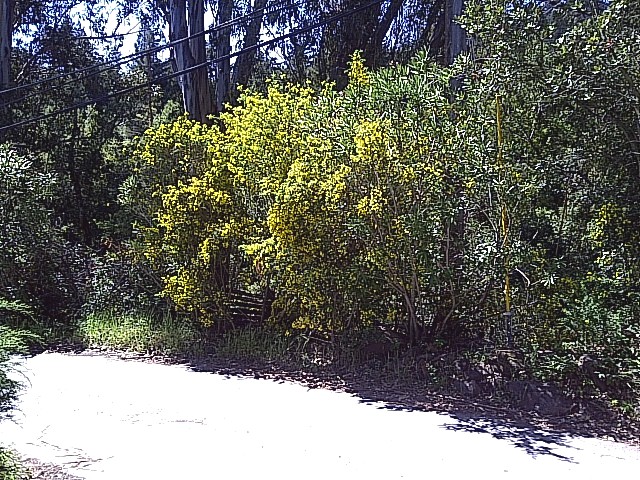
3. Spring has hit. I’m loving the warmth and the sunshine, the wearing of shorts and sandles, the blue skies. I’m not so happy about the pollen, but I’m telling myself the snorkiness of the last few days was a small cold. Denial is a powerful thing.

Scotch broom is pretty much covering our mountains.

4. I’ve made serious progress this past week in thinking out my WIP, thanks to Donald Maass ‘ worksheets and my resurgence of stick-to-itivity. I’m accepting that all the time I spent on character, which felt like rambling nebulousity, is paying off, now that I’m in the plot section. Honestly, I still couldn’t explain how one leads to the other, but I can’t argue with the fact that it’s happening on the page.

5. Oh, and I ordered a new research book, ignoring the half-dozen still on my shelf that I haven’t yet cracked open. I’ve been trying to stay away from research while I work on story, but of course one of my characters decided his story brings in a piece of 1910’ish Chicago that I really haven’t delved into yet (unbelievable as that may seem). Plus, somehow, now that I’m finding the story, I’m feeling the urge to do more research. The whole writing-research thing really does seem to be symbiotic. Or parasitic. Take your choice.

Posted in Uncategorized

What it Means to Trust an Author: Jennifer R. Hubbard

I’ve read one of Jennifer R. Hubbard’s books–The Secret Year (read my review here). As I write this post, I’m 33 pages into her second book, Try Not to Breathe. And she’s done it again.

Jenn writes the kinds of books I don’t ever see myself writing. Realistic YA, yes, but even within that genre, she goes with topics that are ones I don’t think I could/would write about. In The Secret Year, Colt and Julia had a secret year together, but the book opens by announcing Julia’s death to the reader. We only learn about that year in the context of Colt’s loss of anything that could have come after. I haven’t read far enough into Try Not to Breathe to give away any spoilers, but here’s the first line from the jacket blurb: “Sixteen-year-old Ryan is fresh out of a mental hospital and trying to figure out how to reboot his life after a suicide attempt.”

Hard stuff. Stuff I often choose not to read, let alone explore in my own writing.

And, yet, when it’s Jenn writing, I’ll pick up the book, and I’ll turn to page one, and I’ll start reading. Even with that blurb.

Why?

Well, I got The Secret Year, because I’d been reading Jenn’s blog. I still read it; it’s one of the most consistently intelligent discussions of writing and reading that I’ve found out there on the Internet. I bought The Secret Year half because I’m always curious about books by people I “know” online, and also because I knew that Jennifer could write. Good, tight writing–whether it’s in a blog, a comment, or a book–carries a lot of weight for me, has a lot to do with what books I choose off the shelf.

Why did I get Try Not to Breathe? Suicide. Again, not something I easily or casually read about. Not an escape-read, not something I can figure will make me laugh out loud, not something for a quick, light afternoon of reading.

I got Try Not to Breathe because I’d read The Secret Year. Because I trust Jenn.

I trust her to:

  • Develop her characters into distinct individuals, not simply stereotypes of people who have “this kind” of experience.
  • Write a story that, while it may have its roots in a starting moment, abig, starting moment, goes far beyond that moment in exploration.
  • Give me things in her characters that I like and that I don’t like, and to do it in a way that the writing terms “heroic traits” and “flaws” are too simplistic.
  • Never toss a word, paragraph, or scene at me that relies on my automatic reaction–she doesn’t rest her writing on the plain fact death or suicide, doesn’t go for the shock-value of just putting that into the book.
  • Push herself past truisms and stereotypes.
  • Explore both characters and character dynamics (which is, ultimately, what I am ALWAYS reading for).

I know Jenn will write a story about people who seriously interest me, who–by just a few pages in–I care about. I’m only 33 pages into Try Not to Breathe. I’m sure bad things are coming. Probably very bad things. But for these people, in this story, because of this writer–I’ll keep reading.

Trust. It’s a biggie.