Posted in Contest, Critiquing, Memoir

Wednesday’s Winner…& a Memoir Teleseminar

Last week, I interviewed Laura Purdie Salas about the marketing she did for her picture book Stampede! Poems to Celebrate the Wild Side of School. I entered everybody who left a comment in a contest for Laura’s book. This morning, I crumpled up all the little pieces of paper and picked one out of the bowl.

And the winner is…JENNIFER BEASLEY!!!!!

Congratulations, Jennifer. Email me your snail mail address at beckylevine at ymail dot com, and I’ll get this wonderful book out to you ASAP.

And a heads up for any of you who are writing, or thinking about writing, a memoir. A week from Friday, I’ll be doing a teleseminar with Linda Joy Myers about critiquing memoir, over at the National Association of Memoir Writers (NAMW). You’ll find details here about getting in on the teleseminar.

Hope everyone’s writing week is going well!

Posted in Setting, Uncategorized

Getting Past a Setting Stall

A few posts back, I said that, this year, I was going to try & spend my first hour’s work on my fiction. So far (I know–a whole week!), that’s been going well. Probably because I’ve let myself have some freedom on what “work” means during that hour.

Specifically research settings.

My middle-grade mystery is set in “today,” in Santa Cruz, California–which is about 20 minutes away from my house. We go there frequently, not to all the places I used in my book, but definitely enough that I have a strong sense of how the town looks and the feel of the different communities there. (Things like Keep Santa Cruz Weird bumper stickers help!) So I could write my scenes through a few drafts, without any problem. Then, when I needed to remember how many times I felt like falling over at The Mystery Spot, or what route my MC would really take to the beach, I’d drive over with my camera and get the details right.

I’ve been to Chicago and back. I’ve reminded myself about all the brick–red, yellow, and an incredibly lovely pink—and the trees that maybe weren’t so big back then, but were probably around. But there are places I have never been. Like:

  • The inside of a tenement building
  • The lunchroom for workers in a 1913 department store
  • The particular train station my MC has to visit
  • Up the stairs into the 2nd or 3rd floor apartment OVER the dry-goods shop

What I found during the summer was that, if I have NO idea what my setting looks like, I have a LOT of trouble writing the scene. Even starting to write the scene. So I’m letting myself spend some of that morning hour with books and on the Internet–just looking for enough to let my imagination build something up, something I can play with.

Yes, I’m doing this for scenes that will change, for descriptions that may not even make it to the book. Or even the 2nd draft. But it’s letting me step into the world I’m writing about, back in time, and put some of that world onto the page. For now, that’s a good enough reason for me.

That, and the fact that I wrote an entire chapter last week, one I’m a LOT happier with than the many I wrote over the summer.

How about you? How much setting do you need to take the first step into a scene?

Posted in Bravery, Getting Organized, The Writing & Critique Group Survival Guide, The Writing Path, Writing Fears, Writing Projects

Taking Risks…Come On, Just a Few

I am by nature an extremely cautious person. I’m also not so good with change. 38 years later, I’m still not so sure my family needed to sell our smallish tract home and move to the much bigger house, on the top of a hill, with an ocean view and a bedroom for each kid, that my parents had designed and built just for us. Really.

‘Cause you know, why swap out the old for a new? Why take the chance, when where you’re headed might be worse than where you are?

Well, obviously, because it also might be a lot better. Or just really, really good and mesh in beautifully with the happy life you already have.

The last few years, I’ve taken more risks. Nothing huge, from a lot of people’s perspectives, but from Little Miss “Okay, Mom, I’ll get nine books I’ve already read from the library and one new one,” some of the choices I’ve made have been a big deal. And they’ve gotten me to some very good places, including the writing and soon-to-happen publication of The Writing & Critique Group Survival Guide.

So, this week, with school starting, more time to focus, and a year ahead in which I want things to be different, I’m putting myself out there. I’m digging deeper into my WIP, reminding myself how important this story—and my fiction—are to me. I’m working on a couple of basic pitches for two nonfiction projects, to send to my agent. I sent an email off for some consulting work. I’ve got a list o children’s nonfiction-book publishers that I’m going to contact.

You can see where the risk comes in. These are all projects I’m qualified to do, and they’re all things I really love doing. But, yes, it’s a lot. The old me would say I was insane, diving head first into all these options, instead of maybe sticking a toe (or just the tip of a toe) into that water. The new me takes a look at the possibility of insanity and does some reassuring. Here’s what I tell myself:

  • You can do these.  You can. [Sigh.] Yes, honestly.
  • None of these are sure bets. To be realistic, some—if not many—are longshots. The odds of you getting to do all of them—get real. You’re not that good. (Yes, sometimes, a big of ego-deflation is actually necessary these days. When did that happen?!)
  • They won’t all happen at the same time. Projects take weeks, months, even years to come to fruition. You’ll probably be bored, waiting for anything to do.
  • A full, exciting life is better than a quiet, dull one.
  • “Yes,” is better than “No,” much of the time. And for your writing path, just about all of the time.

Do I still get nervous? Of course. Do I let that stop me, as it would have when I was young, from reaching out, from stretching myself for the things I really want. Not any more. I may not race ahead and grab it at full-speed just yet. I do, however, hold out my hand and say, “Please.”

What about you? What risks have you taken, or are you facing, that can add to your writing path, bring you more of the happiness that it already gives you?

Posted in Blog Contest, Marketing, Promotion

Marketing Interview (& Contest) with Laura Purdie Salas

In September of 2008, Laura Purdie Salas joined up with Fiona Bayrock to explore marketing and PR possibilities for two of their picture books that were being published the next year: Salas’ Stampede! Poems to Celebrate the Wild Side of Schooland Bayrock’s Bubble Homes and Fish Farts. And they decided to do this exploration publicly—at their LiveJournal community, Bubble Stampede. Over the next months, the two authors discussed their marketing goals, their fears, and their plans.

I asked Laura if she’d do an interview here, to talk about what some of those plans were, how they year and the release went, and which ideas worked better than others. Happily, she said, “Yes.” Read all the way through—Laura has provided a TON of specific, practical information.

And leave a comment. I’ll enter you all in a drawing for Laura’s book Stampede! I’ll draw the winner next Wednesday, September 2.

And on to the interview.

BL: How did you and Fiona hook up? What made the two of you decide to work on your marketing plans together?

LPS: When I posted one or two Marketing Monday posts on my personal blog, I told readers that I’d be sharing my book promotion journey. Fiona Bayrock and I knew each other from being on the NFforKids Yahoo group, and she emailed me to suggest we join forces and do a joint blog. I thought that was a fantastic idea and said, “Yes, let’s!”

BL: Why did you decide to do the planning publicly, on the community blog?

LPS: Well, I had a nice motive and an ulterior motive. The nice motive was that I like to share stuff on my blog, when possible, that is information and that’s hard information for beginners to find. My ulterior motive was that by sharing my promotion tasks, I’d be promoting my book, of course. Also I hoped to get feedback and ideas from some writers who were more experienced than me. And we did! Finally, I thought being public about it would help make me accountable and keep me on track.

BL: What were your biggest/basic marketing goals for Stampede!?

LPS: Here’s the list I was working from.

Interview/Reviews

  • Contact local media (personally & also through publisher’s publicist). Do again in summer with a back-to-school angle
  • Approach blog reviewers about sending review copy (give list to publicist)

ONLINE

  • Create a STAMPEDE website and give it some presence on my website
  • Create “billboard presence”—my word for a static online site/page that you don’t have to change a lot—on Facebook, Linked In, MySpace, Ning, etc
  • Update Flapjacket, Children’s Literature Network, and other sites that list my books
  • Do an ongoing marketing blog with Fiona Bayrock

Events

  • Book launch
  • Local book events with another author?
  • Attend IRA (International Reading Association) in May this year, here, in Minneapolis
  • Possibly attend ALA (American Library Association) in Chicago
  • Try to arrange to speak at some conferences in 09

Reaching out to Teachers/Booksellers

  • Teacher’s guide
  • Reader’s theatre
  • Authorless event kit? (A set of online materials a bookstore can print out to create a fun storytime with reading, activities, maybe a craft…all without too much work on the bookseller’s part and no in-person visit from the author.)

Reaching out to the Press

  • Create an online press kit
  • Update my bios
  • Create some resource materials (10 Great Back-to-School books, 10 Terrific Poetry Books, etc.) to share in press materials and also on Amazon
  • Write a back-to-school piece for news wire

Name Recognition

  • Guest-teach a couple of classes in the Whidbey Island Writers Association
  • Serve on poetry panel for CYBILS awards
  • Write a bi-monthly poetry column for Kid Magazine Writers
  • Attend local book club with media specialists, kidlit profs, and children’s book buyer for the entire Minneapolis metro area as members, etc
  • Anything that can bet my name in front of people and where I can slide a mention of Stampede! in there

Miscellaneous Stuff

  • Book trailer
  • Blog campaign to get people to request that their library buy a copy of the book
  • Have promotional items made
  • Campaign contacts to review the book on Amazon and B&N
  • Mail press kit to local media
  • Have postcards made as soon as cover is final and start handing them out now!

Mailings

  • Start updating contact list so that I can do mailing to schools, libraries, independent booksellers, and personal contacts

BL: What were your marketing fears?

LPS: In-person events scared me the most. I was losing sleep about a book launch. The idea made me so nervous. The other big fear was just that everything would fall flat. The more you put into it, the harder you try, the bigger our humiliation is if it all falls flat.

BL: Where and how did you gather your initial ideas about what a marketing plan might include?

LPS: The fantastic blog Shrinking Violet Promotions was a great starting point for me. Also, I had been saving emails and articles and all sorts of stuff for years in a folder marked Promotion. It was a “someday” folder…and someday came, and I really did use a lot of that information!

BL: What marketing to-dos went on your original list of things to focus on?

LPS:

  • Contacting the publicity department at my publisher
  • Building the microsite for Stampede!
  • Creating the book trailer
  • Figuring out a book launch

BL: Did you accomplish that whole list?

LPS: I did do all the stuff on that short list, though I ended up doing an online launch. It was a ton of work, but it was also lots of fun. The launch happened in April, but all the activities and comments are still live here.

BL: What was the best thing about marketing your book?

LPS: That’s a tough question, since marketing doesn’t come easily to me. Um…One was that putting so much effort into this really made me appreciate the value of my book. I risked my time, energy, money, and pride, knowing I might not get something in return—but felt like my book was worth it. Two was that by putting a lot of visible effort into Stampede!,I made my publisher aware that I was willing and able to promote my book. And that in turn made my publisher more willing to promote my book, like by sending me to ALA Chicago (and Texas TLA—Texas Library Association—next spring). This is a lot of money to spend on an unknown author, and I think (though I don’t know for sure) that my own promotion efforts indirectly lead to this.

So much stuff we do in marketing has no immediate, tangible result, so it’s hard to evaluate. But I do think impressing your publisher as a busy, effective marketer can only help!

BL: What was the hardest thing about marketing your book?

LPS: Handing out postcards or flyers or whatever at conferences—that is just so not me. Even as I’ve gotten more confident and a little more experienced, I’m still not comfortable with this. OH! And the other hardest part was in bookstore/signing events. Some were better organized than others, and some resulted in a few book sales. But I do not have a salesperson’s personality, and three hours out of too many Saturdays resulting in three books sold just got kind of old.

BL: With the book launched and “out there,” and looking back, is there something you now see as a must-do for writers?

LPS: If you’re not 100% comfortable with marketing, partnering up with another writer with a new book out is what I would consider a must-do! Teaming up with Fiona Bayrock for some online promotion at Bubble Stampede pushed me to do more. And for in-person events, which are what really intimidate me, teaming up with Dara Dokas (Muriel’s Red Sweater) was such a wonderful thing for me. The other must-dos, I think, are:

  • A website or section of a website devoted just to your book
  • Teacher-support materials (reading guide, reader’s theater, etc.)
  • Getting your book into the hands of reviewers (both print and blog)
  • Increasing your visibility in the writing community—don’t always focus on just one book; the more visible YOU are, the more people will recognize your name and hopefully check out your book(s)
  • Make postcards and/or business cards featuring your book cover and hand them out freely

There are a few things I never got to on my list, mostly because I ran out of time.

  • I never did any mailings
  • in-person launch (fear factor, more than time factor)
  • More billboard presence for my book on various online platforms

BL: Are there any other recommendations you’d give to writers whose book will be published in the next year?

LPS: I know I said bookstore events weren’t that successful for me. But it’s great to do them to build relationships with your local booksellers. I’m doing a reading at Red Balloon Bookshop in October, but they also hooked me up with an event at a minor league baseball game and recommended me to a school looking for (paid) author event. Booksellers have all kinds of connections with schools and organizations, so it’s smart to make them aware of you, your book, and what you might have to offer.

Start early. Some of this stuff takes a ton of time! And bookstores and other venues plan events for the future.

Don’t beat yourself up. I did as much as I could for Stampede!. I wanted to learn what works best for me. I didn’t get to everything, but I tried to just be proud of what I did do. And with my next book, I’ll be more selective, concentrating on the kinds of things that worked well the first time around.
Posted in Character, Conflict

Conflict AND Connection

Here’s what I worked on this afternoon.

conflict_connection

Okay, well, I filled it in, too.

Earlier this week, Jenn Hubbard blogged here about reading actor Jeff Griggs’ book Guru. You should read Jenn’s post to see all she got out of the book, but the thing that stuck with me was her realization that our characters need to work together at times, not always be in conflict. 

I started thinking about this as supporting each other, or at least having a connection. And I started asking myself what connection and conflict each of my main characters have with each other.

Enter the chart.

The biggest struggle was, honestly, creating the chart. I am chart-o-phobic. Flow charts are totally beyond me, and even this “simple” one that you see here got me all confused as I started entering info. Had to back out, look at it again, slap myself in the forehead a few times, and restart.

I don’t know if you can read this very well, but the main characters’ names repeat across the top and down the left. Basically, the rows show conflict and the columns show connection. I think. Or maybe a better description is that all the cells UNDER the shaded stairway show connection, while the cells ABOVE the shading show conflict.

To give you a clear (?) example, Nate (formerly known as Love Interest #1) and Gideon (formerly known as Love Interest #2) have the last two rows and last two columns. If you follow Nate’s row all the way across to where he meets Gideon above the shading, you can probably guess their conflict I typed in there—they both want Caro. On the other hand, if you follow Nate’s column all the way down to meet Gideon below the shading, well…you tell me what their connection is. I’m being generous (and wimpy) at this point and saying that they actually do both want Caro to be happy.

I’m not sure where this’ll take me, and I’m pretty sure (I see you nodding) that the info in the cells will change many times during the writing of this story. But for now it’s a reminder that the dynamics of a story work at many levels and that characters, like us, have complicated motives for their actions.

Some of which they’ll actually share with their authors.

Posted in First Drafts, Getting Organized, Thinking

Friday Five: Finding My Way Back into My Story

Today, with a gift of two free writing days (husband and son are off for an end-of-summer backpacking trip), I’m opening up my WIP and digging back in.

Feels wonderful.

Here’s what I’ll be doing:

1. Writing OUTSIDE the house. I’m heading over to the coffeehouse where I’ll be away from laundry and the kitchen cupboards that still need to be cleaned out and all the wonderful books I brought home from the library yesterday.

2. Spending some time thinking generationally. Ideas & thoughts about the mother-daughter pattern of my story—the fears engendered during one’s immigration and the resistance/frustration the other has about those fears—have been simmering the last couple of weeks. I’m pretty sure this is what I brought home from Chicago, both from the research part and from the hours spent with my sister on our family tree. Its brought those two threads together in my mind–not in any clear way yet, but as a weaving I need to focus on. I’m going to try and build a basic timeline of their lives and choices, making sure they also fit in the big historical events that need to be part of their stories.

3. Taking a look at Shutting Out the Sky, a book about tenements recommended to me by Stella Michel.

4. Browing through the chapters I have written. I’m in a much different mode now–realizing I was rushing through pages too quickly for the thinking I need to do on this story. I’m not going to go back and rewrite, but I’ll be taking along a pad of sticky notes to jot down possible changes to make, layers to add, on later drafts. I also just need to remind myself where I’m at and from which scene I need to start writing forward.

5. Let myself fall in love again. Between Chicago and getting life organized the last few weeks, I need to spend some time with Caro, remind myself why her story is so important to me and how I want to bring it onto the page. I’ll be doing a lot of jotting and doodling today and tomorrow, and I may stick a few pieces of paper up around my office to remind me of what I’m doing here, with this young woman.

What about you? What do you do to get back into the swing of the story, after the two of you have been separated for a while?

Posted in The Writing Path, Writing Fears, Writing Goals

And Here Comes School

If you’ve been reading my blog for a while, you know that I consider the actual New Years Day to be August 25th. Or whatever day school starts.

Wednesday, we go pick up my son’s class schedule. Next Tuesday, we head back into the school year. Eighth-grade, at the same middle school, so there shouldn’t be any big surprises. (Of course, now that I’ve said that…). His routine starts up again.

And so does mine. Five hours to focus on my novel. And my picture book. And marketing the critique book. And developing workshops. And thinking about other nonfiction projects I want to go for. This is going to be one of my busiest years in a long time.

I could panic.

Instead, I’m just reminding myself how good it is that all this is happening and that, yes, it’s what I’ve been working toward for years. And I can do it. At least most of it.

I’m working out a new schedule for those hours. One that’s based on the pay-me-first premise of finances, that says you pay your retirement plan first, then take care of the other expenses. This year, I’m paying my fiction first. This does not mean that I’ll be shirking my other projects, like getting the critique book out there to people, or organizing writing classes and conferences, or sending out proposals for more writing. It’s just that–honestly–I always get that stuff done. And pretty well. It’s the fiction that gets pushed to the bottom of the to-do list and, too often, off the list.

So…here’s the plan, guys.

  • Get up an hour-ish before son (whose school starts later this year, so he can actually sleep in till 7:00–woo-hoo!). Take that hour to read email and blogs. Say “hi” to you all over on Facebook and Twitter. Write up posts for my own blog.
  • Take son to school.
  • Come home, TURN OFF THE INTERNET, and work on my fiction for a minimum of one hour. Depositing words into the novel or PB account. (I say fiction here, but it really means my most creative work, which may include that nonfiction, biography PB that’s stewing in the back of my brain. I say writing, but it will also mean doing research, working on character development, or just standing and staring at my white board.)
  • Work on everything else. That being anything from to marketing biz and nonfiction projects to grocery shopping, paying bills, shopping for b-day presents, or adding new lead to the mechanical pencils. Life.
  • Exercise. I really prefer to do this earlier in the day, but when I exercise in the morning, well–somehow the morning disappears. As does the writing. So…this gets pushed later on the schedule chart. 🙂
  • Pick up son. We’ll be carpooling in the afternoons, so there will be a couple of days with a bit of extra time. More pencil leads. Or perhaps a nap.
  • Hang out around son. (I don’t say hang out “with”, because he’s 13, and we’ve prettymuch gone back to parallel-play  these days.) Clean house. Think about dinner. Check in with the Internet. More writing-biz stuff. Putter as productively as possible.
  • Dinner/Family time.
  • Before bedtime, try and re-orient on fiction, if only for a few minutes, so that I’m more ready to dig in the next morning. And with the usual hope, typically fruitless, of sparking some wonderful dream that will iron out all my plot knots and create amazing arcs for my characters.

Next day, rinse and repeat.

Me, a control freak? Ha! But truly, that hour a day is the thing that keeps my fear levels down, the fear that says I’ll make progress on everything but my fiction this year. When I look at it this day, I know I’ll keep moving forward, that I’ll be giving myself the space and time I need to grow this novel and any other creative projects I dip into.

Will it work? Check back with me at Thanksgiving, and I’ll let you know.

Do you have a plan that already works for you? Are you playing with one for this year? Drop a note into the comments and share!

Posted in The Writing Path

Julie & Julia: A Cooking AND Writing Life

I just got home from seeing Julie and Julia. I LOVED this movie. I have to say, until a few years ago, I was not a Meryl Streep fan, but I am SO glad she started doing comedy. Amy Adams was fantastic, and–well–I’ll watch Stanley Tucci in just about anything. I had seen previews and heard friends talk about the movie, and it lived up to all my expectations.

And it surprised me.

Because nobody told me about the writing/publishing thread. In which, I may say, there are many lessons to be learned.

By a writer’s FAMILY.

Here are the things I think the members of a writer’s family or, frankly, anyone in their support-system should take away from this film. (Perhaps MINOR spoilers involved.)

  • Always tell the writer that their book is important, a work of genius, and that it will “change the world.” I don’t care if their book is a novel, a cookbook, or a dictionary.
  • Support the writer in any and all research they must do to write their book–everything from buying MORE books to traveling to Chicago (Thanks, Honey!) to participating in the mass slaughter of several large lobsters.
  • Be polite, tactful, and respectful as the writer works toward publication. Recognize the moment, however, when it is not only appropriate but OBLIGATORY to swear forcefully, in response to a rejection letter.
  • Learn the dance of joy, and be prepared to perform it, in tandem, with energy and enthusiasm–if necessary, in public.
  • Do the dishes.

I think this is an important movie for us ALL to take our family to. Tonight, the theater population was at least 90% women. My husband and son were kind enough to join me for my birthday outing, and they were laughing and smiling right along with me.

They were also, I’m sure, taking copious notes.

In all seriousness, go. The movie, even without the agonies and joys of Julia’s publishing path, would have been delightful. With them, it was a reminder of how hard we all have to work to “get there,” and how worthwhile it is that we are doing so.

Posted in Family, Research

Chicago in Pictures

Edited Monday night, due to moral obligation. Before I left California, I stated that one of the things I would be doing in Chicago was seriously beating (again!) my identical twin nephews in Pictionary, despite their great psychic bond. Son and I have done amazingly well against them in the past. Tonight, though, I am forced to confess, as publicly as I bragged before, that they whooped us well, fair and square.  Congrats, guys. Until next time!

So the research trip is over. I had a great time in Chicago–parts of it look completely new and metallic-shiny, as if the sinking wooden streets and the women in long skirts never existed. Other parts have had asphalt and cement added around them, but the buildings are the same that people lived in 100 years ago, including my grandmother.

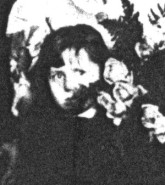
Selma_JennyMosesAnniversary

She’s sitting on her mother’s lap at her parents’ 25th anniversary party. We think she’s two or three. The roses her mother’s holding are right in her face, and she’s being asked to pose for the photographer which, even when I knew her, she never liked doing. She’s also the one who, many decades later, identified 35 out of 45 of the people at the party, giving my sister, my sister-in-law, and me the start of the many ancestry hunts we’ve been doing. Obsessively. If any of you know where to find Nuchka Krupnick in 1920, send me a line, will you?

This is the house my grandmother lived in.

SelmaHouse01

The story is that she and her twin sister would sleep on the balcony when it was too hot inside. Some of the houses also had balconies in the back–we drove around to try and find out if “ours” had one of those, but both my sister and I are navigationally challenged, and, honestly, we had some problem figuring out which back went with which front. So I’m saying, here and now, that this is the balcony my grandmother slept on. 🙂

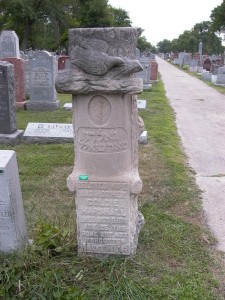
We actually did family stuff on the last morning in Chicago–finding this house and heading out to a Jewish cemetery in Forest Park. A HUGE Jewish cemetery that, way back when, was 300 LITTLE Jewish cemeteries. They are SO organized. Everyone’s in their computers; they can tell you lot number, section number, row number, and grave number. And whether your relative has a monument. Ours did.

GoldieMarshallsGrave01

This great-aunt died in 1918 in the influenza epidemic. She was about 25; my grandmother would have been seven.

Okay, yes, we did do non-family historical research, too.

Our first stop when we got to Chicago was at the Spertus Institute of Jewish Studies.

spertus01

See what I mean by new and shiny?

I had called ahead, a couple of weeks ago, just to check in about stopping by, and the librarians already had books pulled for me, including an unpublished memoir by a man who grew up in Chicago during the time my book is set. The librarians also gave me several other titles to look for AND showed me how to get into the historic archives of the Chicago Tribune.

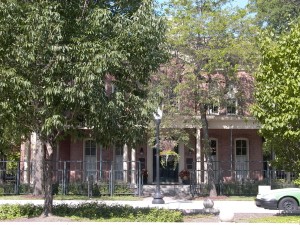
The next morning, we headed over to the place I’d been looking forward to most–the Hull-House museum.

hull-house01

First surprise? The photos I’ve seen of Hull-House are pretty dark–those black & white ones we all know so well. So I’ve had an image in my head of it as a dark, kind of foreboding place. That, you know, Jane Addam’s personality made bright & cheerful. (If you haven’t yet seen the early b-day present my sister bought me here, take a look.

Lovely, pinkish-red brick. You just don’t think about/imagine houses built of brick when you grow up in California. (Earthquakes + bricks = bad.)  Hull-House doesn’t allow photos inside, or I’d be able to show you the tall, spacious rooms with light walls and lots of windows. The house was also smaller than I expected. (This is the original house, during the years Hull-House was open, it expanded to include an entire block of buildings–most of those are gone now.) Being a reader of British mysteries, and living now in the world of Silicon Valley McMansions, I was expecting country-house huge. Instead, when you walk in, you are in a main entry room, with stairs heading up to the 2nd floor, flanked by one other room on each side, and a small room in the back. In the building next door, which used to be attached, the dining room downstairs and the music room upstairs probably fit about 100 people. When Hull-House first opened, club meetings and dances were held in the two outer rooms in the main house–NOT big enough for the hundreds of club members and dancers I had been visualizing.

I’m not sure how all this will affect my story. I do know that I have a feeling of a cozier, more intimate settlement house than I did before, and I know that will make changes in the scenes I’ve written and the ones I’ve only imagined. In a good way, I think. Seeing my grandmother’s house and other up-and-down buildings with two or three apartments in them is making me reconsider who lives where and how far they all have to travel to get to each other. And what happened in their pasts, before they moved into these new places. I found out in Hull-House that tenements were not the big sky-scrapy buildings, with hundreds of apartments (and thousands of people) inside them, but smaller structures–originally built to house two or three families, eventually over-crowded by putting several families into each apartment space. The bigger buildings came later–maybe after WWI? Again, this shifts the images in my mind into something less modern, maybe more interconnected, but–in a way–just as cramped and crumbling and wrong.

One big question for me about this trip was and still is–is there some way in which all this family stuff weaves into my writing of this story. When I started with this idea, there were no connections for me–my MC wasn’t even Jewish. I come from a family with a long history of secular, cultural Judaism–not religious, which has–in some ways–been comfirmed by the trip and by the ancestry hunting my sister and I have been doing. I have no idea, yet, how/if any of that will play out in this book. Today, I say no. But, six months ago, I had no idea that I’d be driving through Chicago, hunting for the #871 on house addresses or walking through an old cemetery searching for the name Goldie. Most likely, the ties between Caro’s story and mine are going to stay inside me, somewhere in feelings and genetic memories, rather than in the words on the page. I suspect, though, that the common threads will pop up every now and then and surprise me and–hopefully–add a depth to this book that I will welcome with heartfelt thanks.

One “for instance”–what do you all think of Clara, instead of Caro? Just sayin’.