Posted in Plot

Surprise!

I talk often to other writers about plotting. And not-plotting. And how much we do. And whether it’s an outline or a chart. And so on and so on…

If you read my blog at all, this probably isn’t news to you, but I’ll put it out here anyway. Hi, I’m Becky, and I’m a plotter.

I plot a lot–from the overall story arc to what’s going to happen in any individual scene. I don’t tackle a revision without looking at my existing plot and seeing where I need to make changes. And then I do it all over again as I revise each scene.

Yes, it’s about control. I need some sense of where I’m going, before I start trying to get there. I’m sure that I need a stronger sense of that than a lot of writers.

BUT…

I truly believe that understanding is what helps me loosen up as I write and let in the surprises.

And, oh, the surprises come. I’ve got a plan for my hero to argue, and instead she goes stone-cold silent with anger. I figure out which character is going to create an obstacle, and suddenly that character is all support and friendship, while someone else steps up to punch my hero in the gut. I pick a setting for its peacefulness and calm, and suddenly all hellamundo is breaking loose.

Yes, there are surprises that aren’t so wonderful: characters I forget to weave into the story who stand there like cold statues, doing nothing. Gaps where I realize I’ve leapt way too far ahead, without building to my hero’s choice or action. And of course, those moments where I realize–oh, BLEEP!–that history doesn’t support the storyline I’ve got going.

Those surprises, I believe, are the cost of leaving room for the others. If it were even possible for me to plot so tightly that I wouldn’t run into any dead-ends, or twisty mazes, I don’t think my characters would have room to step in and take charge. I don’t think they’d be able to shout loud enough to get my attention.

I’m not going to get her wording right, I’m sure, but Martha Alderson talks about plot as the vessel that exists to catch your inspiration. Yes, my plot-box probably has more sections than yours.

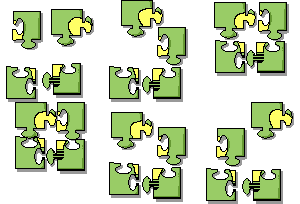
Maybe your plot has a beginning, a great crisis, and three bad things across the middle. Maybe you’re one of those writers I so envy who create a seriously strong one-sentence premise and write from that. Maybe your container looks more like this:

 Whatever we use, however much we plot, I really believe it’s all good. Whatever you have that gives you the freedom to let the words come, keep using it. And enjoy the surprises!
Posted in Uncategorized

Mind the Gap

When your characters dance into your mind, full and alive and layered and laughing, and your fingers type away at the keyboard, and the words appear on the page, how do you know? How do you know if you are painting what your mind is seeing, recording what it’s hearing, or if the sights and sounds are staying put inside you as ideas only. You’re pretty sure you’re getting some of it, you hope you’re getting close, but because your mind is so full of your imagination, how can you be positive?

Of course, this is something you look at during revision, when you come back to the words you’ve written and take a close look at what they actually say. For me, though, it’s also something I trust my critique group to help me with. I know that, if the gap is there–the gap between what I know and what I’ve written–they’ll see it. They’ll point it out, and they’ll help me to fill it in as I revise. This “safety net” that they give me is one of the biggest reasons that I can write freely, why I can (usually!) tell my inner editor to go away.

What about you? How do you separate yourself from the story you imagine as you write and recognize the one that comes off the page at you when you go back and read it? How do you identify the gap?

Posted in Writing Fears

Thanks to Jo Knowles and Steven Tyler

I’m a scene and a half into the second draft of my historical WIP. The last few days, with writing time, have been wonderful–just letting myself relax back into the happiness of putting words on the page. And, yes, with all my words about research, I’m still leaving placeholders for specifics. I hunt for a while and, if I really can’t find the details I need, I add them to a list I’m calling RESEARCH I NEED HELP WITH. And when the list has a few important items on it, I’ll take myself down to San Jose Library and prostrate myself at the feet of the research librarians there. But the pull to write is there, and I am listening.

The words are flowing, my fingers are doing slow jigs on the keyboard. And, yet, as I write, I marvel at the way I can feel so good and still be telling myself that maybe it’s not fast enough, maybe the tension isn’t high enough, maybe I’m not getting enough conflict in, am I seeding enough of the problems early…

Bottom line, I am wondering whether it’s going to be anywhere good enough to catch an agent or an editor and make them say, “Want!”

I’ve been nudging the questions away, because–for pete’s sake–it’s only the second draft. It took a blog post from Jo Knowles this morning, though, to really wake me up and remind me to write. Just write. As if, Jo says by way of Steven Tyler, “there’s no one in the room.”

That’s what I’ll be doing this morning.

Thanks, Jo.

Posted in Early Drafts, Research

More Research: AKA Resisting the Rush

Last night, I took down books down from my shelf to do a bit more research. I’m starting to move into the less general research stage and focusing on specific details I need to create Caro’s world–her world, within that of 1912 Chicago.

Yes, more research.

As I looked at TOCs for the information I wanted, some of “those voices” started playing in my head. You know the ones–those that tell you you’re doing this wrong. Specifically, in terms of research, they tell me I’m wasting time, that I can add these details later, that I’m only on the second draft & I still need to get the story down, the characters talking to me more, that this book is taking long enough to write & I’m just adding hours on hours to the journey. On top of that is, of course, my own tug to just get writing.

I took a breath and told those voices to shush.

Who knows? Maybe they’re actually right. Maybe everything they’re telling me is the truth–that I would be “better off” pushing the research further along the timeline. Maybe I am writing too slowly. Maybe I should get the story and characters solid and then add history and setting.

I can only know one thing for sure and that is that, right now, the voices are wrong. Yes, I want to write. Yes, I want to get back to Caro and Chicago and her huge choices. When I take a close look at how it feels to be writing ahead without the layers of what a city street looked like in 1912, what daily chores she had to face, what her mother is doing while Caro is sneaking out of the house–what she’s doing that lets Caro sneak out of the house–I get a bad taste in my mouth and a sourness in my stomach. It’s not going to make me happy.

I did this on the first draft. I think it was necessary, and I think it paid off–I ended up with some big revelations about the story that I wouldn’t have had if I hadn’t pushed past all the history details. And, yes, it might very well pay off again. But I hated it. No, I didn’t hate all the writing, but I hated the feeling of skimming over the top of Caro’s world, of missing the layers that–to me–create a picture in my mind as I put words down. A picture that has images, tastes, smells, physical sensations, feelings.A picture that lets me connect more tightly with what Caro is experiencing, immerse myself more in her point of view, and lose myself.

One of the things I think many of us have to remind ourselves about, is that we’d better like what we’re doing with this writing thing. Even if/when it starts paying, it’s not going to pay big. (Checks skies for fairy godmother and her Turn-Me-Into-JK-Rowling wand…nope!) Hopefully, eventually, people will buy and read our books. Hopefully, what we’ve written will touch someone’s heart, maybe even a few hearts. But if you add up the minutes of our lives, most of this journey to a book is taken up with the actual process of writing. And if we’re unhappy while we’re doing it…well, for me, that defeats a bit part of the purpose.

So, yes, I told those voices to shush. And I found the perfect chapter, one with detail after detail that let me see Caro moving around in the scene I want to write, one that told me specifically what she is bored with, what she’s pushing away, what her conflict with her mother is about.  I spent more time looking at images and google maps of Chicago, reminding myself that–oh, yeah, the buildings all touch, and they’re narrow at the front but really deep, and brick comes in different colors. This morning, I’m going to dig a little further into some stuff I touched on last night.

And then? And then I’ll write.

It’s a process. It’s my process. It might only work for a day, a week,  three months. For now, though, it leaves a sweet taste in my mouth and lightens my mood. And I’m sticking with it until that changes.

When do you have to tell your voices “shush?” What’s a part of your process that you have to follow–at least for now?

Posted in Uncategorized, Writing

Transitioning Between Projects: How Do YOU Do It?

For the past couple of weeks, I’ve been pretty darned immersed in revising my picture book. People talk about which stage of writing a book we like best–early drafts, major revisions, final polishing. I’ll take any and all of those, as long as I get to a point where I can be and am totally immersed in that project. Where I go to bed thinking about it, wake up on the same path, and–whether I react with excitement or nerves–know for certain that this is the fictional world I’ll be stepping into today.

And then came “the end”–at least the end for now. The picture book has hit the email & the snail-mail, on its way to get critiqued by a couple of people in the publishing world. Despite the fact that I’m not querying or submitting yet, there is a wonderful wing-like feeling to thinking about the story out there, being seen, being read. And I’m letting myself enjoy that feeling.

In pretty much every other sense, though, I’m closing the door on the picture book for a while. I won’t be getting those critiques back until April, probably, and I’m going to wait to see what they tell me before I take the book back to my critique group. I’m also not revising a word of the story until then.

Which means, back to the other stuff. Time to shift gears.

In a way, the transition comes at a good time. My son is out of school for a week, which always throws life onto a different schedule. I’ve got some editing to do, along with prepping a few Power-Point presentation for a local SCBWI workshop series I’ll be doing. That’s the plan for the next week. And then, when my son heads back to school, I’ll head back to my historical.

I said that this is a good way to shift, in some ways. In another way, because I pushed these other things out to get the picture book done, they’re going to pretty much take up this week, which means I’ll be away from Caro & Chicago for that much longer. I’ll be away from the segment of my brain that thinks in terms of creating worlds with my own words. Sometimes, when you’re gone too long, the bridge back can look spindly or like it’s missing a few planks.

I’m thinking, to keep that bridge stronger, I’ll be getting back into my research during non-editing/powerpointing time. If I can’t write about Chicago in 1912, I can read about it. And immigrants. And automobiles. And photography. Obviously, research is its own form of immersion.

What do you do when you’re moving from one project to another, or when you’ve had to step away from the fiction altogether? How about sharing some tips in the comments!

Posted in Friday Five

Friday Five: Random Info that Might Possibly, Someday, Be Useful

Write what you know. I’ve talked about that concept before, how I really think part of creating a story that we love writing (and others hopefully love reading) is stretching ourselves beyond what we know. Still, all of us have histories and worlds that we’ve lived in that could, possibly, add a layer of something extra to a WIP, whether that’s one we’re working on now or one we haven’t even got the idea for yet. The thing is, we never know what that is until and if we need it.

I thought it’d be a fun Friday Five to share pieces of my past that might, in some happy time, be the thing that adds that layer–the detail that flows into a setting, adds a quirk to a character, twists a plot, or amps up some dialogue.

And then I want to hear from you. 🙂

1. I know what happens when you step on a bathroom scale holding a dog that tops out just under 100 pounds. Awake. And moving. And I know just how big the window of time is  before you either drop the dog or, with the dog still in your arms, go over backward in a big, big thud. (Luckily, I also know what it feels like to hold a newborn, and I mean newborn, puppy in your hands and rub its belly to get it circulating and wriggling and happening.)

2. I know what an avocado looks like when a possum has been at it. Think vampire.

3. I know what it feels like to drive through Hollywood on your way to the graveyard shift you’re working, and realize the thin girl walking along the sidewalk is not on her way home from ballet class. At 11:30 at night. In a not-so-great neighborhood. Gut punch.

4. I know what it feels like to get way too much sand and salt water in your face, bodysurfing in Mexico. And then be stung by a jellyfish. In the elbow. The one you might, you know, just possibly want to bend, sometime before the end of the day.

5. I know that peacocks, perched on a fence in the rain, are no more attractive or appealing than a bunch of turkeys in the same position. And that you have to be just as careful where you put your feet, when you walk near them.

There. How about you? Don’t take the easy route. Push yourself to think of things that you can actually imagine in a book or an article, that little tidbit that only you know. Or at least that not everybody on the planet knows.  Go ahead–I want to see what you come up with!

Posted in Uncategorized

Beginnings

I’m sitting at the coffeehouse, having just dropped my son off to do volunteer work (his first day) at the little science center in town where he, many years ago, took after-school classes. I’m having semi-mushy thoughts about how far he’s come, thinking about the two friends he still has, with whom he took those classes, and thinking about how far they’ve come, too. (Their mothers and I, of course, have not aged a day.)

So here I am, thinking about paths and milestones and the beginnings of all those, when I bump into two blog posts in my Google reader, and I realize there must be something in the air.

Kelly Fineman is posting about the fallow periods in her writing, but she warms us up with some thoughts about how she got started on her writing path. I love that Kelly makes a distinction between when she started and when she committed.

And Robin LaFevers is at the start of a new novel and is letting us into her world with a post about how she begins a project. If you haven’t read any of Robin’s process posts, now would be a great time to tune in. And, tell her, yes, we want more of these!

I began writing so long ago I can’t remember; I thought I had committed fifteen years ago, but no that it really didn’t happen until about three years ago when I was hit with the idea for my MG mystery and got serious, in terms of both hours and revision; I started this WIP about a year ago.

Really, you know, it all blurs together, except for moments like today, when I looked at the bike rack by the science center. It’s one of those racks that’s a single tube of metal curving up and down and up and down–one of those that’s perfect for little kids to climb all over, to swing on and between. And I realized that not my son, not one of his friends, would fit on or in it anymore. I’m not sure it would reach up to their knees.

On the writing path, too, there are moments. Kelley’s talked about hers. Mine are the memories of laying on my bed as a young girl, writing a story into my notebook in that curly, loopy cursive we all experimented with at some time or another. Coming to the early meetings of my first real critique group, drinking tea and sharing words. Sitting in the workshop, half-listening to the teacher and half-scribbling notes about Joel & Victoria, the two cousins in my mystery. Reading the passage about the suffrage march in Washington, D.C., when the white suffragists asked Ida B. Wells to walk at the back of the parade and knowing that I had the next story I had to work on. Realizing, as I finished the first draft, that I still wanted to tell that story, but that it was not the one I was working on at the moment. Having instances of revelation and astonishment about story, when I wanted to dance around the room and/or type words into my computer so fast that the CPU would start smoking. More instances of revelation and astonishment, this time about the writing craft–a way to sharpen a character or heighten plot tension–and finding a way to weave all that into whatever book I was working on.

Where am I today? In the middle of all that, still, and knowing there’ll be more to come. We hear it a lot today, and probably enough that it loses some meaning, but there’s a truth in this statement: It’s all good.

What are your beginnings? Your moments?

Posted in Uncategorized

Getting Back to the Calendar

Here’s what I thought would happen once school started. I’d have 6-8 hours a day of just-writing time. You know, because high school would be so easy and straightforward and life, with all its complications and responsibilities and tasks would somehow magically take care of itself.

Um. Yeah.

Let me just say that the past few weeks have felt just a tad scrambled and random and disorganized and—okay,yes, productive in many ways, but not for my writing and not with a high degree of calm, relaxed, sanity.

Which, I reminded myself this morning, means it’s time for my calendar. It’s time to schedule my writing and to fit some planned time in for all that other life-stuff, too.

Here’s how it works, when I remember to do it. The first thing I schedule for the morning, in writing, or–these days–on my Blackberry-is the writing. I take up an hour slot on the day’s calendar, or if I’m being nice and generous, an hour and a half. Sometimes, when I first get back to this “system,” I have to fight the feeling that I’m only dedicating a small piece of the day to the thing I love most. Of course, then I think about the past week or two or…you know, and I realize that’s way more than I’ve been giving to my writing. I schedule this time for a few days, up to a week ahead–basically as far as I can look forward and know what life will be like. Supposedly, anyway.

For the rest of the day’s time, I think about what else I have to do. Sometimes I have an editing job or some freelance writing to fit in. Other times, like now, I feel a serious need to get in some solid exercise–another thing that typically goes missing when my life chooses the haywire path, so I make sure I get some of that down, in writing. This month, it’s paperwork–all the lovely financial-management joys that skulk in corners and make sneering nyah-nyah noises when I try and hide from them for too long.

Writing, exercise, paperwork.

I don’t know about you, but that’s plenty for me to fit into a day, along with, you know, spending time with my family, helping my son ride that school roller-coaster, keeping the house and food supplies in some semblance of order, and–lest we forget–reading.

I’m getting a bit freaked out again just looking at this post.

Breathe.

Okay.

I know this works. As long as I write it down. I might not be speeding along, but I’ll be making progress. And that’s really what it’s all about.

PJ Hoover uses her own very special time-management tools. If you haven’t seen her fun video yet, take a look here. And enjoy the calm.

Posted in First Drafts, Writing

Five Writing Things I’ve Thought about This Week

1. Letting the first draft be the wind-up draft, knowing that the action/big stuff is stating way late in the story. Imagining myself borrowing my husband’s HUGE new shopvac and just SUCKING that slow, padding away in the next revision.

2. Reactions. When something happens in a story, the characters–ESPECIALLY the point of view character–has to react. Sometimes the reaction needs to be as big as the event, sometimes it needs to be hidden and buried from all the other characters, but it has to be there. Otherwise, you’ve got readers turning pages back and forth to see if they missed something…a big HUH??!! thought-bubble over their heads.

3. Setting, setting, setting. How to get SO inside the world that you write it fluidly onto the page, barely conscious of the specific details you ARE using, rather than sitting back, picturing things, and sticking images down like mismatched Lego colors.

4. Anger. Having it be part of the character, be a piece of their essence, be natural & righteous & strong. Instead of writing words like “gasped” and “tensed” and “reddened.” But being semi-okay with those words for, you know…the first draft.

5. The reader. Me, the writer. And what might possibly be the thread that connects us, through the story.

What writing thoughts have been on your mind this week? I’m thinking we have to celebrate them all, as part of why we do this, even when they are frustrating and challenging and potentially mind-blowing in NOT so good a way!

Happy weekend, everybody.

Posted in Research, Writing

Write What You Know? Ahem…

I don’t think so.

If I only wrote what I knew, I would never have:

  • Created a 1st-person, 12-year-old boy protagonist
  • Written a scene at a skate-board park that ends in a get-away race to safety
  • Listened to many explanations of DNA-matching and written about it for 7-year-olds (Hi, Lee!)
  • Taken a trip to Chicago to visit Hull-House
  • Collected two shelves of research books that have me wanting to read (and write) down many, many new paths
I’ve been thinking a lot lately about how we do and can stretch our brains. My husband just finished reading Barbara Strauch’s The Secret Life of the Grown-up Brain (now so overdue at the library, I have to take it back and THEN check it out again for myself to read (Hi, Amytha!)), and he’s been reading me bits and pieces–mostly focused on the fact that, as we get older, our brain does not shrivel up, atrophy, and basically die.
 
Despite what our teenage children may be telling us.
 
 
I think I knew this–I am in many ways much more open to new experiences, new knowledge. Okay, maybe not so much to new opinions, but I just think of that as continuing to grow my stubbornness synapses. (Hi, Mom!) But working on a historical novel has got me thinking about it more, really recognizing what we can do if we try. There is so much I’m putting into my book that I cannot know, not in the sense people talk about for writers. I can’t march through DC with the other suffragists; I can’t sit down and listen to Ida B. Wells anger at being asked to walk at the back of that march. I can’t walk through all the buildings in the Hull-House complex in 1913; I can’t share a room with Jane Addams and experience the warmth and power so many people have written about. And, honestly, I don’t really want to go to Chicago in the middle of a blizzard and stand around for an hour or three to see how it feels.
 
But I can learn. I can push myself not only to read the research, but to imagine the feelings, to close my eyes–and stretch my brain–while I take what I do know and extrapolate outward to a much bigger world of understanding.
 
Write what I know? Only that? No, thanks!