Posted in Picture Books

Julia’s House of Lost Creatures: The Art of the Unexplained

Every time I hit the library, I try to bring home a stack of picture books. I have probably reached my 10,000 hours of reading kids’ novels, but I don’t think I’m there yet on the picture book. Plus, hey, I love them.

Yesterday, in my stack was a copy of Ben Hatke’s Julia’s House for Lost Creatures.
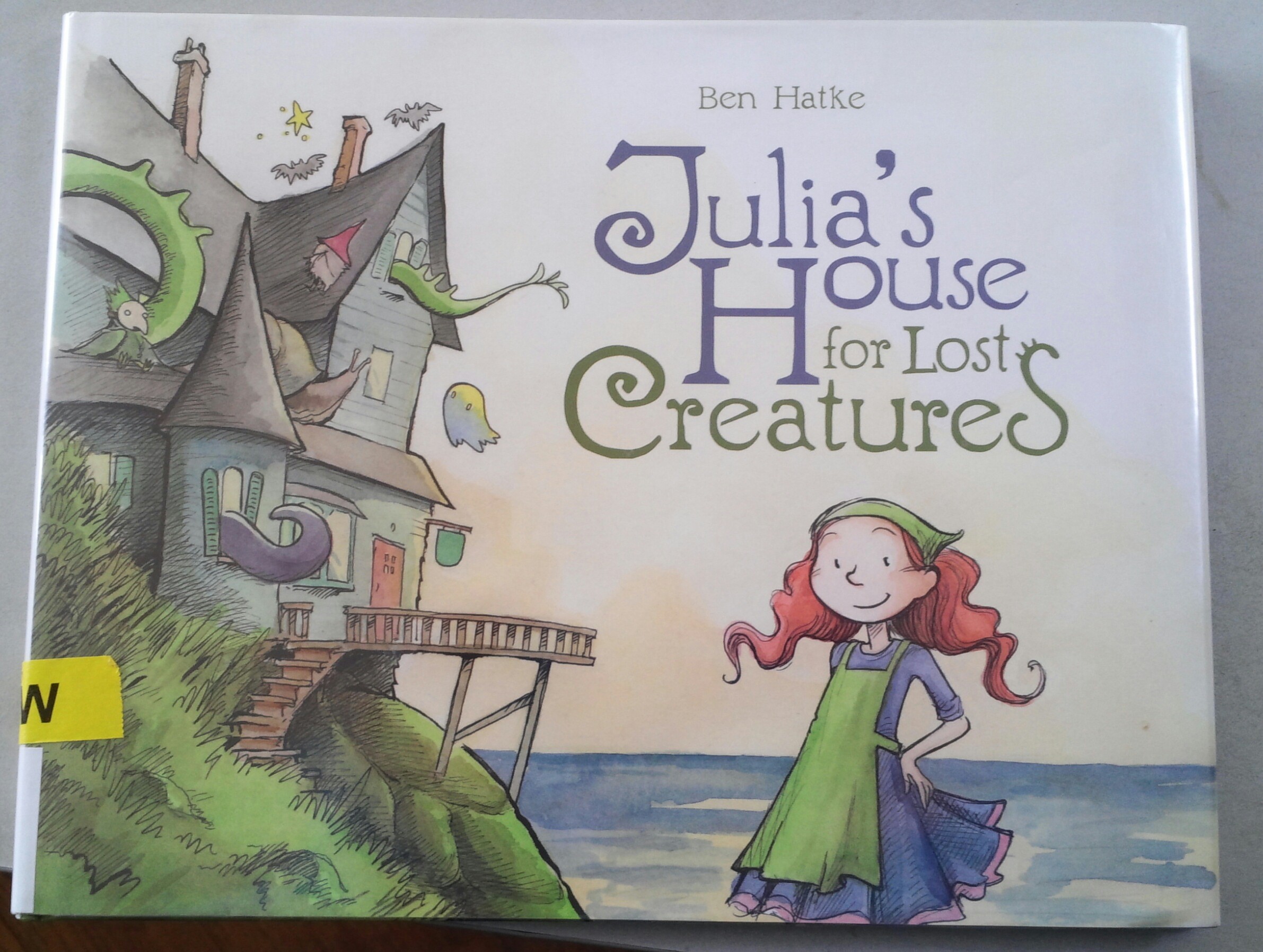
Julia

Let’s put aside my awe (and jealousy) of people who can both write and draw, and let me just tell you one of my favorite things that this book does. Or, rather, that it doesn’t.

It doesn’t explain.

Here’s the first sentence: “Julia’s house came to town and settled by the sea.”

What? Huh? A house that actively comes on its own? How? And why the sea?

Here’s the thing: It doesn’t matter.

Granted, the art adds to the words. We do see the actual arrival of the house (Note: Don’t skip the inside title page, or you’ll miss a lovely piece of the story.) But even the art will, if you let it, just open up more questions. Why is the house transported the way it is? Why did the house (or Julia) pick the sea? Why does Julia have to plant her mailbox?

Again…doesn’t matter.

Because all these whys and wheres, and the hows and whos and whats in the rest of the book, are part of the story world. The house transports the way it does (no, I’m not telling you!), because in this world it can. Julia has to plant the mailbox, because houses have mailboxes, and–duh–you can’t plant your mailbox until your house arrives and settled.

Within the context of the world, the details make sense, and–flip the coin–the details create a world that makes its own sense.

I know there are readers who will certainly ask these kinds of questions. They’ll ask why Julia’s house has a workshop. They’ll ask why Patched Up Kitty is actually made of patchwork cloth. They’ll ask why, if Julia is lonely, she makes a sign advertising for lost creatures.

But I would take just about any wager that the readers who ask these questions won’t be kids. Because kids work within the world they’re reading. And even if they have a question, they’ll feel in their own answers–they’ll add their own layers to the words they’re hearing and the pictures they’re seeing.

They’ll use their imaginations.

I think I have possibly gotten a little preachy here. (Who, me?!) But this is one of my favorite things about good picture books–that they create an entire world in so few words, so few pages of art. (If you want to see one that does a lovely job with pictures only, I also brought home a copy of Mark Pett’s The Girl and the Bicycle-gorgeous and sweet.) And that world may have its own rules, it may have elements that would–in our world–make no sense. But how many things in our world actually make total sense when we’re young. Plus there are other “worlds” out there, other worlds that we’ll grow up to learn about and that are outside our daily experience, and they are open to exploration and experimentation and adventuring.

Possibly books like this help kids get ready for worlds like that.

Posted in PiBoIdMo, Picture Books

In Which I Look Into the PiBoIdMo List and Find it…Not ALL Heffalumps and Woozles

It’s mid-January, which means 2012 is well on its way. Which means, yes, that I should be doing something with that list of ideas I came up with last November, in Tara Lazar’s PiBoIdMo. How easy would it be for me to let this all go? Oh, too, too easy.

So…

This weekend, I went back to step 1 on my post-PiBoIdMo to-do list: prioritize my ideas. Honestly, when I thought about putting my entire list of 50+ ideas in order, it was a bit overwhelming. I mean, I knew without looking that some of those ideas were pretty awful, and I just didn’t feel like spending much any time debating which of them most deserved pride-of-last-place. You know?

I came up with a compromise. I would build the list, and then I would prioritize my top 10. Seems rational, right? Realistically, how many of these ideas am I really going to have time to develop into a full story before next November, and PiBoIdMo 2012, rolls around?

I opened up each file and took a look at the idea, reminding myself what the file name I’d assigned it actually meant. And I have to tell you, as I worked my way through each and stuck them on a list, I was fighting back the slightly nauseating feeling that I wasn’t going to find ten story ideas I could even tolerate. You know, once that PiBoIdMo glow had worn off.

But guess what? Ten is just not that big a number!

I have my list. And that short-list is actually not horrible.  When I looked into the pit and dug around a lot, instead of heffalumps and woozles, I think I found a little honey. Most, if not all the ideas spark at least an image or a bit of character in my imagination, and the couple that don’t–well, they make me at least want that spark. Which is more than I can say for some of those ideas that would have ended up at the bottom of the list.

And the idea that landed at the top? That took the #1 post. Yeah. There’s a story in there I want to write.

How are you doing on your post-PiBoIdMo work? Found any honey yet?

Posted in PiBoIdMo, Picture Books

PiBoIdMo & My Lightening-Fast Reactions

It’s November 10th. Ten days into the month that is PiBoIdMo.  It’s been an interesting week and a half. The guest posts at Tara Lazar’s Writing for Kids (While Raising Them) blog have been great! And it’s as much fun as I thought it would be to just open up my senses and imagination for picture-book ideas.

So far, in terms of numbers, I’m being successful. I’m pretty sure I’ve had more than one idea on every day, and many days in my notebook have three or four ideas jotted down. Are they any good?

Hmm…

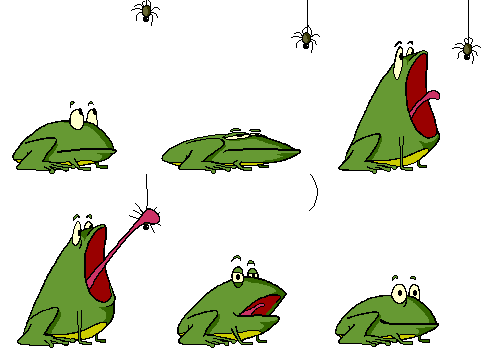
What I’ve found is that, apparently, PiBoIdMo turns me into something an awful lot like this:

No, it doesn’t make me eat spiders. Ew.

It does make me quick. Quick to snatch up any idea that comes into my brain–be that an image, a question, a phrase, a character. I don’t know if it’s the anxiety that I won’t get any ideas that day, or the determination NOT to get anxious about that possibility. But I am not spending a lot of time filtering the possibilities through any questions about whether I can actually develop this idea into a story, or whether this idea has already been done.

I think this is okay. I think it’s probably the right way to go. It’s not that different from the idea behind NaNoWriMo–you’re shooting for quality, not necessarily quantity.

With the assumption, the commitment to yourself, that you will take some of that quantity and actually turn it into quality. No matter how hard that transformation is.

Do I have any ideas that actually feel like winners? Winners to me, yes. I do. There are a few that come with a spark, a smile, a thought that this one is going on the post-PiBoIdMo list of things I want to spend time with. That makes me feel a lot better about all the others that don’t—yet—have that pop. Plus, I have a sense of even more as starting points–ideas that need a twist, or a reversal, or a quirky angle that will turn them from unlikely to likely.

If you’re participating in PiBoIdMo, what have the first ten days been like for you? What have you discovered about yourself, about the way you search for ideas and how they feel when they do come into your brain?

Posted in PiBoIdMo, Picture Books

PiBoIdMo 2011

PiBoIdMo: Picture Book Idea Month.

Art by Bonnie Adamson

Tara Lazar’s answer to NaNoWriMo for all those picture-book writers who weren’t sure what to do with themselves when November hit. You know, other than order a turkey, buy a turkey, eat a turkey, reheat a turkey and eat more of it.

And, hey, let’s all see if we can come up with a non-turkey themed picture-book idea on Thanksgiving Day, okay?!

I wasn’t actually ever one of those novelists. NaNo has always intrigued me, but it also never quite hit the right timing. I was always in the middle of drafting a book, or working on yet another revision. November, as the start of the holiday season, has always presented enough of a challenge to keep up with whatever writing I’m doing, never mind embarking on something new and trying to finish it.

Don’t get me wrong. I love the idea of NaNoWriMo and the thought of pushing that first draft out so quickly. Someday I hope to participate.

Just not this year.

This year, I am again in the middle of drafting. And revising. And, well, you can read about the current state-of-mind in my Novel World here.

But I’m also in the middle of a picture book. And nearing the ending, revision-wise, of another. And I’m loving them. This year, I discovered the magic that is the picture-book genre–playing with big things like STRUCTURE and PLOT and CHARACTER and VOICE in such a tiny form. It’s like doing a jigsaw puzzle the size of a postage stamp. Yes, in true geekdom, I’m finding that…well, fun.

And I want to do more.

What better way than to follow Tara’s lead and try to generate 30 picture-book ideas in 30 days? When all around you, out in the internet-zone, hundreds of other picture-book writers are doing the same? And then, in December, there you are, looking through your new treasure trove of ideas and digging around for the one, three, or many that you want to work on first, that you see real potential in.

That you want to turn into a story.

I’m SO in.

For full information and to sign up, go to the 2011 PiBoIdMo starting post on Tara’s blog, Writing for Kids (While Raising Them). And make sure to check her blog all month, for great posts and giveaways!

Posted in Picture Books, SCBWI

Picture Book Revision: Note to Myself (and Anyone Else Who Wants to Listen)

Today’s Friday Five is a set of reminders to myself about revising this #$@($*@ a picture book.

1. Don’t push too far into the story until you’ve gotten deep into character. Okay, go ahead, push into that story, but you’re still going to have to go back & figure out those people.

2. Your hero has to be active. As active as a five-year-old (or maybe a baby panda) can be.

3. Your hero has to fail. Somehow, even as he repeats his attempts to succeed, he has to fail. You know, probably without a lot of blood or pain.

4. Words come last. I know, you have to put something on the page, or–yeah–you’re not writing a picture book. But do not become too attached to those words. Be prepared to bring out the sharpest, most super-charged chainsaw you’ve got and to use it tearing them up.

5. It’ll be worth it.

Posted in Picture Books, Thankful Thursday, The Writing & Critique Group Survival Guide, The Writing Path, Uncategorized, Writing Goals

Thankful Thursday: Ideas

I think I’ve talked here before about how I used to be a one-idea person. I had one idea for many years, and I wrote on it and wrote on it and wrote on it and sort of revised, and–honestly–it never went anywhere.

So I was really glad when another idea came along. And that idea turned into a story I write and learned-about-revising on, and that I hope–someday–someone will love as much as I did.

But when I was done, then I was sort of staring out into nothing. No more ideas. And this, as you can imagine, was pretty scary. I’d sort of known this possibility was lurking there all along, especially as I wrote and wrote and wrote on that first book and didn’t have any story characters poking at me, asking for my attention. But I had something I was working on, and so I didn’t let myself worry too much about that something maybe not being enough. Until…it wasn’t.

What changed? A couple of things. Caro called to me from the pages of a history book, demanding a place in a real-life moment. I got the contract to write The Writing & Critique Group Survival Guide, and, in the course of that project, I had to come up with many passages from “fake” stories. I used these passages to show my readers what to look for as they critiqued. When I went to think of a picture book idea, I got one–and it turned out to be one that I didn’t want to be fake. It was a story I wanted to write, for real. That idea turned into the picture book I’ve been working on this year. Which, if not done, is at least well on its way to that point.

Somehow, having two projects to work on seemed to loosen the latch on my idea door–I’m now at the point where I have several I’d love to dig into, when I have time. A friend of mine talks about “princess problems,” and I think having too many ideas fits under that umbrella-so no complaints here!

But…I’ve never been in the position of having to actually think of an idea. (I know, another one of those problems!) And I’ve decided that–guess what? I want to write another picture book. There are a few reasons behind this want:

  • I have figured out that I like writing in this genre.
  • I’ve heard recently that some (all?!) agents want a writer to have several picture books in the done pile before they’ll consider signing that writer. (No, I’m not letting this scare me, but I’m accepting it as a possible market reality.)
  • I like having not just more than one idea, but having more than one project I can actually work on at–basically–the same time. I like switching between the two. The thought of doing that with two novel projects pretty much blows my mind, but I do feel like I’ve been able to make steady progress on this picture book and my YA in the past few months. Which is good.

So…the other night, as I was heading into sleep, I let my brain drift. I don’t even know where I was sending it, just…out there. Maybe I was hoping for a visit from the muse, maybe just reassurance that I hadn’t turned back into a one-idea writer (or at least a one-picture-book-idea writer). I went to sleep without the visit or the reassurance, but I’m learning not to let that stress me out too much.

The  next day, I didn’t worry at it, but…sometime in the afternoon, I opened up a new Scrivener file and popped down the basic idea for, yes…another picture book.

Is it magic? Is it just being open to possibilities? I’ve heard this is the most frequent and challenging question authors hear–where do you get your ideas?

As of today, I have no clue. But I’ll tell you one thing–not knowing is definitely a princess problem.

Posted in Picture Books

Picture Books and Me

If you follow me on Facebook or Twitter, you may have–in the past few days–had your fill of this subject. I’ve been working on the picture book a lot lately and I’ve been posting random updates about it. If it makes you yawn, feel free to click away. 🙂

If you’re not sick of this yet, read on.

I’ve committed to a couple of things lately that come with critique opportunities. (To get, not to give this time!). I know that the YA is SO not ready for this stage, so–because I don’t want to pass up the chance–I’m going to be submitting the picture book. Which means I’m also going to be working on the picture book. No, I’m not deluding myself that I can get it Ready-Ready in time, but I can sure as heck get it a lot closer to Ready. That’s the (one?) advantage of working with a lot fewer words.

Anyway, because the posts here may be a bit picture-book-centric for the next couple of weeks, I thought I’d share a little of my reading/writing history, as it pertains to these shorter works. Just so you see what I’m in for and so you don’t wander around under any delusion that I consider myself an expert in this genre. I took this book on as a learning curve I wanted to tackle–I had an idea I loved (and still love, thankfully), and I promised myself I’d take it to the point where I decided it was ready for submission or that submission was not going to happen. Still working toward the first of those choices.

Anyway, let’s go back a few years. Okay, let’s go back a few decades. Picture me in high school, one with an “interesting” English department that sort of skipped over the standards of English & American lit and offered classes in Sci-Fi/Fantasy, “peasant” lit (I have no idea if that’s a real term or just one teacher’s label, but think HalldĂłr Laxness), and–oh, boy–Russian lit. I read Michail Sholokhov’s And Quiet Flows the Don and I was hooked. In love. Skip ahead a few years to college. Somebody handed me a Dickens novel. Then one by a Bronte. Victorian novels–pages and pages of staying with the same characters. Days, instead of hours, in the same world. (I read fast). I fell in love again. And stayed there through grad school.

Now let’s look at something. A Victorian novel, British or Russian, has anywhere from 500 pages (that’s a short one!) to 800+. They have description out the wazoo–whether you’re talking about a place, a character’s physical appearance, or their familial (and often genealogical) background.  Action? Oh, sure, but you can sometimes expect a half-page paragraph to describe a couple of steps of movement. Dense is a good word for the Victorian novel. Lovely, beautiful, spectacularly flavored dense, but still.

Picture books, not so much. The word is spreading quickly through the genre that some agents won’t look at submissions longer than 500 words. Not pages–words. Description? Okay, you can have a word or two, but that’s what the illustrator is for. Background information? Not if you can’t get it across in a sentence. A sentence. (Can you hear Elizabeth Gaskell rolling over in her grave yet?!) My brain underwent a big twist when I started reading and writing YA, but this picture book thing is tying that twist into an increasingly tighter knot. A fun, challenging one that would be the delight of any boy scout, but still, quite the knot.

And here’s another layer of my history with picture books. I had my favorites from when I was a child, sure. And when my son was born, reading to him was one of the fun parts of mothering an infant. But…I could not wait until we could start reading the longer books. No, I didn’t force Great Expectations into his ears, but when we got to Ruth Stiles Gannett and Roald Dahl, I was in heaven.

What I’m saying is that, if you give me a novel to read, I’m happy. (And like the mouse with the cookie, I’ll be asking you for another.) I put down a lot more books now than I used to, but honestly–if you catch and keep me with voice or character or story, I’ll keep going and I’ll be content. I’ll escape into that world and I’ll be glad to stay there for as long as you let me.

If you give me a picture book to read, and you want me to come back, it had better be good. Really good. You had better give me everything–voice and character and story. This book has to snap me in and not let me pull out for even a split second. Which means, honestly, I have not spent anywhere near as many hours reading studying the picture-book form as I have the novel.

So, yes, I have a long way to go. I am working hard to get my 10,000 picture books under my belt (another plus for that fewer-words thing). I am looking at structure and young heroes with strength and word choices. Oh, yeah–word choices.

And I’m trying to plug it all into MY picture book.

Where is this project going to take me. To publication? Oh, we can hope and dream. And the premise of this story is good enough, that I think it’s a possibility. But I do know it’s going to take me deeper into this genre, into finding and reading more of those really good picture books out there that I have yet to read. Or that I will choose to read over.

And it’s most likely to take me those places, and more, on this blog. Lucky you. If you want to come along, I’m happy to share the journey.

Posted in Picture Books, Revision

What’s Harder about Picture Books—#4,385

Okay, maybe I should have said “different” in the post title, instead of “harder.” As I work through my first picture-book attempt, I’m finding lots of things that do just qualify as different, and some that are actually easier than, oh, say, a historical novel. Did someone say *cough*, “Research?”

This week, though, I’m heading into some more revision, and I had a lightbulb moment about what exactly I’ve been struggling with.

When I revise a novel, I work in threads. Or chunks. Or arcs…however you want to describe it. Basically, if I know that a character’s arc isn’t strong enough, I’ll follow her story all the way through the book, tweaking her interactions with other characters, amping up her responses to events, making connections tighter and layers deeper. Or if I drop a new plot point in toward the end of the book, I go through and plant seeds for that point in earlier chapters, making sure (hopefully!) that they mesh well with the rest of the story. The nice thing about this is that it lets me pay attention to something specific and not bounce around as randomly as I would if I were just revising page-by-page with whatever I noticed not working.

The other nice thing is that I can spend some time around each of these threads. As I work, I do notice other things to play with on another revision pass, and I spend more time with my characters, themes, and voice–getting to know them all that much better. It’s not a fast process, but I think the hours are valuable and add to the quality of my project.

Here’s the thing about a picture book. Each “thread” has maybe a dozen sentences to it.  Even if I stare at each of those sentences and think (a la Winnie-the-Pooh) really hard about them, I’m not getting hours worth of revising time for any of them. I realized this was a problem, when I’d tried to revise about a half-page of text and hit overwhelmed. Because…yeah, I was trying to revise three character threads at once.         

I can’t DO that.

So, this week, I’ll be taking it a thread at a time. Which may sound easier, and–in terms of keeping my brain INSIDE my skull, will be. In terms of letting me dig into my story, though, really immerse myself in the characters and plot, I’m just not sure. Even if each revision thread goes quickly, I’m not sure that I can shift onto another and another that quickly. Still…if I spend a half hour or hour per thread each day, I should have another solid revision done by the end of the week, and that’s a goal I can live with.

How do you revise? And does it vary for you depending on the length (or other quality) of the manuscript?

Posted in Picture Books

Friday Five: Thoughts on Picture Books

Before I get started on my Friday Five, don’t forget to stop by and read my interview with Martha Engber, author of The Wind Thief. Leave a comment at that past, and I’ll enter you in the drawing for an ARC of her novel.

I am writing a picture book. Honestly, I wasn’t sure, as a writer over the past few years, whether I would ever do this. There is a magic in this genre, and I–like most people–have been captured by a certain special books that have stayed with me (and on my shelves) all my life.

I’m the person who spent her graduate years studying Victorian novels. Hello? 700+ pages? And this was decades BEFORE Harry Potter. I love novels, I love trilogies, I love series because when you fall in love with a world, or with a set of characters, you get to stay with them. When I was twelve and finished The Hobbit and found out there was more…!!

But I went through the mother years of being surrounded by picture books, by rereading and rereading my son’s favorites and managing to get in a few rereads of my oldies & goodies, as well. And when I got started with my own kids’ writing, the picture book thoughts were there as possibilities–the ideas that were right for that genre, not right for a novel.

So November 1st, in tandem with NaNoWriMo and Tara Lazar’s PiBoIdMo, I dug out the one idea I’d really been thinking about, opened up Ann Whitford Paul’s new book, Writing Picture Books, and got started.

So, for this first week as a picture-book writer, here are five thoughts:

1. I love the rhythm that Ann talks about, and that Anastasia Suen also discusses in her book Picture Writingthe rhythm of the threes. It is a beautifully simple structure and, while I know I’d be crazy to assume that meant simple writing or a simple book, it’s something I can work with. My brain likes patterns, and I like the one I’m finding here.

2. I am learning, all over again, to focus on the hero as impacting his own life. A young child, or a young bunny rabbit, can’t always solve their own problems, but–in a picture book–we’d darn well better see them trying and making a serious difference in the way the plot goes. It’s not just a matter of pushing the adult characters into the background; it’s bringing the child into the foreground. Still working on that one!

3. This thing about leaving room for the illustrator’s ideas is tricky. Critical, I know, but tricky. My gut is that, for this first pass I’m doing, the effort is sort of “blanding” my story out more than I want. That’s okay. During revision, this is something I’ll look at, how to make the words sharp, crisp, and energetic, while still leaving space for the art.

4. Tesseract. Remember that–a wrinkle in time? Something of the sort goes on when I work on the picture book. Time twists in a strange way, reconnecting with word count from a whole new angle. It’s not a switch I can explain, but I feel it. Ten words, which fly from my fingers when I’m working on a novel, take longer for this book. I had some idea (fear?) that I would sit down on Day 1 of this month, shoot off the 500-600 words of the story, know they were bad, and then have no clue where to go next. Instead, I’m still somewhere around the 400 mark, know quite well that’s too many for where I am in the story, and am watching the same kinds of thoughts, questions, and reactions mull around in my brain as I do when I draft 3,000 words of a novel. Cue Twilight Zone music.

5. I’m finding a freedom, for me, in writing a picture book that I don’t always feel when I’m working on a novel. This freedom may mean that I still don’t quite believe I can/will do this, so its more of an experiment than a commitment. (Don’t worry, I’m trying very hard not to let it become that!) Or it may mean that picture books are not (still? yet?) my greatest love, so that I’m putting less pressure on myself than I do for the novels. Or maybe it’s just that, even with the time warpage, I can see the end of the first draft only a day or two away, with revision (which I love) being right around the corner.  Who knows? For this month, anyway, I’m just going with it.

What are your thoughts on picture books? Reading or writing?

Posted in Form, Picture Books, Plot, Structure, Uncategorized, Writing Books

Form: Learning It

Years ago, I read a writing book by Lawrence Block. I’m pretty sure it was Writing the Novel: From Plot to Print. The advice I remember most from this book was that the best way to learn plot was to go out and plot a book. One you liked. By a good writer.

At the time I was working on a mystery novel (for grown-ups), and I did dig a few of my favorite mysteries off the shelf and re-read them and look for the big plot points. I probably didn’t go as far with this as I should have, but (in forgiving hindsight to myself) that book turned out to be the one that dragged on way too long and did nothing to make me happy, and I put it in a drawer when I made the jump to kids’ fiction. Someday, who knows…

Anyway, this week, I’m reading Anastasis Suen’s Picture Writing, and she’s basically giving me the same advice. In her book, she asks writers to storyboard out a few picture books–ones with strong characters. So I went to my shelf.

And just in case any of you are anywhere near being as much of a kids’ book addict as me, I’ll show you my list, so you can ooh and get all nostalgically syrupy for a moment.

Now, obviously, when I talk about form, I’m not talking about a formula. There is no formula, as much as we would sometimes like. But there is form. There is a common structure upon which every book in a genre is built–even if doing the building means taking the familiar shape and twisting or even breaking it.

An example: Suen talks about a big story problem, then three small problems that show the big one. One of the books–Bread and Jam for Frances did have the three problems, although I had to read pretty deeply to identify them to my satisfaction. Another book, though—Miss Spiders Tea Party uses eight small problems to illustrate what’s going wrong. And they both work. Between the identification of the big problem and the ending climax & resolution, the authors give the hero a strong or increasingly bad problems to deal with.

And–here was another fun difference. The Hobans and Kirk handled the last, most critical problem in two very different ways. Remember, this is the problem just before the Climax, so it has to be big, and it has to have impact. In Frances’ story, the Hobans deliver several scenes of Frances not getting any other food than her bread & jam. The authors took their time over the first two problems, but they deliver these scenes in quick succession, not giving Frances–or us–any time to recover between them.

Kirk has taken the opposite route. He gives the first seven problems a two-page spread each (one page of verse & one full-page illustration). The last problem, though, he spreads out over eight pages (four verse and four illustrated). He’s drawing out the problem, raising and dropping Miss Spider’s hopes, and seriously increasing the tension…again, to get us to the climax.

Now, I would never say that writing a picture book is easier than writing a novel. In fact, I’m pretty sure it’s harder, & you’ll probably hear me say that plenty of times in the next year or ten.  But…it is, I think, an easier form to study in this way–simply because there are fewer words in which to hunt for the structure.

Why am I doing this? For the same reason we should all be doing it in whatever genre we’re writing. No, we’re not out to learn that mythic formula. No, we’re not out to play “Copycat the Rich & Famous.”

We’re out to learn everything we can about the form we’re writing. We’re out to make our own books in that form the best that we can.