Blog Posts

Posted in Reading

How Has Your Reading Changed…or Not?

Thirty years ago (yes, really!), I was reading 700-page novels. In high school, I fell in love with Russian novels (yes, again, really!), and then in college discovered the British Victorian writers and fell, if possible, even more deeply in love (yes, oh, whatever…). It was an extension of what I’d felt when I found fantasy writers like Tolkien and his followers–the experience of being a fast reader who could finally stay with one particular story & set of characters for more than a day or two. Those fantasy series, and these novels…kept going. And, oh, the characters.

When I went on to grad school, I knew what I was going to be reading. More Victorians. I ended up doing my orals on the Bront ës, and my thesis on Wuthering Heights. (And don’t you think, BY NOW, that a spellchecker should NOT try to change “Wuthering” to “Withering?!”) I read and read and read and…

…I burnt out.

Grad school was where I discovered that academia was not the right place for me. That while reading was as necessary as breathing to me, and that–yes–I could talk about a book for hours–all this analysis, this taking apart the author’s meaning and intent, was starting to wear thin. And those long books suddenly felt…really long.

So I switched gears. The last semester I wrote my thesis and took one course: Modern British Drama. 20-50 pages/book, with about 10 lines of text on a page. And lots of laughs.

And for reading pleasure, I picked up Barbara Pym’s novels and…mysteries. (Yes, back to books I could finish in a day-and-a-half.) I discovered Ruth Rendell and rediscovered Agatha Christie. Again…not such long books. Some might say Agatha Christie doesn’t do character–I’d disagree. But I think, in Rendell’s novels and the rest of the mysteries I read in the next few years, there was a connection between the characters in the Victorian novels I’d been reading and these new series. The characters stayed around. And, even while they were busy solving crimes, they also (especially the more modern detectives) had their own life problems–problems that also went on and on, over multiple books, not unlike the never-ending problems that carried Victorian characters over 700 pages.

I still read mysteries. They satisfy something in me that I haven’t yet identified, but probably don’t need to examine too closely–they obviously satisfy that something in a huge number of other readers, or they wouldn’t be so popular. If I’m hanging around too long in just children’s or teen books, or in just fantasy, I find myself needing a fix of someone strong and aggressive, who’s out to solve someone else’s problems, even if they can’t really work on their own in a big way yet.

And then there is the kids/teen lit. This probably makes up anywhere between 80 & 90% of my reading today. Why? Well, yes, obviously because I write it. But more than that, because there is just so much on the market that is brilliant. Honestly, if you want to go as far as possible from the dense layers of Victorian novels as you can–pick up a 200-page realistic YA novel. You’d run out of red ink if you tried to edit one of those books from the 1800s into a story for teens today. (Well, honestly, except for maybe Wuthering Heights, but I may be biased.)

But again…the characters. I think this is the core of my reading over the years. The people who all these writers have drawn onto their pages, for me to immerse myself in. You’d think I would read mysteries for the plot, but I can pick up an Agatha-Christie novel for the third time and still not figure out whodunnit. Because it’s the people she wrote about and all their quirks and attitudes and perfect dialogue that hook me in and keep me reading. It was Cathy & Heathcliff and Catherine and Hareton that made me love Wuthering Heights. It’s the scene at the end of The Hobbit, where Bilbo and Thorin meet for the last time, that brings me back for a zillionth reread and has me in tears yet again. It’s the pain of Lia in Wintergirls that wrenches at me, that makes me need to put down the book for a break and calls to me until I pick it up again.

Character. So, yes, if you look at the books on my shelves today and compare them to the ones that were there thirty years ago, they don’t look so much the same. In fact, you could probably fit three of the books today into the space of one from the past. But it seems, after all, there is a connection, a continuity, in my reading over all these decades. Obviously, it’s the quality of the writing. Most importantly, though, I think it’s the people who that wonderful writing–those writers–created.

What about you? What are you reading today that you weren’t reading years ago? Is it a total switch for you, or do you see a common thread? Drop your thoughts into the comments and share.
Posted in Books

Saturday Six: Books on the Way

You know how, every now & then, you look around and you have nothing to read. Yes, I know, even in a house with shelves lining all the walls, shelves that are definitely fully stocked.

It happens.

And then there’s the flip side, when there are dozens of books you want to read, and–suddenly–life happens, and they’re all there for you to read. At the same time.

It’s happening now.

For a quick post, thought I’d share just a half-dozen of the books either on my nightstand or about to show up there soon.

  1. Robin Brande’s Doggirl
  2. Kurtis Scaletta’s Mamba Point
  3. Nathan Bransford’s Jacob Wonderbar and the Cosmic Space Kapow
  4. Anna Perera’s Guantanamo Boy
  5. Kathryn Erskine’s The Absolute Value of Mike
  6. Ruta Sepetys’ Between Shades of Gray

What’s on your nightstand or getting close?

Posted in Uncategorized

Research: Facts AND Feelings

As I work on my historical YA, I’m finding that the longer I do research for it, the more specific I start feeling that research needs to be. It’s relatively easy, I think, to find books and other information about the general history of a place or era. It’s trickier–at least for me–to find the concrete details that will add the depth of realism to my story.

So I keep looking. One of the areas I’ve been struggling with finding more about is the daily life and economic realities of a small-shop owner  in the 1910s. These people and their families seem to fall into a sort of gray area–if not in terms of actual class, at least in terms of class that I’ve been able to find out about. I can find plenty about the big factories, and I can find plenty about the people who worked in those factories, but show me some really specific writing about a family making a decent, if not wonderful, living selling dry goods, and I’ll be dancing.

Well, I kept searching, and a few weeks ago, I came across Robert Spector’s The Mom & Pop Store: How the Unsung Heroes of the American Economy are Surviving and Thriving. I guessed from the title (note the word “are”) and from the description of the book that it wasn’t going to be about the turn of the last century, but I hoped there might be some pieces of history woven in.

Well, there were, but–as I was expecting–they weren’t from the history I needed. Still, I kept reading. Because, guess what? While Spector’s books didn’t have the facts I needed (and probably still need), it goes deep into the feelings I hadn’t yet got close enough to, either, to write the story I want to write.

Feelings of pride in coming every day to the business you’ve built, feelings of frustration at being expected to inherit that business when you aren’t the one who built it. Feelings of independence at working for yourself, feelings of imprisonment at having no choice about who you work for. Feelings of anger and resentment toward “ungrateful” children, feelings of anger and resentment at “demanding” parents. All of which feelings I’ve seen in real life “today,” and all of which I need to think about for my story in the past.

Here’s the thing: history may be facts, but it is also story–historical fiction even more so, perhaps. And story is people–people who interact and resist interaction, who love and hate, work together and fight. And sure, the facts impact the feelings, but there is a universal to those feelings and the people who have them that transcends facts, that transcends time.

If I didn’t believe this, how could I be writing about history for teens reading today?

Posted in Uncategorized

Social Media: Cleaning House

Last week, Debbi Michiko Florence blogged about online time management, how to find the balance with keeping up/keeping in touch and, yes, well…overdoing it.

This discussion comes up a lot, but I think Debbi hit on one of the important points–how it feels when we find ourselves doing what we “should” versus what we want. Basically, it feels wrong.

I think things like this go in cycles. MySpace made way for Facebook and Twitter, and who knows what will dominate now that Google+ is here. Blogs seem to have staying power, although I’ll bet you, just like me, find yourself sticking with a few bloggers that matter to you, for content or personal reasons, and watching others come and go on your blogroll. I also think that Social Media changes for us as our lives change. We shift where and how we want to spend our time.

With my son getting older and more independent (yikes!), I recently added one more piece of life to my weekly hours–a step that (hopefully) inches me back toward real-income-earning work. The step comes with a lot of mixed feelings, mostly good, but is also making me take another close look at how I spend my time. And how I want to spend my time. And I’m with Debbi–I think less of it has to be on social media.

I love my blog. I love talking about writing and critiquing and life, and I don’t see this piece going anywhere soon. I do think you may see a few less posts, which I keep telling myself has to be fine. I also, like Debbi, enjoy reading other people’s blogs, but I do find myself commenting less and less–another thing I think I may have to just accept.

And then there’s Facebook and Twitter. I love Facebook. It’s the big reason I haven’t jumped ship to Google+…I just like it on Facebook. I like the feeling of being connected, and I like how the connection works there. Twitter not so much, and I’m considering if/how I should ease myself away from that world. Honestly, I “know” and interact with some great people there, so it’s not going to happen overnight, but the idea-seed has been planted.

The one thing I have done was get rid of my Goodreads account. I haven’t updated that account with a book review in I don’t know how long, and it’s easier for me to post reviews here & just put up a link at Facebook (and Twitter). I had whittled my Goodreads “friends” down to a very small list, and–you know–I keep up with all those people at their blogs or–you got it–on Facebook and/or Twitter. Goodreads was feeling like one of those niggling little time-consumers, in that I’d get friend requests in my email that I felt bad saying “no” to, or updates that I’d feel guilty about not reading. Yes, I get my book recommendations…other places!

So, for me, I guess this is what it comes down to. What really can go, without you missing it? If you’re happy where you are, with whatever social media you’re using, keep it up. If something’s nagging at you that it feels excessive or unnecessary, take a closer look. What would it feel like to get rid of it? Can you run a test? I’m thinking of a Twitterless September, as a trial run, to see how it feels (I’m guessing just fine!).

How is Social Media feeling to you today? Are there any changes to your commitments/use patterns you’re thinking of making? Any “drastic” shifts you’ve made in the past? Drop a note into the comments and share!

Posted in Uncategorized

Friday Five: Around the Blogosphere

For today’s Friday Five: a few writerly things other people are saying around the blogs:

  1. Janet Hardy on following through on the tension you’ve created.
  2. Jama Rattigan is celebrating the 4th anniversary of her delicious blog by welcoming everyone to her new site.
  3. Kurtis Scaletta talks about the five ways writers have to describe their story and gives tips on them all.
  4. Shrinking Violet Promotions on revising the BIG stuff.
  5. Jeannine Atkins shares a bit about her own, personal plot school.

Enjoy!

Posted in Reading, Recharging Your Writing, Somebody Else Says

Somebody Else Says: Nathan Bransford on Distractions

Today, Nathan Bransford blogs about letting yourself be distracted from your writing, giving yourself recharge/refresh time away from the current WIP.

You can read his excellent, realistic post here.

I’ve been thinking lately about how I’ve been having at once the most relaxing summer I can remember AND managing progress on two WIPs and non-writing work stuff. It’s good, you know. And thinking about the one thing I consciously added more alloted-time to in the past year–reading. I think this has a lot to do with my productivity.  With the recharging that Nathan talks about.

If you follow my blog or my Facebook updates and tweets, you know I read a LOT. I also read fast, so it’s not as many hours as it probably seems, but still…it is the crucial distraction/escape in my life. Yes, I can justify it in other ways, because reading and writing are so interconnected, but to be honest, that’s not why I do it. It’s the one thing (after family & friends) that I do completely by choice and am unwilling/unable to give up. I realized last year that I had cut down on it and that, consequently, I was a lot more stressed. I missed the escape that I get from all the wonderful worlds other writers are creating for me.

So I read.

What’s the distraction that you know, takes you away from extra writing hours, but that there is no way–for good reasons–you’re giving up?

Posted in Uncategorized

Creating Space for the Lightbulb Moments

Inspiration?

Yes, I believe it exists. Ideas come, and they come from places we don’t understand and can’t identify. They show up, changing  a plot or deepening a character, and they do that at a time when, five minutes before, the well was dry. We can stare and stare and see nothing and then, suddenly, a thought shows up, followed by another thought and another…and we’re writing again.

I do believe inspiration exists. I also believe there are things we can do to help it along.

We can:

  • Write as often as possible. I really think 30 minutes every day is more valuable than three hours once a week, and not just because it adds up to a half-hour more. How many times have you not looked at your story for week or so, then set up a block of time to spend with it, only to find that your work is slow and clunky and moving in circles? Believe me, I know that every day is often impossible, but stay in touch with your manuscript as often as possible.
  • Think about your story. Even if you’re not writing, keep the proverbial notebook handy, or (like me) email yourself messages about new possibilities. Don’t get in a car wreck, but–when you can–get your brain back to your book.
  • Talk to people about your book. No, not the people who come up to you and say, “So when I am I going to be able to buy a copy?” But to your critique partners, to a family member who “gets it” and who actually listens–maybe even tosses a few ideas back and forth.
  • Read. Some of this reading will be for research, some will be for craft, and some will be for pleasure. All of us have our comfort reading, the books that we can read without thinking, without emotional upheaval, and I think they’re actually very important to our lives, our sanity. BUT…stretch yourself, too. Find out what books in your writing genre are winning awards, which are creating buzz, and–yeah–which are being censored and banned. Reading authors who have clearly pushed themselves helps us remember to push ourselves. That’s inspiration.

Each of these things, in itself, doesn’t necessarily contribute a whole lot to the progress of a story. But all together, they add up to keeping us connected to our stories. The brain is a deep, convoluted maze, and the longer we stay away from something, the deeper it gets buried. Daily to-dos pile up on top, and–when we’re ready to head back into a manuscript–we have to dig through that pile to get anywhere close. And close is all we’ll get.

Dipping into your story, whether it’s opening a file and free-writing about a character or venting a frustrating plot-block to a friend, keeps you in touch. It keeps your writing at the top of your brain, and it makes it a gazillion times easier to step back into and actually move forward.

Which is the point.

Posted in Picture Books, SCBWI

Picture Book Revision: Note to Myself (and Anyone Else Who Wants to Listen)

Today’s Friday Five is a set of reminders to myself about revising this #$@($*@ a picture book.

1. Don’t push too far into the story until you’ve gotten deep into character. Okay, go ahead, push into that story, but you’re still going to have to go back & figure out those people.

2. Your hero has to be active. As active as a five-year-old (or maybe a baby panda) can be.

3. Your hero has to fail. Somehow, even as he repeats his attempts to succeed, he has to fail. You know, probably without a lot of blood or pain.

4. Words come last. I know, you have to put something on the page, or–yeah–you’re not writing a picture book. But do not become too attached to those words. Be prepared to bring out the sharpest, most super-charged chainsaw you’ve got and to use it tearing them up.

5. It’ll be worth it.

Posted in Writing Books, Writing Tools

Reading for Writing: It’s Not Copying

Years ago, when I was working on a mystery novel, I read one of Lawrence Block’s writing books. (I can’t remember which it was, and, honestly, the list of his books is TOO long to go through right now!) The most important takeaway from that book, for me, was his instruction to pick a few of my favorite (as in, written well) mysteries, and plot them. I’m not getting this exact, because it has been a while, but the idea was basically to go through each chapter & write down the important turning points of the story.

To see how it was done. How it was done right.

In other words, read to find out what the hero did, what happened to the hero to get in their way, what events increased the tension, and how the story–with all its problems–resolved itself in the end.

I still do this, and not just with plot. I talked here about Sarah Ockler’s brilliant management of the passage of time, in Fixing Delilah, and–when I get to that stage of revision–I plan to study how she did it. What she did. It’s not copying, folks, it’s dissection. It’s finding the craft behind the art–a craft the writer may or may not be conscious of, but that I do believe is there, present, for us to find and learn from.

I find myself recommending this technique to editing clients all the time. I’ll do my best to explain how goals & obstacles create tension, how middle-grade voice differs from young-adult, how dialogue beats add to the layers of a conversation or argument. And then I’ll find myself typing this: “Go by the bookstore, or your library, and pick up some books.” I tell them to look at the books they love best, to scan the New Books shelves at the library, or ask the children’s librarian for help. Find a passage (or three) that does what they’re trying to accomplish…and read it. Then reread it. Then reread it again.

One of the “downsides” of doing a lot of critiquing is that, yes, I am more critical of the books I read. In my thirties, I pretty much finished every book I started, no matter what. Now, honestly, you have to catch me in the first two pages, and I will put down a book 3/4 of the way through if the characters or story are letting me down. (And, yes, I do take it that personally!)

BUT…the “upside” of that is that, when a book stuns me, and many do, I have a resource, a tool, for my own writing. My reading eye has sharpened enough so that, as I’m being carried away, a little voice inside is saying, “OMG. Look at that scene structure!” or “That hero is totally taking the lead!” or “Do you see how that dialogue is moving the story forward?!”

I know, weird. But helpful. And, honestly, I think the resource is there for all of us, even if we aren’t realizing it the first time through. It’s why I keep the books I do keep, even with continuously shrinking shelf space–because I will reread them, and I will learn from them.

And doing so will make my writing better.  This Lawrence Block says, and this I know.

Posted in Uncategorized

Local Authors Live: Report

I had a great time in Carmel at the Local Authors Live festival. As I mentioned last week, I haven’t done a festival before and, while I sold about as many books as I do when I give a workshop, there was a definitely different feel to the day. Obviously, not everybody there is a writer, but everybody is a reader, and don’t ask me to figure out which group scores higher as my favorite type of person.

People stopped and talked, just to take a look at what books we were selling, and swapped stories–whether or not they ended up buying a book. And, you know, I just can’t see the not-buying as a big downside (says the lousy marketer in me). A lot of bookmarks went away, and I’m pretty sure 3 or 4 people went off with a new idea about getting together with their friend who also writes or finding a group at some time, to start the critique process. Which just feels good.

Everything was very well-organized and, it seemed, also well advertised, because there were always two or three groups of people strolling by, smiling, making eye contact, or stopping at our table to see what was up. The weather was FREEZING–the fog cleared for maybe a half hour, and the wind never really died down. Luckily, I’d brought layers, although the me that grew up next to Pismo Beach must have had a brain fart, to think that sandals were appropriate wear for the central coast in July.

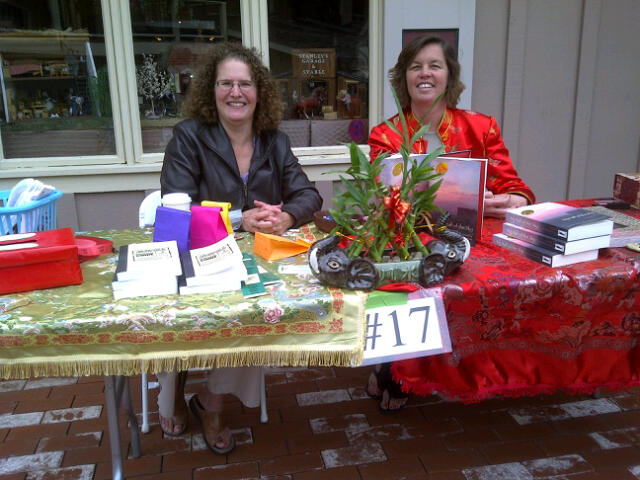
Here’s a picture of me and Jana McBurney-Lin, one of my critique partners and the author of My Half of the Sky. Jana’s wonderful novel is set in China, about a modern young woman struggling to hold up her half of the sky, despite the pushes and pulls of her traditional village. I think the gorgeous Chinese cloths she brought really made our table call out to people.

Another critique partner, Terri Thayer, was scheduled to come down with us, but she had a deadline looming.  We missed her, but all of her fans will be happy to know that she stayed home to write furiously (and brilliantly) on the next book in her Dewey Pellicano quilting-mystery series.

All in all, I’d give the book festival a 10 (despite the fog and the worst sunburn I’ve ever had!). You know, it had a great beat, and you could dance to it. I’ll definitely be keeping my eye open for more festivals in the area.