Posted in Uncategorized

Do the Write Thing for Nashville

Mother Nature is at it again, and this time she’s hit Nashville, Tennessee, with more water than the city can handle. Three writers—Victoria Elizabeth Schwab, Myra McEntire, and Amanda Morgan—have a plan. They’ve set up an online auction blog called Do the Write Thing for Nashville, and they’re donating the proceeds of that auction to Flood Relief.

Writers, Editors, and Agents are donating goods and services to the auction. Stop by and take a look. If you’re interested in bidding on a copy of my book, The Writing & Critique Group Survival Guide, along with a first-chapter critique from me, make sure to check the blog on Saturday, May 8th, when it gets listed for the auction.

Thanks to Victoria, Myra, and Amanda for putting all their own time and energy into this and making it so easy for us to do something to help!

Posted in Character

What Does Your Hero Carry With Her?

In case you aren’t YET a fan of Jim Butcher’s Harry Dresden series, and you aren’t aware that the newest book, Changes, has been on bookstore shelves for a while, I’m here to let you know about it. I’ll also mention that I haven’t read it yet. It’s just come out in hardback and, while sometimes I don’t buy hard-cover booksbecause I’m cheap trying not to break the house budget by spending all our food dollars on book, that’s not why this time. I’m not buying it yet, because I, my son, and my husband reread and reread the Dresden books, which means I will be storing them all for decades. If I bought hardcovers of all the books I was going to keep and reread, I’d run out of space. Like tomorrow. Not to mention, when I truly want to disappear into a book, to just curl up and escape, I really like a light, bendable paperback that doesn’t break my wrist.

So I’m like #3,282,619 on the hold list at the library, and meanwhile, I’m rereading the series to catch up. Again.

And I’m realizing something new. Harry  has stuff.

He’s got magical powers, too, but that’s beside the point. No, he’s got several things that he takes pretty much everywhere with him. I’m not going to get them all, but some are:

  • His wizard staff, which he has carved himself and which gets beaten up and scarred as he goes along
  • His silver pentacle necklace, left to him by the mother he never met, which he can use to bring magical light into any dark situation
  • His blasting rod, which helps him fine-tune his sort of brick-bashing power
  • His black leather duster, given to him by his ex-girlfriend (now disappeared out of his life after she was bitten by vamps and turned into an ALMOST vamp who loves him to much to be with him).  He magicks the duster so that it resists stuff like fire and bullets. Pretty much beats Kevlar hands down.

He also picks up a foo-dog puppy along the way. How cute are these?

Okay, back to the stuff. You can see that each of these items has some symbolic meaning. Butcher does this all much better than my list shows–each of these items is a tool that, most of the time, he uses to accomplish some piece of magic. Yes, sometimes a staff is just a… (couldn’t resist!) But here’s the thing, somewhere in each book, at least one of those tools takes on extra meaning, and–when this happens–Butcher packs the tool and the whole scene with an beautifully emotional wallop that makes the reader sit up and say, “Wow.” And “Oh….”

I want to do this.

Dresden has a lot of things that help him out, but Changes is something like Book 12 in his series. I’m looking for one item, one thing with room for that kind of emotional punch. I’ve been playing with the idea of a photograph in my WIP that will seem to tell one story and, by the end of  the book, reveal a truth that hits my hero hard. On the one hand, this feels a bit trite, but look at my descriptions of Butcher’s symbols–the way I’ve written them, they read as pretty trite, but in Butcher’s stories they feel anything but. So once again, it comes down to craft–it’s only cliché if you let it stay that way. Whether I have that level of craft yet…well, that’s the $10,000,000 question.

Step one, though?

This is a scene I’ve already 1st-drafted, and the photo was nowhere to be seen. It may be too late in the story for an intro, and I may need to find an earlier spot to seed that picture. Or it may turn out that the photo doesn’t work, that I need to dig further, past my first idea, for something that has more inherent meaning, more possible layers. For now, though, I’ve done what’s important. I’ve taken the idea, the initial piece of stuff, and I’ve given it to my hero.

Let’s see what she decides to do with it.

What does your hero carry with her? Why? What meaning does the object have at the start, and how does that meaning change over the story arc?

Posted in Critique Groups, Critiquing, Guest Blogger

Guest Post: Ruth Spiro on Multiple-Genre Critique Groups

Please welcome Ruth Spiro to my blog! Ruth writes for children, but critiques with writers of various genres. When I heard that, I asked her if she’d do a guest post about how that works for her and her critique partners. She said, “Sure!”  Thanks, Ruth. 🙂 Check out her guest post below (especially my favorite line: “I think it’s this flexibility that has helped us remain together through the ebb, flow, and evolution of our individual writing.”) And anyone else feel like we need to ask Bev for her lemon-squares recipe?


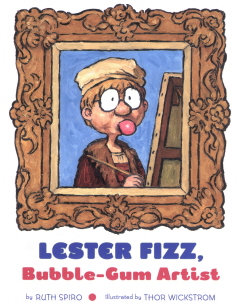
Ruth Spiro is the author of the picture book, Lester Fizz, Bubble-Gum Artist (Dutton).

Before it was published, the manuscript was a winner in the Writer’s Digest 72nd Annual Writing Competition, and also won the Liam Callen Award for Best Overall Contest Entry in the Kay Snow Writing Contest, sponsored by the Willamette Writers in Oregon.

 Ruth’s articles and essays have appeared in FamilyFun, CHILD, Woman’s World, and The Writer. She’s a contributor to The Right Words at the Right Time: Your Turn, edited by Marlo Thomas, as well as Chicken Soup for the Child’s Soul, Chicken Soup for the Beach Lover’s Soul, and Chicken Soup for the Soul Christmas Collection.

 A frequent speaker at schools and conferences, Ruth lives with her family in suburban Chicago, IL. Her website is www.ruthspiro.com. This summer, she plans to lose fifteen pounds and start her own blog.

I found my critique group through a lucky turn of events. I’d just completed a writing class with author Carolyn Crimi, and she connected me with the group because she knew they had an opening. I’ve been with them for ten years now, though the original members have been together since the early 1990’s. I remember bringing my poem “Into the Rain” to the first meeting I attended. They suggested I add more of a story arc, which I did, and it later won the “Bedtime Stories” contest sponsored by Half-Price Books.

Our eight members are: 

 We meet in person once a month at a member’s home.  I know many critique groups work online, but this face-to-face interaction invites discussion, brainstorming and camaraderie – to me, a welcome balance to the solitude of writing.  We email our manuscripts to the group about a week before our meeting, giving us time to read each piece and note our comments. That way, we can get down to business and make the most of our time together. At any given meeting we’ll have 4-5 manuscripts to review; I can only remember one or two occasions when we had eight. Most importantly, we’ve found that Bev’s lemon squares, microwave popcorn, and vast quantities of chocolate are absolutely essential to the process.

Our group is unique in that we write in a variety of genres:  picture books, middle grade novels, YA, non-fiction, poetry… a little bit of everything.  I also write for publication outside the children’s market, and my critique group has willingly read my articles and essays for The Writer magazine, Chicken Soup for the Soul, and the SCBWI Bulletin, among others. They’ve reviewed my website text, school visit brochure… everything but my grocery list. (Which I’m sure they’d comment on, if I asked them to!) I think it’s this flexibility that has helped us remain together through the ebb, flow, and evolution of our individual writing.

I believe we all benefit from reading and critiquing work in a variety of genres. After all, the elements of story apply across the board, regardless of the length or intended audience. Characters, setting, voice… they all need to make sense and ring true. Even the attention to language and rhythm that’s so essential to a picture book can also be applied to a young adult novel. And poetry? It’s everywhere.

The main challenge our diversity presents is in the scheduling. We try to divide our meeting time equally for each manuscript submitted, but when one member brings a 500-word picture book and another has a 15-page novel chapter, it’s hard to do.

Still, I don’t think anyone ever feels that her manuscript hasn’t been given the attention it needed. On a few occasions, we’ve actually devoted an entire session to critiquing a complete novel; although we’d previously critiqued the individual chapters, a complete read-through can reveal issues with plot, continuity, character development, etc.  Plus, it’s great fun to see the finished result of a friend’s months, or years, of hard work!

 Which brings me to the reason why being a member of this group is a joy, and a privilege: I truly consider them my friends. While our main goal is to work together and make our writing the best it can be, we always take time at the beginning of our meetings to ask, “What’s new?” We share good news and not-so-good news about our writing and our personal lives. We’ve celebrated the births of books and babies, and given moral support during difficult times. When I told my group I’d be missing a few sessions because of an upcoming surgery, a few days later I opened my mailbox to find a gift certificate for a restaurant take-out service, so my family could order dinner during my recovery!

While we share the common interest of writing for children, we’re about as different as a group of eight women can be. Luckily, these differences work to our mutual advantage, as well.  The unique perspectives of a high school English teacher, website editor, writing instructor, social worker, zoology expert and fine artist contribute to the knowledge base from which we read and critique manuscripts. Best of all, we respect one another as writers, there’s no air of competition, and we feel comfortable being honest with each other, without repercussion. Discussions may get lively and sometimes we disagree, but at the end of the evening there are always hugs as we walk out the door. 
Posted in Research

Fast Friday Five: A Long Time Ago, in a Chicago Far, Far Away

I wasn’t going to post a Friday Five, but I’m reading some fun ones around the blogosphere & feeling JUST a bit left out! So…five fun facts I learned during research and writing this week. Step back with me, if you will, to 1913 Chicago. It’s a cold, windy year, even for that city, so bring those winter layers. (I know some of you are still wearing them, anyway!)

1. You can, apparently, spread diptheria with classroom pencils.

2. Maybe because you’re being required to turn your pencils in at the end of the class, or the end of the day. Personally, I think I’ll keep my son stocked with his own!

3. More girls were staying in school and going on to college thanboys. Pretty much because they weren’t ever going to make as much $$ as the boys, so if the boys got out of school and worked, the family could support the girl through college (increasing her earning power SOME), but if she quit, she couldn’t earn enough to help get that boy through school. Wait, I’m sorry, did we just tesseract between 1913 and 2010?

4. Nope, still there! Moving on. One of the reason big electric companies had a bit of a battle spreading their services around Chicago, is that it was so easy to set up your own, personal power-station and then sell your extra electricity to your neighbors. Okay, PEOPLE weren’t doing this, but fancy hotels and businesses that wanted to “dress to impress” with bright lights were.

5. Some rich people put just a few electric bulbs into their otherwise-gas-powered chandeliers, and then would light those bulbs for big parties or when the “Joneses” came over.

 Happy Friday. Happy Writing!

Posted in Character, First Drafts

First Draft: Peopling the World or Who ARE These Characters?

WARNING: You’ll be getting a lot of posts about first drafts in the next few months. But don’t worry, those revision posts will be coming along after that!

My friend Jana McBurney-Lin talks about a character in her book My Half of the Sky who came out of nowhere. I think, if I remember right, it’s the woman who tells fortunes in the park and who becomes a central part of the main character, Li Hui’s, life. Jana talks about how this woman started out as a small, secondary character and then grew–of her own accord, pretty much–into someone critical to the story and to Li Hui’s character arc.

Yesterday, as I wrote, four new characters stepped into my story’s pages. Without even so much of an “Excuse me.” The words kept flowing from and around them, so I was kind of like, what the… as I typed their dialogue and actions. I didn’t argue with them, I didn’t try to push them away, I just sort of let them tell me what they were doing there and what they wanted to say.

Jacob, Goldie, Sonia, and Mary, where the heck did you come from? (I’m having a lot of fun naming my secondary characters after some of the gazillion great-aunts and great-uncles I had, some of whom I knew, some of whom I never met, but who definitely seem to have been given the right names for this era!)

Okay, it wasn’t quite all that muse-driven. I did stop typing. I did look at these characters for a minute and try to figure out where and how they fit into the story I had already plotted without them. I thought about the fact that these people might not stay in the book (I mean, I already have two love-interests planned for Caro; what in the world is she doing flirting with this new guy?), and I thought about how these characters might take my story in directions I haven’t foreseen. And I realized that, at this point, either of those factors could turn into a bad or a good thing.

Now is not the time to make that decision.

Now is the time when there do need to be more people in my MC’s life, more people who are just part of who she is, part of the world through which she moves on a daily basis. The scenes I was writing yesterday mostly take place at Caro’s school (let’s not even get started on how little I know about public schools in 1913 yet!), and that school will be a big part of the choices she makes along her path. There have to be students in that school, and there have to be friends and acquaintances and apparently at least one boy with whom she has an ongoing competition to be the best math student. (???!!)

So for now, these folk stay. It’ll hurt, I know, to get rid of any of them, because they came into my brain and into the scenes, if not fully-fledged, with habits and personality traits that I’m already hooked on.  And it’ll be tricky, challenging, even frustrating to build them into something stronger than they are now, if they do need to stay, if they convince me they truly have a role in this story.

But it’s the first draft. It’s the time to scatter ideas and characters onto the page and see where they fall and what they want to do. Yes, I question them. Yes, I stop for a minute to really look at them and ask them, “What are you doing here?” Hello, I’m Becky, and I’m a control freak. I’m getting better, though, at letting go, at keeping my mind open and trusting that these people have something to tell me, something to add to the story.

Of course, if they’re fibbing, I can always—ouch!—bring out that red pen and kill off a few darlings. 😦

Posted in First Drafts, Young-Adult

Thinking Out Loud: The Feeling of Age in Young-Adult Writing

As you know if you read Sunday’s post, I’m getting started on a new scene in my YA WIP this week. I’ve got some basics down for scene structure and plot and character goals, and I’m getting the words on the page. Something else, though, is happening at the same time.

Sometimes, when you’ve stepped away from a project for a while, there are pieces or aspects of it you can see more clearly. I hadn’t realized that was going on with Caro’s story until I started brain-dumping today and finding ideas coming quickly, but still…not being quite satisfied.

It’s the age thing. The teenager. The young-adult. I’m so not there yet.

DISCLAIMER: I know that’s okay. I know I don’t have to be there yet. It’s only the first draft. I have time. I have musing and mulling hours. I can let it come, as it comes.

Still, I’m thinking.

It’s a subtle difference between upper middle-grade and young-adult, but it’s an important one. Factor in that I’m writing a historical YA, and you’ve got another layer of…something else. Honestly, I’m not sure if I will ever choose to write a modern YA (not that I don’t have ideas), because–in some ways–that world still feels so alien to me, about as alien as it did when I was one. A YA. If I ever really was. Which, I know, says I have something to write about, but..well, it’s not here yet.

Back to the historical. I know that this book needs to be young-adult. There are all sorts of reasons—from historical accuracies to the darkness of some things my MC will be dealing with. Yes, there have been wonderful MG books written about horrible times in history, and done brilliantly, but–for this book–that doesn’t feel right for me. Mostly, I think, it needs to be young-adult because of the choice I believe Caro has to make at the end of the story.

Bleak. Alone. Strong.

Caro is pretty much telling me that she has to be this old, this close to as much independence as a woman had in 1913, with the strength and power and rights to make this ending choice. I’m not fighting her.

But…as I write, I haven’t given her what she wants yet. Yes, my MC is the right age, numerically. Yes, she’s living in her world as a teen of that era would have done. Yes, there’s a young man. What’s not there? I’m not sure.

Some possibilities…

  • An incredibly strong sense of herself, a feeling that she is on the cusp of something new and different than what she’s been living?
  • A sense of separation from others, from her family, at the core of how she looks at the world?
  • A need for independence that gets rope burn from the restrictions placed upon it?
  • A feeling that there is more to see, to get to, than she’s experiencing at the moment?
  • A tension in her muscles, a readiness for something she hasn’t yet defined?
  • A feeling of power, unused as yet?

It’s a voice, a core element that I’m still reaching for. There’s a seriousness to Caro’s story that she needs to recognize, through which she needs to move, make choices, and fight. There’s an adultness to her young-adult character that I need to find.

Luckily, I’ve still got some time. 🙂

Have you written young-adult and “younger” books? What do you do when you’re shifting gears from one to the other? Is it about the character, who they are and what they’re after? Or is there a place you push yourself to, to examine more closely, to make the leap?

Posted in First Drafts

1st Draft: Digging Back In

I’ve been on a bit of a hiatus from my YA WIP. It’s been a couple of weeks of spring break vacation, developing and delivering talks, doing some work for a client, getting through a couple of big research books, getting to the next step on my picture book, and I can’t actually remember what else. Although I’m sure there’s more. 🙂

Anyway, the decks are cleared for at least a week, and this week I AM WRITING. (If I could figure out how to do a bigger font in WordPress, you’d really hear me shouting that one.)

Yes, I am writing. Even though, in the perfect scheme of things, I’m not actually ready.

When we last tuned in to the Bat Channel, Batman and Robin were hanging from a beam over a pot of bubbling….

Oops. When I last tuned in to my story, I was not happy with it. The scene I finished up and sent off to my critique group was drifty and unfocused, the MC was NOT on any strong path–forward or backward, and nobody was doing anything I wanted them to do. Probably because I didn’t know what they should be doing.

Well, let me tell you. Coming back to a story that I’ve left in this state, especially after a number of days away, I could totally spend a week in recovery. You know, thinking and thinking and thinking about where I am in the book, rather than storing the questions on the KEEP THINKING shelf in my brain, and writing forward.

I’m staying away from recovery this week. Part of this decision comes from the fact that in a couple of weeks, things get busy all over again, and I want to make some progress NOW. Part of it comes from the fact that I truly believe that getting a first draft OUT will teach me more about my character, about my plot, than going back will…at least right now. But the big part of it is that…I MISS WRITING.

(I apologize for all the capital letters. I seem to be channeling Dorothy Sayers’ Miss Climpson today.)

And so I am going to write. I’m even jumping back in at a point where I should really do more research, since I’m writing the first scene in the book that takes place in a public school in 1913 Chicago, and I seriously don’t have a grasp of that world yet. My mantra for the week? “This can wait.” (See, no more all caps!) I’m going to stick her in a desk and surround her with girls and a teacher, and I’m going to concentrate on goal + obstacle = tension, and I’m going to PRODUCE WORDS. (Oops!)

What do you do when you’ve had to take a break? Do you step back in slowly, or do you throw yourself into the whirlpool, let yourself get sucked under, and see where you end up?

Have a wonderful writing week!

Posted in Friday Five

Friday Five: Oh…Just Stuff

I’ve passed a few milestones in the last couple of weeks, and there are some new ones coming down the road toward me. Looks like for the next couple of weeks, I’ll be able to immerse myself back into my fiction…

but I’ve been having fun with the other stuff, too. The one thing getting The Writing & Critique Group Survival Guide published has taught me (even though I thought I knew it before) is that being a writer is not just about writing. We can fight that fact, if we want, or we can look it in the eye, find the parts we enjoy and concentrate on adding those to our lives, and then…keep writing!

So, here’s what’s been up and will be up with me lately.

1. I’ve given a few more talks about critiquing and critique groups. My wonderful friend and critique partner Terri Thayer sat down with me one day and brainstormed topics. I’ve been having fun and I think the writers I’ve been talking to have as well. We might all even be learning something! Here’s me and David Rasch, VP and Program Chair of the Central Coast Writers Branch of the California Writers Club. (Thanks to Ken Jones for the pic.)

We’re listening to Joyce Krieg talk about all the great stuff the club is doing. If you’re a writer or speaker anywhere in the area, this is a really fun group to hang out with!

2. I’m doing a little more guest-blogging. I’ll be posting over at HipWriterMama next week, and my guest-post at agent Rachelle Gardener’s blog went up yesterday–with a giveaway of three copies of my book, if you haven’t yet won one!

3. I’m revving up to teach my online class through the brand-spanking new Writer’s Digest University. The class starts May 6th, and will focus on critiquing first chapters of fiction and nonfiction. A good way, I hope, for new critiquers to get started.

4. I’ve been dipping back into research for my historical. I’m in that magic place where I’ve found a book that is exactly what I need. You may have seen me tweeting/posting on Facebook about Harold L. Platt’s The Electric City: Energy and Growth of the Chicago Area, 1880-1930. This book is, as far as I’m concerned, a writer-researcher’s dream. It’s pulling everything together for me–where Chicago started, in terms of power, and how it evolved into the world that my character moves through in 1913. It’s a history book that connects everything—electricity, urban development, politics, and the daily lives of us regular folk. And it’s written well. I want to curl up and just read, but I’ve got my sticky notes out and am fitting a daily hour or so of reading in with everything else that’s going on. If you clicked through on the link and checked out the price, you’ll see why I totally heart the San Jose Public Library’s Interlibrary Loan Program this month–as much as I want to own this book!

5. It is going to be SUNSHINY this weekend! I will be reading and researching and critiquing, but I may very well be doing it, hold your breath…OUTSIDE. Now for those of you who know me, you know that I’m not really the communing-with-nature type. (Yes, that’s my family you hear snorting with laughter at the very thought…) I live in the mountains because I like looking out on the woods and the birds and the deer, but I’m very into the humans-learned-to-build-shelters-for-a-reason philosophy. I love to walk, but it had better be with friends and we had better be talking.  Most of the time, especially on weekends, I’m happy to putter around the house, curl up on the couch with a book, or catch up on things in my office surrounded by…more books. I am SO craving sunshine, though, and warmth, that I’m just about drooling at the idea of taking my laptop out on the back deck, finding some glare-proof angle, and critiqung away. Bare-footed. You heard it here.

Posted in Critiquing

Critiquing: Your Brain is Talking–Listen.

In the talks I’m giving this month, I’m getting down to some basics about digging into a critique. I’m trying to give new critiquers some tools to get started with confidence and encourage critiquers who have been doing this for a while to stretch themselves.

And the first thing I’m telling people is to listen to themselves.

When you sit down to critique someone’s manuscript, the first thing you’re doing is reading. Okay, that may sound too basic, but this is where it all starts. You’re turning pages, you’re taking in the words, and you’re responding.

Let me say that last one again…You Are Responding.

When we start critiquing, we’re not always so sure we’ve got anything intelligent to say. Maybe nothing unintelligent, either! We read the manuscript, mention a few inconsistencies and commas, then pass the pages back with a smile and the comment that we “like it.”

The odds are, though, that we’ve read some pages, passages, or paragraphs that we didn’t actually like all that much. And we’ve ignored those bits. Maybe not intentionally; maybe we didn’t even notice that we had a bad feeling. We did, though, feel it.

As a critiquer, the first thing you have to do is pay attention to those feelings, to the emotional responses you’re having to your critique partner’s manuscript. You need to register when you’re feeling bored, or distracted, or irritated, or confused. And when you get one of those feelings, or any other response that pulls you out of that book, you need to STOP. Do not keep reading, do not turn more pages, do not collect $200.

Your responses mean something.

Figuring out what they need is another step, another blog post. Today, I want to remind you to pay attention to your feelings, your reactions. You are not just a writer; you are a reader. How old are you? How many years…decades…have you been reading books, talking about them, sharing out loud what you did and didn’t like about them. I’ll say it for you–a long time!

You have experience. You have skills. You are good at this. Yes, you may–as I said above–need to stretch yourself, push yourself past your critical-thinking comfort zone and dig more deeply into why. But don’t ever discount the responses you’re having as you read.

They’re real, and they’re important. Listen.

Posted in Marketing

Marketing Monday: What Do You Think of Newsletters?

For about the past two years, I’ve had an email newsletter that I send out, oh…quarterly. It usually has some basic information about what’s coming up for me in the next few months, or what I’ve been doing that’s exciting (for me, at least!). Then I add a few links to posts I think might interest readers, and I send it out.  I use Constant Contact, and I’ve been more than happy with their templates and the way they store and let me update my mailing list–either manually, or through my blog/website.

I am, however, considering whether to keep the newsletter going.  I’m going to summarize my thoughts about why and then follow up with a few questions for you to, hopefully, get your take on things. I’d love–as usual–to hear from writers who get newsletters and writers/readers who receive them (or work very hard not to).

A few years ago, I think email newsletters were the best, if not the only, way to reach readers directly–at their inboxes. Then along came Facebook and Twitter and Goodreads and all the other social networking sites. Facebook sends me a note–to that inbox–when anyone contacts me in any way on their site, and with Tweetdeck, it’s easy for me to see if anyone’s trying to get in touch with me directly out on Twitter. I get messages from Goodreads for updated booklists, and I get Google Alerts that let me know when I, or my book, am mentioned pretty much anywhere. (Okay, not yet on Mars, but I’m sure that’s just a few years away.)

The other thing that these sites all do is make it incredibly easy for me to get information out. I know there are all sorts of questions about how easy it is to social network, about the best way to tweet effectively or to use a Fan page on Facebook, but in actual time, there’s just no comparison between typing in 144 characters on Twitter and setting up the next newsletter to be delivered.

I don’t have a huge mailing list for my newsletter. In real marketing terms, it’s probably considered almost infinitesimal. And I know that when I send it out, at least a few people are reading it–because I can see when they’ve clicked over to my blog to check out some of those posts I’ve linked to. But…if I’m going to use this list to any purpose (if that’s still truly possible), then the list has to grow. Which means I have to solicit (nicely) people at workshops and conferences and do something else (ideas?) to get its numbers to increase. These tasks are feeling like they’re hitting the side of the scale I call “Not my comfort zone and possibly not worth my time & energy.”

What do you think? Where are newsletters falling these days in the marketing world, in terms of popularity and effectiveness? If you send out a newsletter, how are you feeling about it? I’d love to hear what you include, how often you send it out, and whether (and why) you feel it’s a useful marketing tool. If you don’t send a newsletter, do you still keep a mailing list and how do you use it? If you’re a reader of newsletters…why? 🙂 What is it you like about them and what makes you sign up for one and keep reading it when it comes? And if you’re someone who does whatever possible to avoid getting a newsletter, please share that, too.

Thanks again, all, for letting me pick your brains and poll your thoughts! And a happy, productive week to you all, this Monday!