Posted in brainstorming, Dreamscapes, Getting Organized, Picture Books, Writing Goals

Getting My Dream Ducks in Order

As good as I am at multi-tasking, my natural, happy mind-state is to think and act in a linear path. One thing at a time, put it down, pick up the next, work on that, repeat. And for many years that has worked for my writing. Until recently, I was never popping with story ideas–I could pretty much put all my focus onto wherever I was in whatever novel I was struggling with at the time.

Then picture books came along to say, “Hi!” Storystorm is a huge part of my idea generation, but also–these days–some muse (maybe the Muse of Overwhelmedness) sends ideas to me on a regular basis. And you know what?

I CAN’T WRITE THEM ALL AT THE SAME TIME!

Add to this that I am moving toward querying agents. And while I would like to just dive in head-first, some very wise people recently reminded me of the important steps involved in a smart agent search. And..guess what?

I CAN’T DO ALL THE STEPS AT THE SAME TIME!

And once more piece–now my looking-forward is a mix of dreams, goals, and actions. That’s about as non-linear as you can get. Some people could work it into a flow chart and feel comfortable dropping onto any arrow. But not me.

I CAN’T FOCUS ON MULTIPLE BIG-PICTURE VISIONS AND TINY DETAILED TASKS AT THE SAME TIME!

It was a busy week at the day-job, and I had to push the ALL down to the bottom of my brain for a few days. (No, of course it didn’t stay there, which is why I ended the week feeling like I had gone ten rounds with…Yes. The Muse of Overwhelmedness.)

So…I went to bed early last night, and I slept in this morning. I let my mind gently roam its way to a couple of Storystorm ideas, and I had breakfast and caffeine. And then I played with dream-scaping.

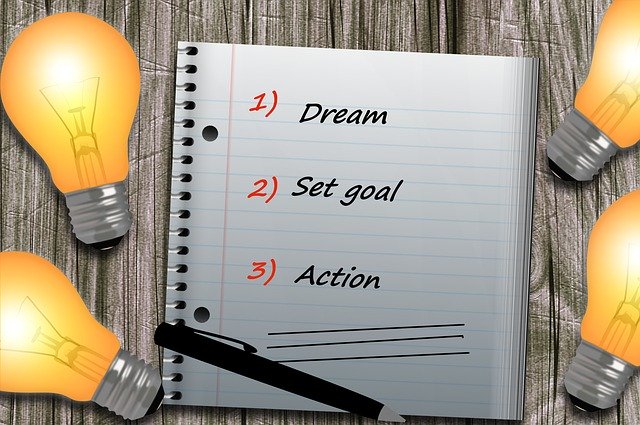
Dreamscape 2

Typically, these brainstorming-circle tools don’t work for me. The fact that this one has, at least in having filled up a page with bright colors and actual text, is–I guess–reassuring. In an oh-good-I-am-finally-deep-enough-into-this-writing-thing-to-have-my-head-explode way.

How I turn this dreamscape into process(es), I’m not sure. In my past, free-to-be-linear life, my lists were a straight line of numbered tasks, and I got to happily cross off each one as I finished it. This new world is filled with tasks that connect to each other backward and forward, get to be repeated time after time, and play a role in various and sundry scenarios. It’s as if a nice, simple If…Then statement met up with Wile E. Coyote.

But I think this is my new normal, and it’s a normal I have been aiming toward for years. So I’m celebrating by being grateful and breathing deeply. And I’m keeping the nice paper and pretty pens near at hand.
Posted in Picture Books, Storystorm, Uncategorized

Storystorm 2020: I’m in!

I just signed up for Storystorm 2020.

If you aren’t familiar with Storystorm, it’s the creation of Tara Lazar–author of so many fantastic picture books. To name just a few you should definitely check out: The MonstoreNormal Norman, and The Upper Case: Trouble in Capital City.

Every January picture book writers sign up to participate in Storystorm and commit to trying really, really hard to get 30 new picture book ideas by the end of the month. Every idea counts–no matter how wonderful or horrible. Personal tip: Do not second guess yourself; just write that idea down! And Tara gives so much support–daily posts from authors and other publishing professionals to inspire, encourage, and kick your brain into gear. Plus prizes!

This year, along with coming up with 30 new ideas, Tara is suggesting we also pay attention to our creative process. 2020 is, for me, all about new ideas. I’ve been working for quite some time on revision, getting ready to query in the next month or so. Now I need to grow my pile of actual stories. So I’ll be watching how I do come up with those ideas, what I observe, what I remember, what direction my brain drifts, and when I hear that *ping* that tells me I at least have something to write down in my notebook for the day. Maybe I’ll post about it!

If you haven’t done Storystorm before and are wondering if it’s for you, I say go for it. The worst that could possibly happen is that you have no more ideas at the end of January than you do right now, as you read this post. And I can just about, 99.99999%, promise that won’t happen. So what have you got to lose?

Don’t forget to sign up for the Storystorm Facebook group, too. See you there!

Posted in mentor texts, Picture Books, Research, Uncategorized

Where to Find those 10,000 Books

So at some point in Outliers, I guess Malcolm Gladwell said a few things about putting 10,000 hours into something you want to do well. And possibly there is debate about not only what he said, but about whether he was right.

Whatever Gladwell actually said, how many times have you heard other writers, publishers, agents, your mother say that–to write–you need to read? A lot. Do you really need to read 10,000 books? Sure. Even more. I don’t actually think there’s a cut-off, a number beyond which you’ve gathered everything you need to know. I do agree that reading is critical to growing my writing skills and that a whole bunch of that reading needs to be in my genre.

I’ve talked here before about mentor texts, the picture books I go to when I’m stuck. I look for something the authors have done that I’m not doing yet, look for places they’ve cleared the particular hurdle I’m facing. I dissect, I analyze, I scribble notes. (No, not in the book!) And I am always looking for new mentor texts–books that tell a story as well as I’m hoping mine will some day. Where do I find these books?

I check out the picture-book section every time I walk into a bookstore. I browse library shelves, and I check out the books I find. I look at the websites of agents I’m researching, and I put their books on hold. I google things like “best picture books of the year,” and I put those books on hold. I read blogs by picture book writers, and…yep, I put more books on hold. Every couple of weeks, I take a pile  of picture books back to the library, and I pick up my next stack.

I’m looking for some new sites I can explore. So I thought I’d ask here for your suggestions–where to you go to look for what’s new and good? Thank you in advance!

I’ll start:

There you go! Got anything to add?

Posted in Book Review, Nonfiction, Picture Books, Uncategorized

Review: Just Right – Searching for the Goldilocks Planet

I have a bit of an infatuation with nonfiction picture books. Yes, I love them, but infatuation implies a sense of distance, of something out of reach. At this point, writing a nonfiction picture book feels out of my reach. In a good way–yes, someday I might write one–but for now I get to experience that feeling of awe on top of the admiration.

So I pick up nonfiction picture books here and there, let myself read and enjoy them, but I don’t buy a lot. I’m writing fiction, and I need mentor texts, so that’s usually where I spend my money.

Occasionally, though, I read a nonfiction picture book that is so incredibly well done, so gorgeous, that I need to own it. Just Right: Searching for the Goldilocks Planet, written by Curtis Manley and illustrated by Jessica Lanan, is one of these books. The writing and the art are amazing, conveying perfectly both the facts and the magic of space exploration.

Note: I apologize profusely to the author and artist for the way my phone wiggles the lines of texts and absolutely distorts the colors in the illustrations. Definitely go get your own copy so you can read and see this book for yourself. To get a much better understanding of how the story and art weave together and to see the actual physical beauty of the book, take a look at this trailer on Lanan’s website.

Manley’s writing is, like the book title, just right. He presents the information with clarity and the flow and pacing of a good story, bringing us on a journey from the discoveries of the past, to the understanding we have today, to the possibilities pf what we will learn in the future. He does a beautiful job of taking us far out into space–the definitions, the technology–then bringing us tightly back to how that all connects to Earth, to the work our scientists are doing, to how each one of us. His language ranges seamlessly from poetic to concrete and active.

hand-text-use.png


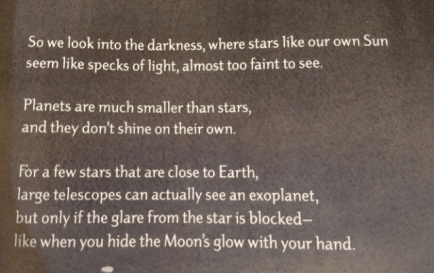
Manley chooses to write with the second person you, and it’s wonderfully effective. After reading this page (and seeing the art below) children will run outside to put their hand up to the sun, see what happens for themselves, and let their mind roam out to the “specks of light” they’ll see in the sky that night.

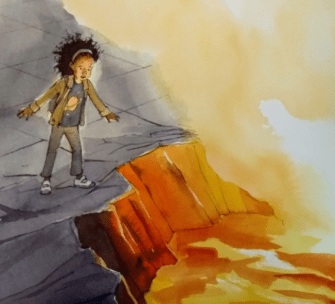
Lanan has picked up on that you in her art with a beauty that, frankly, stunned me.  Here’s the illustration that accompanies the words above.

hand art brighter

Lanan’s illustrations show the story of this girl and her family on a visit to an exhibition on exoplanets, and–while we basically follow the whole family–the parents and young sibling quickly become ancillary to the girl’s experience. She is the child reader; she is who Manley is writing for. The rest of the family is interested in the exhibition; the girl is completely immersed. She explores pieces of the exhibition her family passes by; she lingers behind in rooms from which her parents are already moving on. Her fascination simultaneously leaps off the page and pulls us deeper into a connection with what she is feeling.

fascination

And whoever worked on the layout of the book got it “just right.” (Despite the way my phone is showing it below!)

left spread one more time

right spread really use

The words that fill the left page of this spread, which pull us out to the stars visible through only the most powerful telescopes, are balanced with the smaller chunk of text on the right–Manley even uses the words tiny and small to emphasize the comparison.  The art on the left side shows the vastness of space; the right focuses our attention on our own smallness and the immediacy of the impact this view has on the girl.

No spoilers about where this book takes you at the end, but I can tell you that I was on the edge of tears when I finished reading it for the first time.  This book needs to be in every family and in every classroom, and I hope whoever is reading it has the sense to do so outside with a clear view into the sky.

Posted in Book Review, Picture Books, Uncategorized

Review: The Remember Balloons

I don’t remember why I put The Remember Balloons on my to-read list. I’m very glad I did, though. The book, written by Jessie Oliveros and illustrated by Dana Wulfekotte, is a lovely story that does an absolutely beautiful job depicting the magic relationship that can exist between a child and their grandparent, what it looks like when that grandparent experiences dementia, and the loss we all feel when that happens. But the particular thing this story does is explore the way that loss can get mixed up with confusion, hurt, and anger–maybe especially, if you’re a young child.

Bright lost silver balloon

I didn’t actually know what the book was about when I opened it this morning. In fact, the first page–where a young boy tells us that he has “way more [balloons] than my little brother”–made me think it was going to go down some path about sibling rivalry. The next page wiped that away, as the boy shares with his little brother what’s in his favorite balloon–the fun memory of his last birthday party. At this point, I thought the idea of balloons as memory holders was nice, but I wasn’t expecting the power that Oliveros and Wulfekotte give to the metaphor.

Warning: Some spoilers after this point.

Starting with the comparison of his balloons with his little brother, the boy follows that comparison to the fact that his parents have many more balloons then takes us to his grandfather–who has the most balloons of all. They go further, then, showing us how those balloons hold amazing memories–memories that the boy asks to hear about again and again. And then one step further, to a very important balloon–a silver one.

Bright silver balloon

He has the same balloon. It holds a memory of “the day we stood on the dock till the sun went down, feeling tug after tug  on our lines. Grandpa and I must have caught a thousand fish.”

Having the boy tell the story, in first person, was the perfect choice, I think. His voice is simple and clean, but words like and my and we keeps the story close and personal–the reader really is strongly drawn into the boy’s feelings. I, as an adult reader, recognize those feelings, and I think a young child going through a similar experience will recognize them, too.

“Grandpa’s balloons start floating away, faster and faster.
Running down streets and up hills, I watch the balloons grow smaller.”

And then, after a perfectly placed page turn and given a full two-page spread…

Bright cover

I’m not going to spoil the ending, but the crisis is absolutely perfect and the ending resonates with the hope of finding another, new way to connect with someone you don’t want to lose. Not every child will have the opportunity to take the step the boy does, and not every child will feel able to. But books like this aren’t here to present a one-size-fits-all solution, and they shouldn’t–life doesn’t always come with a solution. What this book does do wonderfully is show the thing one child tries, and–by doing so–opens up the possibility that another child–the child outside the book–will find something they can try as well.

There are a lot of books out in the world, created by people who want to help children understand the big, and sometimes bad, things that happen to them. And–let’s face it–to help the adults who are struggling to explain something they don’t fully understand. They’re hard books to write and hard books to illustrate–hard books in which to balance story and support.

The Remember Balloons succeeds on all counts.

Posted in First Drafts, Picture Books, Uncategorized

Better Questions This Time Around

I’ve pretty much spent the last year in picture-book revision mode–before the Big Sur workshop to get ready and after the workshop to integrate the feedback I got.  I’m sending these stories through my new critique group and then using their comments for yet more revision. But, as I submit to the group and wait for our meetings, I’m finding I have time to play with new ideas and write some early drafts.

The good thing about all this is revision is that I have learned a bit. (As one does.)  No, my first drafts aren’t suddenly works of beauty. No, I don’t understand what my hero wants on the first go.

But I’m asking better questions. Questions that, on previous manuscripts, I didn’t think to ask until draft four or draft six or draft nine. Questions that I knew all about from working on novels, but that I hadn’t yet woken up to applying to picture books.

Questions like:

  • Who is this character, that they have this specific-to-them want? What does the want say about them?
  • What “universal” childhood experience/feeling does that want touch on?
  • How does the character approach their attempts to get what they want, and how do they respond to their failures?
  • How does each failure lead into the next attempt; how does the big failure shift the character into a new, different story step?
  • What powers the character out of the dark place to push, one more time, for their own success? (Thinking again about what that original want said about them.)

And then there’s the biggie that perhaps isn’t/shouldn’t be an active part of early drafts, but that is starting to claim its place in the back of my brain even as I start to put the first words on the page.

What can I do with this story to give it that something extra,
that will turn it into a book a child ask for again and again? 

I’m not sure if having a stronger toolkit of questions is going to make my writing process easier or reduce my revision time. But I feel like I’m getting to step into the water at a deeper spot, like I can take my feet off the ground to swim at least a ways out of the shallow end of the pool. I’m leaving the swim noodle behind.

Posted in Book Review, Nonfiction, Picture Books, Uncategorized

Keith Negley’s MARY WEARS WHAT SHE WANTS

I love good nonfiction picture books, but I don’t purchase a lot of them–I’m writing fiction, and so most of my book budget goes toward good examples of that genre. Every now and then, though, I come across a nonfiction book I can’t leave at the store.

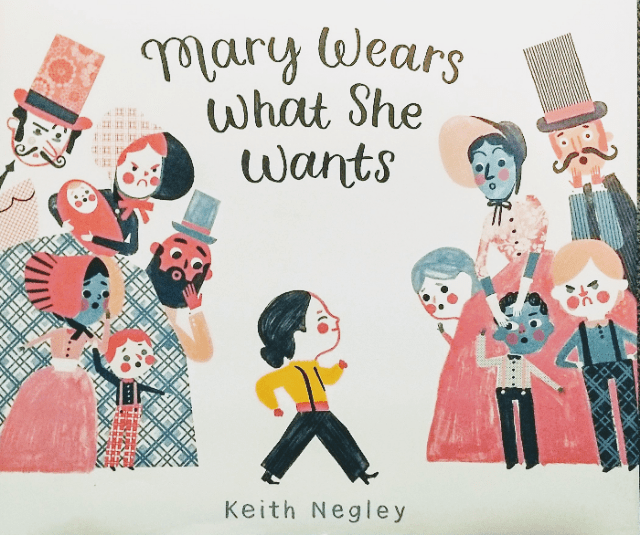
Keith Negley’s Mary Wears What She Wants was one of those–telling, as it does, a snippet of the life of Mary Edwards Walker. The title caught my eye–because it focuses on the fact that Mary is doing what she wants to do, as opposed to the fact that she is wearing pants instead of dresses. As soon as I pulled the book off the shelves, the art caught and held me. Look at that cover–I loved Mary as soon as I saw it. She strides along, head held high, looking straight ahead & not giving the naysayers a speck of her attention. And you could pull me into a debate about her facial expression, but I think she’s wearing a very small smile of determination and freedom.

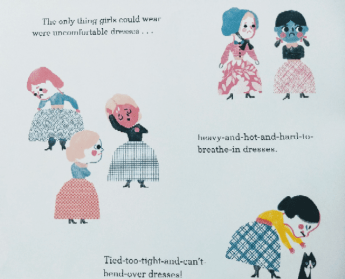
This book seems, to me, a wonderful example of words and art supporting each other. Negley is a writer-illustrator, so maybe it’s a bit easier to leave yourself room for art, but I’m guessing it’s just different. Still, however it is all working inside his head, Negley weaves together text and illustrations magically. Some places, he uses gorgeously concrete words with sparse illustrations, like this page early on, where Mary and other girls face all the problems that come with wearing a dress. (I apologize for what my phone camera does to the font–it’s nice and sharp in the book!)

Mary 3a

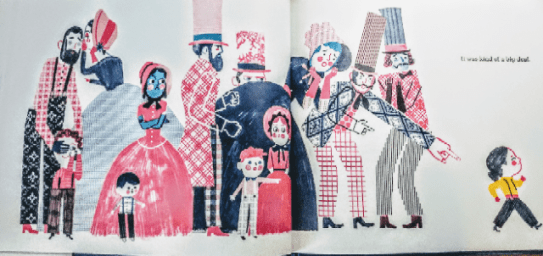
In other places, he flips the balance completely, filling a page or two with art and just a few words. The sentence on the spread below–“It was kind of a big deal.”–is essentially a mike drop (even though the story continues when you turn the page.)

mary 4

And the story has tension. Despite the look on Mary’s face–and the certainty she has about there being no reason she shouldn’t wear pants–Mary does worry and she is a bit afraid. Mary meets every obstacle head-on, with force and power. I think, though, that–as you read–it becomes clear Mary would be happier if she didn’t always have to be fighting.

Obviously, I think every child needs this book–no matter what gender they identify with, no matter if they are happy or not wearing the clothes people give them. It’s a book about crossing boundaries, opening eyes, and resetting “truths.” Mary Wears What She Wants sets as a standard the right to think for yourself and make your own choices. And shows a path for doing just that.


Posted in Picture Books, Uncategorized

Finding Balance (In Picture Books)

Rhyming in a picture book is one thing–and, so far anyway, it’s definitely one thing I can’t do. (If you want to read a few books by authors who can, I suggest pretty much anything by Sue Fliess; Interstellar Cinderellawritten by Deborah Underwood; and Cheerful Chickwritten by Martha Brokenbrough,) There’s also rhythm which, I think, is made up of word and sentence patterns, emphases, inflections, etc. that you hear (or don’t hear) when you read a picture book out loud. Take a look at In a Blue Room, written by Jim Averbeck (the rhythm is almost musical) and Sparky!written by Jenny Offill (I think the rhythm of the longer sentences broken up by the shorter ones mirrors the differences in personal rhythm between the girl and her sloth).

And then there’s balance. I’ve been thinking about this a lot, and I still don’t know how to explain it. It has to do with plot and structure. It has to do with how the story develops. It has to do with repetition. But, most of all, I think, it has to do with how the author distributes weight across…oh, across the pieces you would label “stanza” and “scene” in other genres. When the weight is distributed evenly, the story works. It flows.

Balance is actually easier to identify by its absence–that little bump you hit when the you read a sentence or a scene, and it isn’t quite delivered in the way your brain was expecting. author uses a set of three plot points, but one is two long sentences, the next is a half-dozen shorter ones, and the third is a single word with an exclamation point at the end. (Yes, I’m exaggerating–I told you it was hard to explain.)  For me, it manifests mostly as a moment of, “Huh?”

For some examples of balance done well, look at Sophie’s Squash, written by Pat Zietlow MillerBike On, Bear, written by Cynthea Liu, and Children Make Terrible Pets, by Peter Brown. Maybe after you read them, you’ll be able to define it.

Whatever it is, it seems to be the foundation I need when I’m writing or revising a picture book. Do I always build it early on? Of course not. Do I have anything close to it for several revisions. Rarely. But once I have some kind of draft–whether first or fourteenth, I can feel when and where the balance is off. And that’s often where I start the next draft, trying to pull that spot back into balance with the rest of the story. Or if I love that spot, try to pull the other stuff into balance with it. The best way I can describe it is–it feels like when you think you have the right puzzle piece of blue to fit into the empty spot of sky, but–when you go to press it in–it doesn’t quite fit. So you have to go off and hunt through all the other blue pieces.

I hate that when I’m working on a puzzle. Luckily for me, I love it when I’m writing.

If you want to see other posts by me about picture books, and some great craft posts about middle grade and young adult books, you can pop over to KidLitCraft. I’ll be blogging here and there, on an occasional basis.

Posted in Chapter Books, Conferences, Picture Books, Uncategorized

Fall Writing Plans

For a while now, I haven’t put any real schedules on my writing. I had been in a bit of a slump for a year or so, and I was changing jobs, and…well, life. But the slump seems to have shifted away for now, and the new job came with new hours, which unexpectedly got me writing in the morning again. I feel as though I’ve landed in a good grove.

I still don’t want to squeeze myself too tightly into must-do goals, but there are a couple of things coming up that seemed worth planning around.

In December, I’m going to the Big Sur Writing Workshop for the first time. I’m really excited about getting to get critiques on some of the picture books I’ve been revising. If I had to set a goal for outcomes, it would be that the feedback and ideas I get there will help me get to the next stop on the writing path–querying agents for these manuscripts. I want to have some flexibility about what I decide to share in the critique groups, depending on how each session goes. I have one absolutely ready to share, two that I want to run through one more time, and a fourth that was a picture book, but that I have taken down to one or two bones and am building back up. I will have at least the first three ready by Big Sur, and I want to have the fourth at least to a draft I’m not embarrassed to put out there. Assuming no creeks rise, this all seems doable.

The second thing coming up is a vacation to Sedona. Of all the places we vacationed when I was growing up, this was one of my favorites, and my husband has never been. He loved Moab, and I feel like Sedona is Moab, but with a bit more up and down geology, cooler temps, and actual trees. We’re driving (Vanagon road trip!), so I’ll have a couple of days each direction to think about some project, talk out loud about it (lucky husband!), and jot down any ideas. Then, in Sedona, we’ll do our usual–split up for a few hours each day; my husband gets out on his bike, and I get into my writing.

I could save this for more revision, or for making big progress on the fourth picture book, but I think I want something looser, with more room for play. So I’ll be working on an idea for a chapter book. If you follow me on Facebook, you may know that I’ve been inspired by reading Debbi Michiko Florence’s Jasmine Toguchi books. One of the things I absolutely love about picture books is how the short form and the young audience create constraints for me to work within, and it seems like chapter books have their own set of “specs.” I have one idea that’s been tickling my brain a bit, so the Arizona trip is for that. I may play with an opening scene; I may take a stab at an outline; I may decide the idea is not workable and brainstorm a few others. I may find out that I am totally wrong about chapter books and that it is not a genre I want to get into. But I don’t think so.

It feels so good to be solidly back on the writing path, even if I still (and always!) don’t know where it’s going to lead. Writing steadily and seeing my manuscripts and my crafts get stronger, having the energy and courage to dig into something new…this is my happy place. Fall is always my favorite season and, this year, I think it’s definitely going to be a good one.

Posted in Picture Books, Uncategorized

In Which Pooh Has Fun with Picture Books

Okay, not Pooh, me. I’m having fun with picture books right now.

I’m not sure if I’m actually on a roll, or if I lucked out and landed on a couple of older ideas that suddenly turned into something, or if it’s in good part because I’ve been working with a wonderful editor. Whatever the reason, I have spent the past few months revising a few picture books and feel like:

  • I’m loving the stories.
  • I’m loving the revision work itself.
  • I’ve possibly hit a new level of sorts in my writing craft–at least in this genre.
    (There is a middle-grade novel waiting for me to come back to it soon, and I’m not making any claims of writing craft on that one yet!)

I was listening to a podcast today in which an editor was comparing reading a short story to reading a novel, and she said something about how–in a short story–everything has to count. That’s not the newest idea, and I don’t actually know where she went with that thought, because I drifted off a bit into that truth about picture books.

In picture books, hoo boy, every word does count. Seriously, this past weekend, I changed a number in one line from “eleven” to “fourteen,” and I am SO much happier with that line. It has something to do with the two syllables having a better rhythm in that line than three. And it has something to do with there being a “t” sound in fourteen and in the word that follows it. And it has a lot to do with the fact that when I swapped words, the line sang much more sweetly than it had before.

Yes, it’s harder to make every single word count, but I seem to get less lost and drifty when I’m revising a picture book, than I do in a novel. (This week, at least–don’t hold me to this statement in April!) And while I don’t expect to ever write a rhyming picture book, I love discovering the rhythm that goes best with each story. I am tone deaf, but I know when I’ve written a line in a picture book that “sounds” flat. And I know when I rewrite the line and hit the true note.

Where am I going with this? No idea! I’m having thoughts about the middle-grade that may, once I dig back in, get me past “stuck.” And I haven’t yet gone back to my pile of picture book ideas to see if any of them spark in my mind. Probably I’ll do both.

For now, I’m just letting myself fall in love with writing again.