Posted in Blog Contest, Blogging, Blogs, Marketing, Promotion, The Writing & Critique Group Survival Guide

Marketing Monday: Setting Up a Blog Tour & Adding a New Blog Feature

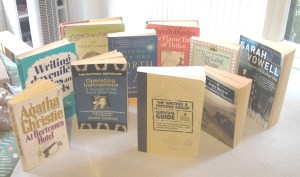
Before I get down to business today, I want to show you a few of my favorite books.

Wait, what’s that one out in front? Is it…? It is! Yes, two copies of The Writing & Critique Group Survival Guide showed up at my house this weekend. Did I mind the rain and gray skies? Not after that delivery, I didn’t!

Okay, so if the book is here, this means I should get back to my marketing to-do list and get some things checked off. The book is due out January 15th, but I’ll have some copies before then that I can, and want to, use for marketing. I’d like to set up a blog tour for January…with giveaways! I’m keeping this simple, just hoping to visit a few blogs and let people know about my book, share some thoughts about critiquing and critique groups. If you’d like your blog to be a stop on the tour, I’d love to come by. I think interviews are fun, because I can talk about what you and your blog readers want to hear, but I can also do a guest post if that’s easier for you.

If you’d like to host me at your blog, please send me an email at beckylevine@ymail.com

The other thing I’m looking to do is add a new, probably monthly, feature to my blog in 2010. I’d like to host you, if you’ve got a story about a critique group or experience to share. (Obviously, I don’t want posts that are just rants or vents, but I’m definitely open to learning-experience stories as well as the more positive kind!) And if you’ve got a book out or coming out that you’d like to promote, I’ll include pictures and links to let people know about it. You can also donate a copy of an ARC or published book, if you’d like me to run a contest.

Again, if you’d like to guest blog here with your critique story, please email me at beckylevine@ymail.com

Next post, back to our regular, random programming.

Posted in Book in a Week, First Drafts, NaNoWriMo, Revising

Let’s Talk about 1st Drafts: A (Hopefully) Gentle Post-Nano Pep Talk

A week or so ago, I blogged about progress–thinking about what people would be feeling as they came to the end of NaNo. Now that NaNo is over & authors everywhere are actually looking over what they did produce in November, I’m feeling the need to talk about things a little bit more. Actually, this post is prompted in part by the disappointment an online friend was (hopefully, not is, anymore) feeling about her 1st draft. So this may turn into a bit of a rant.

Qualifier: I very much like the idea of NaNo. I did a variant in Book in a Week a few years ago, and I was thrilled with the results–with where that week got me, in terms of understanding my story and in terms of having actual material to move forward with.

Note that I did not say I was thrilled with the draft.

That first draft was–well, let’s just call it an Anne Lamott-approved 1st draft. I sat down to read it after the week, and started scribbling notes and thoughts, and then I stopped reading. Because it was just that bad.

I did not stop revising. By maybe 1/3 of the way through, I’d seen that my hero was being a totally passive observer, letting his sidekick drive the choices and actions of the story. I didn’t have to read the whole manuscript to find out whether he continued that way; I knew he did. And I knew that, before I could do any other revising, I had to tackle this major problem.

So I wrote a second draft, in which I pushed that hero to the front. I made the story goals his goals, and I threw the obstacles in his path. Did I work on other, smaller issues as I went through all the chapters? Of course, I did–I’m human! But that was the revision focus. And when I finished that draft, I had something I thought I could work with. Something I thought I could pass through my critique group without too much humiliation and embarrassment.

What’s my point? That first draft–whether you wrote it in a week or a month–is supposed to be bad. REALLY bad. How could it be otherwise? Unless you have the brain of, I don’t know…Stephen Hawking? Albert Einstein? William Shakespeare? ______________ ? (Fill in the blank with the name of any famous author you’ve heard say they DO write a beautiful first draft!), you cannot write a manuscript that fast and THINK about it at the same time. Yes, I know, you did think. So did I during the Book in a Week process. But I thought for seconds and minutes. I did not think for hours, because I had none of those to spare. And neither did you.

What do you have, from your NaNo work? Do you have crap? If you answer anywhere near “Yes,” I want you to step away from the computer, give yourself a hug and some chocolate, and do the happy dance. Because you’re supposed to have crap. And you got it in a month–many of us take a YEAR (or more) to reach that point! You get to start turning that horrible stuff into something better 11 months ahead of schedule. Are you on Twitter? Did you see all the tweets from agents and editors, in varying degrees of tact, asking you NOT to query them about this manuscript on December 1st? The fact that you recognize how bad your first draft is proves you have the skill level and the knowledge of the craft to see that.

Okay, rant finished. But seriously, if you’re feeling disappointed or discouraged or–please, no–like you’ve failed in any way, well, just don’t!  Is there something you particularly hate about the story so far? Wonderful! Take that element and fix it. Figure out what you hate about it, why it makes you want to take the whole manuscript and use it to heat the wood-burning stove this winter, and revise around that problem. Save the AL-approved 1st draft, if you want to reassure yourself that you’re not losing any treasures (but really so you can show yourself how much BETTER that next draft is–and the next, and the next…).

I love NaNo and BIAW. I love the idea of tackling this big a project in such a short time, of riding an adrenalin wave, of producing more words and ideas than you ever thought possible. I browsed through NaNo’s website before writing this blog, and that’s really what the month is supposed to be about. I do not like all the bad feelings that come to some NaNo writers when the adrenalin leaves, and the crash comes. No matter how bad those words look on the page, you have achieved something wonderful.

Let yourself believe that.

Posted in Character, Plot, Uncategorized

Making Connections, Deepening Story

When I went away to college many, many years ago, I moved about 5 hours away from home. Not far, probably, compared to some of you, but for the shy kid I was, it was a good distance. It meant that coming home for weekends was not a given, and it meant one miserable trip that involved a city bus to a greyhound bus to another greyhound bus that made 1.32 gazillion stops (I counted!) in Los Angeles and many hours beyond that. And the return trip.

Which is why I was more than grateful that I knew someone at the school from my hometown, someone with whom I could grab an occasional ride up the state.

She was a friend of my older sister’s. She was two years older than I was and, I’d bet, pretty darned close to as shy as me. She drove a car I fell in love with–a 1960-something Mercedes Benz with seats out of a Pullman car and a steering wheel that, if you held onto it 10 & 2, you got a nice yoga stretch.  Anyway, this friend would call me up if she was going home & offer the passenger seat, and I would check with her at holidays to see if she was heading home.

Why am I going on about this? Because this was not just someone I knew, a college-mate I’d met and developed my own, one-to-one relationship with. This was my sister’s friend, the daughter of neighbors that (probably) brought one of their pets to my parents’ veterinary clinic. She was the middle sister, like me, with an older brother we all had crushes on, and a younger sister, as well. If you drew lines between all the people we both connected to, it would look like a spider web of interlacing strands. And, frankly, it was these connections that made it possible for the seriously-shy me to accept (and ask for) rides from this woman and for her to offer. We knew we had something, at least, to talk about for those hours driving along the Pacific Ocean. The connections added layers to our interactions.

Just like in a novel.

I just solved a plot problem tonight. I knew what my MC should do next, but I could see it taking her down a path that would be a problem later. Not a problem for her, but a problem for the story–this one action was going to make her step in and out of just one too many opportunities, with the bouncing out making her feel like a quitter. Which she is not. This has been a stumbling block for me every time I looked down the line at upcoming scenes. Tonight, I worked it out. If the opportunity I set up for has a connection to the next opportunity, a connection with the people involved, then she doesn’t have to quit. Instead, she’ll move forward on that path.

To be more specific, I gave one character another role–which gives that character another link to my hero. Instead of two separate people with whom my hero has to interact, on totally different planes, she now has a single person with whom she interacts on two levels. Deeper. Stronger.

When you’re working with your plot and thinking about paths for your hero, look at who’s hanging around on that path. Are they isolated from each other, or connected? Take two characters who do know each other–who else can you bring into the mix? As you connect, as you braid more lines together, what overlap do you see between worlds? What extra ripples does someone’s action start…in how many ponds? Who opens up to whom and who tells takes on who else? How much more interesting does your story become?

Try mixing things up and take a look. I predict you’ll be pleasantly surprised! 🙂

Posted in Blogs

Friday Five: Taking a Look around the Blogiverse

I feel like I’ve been doing a lot of navel-staring the last few weeks, like I’ve been a little too wrapped up in ME.  But I do love touching base with a Friday Five. So this Friday, I’m going to point you to a few other people…enjoy!

1. Start at Susan Taylor Brown’s blog. All this month, she’s posting about 31 Blogs (You Might Not Know) to highlight blogs she enjoys that may have flown under our radar. Just a nice tidbit every day, but she’s bringing lots of wondering bloggers to my attention. Susan’s posts this month and her generosity at her blog are actually my inspiration for stepping back from the mirror today–thanks, Susan!

2. Martha Alderson is The Plot Whisperer. Last year, she filled December with wonderful posts about what to do about revising the novel you “finished” during NaNo. She’s back this year with the 2nd Annual International Plot Writing Month. Posts start here.

3. You know them as The Shrinking Violets, rescuers of all introverts. Who are they behind their superhero masks & capes? Robin LaFevers and Mary Hershey, wonderful writers and bloggers. For intensive writing advice and wonderful motivation, check out Robin’s and Mary’s individual blogs.

4. Do you want to learn about the publishing industry–about what’s happening today and what may very well be happening tomorrow? Jane Friedman is publisher and editorial director of the Writer’s Digest brand community. She has two blogs (maybe more!) at There Are No Rules and Publishing Passion. Jane has strong opinions and ideas about what publishing is doing and what it should be thinking about. You may or may not agree with all she says, but she is on top of everything that’s happening today, and she does a brilliant job of sharing all her knowledge and experience with those of us struggling to figure it all out. Her posts are not to be missed.

1. If you’re a kids or YA writer, you already know Jen Robinson. And if you don’t, well, you just head over and introduce yourself to her blog now. What if you don’t write for kids and teens? Well, Are you an adult who’s been hearing about this surge in YA lit and wondering where to get started? Do you have any kids in your life who love reading, or who are struggling to find that love? Do you have a list of young ones and teens on your holiday-gift list? Do you care about literacy, about promoting reading for all ages? Jen is a passionate advocate for literacy, for bringing books into children’s lives, and for continuing to read “young” books into our adult years. She knows more about kids/YA books than anyone I know, and that’s saying a lot. Her generosity of time and energy are epic. Get her blog into your blog reader now.

There. Now you have more links to add to your already busy lives. 🙂  Happy friday & happy reading!

Posted in Historical Fiction, History

Historical Fiction: Keeping the Background from Taking Over the Foreground

I just thought of two historical novels I need to go back and reread, and they’re both by Rita Mae Brown. The first is High Hearts–a Civil War Novel, and the second is Dolley–novel about Dolley Madison. I read both these books while I was living in Charlottesville, Virginia, and both–especially High Hearts–blew me away. This was decades before I ever thought I’d be writing historical fiction myself.

And now here I am, thinking about how I want to play with/work with this genre and guessing that if I want to see some of the best possible example of how to do it right, I should open these books again. (Oh, darn. Such a chore!)

Because guess what I remember about those books? The stories.

Not the history.

Yes, of course, I read about battles in High Hearts, and I “saw” the White House burn in Dolley. Real people walked through all the pages of Dolley, and there is one scene from High Hearts that I feel pretty sure was based on a true event, because I’m not sure anyone, even Brown, could imagine that horror. (No spoilers, go read the books!)
 
Overall, though, I’m pretty sure (it’s been a couple of decades since I turned those pages) Brown placed the history of the time into the background of the books. The wars and the government officials and the soldiers and the ladies are part of the setting. And, in a way, they all weave together to create a single character you could just call Era. Or The Times. Of course those elements interact with the primary characters, of course they affect the plot. But they are not the story. The story is what Brown’s main characters–one fiction and one fictionalized–do.
 
I’m reminding myself of this as I plot. I’m focusing on my hero again, looking at her actions and her problems. I’m not shedding all the history she moves through, but I’m trying to think of her as an individual. Yes, some of her conflict is because of the times in which she lives, but it’s important that I could pick her up from those times and put her down in some other, and she’d still be who she is, down in her bones.
 
Luckily, I still have High Hearts on the shelf. Time to get another copy of Dolley. And time for you guys, whether or not you’re writing historical fiction, to check out both novels for yourself!
Posted in Character, Heroes, Plot, Scenes

What Would Caro Do?

Today, I will get closer to Caro, the hero of my YA WIP.

Well, that’s the plan.

I’m still plotting into the middle. I’d say “through” the middle, but not yet feeling that optimistic. And I’m realizing that part of the problem I’m having with the current mish-mash of scenes is that I haven’t honed in enough on my hero’s active goal. I know her emotional goals, but those don’t really drive her choices and actions–not with her knowledge, anyway. When I was plotting my mystery, I could always ask, “What would my hero do to…solve the mystery?” (And then, of course, I’d ask, what someone else could do to PREVENT his solving it!). That MC had a very concrete, active goal to work toward.

I am not going to sit and stare at my computer or out the window until I come up with the equivalent, active goal for Caro. Because, yes, I could do that until the cows came home and, frankly, had a good laugh at my expense. Instead, I’m going to take it scene by scene for a while. And I’ll look at these elements:

  • What did Caro do in the previous scene or few scenes?
  • What were the consequences of those recent actions?
  • How does she feel about what she did and about what happened?
  • Who did she set up a conflict with?
  • What other character has a strong goal at this time?
  • What story element have I not dealt with in, perhaps, too long?

And out of that, I’m going to give myself a kinder, gentler question to answer.  That question will be, “What would Caro do to…solve some problem.”

This problem may not be the one she actually needs to work on at the time. It may turn out to be a problem that, in the end, I (and Caro) decide to throw away completely. It almost certainly won’t, yet, be the problem that is her equivalent of solving a mystery.  Hopefully, though, it’ll be a problem that lets Caro and I move her plot forward and grow a deeper understanding of what it is she truly wants.

What does YOUR hero want? And what step could she (possibly!) take today to achieve that goal?

Posted in Conflict, Dialogue, Scenes

Triangles-More Angles and Sharp Edges

Geometry? I don’t think so. Triangles, in math, hold no appeal for me.

Triangles in fiction, though, are a whole different subject.

The picture book I’m working on has three characters. Okay, well, four, but one’s a surprise, and I’m not talking about that one yet. But the family–three members.

I knew what the son–the hero–was about. I knew what the father was about. And I knew there was/should be a mother. Even if I didn’t know, at all, what she was about.

I wanted that mother. Not just because, well…I wanted to be in the story. For one thing, I wanted my young hero to have two (albeit well-meaning) antagonists, so he really has to fight to come through the winner. But also because I just like triangles.

Pick a scene, any scene. You’ve got two people in that scene, interacting with each other. Those two people can have a conversation. Those two people can have an argument. Those two people can create some serious tension.

Three can do more.

If you’re reading a scene with two characters, you may get some surprises, but there is a pattern you–as the reader–will be following. It’s kind of like watching tennis or ping-pong. It’s not always back and forth–the server might double-fault, or the receiver get aced. But basically, you know who’s going to hit the ball next. In a scene, you know–basically–who’s going to speak next, or act/react next.

If you add a third character to that scene, all bets are off. You can’t know, as the reader, with any certainty, who’s up next in the rally. You can’t anticipate, for sure, who’s going to be arguing with whom, or when (even if) the third character will throw in their own two cents. You can’t guess, when the hero takes a punch at someone else in the room, whether he’ll hit his target or that other guy in the room.

And, honestly, there are plenty of times when the writer can’t predict any of this either.

So I’m keeping my mother. With the help of a critique from Susan Taylor Brown, I now have the spark of an idea of what the mother is about. I’ll play with that in the next draft and see what she gives back to me, to the story. To that triangle.

Posted in Holidays

Lazy Time/Holiday Thanks

There is something about knowing that school is out for a few days, people will be visiting, and food will be cooked to just put me into an I-Don’t-Have-To-Do-Anything mood. Okay, yes, a bit of cleaning, yesterday’s massive grocery shopping, and some organization, but I have a low-tolerance for stress and a high-tolerance for break-time! So, a day early, here is what I’m feeling thankful for this year, over the next few weeks.

  • Having a husband who cooks and loves it. Turkey? He’s smoking it. Main course for big family gathering on Friday? He’s cooking the cabbage leaves and the stuffing, and I’ll just help roll everything together. It’ll be a big production, with lots of family/audience participation, and everyone will have a blast.
  • Having a son who makes times like this easy. Quiet Thanksgiving, Son. Great, Mom. Crowded, rowdy Day-After-Thanksgiving, Son. Great, Mom. How about you dump the brown-sugar on the yams and bake them, Son? Um, Mom… Would you rather do the turkey, Son? Yams–Great, Mom! 🙂
  • Having some of our family close enough that sometimes we don’t have to drive anywhere to share time and space with them, and that–when we do–it’s all in a day’s trip. Having family that is fine with whatever we cook, has no problem with paper plates, and will spread out to eat in our kitchen and/or living room wherever there’s room. Having family that believes in crashing on a futon or the camping cot or the floor for the night, and that makes it all work. And having family that, even when they’re farther away, take the time for a phone call when they see you’re awake and updating your Facebook status!
  • Libraries. Yes, I’m obviously thankful for that all year, but days like these–even more so. Knowing I have that extra reading time-because that’s one way in which I, my husband, and our son fill down time–just makes me more grateful than ever than I live in a place where I can walk in, browse shelves, and take away a stack of books for free.
  • Seeing the economy staaaarrrrt to perhaps turn around. No, I don’t believe in “The Recession is Over” line, but I do see more cars on the freeway, hear of less people out of work, and have hopes that the path is curving upward just a bit, instead of continuing that steep, downhill slide.

Happy Thanksgiving to you all, and may you eat loads of your favorite foods, while wearing pants comfortable enough to take it all!

Posted in NaNoWriMo, Progress

Progress: The Muddy Definition

I didn’t do NaNo this year. I keep saying that someday I will, but November never shows up on my calendar as a one-project, one-focus month. Every year, though, I follow along on blogs and Facebook and Twitter and eavesdrop on the conversations about how everyone is doing.

And every year, at this time of the month, with turkeys on order at the grocery store and cranberry sauce gelling in the pot, I think…how must NaNo writers be feeling. Four or five days with kids out of school, family visiting, and tryptophan sending us into naptime…and how many more words left to write?

I find myself worrying a little about NaNo stress levels and hoping that nobody’s really beating themselves up about word count or having to write The End in concrete in a week. I find myself hoping that they know there are many different meanings to progress and knowing that they have already achieved some form of it.

Here are just a few things that qualify, on my tally sheet, as progress:

  • Discovering the true, important goal of your hero.
  • Figuring out why your antagonist is so mean.
  • Working out the elements of your world–whether that be an elven forest, a far planet, or a particular street corner in your neighborhood.
  • Writing five chapters in a row without knowing what you’re doing, then realizing the connection between these scenes and the story arc—even if  you put off the revision till later.
  • Writing a half-page of perfect dialogue.
  • Writing one chapter in third person, another in first, two in present-tense, and six in past. And being okay with the fact that you’re playing around and experimenting.

Whether you did NaNo or not this month, I’m betting you achieved one of these progress markers, or another with as much weight. Let’s face it–the best progress of NaNo is taking your writing so seriously, with utter commitment, for this one month. And realizing, out of that month, that–minus the sore wrists and the exhaustion–this is the commitment you want to feel about your writing all year long.

What’s your definition of progress? What did you do this month that makes you proud of yourself as a writer? Leave me a comment and share.

Then go out and buy another two pounds of yams and another can of whipped cream for that pumpkin pie!

Posted in Friday Five

Randomy Friday Five

1. I’m guest blogging today at Killer Hobbies, filling in for my critique partner who’s off being incredibly creative and productive at a writing retreat. The rest of the Killer Hobbyists have been blogging about the writing craft all week–incredibly detailed information about technique. Stop by and leave a comment on any of the posts, and Terri & I will enter you for a chance to win a copy of The Writing & Critique Group Survival Guide.

2. I’m feeling pretty committed to working through the entire plot (at a basic level!) of my WIP. I’m also heading into plotting the middle, which is going to test that commitment in a big way. It’s good timing, though, with the holidays coming up–less time for sustained writing, plenty of time for sitting down at the computer and figuring out a few scene goals.

3. I got some early critique feedback & questions from Susan Taylor Brown yesterday on my picture book. Good stuff. Yes, the mom either has to step up to the plate and DO something, or she can just back slowly away from the story at all. I’m in favor of the first option; we’ll see what she and I can come up with.

4. The weather today is some of my favorite. Gray clouds overhead with a little breeze that, every few minutes, picks up and blows leaves around, makes the bark on the eucalyptus trees wave, and causes SOMETHING you can only hear to skitter across the road or roof. It’s incredibly cozy, calling for fleece and a fire, I think. Okay, maybe not till tonight!

5. I’m jumping all over the place on Pandora, looking for new music I can plot to. I can do a bit more lively with plot than I can with writing, in fact more energy helps. This morning, I’m listening to Spin Doctors radio, but I’m considering some reggae for later in the day.