Posted in Character, Plot, Uncategorized

Making Connections, Deepening Story

When I went away to college many, many years ago, I moved about 5 hours away from home. Not far, probably, compared to some of you, but for the shy kid I was, it was a good distance. It meant that coming home for weekends was not a given, and it meant one miserable trip that involved a city bus to a greyhound bus to another greyhound bus that made 1.32 gazillion stops (I counted!) in Los Angeles and many hours beyond that. And the return trip.

Which is why I was more than grateful that I knew someone at the school from my hometown, someone with whom I could grab an occasional ride up the state.

She was a friend of my older sister’s. She was two years older than I was and, I’d bet, pretty darned close to as shy as me. She drove a car I fell in love with–a 1960-something Mercedes Benz with seats out of a Pullman car and a steering wheel that, if you held onto it 10 & 2, you got a nice yoga stretch.  Anyway, this friend would call me up if she was going home & offer the passenger seat, and I would check with her at holidays to see if she was heading home.

Why am I going on about this? Because this was not just someone I knew, a college-mate I’d met and developed my own, one-to-one relationship with. This was my sister’s friend, the daughter of neighbors that (probably) brought one of their pets to my parents’ veterinary clinic. She was the middle sister, like me, with an older brother we all had crushes on, and a younger sister, as well. If you drew lines between all the people we both connected to, it would look like a spider web of interlacing strands. And, frankly, it was these connections that made it possible for the seriously-shy me to accept (and ask for) rides from this woman and for her to offer. We knew we had something, at least, to talk about for those hours driving along the Pacific Ocean. The connections added layers to our interactions.

Just like in a novel.

I just solved a plot problem tonight. I knew what my MC should do next, but I could see it taking her down a path that would be a problem later. Not a problem for her, but a problem for the story–this one action was going to make her step in and out of just one too many opportunities, with the bouncing out making her feel like a quitter. Which she is not. This has been a stumbling block for me every time I looked down the line at upcoming scenes. Tonight, I worked it out. If the opportunity I set up for has a connection to the next opportunity, a connection with the people involved, then she doesn’t have to quit. Instead, she’ll move forward on that path.

To be more specific, I gave one character another role–which gives that character another link to my hero. Instead of two separate people with whom my hero has to interact, on totally different planes, she now has a single person with whom she interacts on two levels. Deeper. Stronger.

When you’re working with your plot and thinking about paths for your hero, look at who’s hanging around on that path. Are they isolated from each other, or connected? Take two characters who do know each other–who else can you bring into the mix? As you connect, as you braid more lines together, what overlap do you see between worlds? What extra ripples does someone’s action start…in how many ponds? Who opens up to whom and who tells takes on who else? How much more interesting does your story become?

Try mixing things up and take a look. I predict you’ll be pleasantly surprised! 🙂
Posted in Character, Heroes, Plot, Scenes

What Would Caro Do?

Today, I will get closer to Caro, the hero of my YA WIP.

Well, that’s the plan.

I’m still plotting into the middle. I’d say “through” the middle, but not yet feeling that optimistic. And I’m realizing that part of the problem I’m having with the current mish-mash of scenes is that I haven’t honed in enough on my hero’s active goal. I know her emotional goals, but those don’t really drive her choices and actions–not with her knowledge, anyway. When I was plotting my mystery, I could always ask, “What would my hero do to…solve the mystery?” (And then, of course, I’d ask, what someone else could do to PREVENT his solving it!). That MC had a very concrete, active goal to work toward.

I am not going to sit and stare at my computer or out the window until I come up with the equivalent, active goal for Caro. Because, yes, I could do that until the cows came home and, frankly, had a good laugh at my expense. Instead, I’m going to take it scene by scene for a while. And I’ll look at these elements:

  • What did Caro do in the previous scene or few scenes?
  • What were the consequences of those recent actions?
  • How does she feel about what she did and about what happened?
  • Who did she set up a conflict with?
  • What other character has a strong goal at this time?
  • What story element have I not dealt with in, perhaps, too long?

And out of that, I’m going to give myself a kinder, gentler question to answer.  That question will be, “What would Caro do to…solve some problem.”

This problem may not be the one she actually needs to work on at the time. It may turn out to be a problem that, in the end, I (and Caro) decide to throw away completely. It almost certainly won’t, yet, be the problem that is her equivalent of solving a mystery.  Hopefully, though, it’ll be a problem that lets Caro and I move her plot forward and grow a deeper understanding of what it is she truly wants.

What does YOUR hero want? And what step could she (possibly!) take today to achieve that goal?

Posted in First Drafts, Getting Organized, Organization, Outlining, Plot, Scenes

Thursday’s Target-A Rainbow of Sticky Notes

Yesterday, I reread Robin LaFevers post on index cards. Then I went out and bought some sticky notes. Two packs. Five colors each.

Because I’m confused.

Not from Robin’s post. From my own plot. Too confused to know what to write next. So I’m trying something that occasionally works for me, but only occasionally–going visual.

My MC has three (maybe four) possible paths. Well, in all likelihood, she’ll follow all the paths somewhere in the story. I think. At the end, though, she has to choose one. I know this. I even know WHICH path she’ll choose. I also know (darn it!) that I can’t just lay these paths out sequentially or in parallel, which is how they’re feeling in my brain right now. No, I have to weave them.

Which means I need connections. Overlaps. Characters with more than one role. Layers.

I know, these come in revision. And I’m still on the first draft. Well, actually, I’m just a bit stalled on the first draft.

I think writer’s block may actually be this kind of stall–and maybe more aptly named writer’s jam. It’s not that I don’t have any ideas. It’s not that I can’t see my MC acting, going places, talking to people. It’s that I have LOTS of ideas, lots of action, people, and places. But they’re all crowded together, like I’ve poured them into one of those cake-icing bags–the ones that narrow down to a tiny hole. And all the ideas are trying to get out that hole…at the same time.

So I’m going to play with my sticky notes today, on my whiteboard, and try to come up with some pattern that shows me what to focus on. What to pull out of the hat next. I’m going to use a different color for every scene on one of those three (four?) paths and then try to move things around. (Yes, I know I said I had 10 colors. Hey, you never know!)  Hopefully, I’ll get THE idea that lets me move forward.

What do you do when you need a “lightbulb moment”?

Posted in Plot, Scenes, The Middle, Thinking

Plotting the Middle–One Attempt to Find a System

I don’t know about you, but my brain does strange things in the early stages of thinking about a novel. Many of those things are strange in a good way. Others, not so much.

Lately, as I spend time with my current WIP, I’ll be immersed in some wonderful, creative brainstorming about my hero or another character or a setting, and my mind starts going off in tangents about scenes that need to happen or about the big, dramatic choices my hero will have to make by the end. Fun things like that. And then, all of a sudden, I’ll have one of two thoughts. They are:

  • I have WAY too many actions/events that have to happen in the middle of this story!
  • How in the WORLD am I going to find enough actions/events to fill up the middle of this story?!

Note: Exclamation points denote panic.

Double Note: Yes, I realize those thoughts are extreme opposites. Donald Maass would love me as a character.

The point, today, is that I did spend a little time the other day thinking, again, about how to plot out that middle. How to find a way to place it–as a craft element–somewhere between a dense, overcrowded mess and a gapingly empty maw. And here’s what I came up with.

I’m getting a pretty good idea of what both the beginning and the ending of this story need to be doing. As I work, my brain goes back and forth between those two points, thinking about how they connect and what layers they share.  And I’m making myself slow down a bit and think about ways to weave those threads through the middle.

Here’s an example. Let’s say I’m writing a story about a tortoise and a rabbit. No, let’s call that second character a hare. The hare challenges the tortoise to a—okay, you know the story. You’re probably thinking it’s a pretty simple plot (which makes for a good example!), but there are a few layers here. We need to show the hare’s speed, and its cockiness, and its lack of manners. We need to show the tortoise’s slowness, its confidence, and its style.

Let’s take one set–speed and slowness.

In the Beginning, speed is strength and slowness is weakness. By the End, the tortoise has reversed that valuation–slowness can be power and strength may not be so good over the long haul. (Sounds like an ode to my running, but let’s not go there.) Obviously we can’t just snap our fingers and have that change happen–that’s wishful thinking, not storytelling.

We need two or three plot points in the Middle to make the change happen.  And this is where I’m taking a few minutes, to ask myself, “What could those plot points be?” And for each thread I think about, I’m making a quick list of possiblities…like this:

  • The hare could laugh at the tortoise and all the other animals for being slow.
  • The tortoise could stop in the middle of the race to help a young animal that is hurt or lost.
  • The other animals could have a meeting and decide to help the tortoise.
  • The elephant could fill up its trunk with water from a nearby lake, then flood the path so the tortoise could swim the race.
  • The bees could magically polinate a nearby field of poppies into bloom, so the hare would fall asleep–oh, wait, that’s another story.

Anyway, you see the point. Each of these possibilities could (I’m not necessarily saying should!) be a scene in the story. In sequence, they show the progression from the hare being the one with power, to the tortoise earning the strength and support of friends and turning the tables on his long-eared antagonist. Et voila, some of your middle is filled.

What do you think? Is this a possible tool to help make that middle less scary, less intimidating? Do you have techniques you use to plot your way across the void? I’d love to hear them, because–whatever may or may not work–I’m pretty sure I’ll be trying them all in the next few months!

Posted in Guest Blogger, NaNoWriMo, Plot, Revising, The Writing Path

Guest Blogger: Martha Alderson

Martha Alderson is a friend, a critique partner, and a wonderful teacher of plot. Her blog, The Plot Whisperer, is a font of information about crafting your fiction, and you can buy Martha’s book and other plot tools at her website, Blockbuster Plots. To celebrate the end of NaNoWriMo, Martha has declared December National Plot Month and is giving daily tips at her blog to help you get started on revising that manuscript.

I asked Martha to stop by and give us just a taste of this next stage, how to look at those tens of thousands of words you just produced and figure out what you’re supposed to do with them.

Welcome, Martha!

Thank you, Becky, for inviting me to guest blog “about the kind of plotting a writer can do when they’ve FINISHED NaNoWriMo.” I agree with you that this is a crucial time–because, as you say–“it’s the first time (if the writers have done such a fast first draft) that they start shaping the story.”

The craft of writing involves taking what the muse has offered during the first draft and shaping the words into a coherent story. This step involves more than rewriting. The craft of writing requires a revisioning of the overall story.

The first draft is all about getting the words on the page.

Now it is time to forget the words.

Instead, stand back and analyze the story as a whole.

Consider the overall structure, how the characters develop and transform, where the gaps and holes appear, how the dramatic action rises and falls, the flow, the pace, the voice, what themes are introduced, and the overall meaning of the story itself.

Plot Tricks & Tips to Prepare for Draft Two

  • Do not read your manuscript for at least a week, preferably longer.
  • Do not show your first draft to others.
  • No editing. (Editing keeps you at the word level. Now is the time to consider the story as a whole.)
  • Break the story into the Beginning, Middle, and End. Each part has specific parameters and is easier to manage that takes place in each section.
  • List the main events that take place in each section.
  • Plot out step-by-step what happens to the main character in each of the three parts, both in terms of the action and in terms of their own individual growth, based on the action.

If you have a draft of a novel, memoir, or screenplay and are at a loss as to how to take your writing to the next level, join me throughout the month of December. I’ll take you through the process of crafting your first draft into a viable story.

Posted in Outlining

Outline: What’s Your Definition?

Today’s post is in honor of all the NaNo writers out there, and all variations thereof, who may or may not be writing from some kind of outline. To all of you: Go, go, go!

Outlines. Think back to school–junior high, high school, even college. You had a paper to write, an analysis of a book you’d been assigned. You were organized, you’d learned the method, so you started with an outline. You know: Thesis, Topic Sentences, Supporting Details, Conclusion.

Remember?

It’s a useful technique. I kept at it when I became a technical writer, and I use it today for my nonfiction. It’s a great map to write from, and it gives me a starting point to go back to, if I get distracted or off track, to re-organize things a bit, get my new focus down on paper. And, yes, it’s got that basic form: Chapter 1, Heading 1, Heading 2, etc, etc.

Not so my fiction. Probably because there are too many layers to fiction. If I try to fit them all into headings and subheadings—my brain will implode. Messy. So how do I outline?

I start with Martha Alderson’s Scene Tracker. The Scene Tracker has several columns of information that you fill out for every scene. I add columns of my own, things I tend to forget about unless they’re right in front of me. And I’m sure I fill every column out with a LOT more text than Martha expects. I don’t trust myself to remember big ideas from a word or two, so I end up using a teensy font and get these very skinny, very TALL columns to squint at later. But the system keeps me organized, which keeps me calm and (relatively) sane.

I also always have gaps. I find it too hard to “outline” my story all the way through, without getting down to doing some writing. The outlining process stirs ideas that go beyond details and facts–scenes, character moments, tensions–and I need to start writing.

Before I write any real scenes, though, I usually take things one step further. I open a file for those scenes–starting with the beginning of the story. In that file, I write the basic action that I visualize in the scene–what the hero does, who and what they run into that makes their life difficult, and where, by the last page, they need to be heading. I get down the goal of every major player in the scene, and I try to come up with a plan to put those goals in conflict. I also throw in a lot of fairly random thinking about theme, tension, setting, and various connections I’m starting to see.

When I’ve done this scene planning as long as I can stand it, I start writing.

Do I stay with the “outline” I’ve plugged into my Scene Tracker? Do I stick to the goals and actions I gave my hero in the scene basics?

Sometimes, yes; sometimes, no. I said that I use my nonfiction outline as a guide, as the original drawing board that I often go “back to.” Why should my fiction plan be any different? Would I love to know everything ahead, have the story perfectly drawn out in my head and on paper, so I could just write and write and write? I’ll admit it: Yes, I would.

I just don’t think its possible. And I don’t think it’s a good goal for the writer to shoot for. Every time I lose myself off the outline, I come up with something new and exciting, something that either turns the story in a new, better direction or something that adds a layer, a depth, that simply didn’t exist before.

Here are a few more blogs and articles I found about the variations of outlining:

What about you? What’s your definition of outline these days?

Posted in Uncategorized, Writing Books

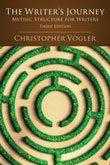
The Writer’s Journey: Start Here

Have you read this book?


You might not recognize the cover. I didn’t at first, because it doesn’t match my copy. Of course, mine is only the second edition. This one’s the THIRD edition. Christopher Vogler’s The Writer’s Journey is like the energizer bunny–it keeps getting printed and printed and printed…

There are plenty of reasons why. First, Vogler has a lot of important things to say. His book is based on Joseph Campbell’s ideas about the hero’s journey, the common storyline in so many myths. Vogler does NOT, as some people seem to fear, advocate writing from a template, a formula. What he does instead is analyze the common elements of all stories, in a way that makes us recognize the patterns and layers we’re all struggling to find in our books and bring to the surface. I have a very specific criteria for a “good” writing book, that I find myself putting it down before I reach the end and rushing back to my story to get all the new ideas onto the page. The Writer’s Journey more than qualifies.

The other big reason is more practical. Basically, if you want to have a discussion about plot, or character, this is your starting point. As an editor, when I talked with a client about what their hero was doing, what the other characters were up to, I’d inevitably find myself talking about Vogler’s book. I’d suggest that, even before they looked at my critique, they should probably pick up a copy of The Writer’s Journey and read it through. This book is also the basis of so many brainstorming sessions I have with my critique groups, whenever we get deep into what our hero is (or isn’t!) doing.  Teachers in writing classes point to Vogler’s book, and The Writer’s Journey is referenced in more other writing books than I have time to count. You need to know what all these people are talking about.

I’ll admit that Vogler hasn’t solved the problem of the story middle for me. And, these days, I’m also pushing Les Edgerton’s book Hooked as a must-read companion to The Writer’s Journey.  Edgerton builds on Vogler’s ideas, and really hits on the kinds of beginnings we need to be writing today. Still, I find myself going back to Vogler’s book time and time again, when I’m stuck, when I’m trying to figure out WHO my hero is and needs to be, when I’m just trying to get a closer look at the layers of my story.

Whether you’re just starting on your writing path, or you’re already treading strongly along it, I recommend dropping this book into your traveling pack.