Posted in Writing Books, Writing Tools

Reading for Writing: It’s Not Copying

Years ago, when I was working on a mystery novel, I read one of Lawrence Block’s writing books. (I can’t remember which it was, and, honestly, the list of his books is TOO long to go through right now!) The most important takeaway from that book, for me, was his instruction to pick a few of my favorite (as in, written well) mysteries, and plot them. I’m not getting this exact, because it has been a while, but the idea was basically to go through each chapter & write down the important turning points of the story.

To see how it was done. How it was done right.

In other words, read to find out what the hero did, what happened to the hero to get in their way, what events increased the tension, and how the story–with all its problems–resolved itself in the end.

I still do this, and not just with plot. I talked here about Sarah Ockler’s brilliant management of the passage of time, in Fixing Delilah, and–when I get to that stage of revision–I plan to study how she did it. What she did. It’s not copying, folks, it’s dissection. It’s finding the craft behind the art–a craft the writer may or may not be conscious of, but that I do believe is there, present, for us to find and learn from.

I find myself recommending this technique to editing clients all the time. I’ll do my best to explain how goals & obstacles create tension, how middle-grade voice differs from young-adult, how dialogue beats add to the layers of a conversation or argument. And then I’ll find myself typing this: “Go by the bookstore, or your library, and pick up some books.” I tell them to look at the books they love best, to scan the New Books shelves at the library, or ask the children’s librarian for help. Find a passage (or three) that does what they’re trying to accomplish…and read it. Then reread it. Then reread it again.

One of the “downsides” of doing a lot of critiquing is that, yes, I am more critical of the books I read. In my thirties, I pretty much finished every book I started, no matter what. Now, honestly, you have to catch me in the first two pages, and I will put down a book 3/4 of the way through if the characters or story are letting me down. (And, yes, I do take it that personally!)

BUT…the “upside” of that is that, when a book stuns me, and many do, I have a resource, a tool, for my own writing. My reading eye has sharpened enough so that, as I’m being carried away, a little voice inside is saying, “OMG. Look at that scene structure!” or “That hero is totally taking the lead!” or “Do you see how that dialogue is moving the story forward?!”

I know, weird. But helpful. And, honestly, I think the resource is there for all of us, even if we aren’t realizing it the first time through. It’s why I keep the books I do keep, even with continuously shrinking shelf space–because I will reread them, and I will learn from them.

And doing so will make my writing better.  This Lawrence Block says, and this I know.
Posted in Writing Books

Friday Five: Favorite Writing Books

I’ve written about some of these books here, but it felt like time to just toss up a list. As of today, and in no particular order, these are my top 5 books on the craft of writing. If you’ve got some other favorites, add them to the comments, where everybody can see!

I have to mention one other book, which I haven’t actually read yet, but which I have on order–after listening to Merrily Kutner explain the diagramming method for picture books that the author teaches.  I’m pretty sure I’m going to seriously love  Eve Heidi Bine-Stock’s How to Write a Children’s Picture Book, Volume I: Structure. I’m pretty sure I’m going to like Volumes II and III, too, but I’m going one at a time for now!

Posted in Form, Picture Books, Plot, Structure, Uncategorized, Writing Books

Form: Learning It

Years ago, I read a writing book by Lawrence Block. I’m pretty sure it was Writing the Novel: From Plot to Print. The advice I remember most from this book was that the best way to learn plot was to go out and plot a book. One you liked. By a good writer.

At the time I was working on a mystery novel (for grown-ups), and I did dig a few of my favorite mysteries off the shelf and re-read them and look for the big plot points. I probably didn’t go as far with this as I should have, but (in forgiving hindsight to myself) that book turned out to be the one that dragged on way too long and did nothing to make me happy, and I put it in a drawer when I made the jump to kids’ fiction. Someday, who knows…

Anyway, this week, I’m reading Anastasis Suen’s Picture Writing, and she’s basically giving me the same advice. In her book, she asks writers to storyboard out a few picture books–ones with strong characters. So I went to my shelf.

And just in case any of you are anywhere near being as much of a kids’ book addict as me, I’ll show you my list, so you can ooh and get all nostalgically syrupy for a moment.

Now, obviously, when I talk about form, I’m not talking about a formula. There is no formula, as much as we would sometimes like. But there is form. There is a common structure upon which every book in a genre is built–even if doing the building means taking the familiar shape and twisting or even breaking it.

An example: Suen talks about a big story problem, then three small problems that show the big one. One of the books–Bread and Jam for Frances did have the three problems, although I had to read pretty deeply to identify them to my satisfaction. Another book, though—Miss Spiders Tea Party uses eight small problems to illustrate what’s going wrong. And they both work. Between the identification of the big problem and the ending climax & resolution, the authors give the hero a strong or increasingly bad problems to deal with.

And–here was another fun difference. The Hobans and Kirk handled the last, most critical problem in two very different ways. Remember, this is the problem just before the Climax, so it has to be big, and it has to have impact. In Frances’ story, the Hobans deliver several scenes of Frances not getting any other food than her bread & jam. The authors took their time over the first two problems, but they deliver these scenes in quick succession, not giving Frances–or us–any time to recover between them.

Kirk has taken the opposite route. He gives the first seven problems a two-page spread each (one page of verse & one full-page illustration). The last problem, though, he spreads out over eight pages (four verse and four illustrated). He’s drawing out the problem, raising and dropping Miss Spider’s hopes, and seriously increasing the tension…again, to get us to the climax.

Now, I would never say that writing a picture book is easier than writing a novel. In fact, I’m pretty sure it’s harder, & you’ll probably hear me say that plenty of times in the next year or ten.  But…it is, I think, an easier form to study in this way–simply because there are fewer words in which to hunt for the structure.

Why am I doing this? For the same reason we should all be doing it in whatever genre we’re writing. No, we’re not out to learn that mythic formula. No, we’re not out to play “Copycat the Rich & Famous.”

We’re out to learn everything we can about the form we’re writing. We’re out to make our own books in that form the best that we can.

Posted in Character, Heroes, Somebody Else Says, Writing Books

Somebody Else Says: Nathan Bransford (and Me) on Redeemability

Okay, I know it’s starting to feel like this is a bit of a cheating week for me. First, I the WONDERFUL and BRILLIANT Shrinking Violets guest post for me. (I know how much you all loved that, though, so no guilt here!). Then I resort to a visual image, no words, about my workday, and I didn’t even find that image myself–Nastassja Mills did! And now, I’m sending you over to read Nathan Bransford’s blog.

Still, no guilt. Because Nathan is always worth listening to, and also because I am going to throw my own two cents into the pot here. Nathan’s basically talking about how to make it work that your hero does something horrible or has a pretty nasty flaw. And his basic idea–although he says it much better and in more detail, so you MUST go read the post–is that you do this by redeeming your hero.

What I started thinking about, though, as I read the post is that this implies another need, perhaps. And that would be the need to have our hero do something “bad” to start with. Yes, I’m still buried in Donald Maass’ workbook and theories, but this seems to me to fall under that big umbrella of pushing our heroes past our their limits.

I am having the sense as I think about my fiction WIP and draft out a few early scenes that I’m making my hero pretty darned, well…heroic. That’s okay. In fact, that’s good. Some pretty nasty things happen to her, and she’s going to have to be strong, or to repeat the highest praise I’ve ever heard about any heroine from literaticatkick-ass. But…

She can’t be Wonder Woman. (For one thing, the story is set in Chicago, 1913–in MARCH, and that outfit would be completely inappropriate.)

One of my goal for this character is to find out what she does wrong. It has to, I think, be a necessary wrong and one that is ultimately a critical part of her quest and growth, but it does have to be bad.

What about your heroes? Do they wear cloaks because they’re hiding something? What’s really under that mask? How bad can you make them? And how will you, as Nathan says, redeem them?

Posted in Blog Contest, Writing Books

Book Review AND Contest: Writing the Breakout Novel

This week, I’ve been reading Donald Maass’ book Writing the Breakout NovelI just finished skimming through the last few chapters, which provide a sort of overview about some specific plot styles, theme, and a bit about publishing.  Since I’m getting ready to dig into plotting a first draft of my WIP, I was more interested in the material about crafting and writing that draft.

And I got plenty of that in the last few days.  True confession time: I tried to read Maass’ book a couple of years ago, and it just didn’t get me. I was actually annoyed by what I thought he was saying, and frustrated with his perspective that his was the absolutely right way to do things.

When I picked up the book last week, to try again, I felt like someone had substitutedcompletely new, different pages. This time around, I was slapping myself on the forehead, shouting “Duh!” and agreeing with everything Maass says.

I’m pretty sure that, last time, it was me, not the book–where I was with my writing and the project I was working on.

This next book that I’m starting has the potential for all the things Maasstalks about: plausibility, inherent conflict, originality, and gut emotional appeal. It’s the potential part, though, that I’m welcoming Maass’ help with. Because, in the book, he talks not only about how important all these element are, but HOW you can get them into your story. He hands out questions to ask about our books, what to do when we don’t find the answers we want (or any answers at all!), and techniques for basically deepening every piece of your story.

Maass talks about characters and tension and subplots–all the things that, when done well enough, give your story the layers it needs to catch the reader and keep them hooked–to the very end. He shows you why NOT pushing yourself doesn’t work, not for this particular story or for your writing skills.

When I first dipped into this book, I thought Maass’ angle was all on the selling success of the book. Again–what was I reading? He emphasizes over and over again how his advice and information are about the craft, and he’s right. Yes, he thinks following this advice will give a writer more chance of “breaking out,” whether that means selling more copies of a book than ever before, hitting the NY Times bestseller list, or simply succeeding in making an agent love your project. He doesn’t make any guarantees, though, and he wants us to try his techniques because we love writing and because we want to be better at it.

He’s got me pegged.

How about you? I haven’t run a contest yet at this blog, and today seems the place to start.  It’s Martin Luther King Jr’s birthday, a time for giving and support. And tomorrow the whole country starts off in a new direction, on a strong, hopeful path. I want to celebrate.

So…leave me a comment about this post, between now and end-of-day Monday, January 26th. I’ll draw a name on Tuesday, and the winner will get their choice–a copy of Writing the Breakout Novel OR Writing the Breakout Novel Workbook, also by Maass. I’ll be buying my own copy this week! 🙂

Posted in Books, Publishing, Somebody Else Says, The Writing Path, Writing Books, Writing Goals

Somebody Else Says: Jane Lindskold

I was going to put up this great, maybe-even-profound blog about…blogging first thing this week. Then I read this post by Jane Lindskold at Tor.com and thought it was a good one to share. We can all use more info about What Happens After the Book is Written. Hop over and have a read.

Thanks to Nathan Bransford for the link.

See you in a few days for that brilliantpost on blogs!

Posted in Revising, The Beginning, Writing Books

Les Edgerton’s Hooked

Back in October, I talked about The Writer’s Journey, by Christopher Vogler. In that post, I mentioned Les Edgerton’s book Hooked: Write Fiction That Grabs Readers at Page One & Never Lets Them Go. I said I’d talk more about Edgerton’s book in another post.

So here we are.

With November and NaNoWriMo ending, and the new year heading our way fast, I thought this would be a good time to pick up this thread. Revision is, in a big part, about structure–about what happens when and which scenes go where. Edgerton’s book is solely and completely about the beginnings of a story, but (pardon the pun) that seems as good a place as any to start.

Edgerton talks about a lot of the same things Vogler does—at least in terms of the early part of the hero’s journey. Edgerton may not call everything by the same names, but in his chapters, you’ll find the ordinary world, the inciting incident, the threshold, etc. The big difference, though, between the two books is Edgerton’s emphasis on how quickly we, as writers, have to get those starting points onto the page.

I write fiction for kids–middle-grade and YA readers. These readers are not known for their patience with authors. You can blame it on action movies and video games, or you can credit these kids with the sense and intelligence to recognize and appreciate a tight, fast-moving opener. As someone who, in the past ten years went from reading (and loving) 700-page Victorian novels to devouring 250-page tense and terse, funny and furious YA books—I can say the decade has been a good education in writing.

Because it’s not just kids’ books that move more quickly today; it’s all books. At first, when you realize just how much Edgerton is asking you to do in the first chapter, first scene, first page, first paragraph, it’s intimidating. And part of your brain may go into the “I don’t have to” whine. But keep reading. And go back to the books you’ve lost most in the past couple of years. You’ll see that he’s right.

It’s not just that we’re told over and over that agents, if we’re lucky, read the first five pages. It’s not just that we know most book buyers skim the first page, maybe the last, then make their decision about whether to buy that book or leave it on the shelf where they found it. It’s that, these days, a good story sucks us in from Page 1, hooks us, and goes racing along so quickly that we have to grab on and ride, just to keep up.

This is the kind of story I want to be writing.

Thankfully, Edgerton doesn’t just point out the necessity of this kind of beginning. He gives thorough, detailed information about the big pieces of this skinny little beginning, and he follows up with seriously helpful (and funny) instructions for how to put those pieces together.

If you haven’t read Hooked, take a look. Especially, if you’re looking at a revision, post-NaNo or not, take a look. I think you’ll be glad.

And don’t forget to check out Martha Alderson’s blog, Plot Whisperer for Writers and Readers, all through the month of December, for tips on plotting out your revision. Martha will be guest-blogging here, too, soon!

Posted in Uncategorized, Writing Books

The Writer’s Journey: Start Here

Have you read this book?


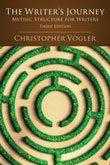
You might not recognize the cover. I didn’t at first, because it doesn’t match my copy. Of course, mine is only the second edition. This one’s the THIRD edition. Christopher Vogler’s The Writer’s Journey is like the energizer bunny–it keeps getting printed and printed and printed…

There are plenty of reasons why. First, Vogler has a lot of important things to say. His book is based on Joseph Campbell’s ideas about the hero’s journey, the common storyline in so many myths. Vogler does NOT, as some people seem to fear, advocate writing from a template, a formula. What he does instead is analyze the common elements of all stories, in a way that makes us recognize the patterns and layers we’re all struggling to find in our books and bring to the surface. I have a very specific criteria for a “good” writing book, that I find myself putting it down before I reach the end and rushing back to my story to get all the new ideas onto the page. The Writer’s Journey more than qualifies.

The other big reason is more practical. Basically, if you want to have a discussion about plot, or character, this is your starting point. As an editor, when I talked with a client about what their hero was doing, what the other characters were up to, I’d inevitably find myself talking about Vogler’s book. I’d suggest that, even before they looked at my critique, they should probably pick up a copy of The Writer’s Journey and read it through. This book is also the basis of so many brainstorming sessions I have with my critique groups, whenever we get deep into what our hero is (or isn’t!) doing.  Teachers in writing classes point to Vogler’s book, and The Writer’s Journey is referenced in more other writing books than I have time to count. You need to know what all these people are talking about.

I’ll admit that Vogler hasn’t solved the problem of the story middle for me. And, these days, I’m also pushing Les Edgerton’s book Hooked as a must-read companion to The Writer’s Journey.  Edgerton builds on Vogler’s ideas, and really hits on the kinds of beginnings we need to be writing today. Still, I find myself going back to Vogler’s book time and time again, when I’m stuck, when I’m trying to figure out WHO my hero is and needs to be, when I’m just trying to get a closer look at the layers of my story.

Whether you’re just starting on your writing path, or you’re already treading strongly along it, I recommend dropping this book into your traveling pack.