Posted in Uncategorized

Around the Blogosphere: Who’s Got their Blogging Cap On?

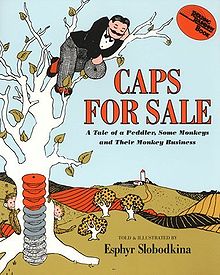
Anyone remember the book Caps for Sale?

One of my all-time favorites. I’m trying to remember back to when I was a kid, but I think I related to both the monkeys (I mean, how could you resist?) and to the peddler (SO frustrating!). And I do remember thinking…All those caps! On ONE head!

Well, this month, I’m mostly relating to the peddlar. Not with the frustration, but with all those caps! With high school starting, I’ve been wearing my mom cap a lot (although very subtly and sneakily, I assure you). I’ve been doing more critiquing for clients–so there’s an editor cap. Got the house tidy for my parents’ visit–that’s a housekeeping and daughter cap. Baking cap goes on later today to make my husband’s birthday cake. And I’m prepping for the Central Coast Writers Conference next week–look at that sparkly speaker hat.

I’m having fun with all of it, but I seem to have misplaced my blogger cap for a bit. *Checks behind computer–nope* So…I’m going to look around the blogs & share what some other cap-wearers are up to!

Enjoy your week. And I’ll keep looking for the monkey who stole that blog cap.


Posted in Uncategorized

Monday Musings

Here’s what I’m thinking about as the week starts:

1. There will be a pattern to this thing called high school. I just have to wait a bit to see what that pattern is. Really.

2. Guinness Chocolate Cake for my husband’s birthday. Thanks to Janet Rudolph for bringing it to my attention.

3. There is something happening with this new semi-not-really-vegan eating thing I’m doing. And that something actually seems to be healthy and good, even if it makes no sense to my brain.

4. Windsor Castle tea is okay, but when my Yorkshire Breakfast shows up, I’m totally mixing the two together.

5. Escapist fiction has a serious purpose in life–relaxation, fun, getting you and your son and your husband out of YOUR OWN HEADS. See Eric Flint’s 1632 series for clarification.

6. Context and connection is really important when you’re writing history . Otherwise, I have to work really hard to figure out that context and make those connections, and–you know–I just end up falling asleep on the couch. (This is not related to the alternate history of 1632, see item 5.)

7. It’s really fun to say to your teenage son, “Yes, you can have friends over this weekend. I’m open. So, hey, you go schedule it all!”

8. I’m starting to want a kitten. I thought this wasn’t supposed to happen for another four years, to coincide with son’s departure to college. I  blame Carrie Jones.

9. I am not happy with what the clothing stores are telling me I should be wearing these days. It’s almost enough to make me start sewing again. You know, if I didn’t absolutely hate sewing.

10. Five days till the weekend! Have a great week. 🙂

Posted in Uncategorized

Anticipation, or In It for the Long Run

I was mulling over this post, and then I came across Shawna’s post at Just Another Day in the Life, on the waiting that is such a part of the publication (or getting-to-publication) process. It says some of what I was already thinking, and I thought I’d add my tweak to the discussion.

Just so you know, this is a realization post, not (as much as it might sound like one) a whine post.

After getting a good way into the synopsis I’ve been working on, I read a bit further into the SCBWI grant information (and, yes, I should have done this sooner; but, no, I didn’t; and, anyway, I got a lot of good information and push out of the work I did do. So.). And it turns out I’m just not far enough along in this manuscript to apply for the grant. Don’t worry, I know there’s a YET in that sentence, and I’m certainly not ruling out the possibility of submitting for another year.

Anyway, I admit, I did have a few hours of “funk” when I first figured this out, but then, you know, my copy of the Writer’s Digest magazine article in it showed up, and life was pretty good again. Still, it all got me thinking.

And I realized that, while I drink hardly any caffeine and don’t ingest any other form of stimulant (other than an occasional decongestant!), I still may have a bit of adrenaline junkie-itis in my make-up. As in, one of the reasons it felt good to think about applying for the grant and one of the reasons I hit a funk, was that not applying meant I don’t have anything big and exciting to anticipate in the near future, not in terms of that journey to fiction publication that Shawna’s talking about.

I may be one of the few people I know who likes the querying process. When I was submitting for my MG mystery, I always made sure I had a few letters in the queue, because I loved the feeling of knowing something of mine was out there and of hoping that maybe, just maybe, it would open a door. No, I don’t love the rejection process; although, yes, nice/complimentary rejection letters can and do make me feel pretty good. But I do love the hope, the chance that when you open your email in the morning, or when you answer the phone, there just might be balloons and confetti waiting for you.

No, I didn’t really expect the balloons for the grant app, but I guess, without realizing it, I was looking forward to what I will now officially call the “possibility high.”

A few years ago, the funk would have been a lot bigger. I think I’ve gotten better at the waiting, and I certainly have lots to be doing during this period–again, like Shawna recommends. Part of this comes from the reassurance that I have, for the first time in my life, plenty of story ideas percolating in files & in my brain. Another part comes from working on a historical novel, I think, and facing the fact that research adds time–TIME–to the writing process, and that there is no cutting corners on it. I also think, though, that a big part of the understanding comes from spending time online, listening to other writers stories, paying attention to what agents and editors are saying, and just hearing that, yes, this is the way it goes. So…thank you, all.

We have to remember, guys, that we’re in this for the long run. We’re writing because we have stories to tell and because, as hard as it can be, there is nothing…nothing “like simply messing about” with words.

Guess I’ll just have to get my adrenaline fix somewhere else.

What?! I meant, watch. Do you think I’m insane?!

Posted in Uncategorized

HF: WAR GAMES—Weaving History into the Child or Teen’s Story

Every now and then, I review a book here that has really caught me, either emotionally or because of some element of its craft, something the author has done particularly well, at least in my opinion. I’m trying to read a lot of teen historical fiction these days, be it middle-grade or YA, and I’m trying to learn from those books–from the way the author approaches some element of writing in this genre. Getting my general impressions down in more specific words & sentences helps me hone in what about the book impressed me. And, lucky you, I’ll be doing that processing here. 🙂 I wouldn’t call this a regular thread, but if you see a blog post that starts with HF, you’ll at least know that’s what’s coming.

I just finished War Games by Audrey Couloumbis and Akila Couloumbis. It’s an excellent book, showing me a world I knew nothing about–WWII Greece–and beautifully showing it through the eyes of a young boy.

What absolutely hooked me about this story is how well the authors wove the war into the opening chapters, when the Germans hadn’t yet come to the town of Amphissa, when the people there had gotten used, in some way, to living with the Italian soldiers, and when boys could still argue over marbles and worry about getting scolded for trading away the wrong goat.

I’ve been worrying musing about how to accomplish this very feat, in my WIP–how to weave the bigger, problem world into the opening, when the MC is still totally wrapped up in her own personal time and space. I’ve been thinking that I can’t just drop the big problems in when they get big, that I have to seed what’s coming, without waving the big red flag labeled IMPORTANT FORESHADOWING HERE.

So you can bet, as I was reading the opening chapters of War Games and saw what the Couloumbises were doing, that I was running for the pen and sticky notes. I’m going to break down some of the opening here, but, believe me, there will be no spoilers!

Chapter 2 is completely taken up with a bet that Petros and his older brother Zola have about who can shoot more birds. The focus is tight and narrow, on the boys, their bet, their arguing, and the third corner that is added to the triangle when their cousin Stavros shows up. There is no hint of war, of danger, but at the end the author seeds the bigger tension by having Stavros kill a swallow–an act known to bring bad luck.

Chapter 2 brings the fact of the war, with a moment when Petros thinks about the drachmas under his father’s bed and how, since Greece surrendered to the Germans, drachmas are worth nothing and people are now trading instead of paying money for goods. The rest of the chapter is mostly taken up with Papa telling Petros to take their biggest male goat to trade for his uncle’s biggest female, so their family can have the milk. Petros, knowing his uncle will not cook a goat, takes the smaller one–his favorite, the one he wants to keep alive.  Along the way, he talks to some Italian soldiers, cautious but without real fear, as they casually lay about in the countryside. The soldiers joke with him, but they do not answer his questions about when the Germans will come. With about two lines of dialogue, the authors establish that while, right now, life is not so bad for Petros, there is a worry–and a little excitement–lurking in the background.

This is the way of the next few chapters. We stay in Petros’ world, in the scolding he almost gets about the goat, in the chores he does, in the bickering between the boys. All along, we get trickles of curiosity, anticipation, of parental concern, over whether or not the Germans will come to their town, of what trouble that will mean. The authors give us just enough information so that we know something is coming, but also takes the time to really immerse us in Petros, his personal hopes and problems–for this time, at least, separate from the war.

And then with one big crash, Stavros’ brother, Lambros, is home from fighting in the Greek army, bearing wounds and the news that the Germans are mere days behind him. At this point, the authors flip everything–from now on, the war and its immediate consequences for Petros’ family are in the spotlight, while Petros’ specific goals and actions weave through as the thread that keeps everything connected to him, and for us.

I know this is only one technique for writing historical fiction, but I also know it worked really well in this book. So…the lesson learned, I think, is that if we really establish our MC at the beginning, then when things erupt, their strength as a character will keep the reader caring, even as history and its more global problems take over. We have to take care not to overwhelm the opening with history, but do need to show how it touches, intersects with, the smaller place where the MC lives. And we must make sure that, whenever history takes dominance, the hero’s character arc is the path our readers follow through it.

Once again, folks, it’s about balance.
Posted in Uncategorized

Comparisons: A Small Rant

People, people, people.

I am glad you all love Mockingjay. I’m happy you’ve been able to immerse yourselves in it over the past day or two. I’m thrilled that it seems to be proving all you wanted. Full disclosure: I haven’t read it yet, but I will, and when I get there, I’m pretty sure I’ll be seriously impressed as well.

BUT…

Please don’t compare yourself as a writer, as a not-as-good writer, as a writer-who-will-never-write-this-well. I don’t know Suzanne Collins personally, but I am willing to bet this was NOT HER GOAL when she wrote her trilogy. Really.

Okay, not everybody’s doing this. But I’ve read a few posts on Facebook and Twitter, though, and probably you’re half-joking, at least. I hope. Because comparisons stink. They make you feel bad about yourself, with no reason. No, I can’t tell you you’re wrong. In many ways, you’re right. Suzanne Collins has written a wonderful book, one you will not write yourself. I won’t write it, either. I also won’t write The Princess Diaries, My Father’s Dragon, Zen and the Art of Faking It, Donuthead, or Wuthering Heights.

Thank goodness someone already did.

Because these are some of the stories that made me fall in love with books, and keep me there. They’re the reason I write.

I know you guys don’t really mean it. I know you’re in love with Suzanne Collins’ stories and are happy, SO happy, that she’s given them to us. I wince, though, every time I read a post saying one of you will never be this kind of writer. I want to hug you, to tell you it’ll be okay, and then–honestly–to throw a pillow at you (a soft, feathery one, but still…).

YOU’RE WRITING. You’re doing wonderful things, putting together beautiful (okay, and not so beautiful) combinations of words that nobody has created before you. You’re telling your story, the best you can…and that’s HUGE!

Remember that, okay?


Posted in Uncategorized

In Which I Try to Tie Life to Writing…At Least for this Post

Today, bright and EARLY, I drove my son down to the high school to pick up his class schedule. He worked his way easily through the combination assembly-line, processing center (his description), while I waited in the parking lot (with Meg Cabot’s Insatiable for my reading pleasure).

We’re at a milestone here, of some sort. Oddly enough, things feel pretty calm and seem to be flowing easily toward next week, when school actually starts. I’m pretty sure we’re not just in the eye before the storm, that my son is ready for the next step and, I guess, so am I. The next few years are obviously going to be about letting go, and I think we’re at the right place to start doing that.

I’m writing about a hero whose mother can’t let go–can’t let go of who she thinks her daughter should be, of who she needs her daughter to be, for her own sanity. And it’s not going to end prettily, I can tell you that.

And I’m trying to be a writer who can and does let go of her characters. It’s starting to happen, where Caro will take over a scene and suddenly start talking to another character, or she’ll make a decision without consulting me and get a scene going in a direction I didn’t expect. And I’m working hard to go with this, to go where she’s telling me. It’s pretty clear there’s no point in arguing.

Does this mean I won’t argue with my son in the next few years?

Yeah, right. Does the sentence “Get out of bed now, or you’ll be late!” mean anything to you? (Other than being a direct quotation of my mother’s words, every morning, 30+ years ago?)

But…I will have to keep my mouth closed more often. I will have to listen and watch a lot more. I’ll be making fewer of the decisions and sort of just “being there” for the consequences, good and bad. Hopefully, mostly good. (As opposed to Caro’s story, where they’d better lean heavily on the bad side.)

Milestones. So much more complicated than plot points, you know?

What’s changing for you this year? What changes do you plan for your characters? Happy writing through all of it!

Posted in Uncategorized

Synopsis: What I’ve Learned So Far

I spent the weekend working on the first draft of my synopsis for my online class. I’m very happy with the class and the teacher, so, for those of you who were wondering, it’s Teresa  Bodwell’s “Developing the Selling Query Letter and Synopsis,” offered through Savvy Authors.

Carolyn Donnell, a fellow member of the South Bay CWC club, asked me if I was going to blog about writing a synopsis. My first reaction was that, as I said, I was taking the class because I didn’t know how to write one! Then I started thinking and writing and, of course, came up with a few things that are working for me, so…time to share.

Just remember, these are random things I’ve tried, I’ve done, or I’ve thought about as I wrote this weekend. These are not in any order, or intended in any way as a lesson. And, fair warning, this post gets fairly long. Even for me. My recommendation: TAKE A CLASS! A fairly quick one, like Teresa’s, so those deadlines are actually real motivators, and push yourself to go through the steps. I’m not going to end up with a finished product after this, but I will definitely be ready to take what I’ve got and send it through my critique group a few times until it is polished and ready.

Here’s what I played with/learned so far:

  • Write a pitch paragraph first, as if you need that query letter today. Even if you don’t. The class had us write a query letter, and I basically used the one that’s been relatively successful for me in the past, but–obviously–I had to come up with a totally new pitch. It helped to remind me where I need the power and conflict to be in the story, even if it’s not there yet. Which it’s not. Yet.
  • Collect your building blocks. If you don’t have them yet, get out the table saw and the paint and make them. I used this post from Helene Boudreau to get started collecting plot points, then added to those with the chapter on “Dissecting the Synopsis” in Elizabeth Lyon’s The Sell Your Novel Toolkit and the article recommended in the class–Lori Devoti’s “Plotting and Synopsis Point by Point.” (Go to her website and you’ll find it here, in her writing articles.)
    Both Lyon and Devoti base their tools on the hero’s journey, which is a good way, I think, to keep tension and rising conflict in mind as you’re plotting/synopsizing.)
  • Track your characters. So far, in my first draft, the middle is pretty muddy, especially when it comes to what everybody’s doing to make Caro’s life harder and what she’s doing in reaction. So I knew I needed to work on that, or the synopsis was going to turn out just as vague and wishy-washy. NOT my objective here. The only way I know to do this kind of plotting is to keep going back to your main characters and thinking of SOMETHING they can do to impact your MC’s life, to create an obstacle. And it has to be something specific, something concrete that can turn into an action–a real plot point.
  • Keep thinking about cause and effect. I really think this is what drives a synopsis. (Yes, okay, it’s what drives the story, too, but it’s still the first draft, okay? Sheesh!) So in my table, where I was throwing in the actions of the characters, I added a column to show what Caro would do in response to each of the problems/obstacles someone else was creating. Funny enough, a lot of those responses were things she is already doing in the book; it’s just that so far, she’s sort of doing it all for no real reason except I tell her to. Now, I think, I’m a lot closer to the causes that create the effects.
  • Pile on the problems. I think we all have a tendency to back away from complications, which is–of course–the exact opposite of what we need to do for our stories. This was the chance, for me, to make things worse and worse for Caro, without letting myself think too much about the fact that, eventually, I’ll have to write these things!
  • One of the things they tell you about formatting a synopsis is that the first time you write a character’s name, you should put it in all caps. They also tell you not to use a character’s name unless they’re really important to the plot. Well, as I worked, it seemed obvious that if I mentioned a character twice, it was much simpler (and made the writing cleaner) to just give them a name. And, guess what, if I wasn’t going to mention them twice (as in 1) they cause a problem and 2) Caro has to deal with/resolve the problem at a later point), then they probably weren’t important enough to the plot to be in the synopsis. I actually “killed off” one, maybe two characters, in the story, just by seeing that they create no situation for Caro to follow through on.
  • As you start writing the actual synopsis, put your hero in the forefront of your brain as the one in charge, the one directing/causing the action and keep her there. If you start a sentence with the action of another character, make sure that your MC shows up quickly in that paragraph, as reacting to that action. Your hero has to drive the synopsis–those agents and editors want to know that she is powerful and strong and capable of taking on all these people and beating them. Yes, of course, she has to hit bad spots; she has to make mistakes and learn from them, but she also has to be acting constantly. If she’s not doing that in your synopsis, they’re going to have a hard time believing she’ll do it in your book.
  • Don’t worry about length. Not yet. I’m writing this synopsis for the SCBWI WIP grant, which requires a synopsis of no more than 750 words. Right now, mine is somewhere between 800 and 900 words. Okay, I can trim. I will trim. But first I need to get the darned thing written. I need to submit it to the class and find out what’s confusing, what’s weak, what’s too crowded. I need to rewrite it and send it through my critique group several times. (Head’s up, guys, it’ll be in your laps soon!) And then, yes, I’ll trim. If you’re shooting for a 3-page synopsis, and you end up with a page to start, great! Layer in a couple more important plot points, add layers to your hero’s conflict, check if anyone’s subplot really is critical to the story. Just don’t check the word count while you’re writing the first draft. Later, dudes, later.
  • Jump around. Normally, I’m a huge advocate of NOT revising while you write. For me, though, I found that it helped to go back and forth between the earlier sections of the synopsis and the later ones. As I got closer to the end of the middle, to the crisis and climax, I would find myself adding a character or an important plot point and realize that was the first time I was mentioning them. In other words, I hadn’t seeded the problem, hadn’t introduced a character that was turning out to be important. So I’d back up, find a place I THOUGHT might be an okay place to weave in an early mention, and I’d drop something into the paragraph. And, yes, when I went back for a quick re-read before submitting the synopsis to the class, I moved a few things around. But I could do that, because they were there. You have to get all the puzzle pieces on the table, face up, before you can figure out what to do with them.

So there you have it. A long, overly detailed, slightly chaotic synopsis “lesson.” The most important thing that I got out of this exercise, besides–yes, a decent first draft–was the realization that this is another one of those places we have to push ourselves. Consolidating an entire story, especially one you don’t fully know, is hard. Intimidating. SCARY. And….? It’s the time to tell yourself, “So what?” How badly do you want to make trips to Chicago for research? How much do you want to be able to shut yourself into museums and libraries, to walk around neighborhoods, to talk to experts? How great would it be to get a grant that would make all this easier? And, bottom line–how badly do you want to figure out your plot and write a story with power.

Yeah, pretty badly.

I told myself that I would take this class, write this synopsis, not just because of the grant, but also because it would help me move forward on this book, help me get a tighter plot before I started revising (which is maybe a dozen more 1st-draft scenes away?). And guess what…I was actually telling myself the truth! I am so happy with all the plot points I came up with, the connections I saw, and the force that my MC is becoming. The story is actually starting to make sense.

What about you? Do you write a synopsis before an agent/editor asks you for one? At what stage/draft do you find it the most helpful? And what does it do for you, for your vision of the story?

Posted in Uncategorized

Friday Five: Chit-Chat around the Blogosphere

For today, I’m sending you away, to a few fun posts that caught my eye recently. You know, from other people! Enjoy.

  • I love this comparison from Jan Gangsei about the similarities between middle-age and the middle-grades:
    The View from the Middle
  • My friend and critique partner, Terri Thayer, talks about her latest vacation/family reunion and the magic of cousinhood:
    Family Fun
  • Jenni Bielicki and Stacia Deutsch are doing the Avon Walk for Breast Cancer and their team, Critters against Cancer, are holding an auction to raise money for the cause. I’ll be contributing a critique and a copy of my book. Check it out here:
    Critters against Cancer
  • Anna Elliott talks about stretching ourselves into the areas we think we can’t go:
    A Funeral of the I Can’ts
  • Jama Rattigan’s blog almost always makes me hungry. (Not to mention making me yearn for a few teddy bears to hug!). If you haven’t discovered her yet, this post on the victory of macarons over cupcakes is a beautiful place to get started. I’ve been trying to think of an Occasion coming up, just so I can order a box.
    Macarons: Love at First Bite

Happy Friday, and have a wonderful weekend.

Posted in Uncategorized

Thankful Thursday: What a Summer

School starts for us (okay, for my son!) in a week and a half. I guess this is pretty late, since so many kids around us, geographically and virtually, have already gone back. Considering that we’re still socked in with fog every morning, and I’m taking a sweatshirt outside for exercise in the late afternoons….well, it doesn’t quite feel like the end of summer.

Oh, I’m ready. And I think my son is, too, as much as a teen can be ready for school to start. But here’s the thing–it’s been an incredible summer. The best I can remember for a loooooooong time.

Now, honestly, I have to give some major credit to the thyroid meds I started taking a year or so ago that seem to have finally kicked in to really give me back the energy I lost somewhere along the way. Quick “sell”: Ladies, if you’re thinking your thyroid might be low, check it out. And be aware that the numbers stated as “okay” aren’t always, that–as my wonderful doctor says–“Different people feel right at different numbers,” and really talk to your doctor about what’s going on. I am a total and complete convert.

Okay, off the med-sell. Basically, I just seem to be at a point in my life where things are coming together. My son has had a good summer too–with all the laziness and creativity and random this-and-thats a kid’s summer should have, I think. Sure, there’s been some boredom, but when I’ve checked in with him, he’s said that that’s a part of how he wants his summer to be. So, okay, then. He’s been doing the teen sleep-in which, combined with my new ability (see above) to wake up happily at six-ish, has meant incredibly productive mornings for me. And then there was the non-heat, which means I’m actually happily functional for walks or board games or necessary errands in the afternoon.

The thing is, I’ve hit some kind of balance between work and, well…life. Even, it seems, between fiction writing and other writing, critiquing, and marketing. So I’m able to enjoy all of them and see the progress that’s happening in most of them.

Will this last? Well, I certainly hope so. I know, though, that life is ups and downs, twists and turns. My son is starting high school in 12 days–which puts us all into a new world. I’ll be doing more speaking and traveling next year. I’ve got to take on a few new things to do with running the business of this writing thing. And there’s a second draft coming sometime in the nearish future. So change is coming, and any one part of it could tip the scales.

But I’m learning, I think, to choose what to add and to be able to merge the new into the old. Somewhere in the last couple of years, I hit the middle-aged mark (calculated, of course, with the base of my grandmother’s ages, who both lived into their nineties, and adding a few more years for generational increase!), and I have to tell you, it’s a pretty good place to be. I’ll write about teens and love it, but I’m not looking for that time-travel machine to take me back there and do it again. (Picture Bill Murray in Groundhog day, but with 15-year-old angst and knowing he’d never get Andie McDowell.)

Summer, for me, used to be the hardest challenge of the year, a time when I felt hard-pressed to find anytime for myself and guilty about feeling that way. It’s gotten easier, of course, the older my son got, but this year, I swear I heard the CLICK of everything coming together. It was a lovely sound.

So, today, I am thankful for a summer that gave me back the ease of vacation, the pleasure of enjoying time off, and a vision of possibilities for the future. And a path into autumn, my favorite season, that isn’t built simply on relief.

Happy Thursday to you all.