Posted in Uncategorized

Five Things I Learned at Work this Week

Okay, honestly, two weeks–my first two weeks on the new development/grant-writing job.

  1. When you’re “of a certain age,” the best desk chair is the one that makes you sit up straight.
  2. Budgeting can actually be fun, when you’ve got a workshop teacher who sees said budgets as “telling a story.”
  3. A seven-minute commute is just as stupendously fantastic as you predicted it would be.
  4. Your teenage son can (totally and easily) survive fewer hours of your scintillating presence than he is used to being tortured graced with.
  5. New [people, places, tasks: take your pick!] shake up and wake up your brain.

Here’s to change–the good kind, anyway!

Posted in Uncategorized

Critique Comments: Remembering to Give them Time

Yes, I’ve written about receiving a critique. I’ve spoken to groups about receiving a critique. I’ve received critiques. Time and time again. You’d think I would remember, right up at the front of my writing and revising brain, the most important parts of the process.

Oh, if only I were that good.

Here’s the rule: Don’t always assume your initial reaction to a critique comment is going to be your final reaction. Or even just your second and third. So, so often, feedback from one of your critique partners makes you shake your head vehemently (to yourself, of course!) and scream a silent, internal, “No!” They suggest a character or plot change, a major shift in voice, and all you can think is how wrong they are. How absolutely crazy wrong.

Um…

Don’t lock the door on that belief. Don’t drop it into a pile of wet concrete and let everything harden around it. Because, odds are, you’re going to get to a point in revision where you want to take it out again and look at it. Closely.

It happened to me (again!) last week. I’d had a critique session on a new picture book, and one of my wonderful critique partner had talked about getting the action to more fully and accurately bring out the theme of the story. Now, it’s just possible that, in all our years of critiquing together, I may actually have never mentioned my aversion to the word theme. Yes, I know it’s important. Yes, I know stories have them. Yes, I know it’s something I should be at least understanding about my writing, even as I carefully work not to hit the reader over the head with whatever it might be for any particular book.

That doesn’t mean I have to like it.

Anyway, so of course, unbeknownst to my critique partner, my hackles were up at the first sound of the word. Which may have had something to do with my initial (internal!) reaction to her description of what the theme was in the picture book.

Critique Partner: So the theme is …..

Becky: The theme is SO NOT….!!!!

Hopefully, I kept my face blank and/or semi-smiling so she didn’t get the full blast of that response.

Anyway, you can see where this story is going. I sat down over the weekend and did my usual first step of revision: reread the critique comments. When I got to this critique partner’s notes about the theme, I was still shaking my head, but it was a milder shaking–with a bit of an amused and tolerant smile as accompaniment. Hey! You’re going to have these feelings. You’re going to turn into an intolerant, conceited, patronizing jerk when you get feedback, and it’s okay…as long as you do it in private! It’s a defense mechanism, we all have them, and they need to be let out occasionally–off-leash–or they get really cranky.

So I put the comment aside, and I started thinking through the other problems I knew were there, as well as the other more head-nod-provoking suggestions from this critique partner and the others. And pretty soon, I was doing what all good critiquers get their pet authors to do: asking myself questions about the story. Questions like: How can my little hero direct more of the action? Why does that secondary character react differently to him than everyone else does? What is that other guy’s problem, and what is he afraid of?

And pretty soon, despite (or probably because of) that one comment about theme, my brain circled back to it–this story’s theme. With a slightly different take at first, but one that, ultimately and totally connected up with the original definition from my crit partner.

What did I do?

  1. I sighed.
  2. I thunked my head a few times on my desk.
  3. I posted a paean of gratitude (AKA a buried apology) to my critique partner on Facebook.
  4. I took more notes about the new (and better) revision path.

The moral, once again, is sometimes your gut reaction is not the best one to follow for your writing. Yes, trust yourself. Yes, value your own experience with and understanding of your story. But listen to the people who have come from outside your story to read it and help you with it. Whether it’s the newness of an idea, the shock to the system of a direction so totally different from where we thought we were going, or even just an irrational fight-or-flight response to something we’re not sure we can handle…there are lots of reasons we react negatively to critique feedback.

And, believe me, there are lots of reasons to take a second look.
Posted in Uncategorized

And the Writing Path Takes Another Curve

I’ve actually known this curve was coming, for, oh….more than ten years. This is the curve I promised myself all that time ago, when it made sense–sanity-wise–for me to stop working as a tech writer and do the staying-home thing with my son. Yes, I kept busy, obviously. I wrote my fiction, and I did some freelancing, and–you know, wrote The Writing & Critique Group Survival GuideI always knew, though, that unless my writing really took off (and I mean really, as in something like being the next J.K. Rowling), I’d be going back to work.

Last Monday was the first day at my shiny, brand-spanking new job.

I’ve spent the last year doing volunteer development work for a local museum made up or an Art museum and a History museum. This summer, we all agreed that it was the right idea for me to transition out of volunteer and into employee, with–of course–more hours.

It’s time. I hadn’t realized until Monday how ready I am for this. I love my fiction, oh, yes, I do, and it’s not going anywhere. But I’d forgotten the energy of actually being busy from a deadline. From multiple deadlines. I’d forgotten that feeling of accomplishment as one task after another gets done and checked off the list. I’d really forgotten the feel of working with more than one person, face-to-face, rather than over email. I’ve been getting a taste of it for the past year, but it really hit full-force this week. In a good way.

Years ago, I was a docent at Ashlawn, James Monroe’s historic home in Charlottesville. At that time, I thought I’d come back to California and get a job in another historic building, but that didn’t happen. Closed-captioning and technical writing came along instead. The thought, though, has always been at the back of my mind. And now? I’m spending my work hours either in an old, adobe fire station or a mill annex, the first building in the town. Life comes in a circle, sometimes. And did I mention both buildings are less than 10 minutes from my house, giving me about the best commute I could ask for in the Bay Area.

Some things are still a bit surreal. How long eight hours really is, and how short a time it can be when you’re truly busy. How much older my back has become in the intervening years since my last “job.” As far as I can tell, I snapped my fingers, no time passed, but my back became suddenly much pickier about chairs. I’ve got yet another email inbox. The to-do list feels just a little bit like The Blob–expanding at an amazing rate. I’m home less and, with it being summer, seeing my son less. It’s a part-time job, which is working well, but still…this last week, it was him staying home and me going out. Yeah, weird.

And then, to be honest, yes: there is a bit of anxiety and panic about my own writing. It’d be easy to look at the last years and then look at myself and say, “Well, you didn’t really do much with that window of time, did you?” It’d be easy to look at the future and ask, “Exactly when/how do you expect to get your fiction done and published now, if you couldn’t before?” The Evil Editor has a twin: The Evil Life Planner. Well, my goal is to pay them both equal amounts of inattention. Because if there’s one thing I’ve learned, it’s that panic is pointless. Wait…picture it on an embroidery sampler: Panic is Pointless. I will write. And I will revise. And, somehow, I’ll fit it in with all the other things I need and want to get done. There’s been a bit of talk around blogs and Facebook lately about how the phrase A Writing Life has two, equally important, elements: writing and life.

And, frankly my dears, I plan to have them both.

Posted in Uncategorized

EYE OF THE STORM: All the Things Kate Messner Did Right

I just finished reading Kate Messner’s Eye of the Storm. Great read. It’s a fast-paced adventure story, a well-done dystopian, and an excellent exploration of real choices that real kids have to make. I was going to put it down for a while Sunday morning and get some of my own writing done, but I couldn’t. So, yes, I blame Kate for my not digging into a picture-book revision this weekend, but, hey–she got me thinking, once again, about possible revisions for my middle-grade novel, so…it’s all good.

Anyway, I’m not going to go into much talk about the story itself. You can check out the blurb here, at Kate’s website. What I want to talk about is Kate’s writing craft, which impressed me so much on every page. As I read, I just kept thinking, Wow, a different writer would have done this, or another writer would have backed off from this…So today I’m blogging about all the things I think other writers would have done with this story, things that would have made it weaker, more cliché, less tense and less engaging. Basically, I’m going to tell you everything I think Kate did REALLY, REALLY right–but in reverse.

Side note: I want to make clear that I am totally including myself in that category of writers who wouldn’t quite have managed what Kate pulls off so beautifully. That middle-grade novel I mentioned has been sitting on a shelf for quite some time, basically stagnating from one big flaw. One BIG flaw. I know what it is, I know what’s missing, but I haven’t yet figured out how to revise to get rid of that flaw. I’m not saying I’ve got it down, but reading Eye of the Storm definitely showed me how someone else (yes, Kate) addressed and solved the issue in her book. And while I know she did that for her own story, not mine, I’m seriously grateful.

Anyway, for a Monday morning, here’s me thinking about what other writers would have done…

  • Other writers would have forgotten the little, concrete details about how life is different in Jaden’s world, where the weather has gotten so extreme that people’s lives are basically ruled by the threat of massive tornadoes. Not Kate. There’s a beautiful moment when Jaden gets a new bike, and she has a great memory about the one friend who insisted on riding her own bicycle long after everyone else gave theirs up–even though the only safe way to do it was by staying on your own street, riding a few yards one way, then turning around and heading back. Tiny circles. Beautiful.
  • Other writers would have chucked friendship and intelligence for tension and conflict. Now, we all know I’m a big fan of tension and conflict, but…when characters act like idiots just to achieve that conflict, nope. I don’t want to give any spoilers, but another writer would have made Jaden’s friend Risha jealous of Jaden’s successfully budding romance with Alex. Kate didn’t. Another writer would have put the stepmom and the mother in conflict, just because, well…stepmoms are always bad, right? Nope. Kate didn’t. She let the characters stay intelligent and stay supportive. And it all felt real.
  • Other writers would have stopped the crisis a lot sooner, made the bad stuff take up one page or two in the middle of one scene, and then be quickly resolved so that the world could turn happily again. Sometimes, I think, we get a bit caught up in turning our heroes into superheroes, who just need to get to the right moment, snap their fingers, and make everything right again. Kate didn’t. The crisis escalates and gets worse and gets her heroes in deeper. It doesn’t feel contrived, it doesn’t feel too long, and–believe me–it’s why that picture-book revision didn’t get started.
  • Other writers would have taken more responsibility off the hero’s shoulders. Not Kate. As things get bad, Jaden makes things worse. REALLY WORSE. She already feels like the big problem of the story is, in part her fault, and in the crisis scenes, she makes that belief come true. Which pretty much means that there is only one person who can fix it–yep. Jaden.
  • Other writers would have forgotten the dog. Sorry, you don’t get an explanation of this one, because I’m not giving things away, but I’ll just tell you that Kate knows exactly how to make a problem really matter, at the emotional level. The level at which a character has to take action.
  • Other writers would have drawn out the decision-making, the time spent on getting the character to take that action. You know–more waffling, more dithering, more back and forth of should-I, shouldn’t-I. Not Kate. She gives just the right amount of time to Jaden’s indecision–the amount that is reasonable and realistic, given what’s at stake for Jaden when she does decide. And then, yeah, she hits Jaden with the absolute perfect thing to push her over the line, to make her say “Yes,” and move forward. Exquisite.
  • Other writers* would have made the conflict a lot farther away from home. Again, I’m getting close to a spoiler here, but let’s just say that the bad guys in this story aren’t separated from Jaden by geographical or emotional distance. What the bad guys do doesn’t just matter on an objective, save-the-world level, or even just on a here’s-a-puzzle-to-solve level. The bad guys’ actions hit Jaden hard, personally, which pretty much adds all the conflict I could ask for and keeps that story-tension running high, high, HIGH.
  • Other writers would have let people off the hook at the end, to get that happier ending. Kate gives everyone what they’ve got coming. There’s a very real satisfaction to the consequences of the story, not a feeling of revenge or just desserts, but of having it all make sense. And be believable. Kate understands that her readers understand–she gives them credit for the same intelligence she weaves into her characters, and it all works.

*This is my biggie. This is the thing I’ve been struggling with on my MG, and this is the thing that just jumped out at me from EYE OF THE STORM to shout, “Hey, look how Kate did it!”

There you have it. Go out, pick up a copy if EYE OF THE STORM. And let Kate show you what she’s shown me. And, for a little more from Kate, check out her summer blog series on online lessons: TEACHERS WRITE!

Posted in Uncategorized

Friday Five: The Birds

No, I’m not talking about the Hitchcock movie. I’m talking about our back deck.

Every morning, my husband takes out a cupful of bird seed and scatters it along the deck railing. On the table. Along the ground. Then he whistles.

And they come. Oh, do they come. Our regular are:

1. Stellar Jays. Or as we affectionately refer to them: Pig-Birds. These guys come to gobble up whatever we put out there, although I’m not sure how they can eat, what with the squawking and squabbling they do. They land and take off rapidly, they hop at each other to establish some kind of temporary dominance, and they turn their back on the woodpeckers (see below) as if they think this means the other birds can’t see them. Definitely my husband’s favorite.

2. One Scrub Jay. Yes, just one. Okay, maybe there are two, but we never see them at the same time. I know a lot of people prefer the Stellars, in terms of sheer amazing beauty, but–believe me–after fifteen minutes of loud, boisterous, gorgeously BLUE Stellar Jays trying to assert power, one solitary Scrub Jay brings along a subtlety that has its own kind of appeal.

3. Acorn Woodpeckers. These guys hold the true power among the birds, as much as the Stellars try to pretend otherwise. It must be the beaks, right? Because they’re no bigger than the Stellar Jays, and they come nowhere near to outnumbering the Jays on our deck, at least. But, boy, an Acorn Woodpecker lands, and the Jays take off. Yes, they come back, but there’s a space around each woodpecker that they don’t venture into. I guess, if you’ve been sharpening your beak on an oak tree for your whole life, you’re not too worried about a Jay with attitude. Because, for you, it’s only attitude.

4. Juncos. These are my favorite. I leave the attention-demanding Jays to my husband. The Juncos have an intelligent quietude toward them. They don’t get squawked at or chased away much by the Jays, and–for their part–they don’t bother the Jays. They hop around the railing and down on the ground, and they’re perfectly content to hang around into the afternoon to check whether there’s anything left from the morning feeding. They also hang out in the plants at the front of the house, just outside my office window, rustling leaves and doing little flits of movement that I can only just catch out of the corner of my eye while I work. The last week or so, we’ve seen a few juveniles. They hang out with Dad, and–I think–he helps to feed them, even though they’re as big as he is. At least, I think that’s what he’s doing when they touch beaks. Maybe, though, they’re just friendly little parent-child kisses. Whatever–very sweet!

5. Doves. I won’t go on, because I know everyone loves doves. Not me. Ever since I had about a gazillion of them outside my bedroom window, my last year of college, when I lived on Balboa Island, that cooing has driven me crazy. The Jays try to chase the Doves off, and–frankly, I’m cheering the Jays on–but it doesn’t work. They are just too stupid to get that they’re being pushed around. Or to stop cooing. Sheesh.

We have a couple of other occupants on that deck. We sometimes get a couple of Black-headed Grosbeaks and an occasional California Towhee, who I love–such a beautiful pinky brown and hard to watch for any amount of time, because he takes off quickly. We have ONE SQUIRREL that has found its way to the feeding party, and let me tell you, that squirrel does not leave much for the birds. Once he’s there, even the woodpeckers don’t mess with him (HOW does a squirrel outrank a woodpecker beak?). And while the birds peck and grab, that squirrel is like the most powerful vacuum cleaner you’ve ever owned. He pretty much moves along the railing and hoovers up everything there. I wish I could get my pots and pans that clean. I like the squirrel better than the doves, but still…I wouldn’t mind him sharing just a little more, so the Juncos would have more to come back to in the afternoon.

The last member of the deck club? My cat. If she gets herself established out there, usually in the shade under one of the chairs, the birds will show up and nobody bugs anybody else. They must realize she’s there, right? But she’s old and deaf enough to just lay there and enjoy the sun and the view, and the birds keep eating along and hanging about. Animal dynamics: Go figure.

I don’t consider myself a birder. The idea of a life list fills me with intimidation and panic. But something about having lived in this house for almost 20 years and watching the comings and goings, the new arrivals, makes me feel at least a little connected to “our birds.” At least enough to keep buying that bird seed.

Posted in Uncategorized

Summer Time

A while ago, I wrote a whole post here about the difference between time in the summer and the rest of the year. The Internet ate that post (with a little help from me), but I keep having reminders of this feeling: that time moves differently during the summer. Sometimes slower, sometimes faster, but really not the same as in the other seasons.

June was two weeks straight of camp, then a busy 4th of July week with people coming and going, including me, and son practicing for his first band gig that Saturday. Where are we now? Camp is over, summer homework is starting to rear its semi-ugly head, and I’m just letting myself transition gently into yet another pace of living.

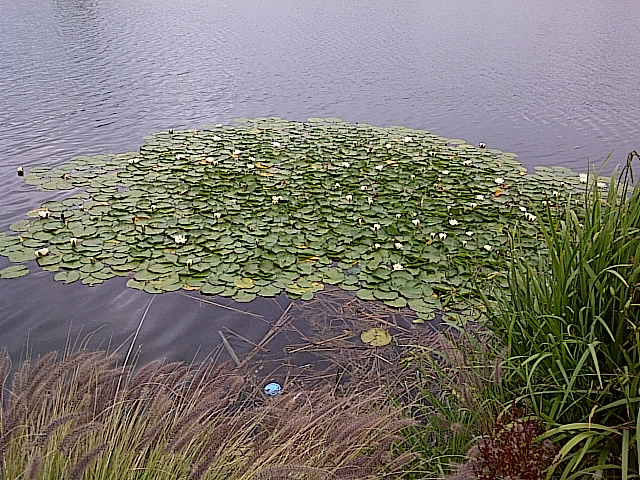
Which, this week, means walks. I’ve got three Walks With Friends on the calendar, and I’m hoping all of them come off. It’s a good indication to me that I’ve been just a little too introverted, maybe even just a little too focused on head-calming-yoga, when all of a sudden I both want to get out and stretch my legs and reconnect with…oh, everybody. Today, I got up just a little early and met with Terri Thayer, one of my critique partners, to get in a creek-trail walk before our meeting. We walked a creek trail that we’ve often walked before, and we talked and talked. This is why Walks With Friends work so well for me–I don’t even notice the exercise. Sometimes, I don’t even notice the scenery, especially when it’s a familiar path and I can trust my co-walker to navigate. (I can get lost anywhere/anywhen if I leave the directional decisions to myself.) Today, though, I did notice. And I saw this.

A huge mass of lilypads. Now I must have seen lilypads before. In fact, someone in my family is going to say, “DAD has lilypads in his pond.” But I have never come across yards and yards of them, with those huge, amazing flowers (which you can barely see) all over them. It was one of those surprise moments, one that pulls you out of the talking place, out of the hand-waving, laughing, story-telling, ignoring-all-nature place and says, “LOOK!” And, for all I know about lilypad blossoms, one of those moments that could only happen in the summertime?

What’s different about the pacing, the moments, in your summer. And what do you do to make sure you enjoy whatever it is?

Posted in Uncategorized

Problems: Don’t Forget to Blame Your Hero

We all know our heroes have to encounter problems along their path–obstacles, detours, crises. But sometimes we forget that some of those problems, sometimes the most important, have to be created by the hero herself.

Sure, you can throw all sorts of stuff at your hero from outside–betrayal from a best friend, a parent who holds the reins too tightly, even a stick of Acme dynamite from some random bad guy. And your hero can fight through these obstacles, conquer them, and march through to the other side. Victorious. Strong.

And not so real.

Remember that flaw? The big character one with which all our heroes are supposed to come equipped? It’s important. It’s not enough for a flaw to be part of how a character thinks, or that shows up in the words he says. We need to show this flaw in action. We need to show this flaw making things worse for the hero. Partially because we all have those kinds of flaws, and we’re trying to create heroes that feel, at least a bit, like someone we could meet on the street. (Okay, more interesting, more fun, more tragic, but…just a little like us.) If you don’t believe me, go to 4:15 in this video and listen to Stan Lee. You’re not going to argue with Stan Lee, are you?

There’s more, though. The other reason we need to see this flaw in action is that it sets up our hero for change. Growth. That other all-important factor in a story our readers can relate to. If your hero starts out perfect, or even just perfect in action, where are they headed? To an ending in which they’re exactly the same as they started out. Why change when you don’t need to? Why change when your behavior keeps you safe and lets you easily tackle anything from an irritating fly to a massive avalanche?

BUT…if your hero is causing problems for himself–if he’s tripping on his own straggly hem, so to speak–then he’s got an important path to follow. He needs to gain strength, access his intelligence and imagination, step up to the plate. Otherwise, he’s going to stay stuck in the same story, with the same problems. You know the saying, you can’t run away from your problems? Just as true in fiction as in real life–only in fiction, you end up with a boring story as well as an unhappy person.

So, as you’re setting out to create those obstacles, the ones that add tension and excitement to your storyline, keep your hero up front in your planning. Yes, let the locusts swarm, let the bad guys drop the bombs. But don’t be satisfied with just letting things happen to your hero. Make sure she makes things–bad things–happen as well.

Posted in Uncategorized

Thankful Thursday: Hours and Hours

It’s been a nice week. Son’s camp–at which he’s had a wonderful time (yay!)–runs from 8:30-4:00, and it’s a ways away, and I pulled a little less carpool duty thanks to a wonderful husband and some other very nice parents. Which has pretty much meant…

Time. Slow time.

I actually did use it. Last weekend, I sent a new picture book off to my group for critique, and this week I drafted another one and started brainstorming a second one. Both obviously need work (okay, probably all THREE need work)–the complete draft that poured out of me on Monday is more of a moment than an actual story, but I think there may be a story hope at least in it. The second one, still in thinking stage, has a hero I like, some great ways to (possibly) weave true science into fiction, and an antagonist that needs…oh, you know, at least a personality.

I got work done that needed to be done. I kicked a couple of life tasks off the to-do list. I did yoga. I read.

Next week, camp’s over, relatives come, I do some travel–for which I’m thinking I’ll actually leave the laptop at home. The pattern’s going to change again, as it always does. And next week will be good, too.

But for the leisure and the relaxation of this past week, I am definitely thankful.

Posted in Uncategorized

The Problem with Endings

You’re writing along. Things are good. You’ve got a sweet, but not perfect protagonist developing, the supporting cast is strong, and you’ve hit the funny bone in some of the right places. You’re happy, you’re feeling like…oh, yeah, I’m a writer! Basically, that first draft was a:

And then you get to the end. The wrap-up. And your brain turns from a bubbling cauldron of brilliance to this:

Pardon the 80s valley talk, but basically you’re like…Whoa! What?!

And you realize the following:

  • You don’t really have your MC being quite active enough through the story. Because if you did, you’d have a much better idea of what he was supposed to do now.
  • You haven’t settled on the true purpose/meaning/theme of this story yet. Because you can’t really tell if this conclusion ties in with whatever you thought that was, or if it’s totally random.
  • You look at that ****load of art notes and feel relatively certain it’s too big a ****load, and start asking yourself if 1) you’re not telling the story well enough with words and 2) is there an illustrator on the planet that wouldn’t hate you if they saw this manuscript.
  • The word “goal” starts bouncing around in your head, at the end of questions like: “What is the protagonist’s…?” and “Do you even have a clue about the darned…?”
  • You wonder if the blueberry muffins are really enough.

So what do you do when you get to this stage? Well, if you’re me, you shout, “First Draft!” and drop-kick that evil editor out of the picture, at least for now.

You spellcheck, do a word count, and you pop that puppy into an attachment and email it off to your critique group. Who love you no matter what.

And then you start looking for the next picture-book idea to brainstorm.

Posted in Uncategorized

When Procrastination Pays Off

Okay, you know how it goes. You haven’t quite got that story to the place where you’re ready to write. Or maybe you’re a pantser, and you’re always ready to write, but for some reason it’s not flowing today. The pants are too tight. Too loose. Whatever.

So you find something else to do. Something you need to do. Oh, it’s part of the writing process. Maybe it’s research, a book you’ve found that really does have all the details you need. Or there’s an actual site you have to check out, to get the description correct in this scene. Sure, yeah, that site happens to be at the beach. Next to the ice-cream truck. On the most beautiful day of the year. Hey, it’s part of the writing process. No research? Surely there’s a writing workshop you need to take–the new one on settings you’ve heard so much about, or the one that promises to teach you the trick to writing a foolproof query. Yes, absolutely. All important. Part of the writing proc—you get it.

For me, it’s almost always plot. You probably know that by now. When I get muddled or frustrated or lost, I back out of the words and try to see the sequence, the structure, the map. And, yes, like all my other examples, it’s something I need. Truly.

It’s also, though, oh…just a little bit of procrastination. That’s what it feels like, anyway. Especially when I am frustrated or lost, and I have strong doubts that the plot work will lead to anything helpful. Heck, by that point, I usually have doubts that Hermoine Granger could come up with anything helpful. And I end up being pretty sure I’m just playing head games with myself, coming up with an excuse not to face the hard stuff, filling time instead of filling pages.

Oh, and isn’t it nice when I’m wrong?

Today, I did just what I’ve described. I stopped by my Bookmobile and got most of the picture books that Eve Heidi Bine-Stick dissects in  How to Write a Picture Book, Vol 1: Structure, and I started reading. First the picture book, then Bine-Stock’s breakdown. I got through Leo the Late Bloomer and Harry the Dirty Dog (a book I have always loved so much, I didn’t even have to get it from the library; it’s already on my picture-book shelf!). Not only did these examples wake me up to the fact that I’m probably writing a simpler/younger picture book this time around, but they helped me see the structure more clearly and–as usually follows upon that clarity–got the story ideas popping!

I ended up where I always end up with a good writing-craft book: putting the book down and racing for my computer.

And, of course, doing the happy dance.

Such a happy dance that I’m not even embarrassed to paraphrase something from the A-Team: I love it when a procrastination plan comes together!