Posted in Uncategorized

Thankful Thursday: A Little Bit Selfish

I know most Thankful Thursday posts are about things that come to us from outside–from people we love, from life, from chance. Today, though, I’m turning the lens at a little bit different angle, and mentioning a few things I’m thankful for that I give to myself. Obviously, these all happen withe the support of my family and other people close to me, but I also realize how important it is that I gift them to myself, that I choose the things I need in my life and that I take steps to make them happen. I think, too often, we forget about those pieces of life and then–honestly–we’re not good to ourselves or anyone else.

Today, I’m thankful for:

  • Yoga. I know one of the ultimate goals of yoga and meditation is that they will help us open up to the world around us, to others in that world. Right now, though, this is for me. I started it a year ago, when the creaks and groans coming from my body joints got a little too loud for me to ignore. What a surprise when I found that, not only did my body feel better with regular practice, but–oh, boy: my mind is so much more relaxed and happy.
  • Doing the work I choose. Yes, I know I’m lucky. I know life and chance and my husband have a whole lot to do with the fact that I get to choose what job I’m doing right now, that I got to choose the path I wanted to head down when I went back to work. Still…I made an effort to find out what I might like. I decided not to go backward, to a job that I’d been more than done with when I exited it years ago. And I decided not to just grab the first thing that came along–although, believe me, it was tempting. I looked for and found something that fits into my schedule and location as much as anything can, and I went for it. Yes, luck. But also, taking on the challenge.
  • The fact that I share my writing with others. I think sometimes I talk glibly about critique groups, about how necessary and helpful they are (and I totally believe that), but you know what? Taking that first step- is hard–either the very first step of joining a group  or that “first time” we go through every time we send out a new piece. I do get why some writers don’t take the step. For me, though, it’s an absolute must. I cannot write in a vacuum. And–when I feel it’s ready–I submit my work to agents and editors. Again, hard. I write because I need to (see below), but I also want to see my writing on bookshelves and e-readers. And I want children and teens to get a chance to read it. So…I share.
  • Saying no. This is a big one for me. Oh, sure, growing up, I said no in plenty of ways. By not showing up in the first place. By pleading some made-up excuse. By managing things so I didn’t get asked. This is very possibly the biggest way I’ve grown over the decades. It’s kind of like what I say about revision: knowing you’re going to revise gives you the freedom to let the first-draft writing flow. Knowing I can say no gives me the freedom (and power) to step myself out into the big, wide world and see what comes along.
  • My writing. Of course I want to be published. Of course I want someone out there to read my work and say, “Hey! This is good. We want it!” All those authors I love so much, the ones I rave about in reviews, the ones whose books I read as a child and collect for my shelves today–that is so much the tribe to which I want to belong. BUT…I write for me. I write because I have a plot I want to see on paper, I have a character who–no matter how much she tries to fight me–I am going to figure out. I write because the electricity that flows from my brain to my typing fingers when a story is going well—there is just nothing like it. But you know what? Those words don’t write themselves. I’ve had ebbs and flows of writing my whole life–who doesn’t? But I started making up stories almost forty years ago, and I’m still at it. I’ve even gotten better. And, honestly, I just love that fact.

What about you? What are you grateful for in your life that you’ve given yourself? We all get from everybody around us, but we give, too. And it’s so important, I think, that we remember ourselves in that caring. So leave me a comment and let me know: what is your gift to yourself?

Posted in Uncategorized

Surprise Books: Toby Forward’s DRAGONBORN

I’ve been reading a lot of surprise books lately. Mostly, it’s been tied to my new Kindle and my browsing through the rather randomly organized Kindle “shelves” at my library. But every now and then, I take a book off a physical, you-can-actually-touch-this shelf and end up thinking, Wow–I didn’t see this story coming.

Today’s surprise read is Dragonborn by Toby Forward.

I picked this up because it’s a dragon book. Sort of out of habit, from all the years when I brought home anything about dragons for my son to read, or at least decide if he wanted to read. A bit out of interest, because after reading most of the dragon books I brought home for my son, I’ve become a bit of a dragon addict, too. And, oh, just because, you know–you never can have too many possible reads on your nightstand and/or Kindle.

So where was the surprise? Well, from the cover, I thought Dragonborn would be a relatively “young” middle-grade read, with a fairly simply storyline, not too complicated characters, and some cute stuff with dragons. A quick, light read–maybe for the end of a longish, tiredish day. I’m not really criticizing the cover at all–the dragons themselves are beautiful, I love the image of Sam up in the hills, with the lights of the city or village down below in the distant. But…I think the cover, especially the picture of Sam, did create the impression I had about what the story inside would be like. It has a kind of Disneyesque feel to it. Again, not a criticism, but definitely a certain feel.

And the story is just not Disneyesque at all. Okay, yes, someone important dies in the first pages (and that’s not a spoiler, it’s the opening!), but the death is told without high drama, without any of those intentionally overt yanks at the heartstrings that were such a part of oh, say, The Lion King. It’s told with a quiet sadness, almost an inevitability, and with a lovely thread of where-does-this-take-us-now for Sam, the hero, and for the reader.

The rest of the book lives up to the opening. And, to me, counters that first impression of the cover. The writing is clean and clear, so–yes–a strong reader of 8 or 9 could totally read this book. And, I think, enjoy it, but they would need to be a relatively sophisticated reader for that age, which is different than being a strong reader. The vocabulary wouldn’t be over their heads, and the sentences are tight and not overly long. But…the whole story leads you along, in a good way, with unanswered questions. Sam is the hero, and you are given access to some of his thoughts, but not all–so some things come at you as an Oh! moment.

One of my favorite of these moments is when Sam ends up at the wizard college and is asked to prove he can do magic. We know that Sam has been taught that magic is not for games, that it’s not to be wasted, and we know that the wizard college teaches just the opposite–that wizards should use magic for anything they need, or anything needed by a client who’s willing to pay the wizard. What we don’t really know is whether Sam has much, if any magic. And then, after Sam confirms that the head wizard, Frastfil, is ordering him to do magic:

Sam clapped his hands. The door slammed shut, wrenching itself away from Frastfil’s hand. Frastfil found himself swept back into the room and forced around the silly desk that his whatever had owned and into the armchair. The chair spun around  and around and around, and lifted into the air, with Frosty holding on in terror of falling out. All the books jumped off the shelves and formed a cloud of paper and boards around Frosty’s head, spinning in the opposite direction from him, like a dust whirl in hot summer.

Whee! In an instant, we not only know that Sam has magic, we know that he has a lot, and that–even more importantly–he is smart about that magic.

Other elements take this story up a notch for me and, I think, for older readers (older than 8 or 9, AND older than me!) who might not be attracted by the cover. Sam is the hero, but he’s not the only point-of-view narrator. The story is broken up between Sam’s story (told in not-so-close third-person), entries in his apprentice’s notebook, and the relatively closer third-person point of view of several other characters, including some good guys, some bad guys, and a dragon. At times, that dragon narrative is further complicated by being the mixed-up pov of a dragon that has been taken over by something evil. At other times, we’re in a kind of dream-state where Sam is seeing and feeling through the dragon’s vision, and vice-versa. And we get into the pretty nasty pov of the antagonist–close up to her ickiness without getting to share exactly who or what she is. The truly nice thing is that all this is done without confusion, in a way that left Me-the-Reader happy with what I did get to know and just the right amount of intrigued with what the author wasn’t yet sharing. Really beautifully done, but….again, I feel like the cover is presenting a story without all those layers.

What am I saying here? I guess a bit of reminder that you really can’t judge a book by its cover, a bit of frustration that–on another day, in a different mood–I would have passed on this book because of the cover, and a big chunk of recommendation that you check out this book for yourself. Mixed into all that is the usual curiosity about what goes into a cover decision and how many different ways there are of viewing a story and its market.

Interesting little addition: As I was writing this blog, I went over to Toby Forward’s website to get the link and to see if there were any more books coming in this series (yes, there are!). And I saw that the book was first published in Great Britain and that–whoa!–the British cover is totally different. Do I think it’s better? Well, artistically, I like it more, but I’m not actually sure it does a truer job of showing what’s coming once you turn to page 1, since there’s no sight of Sam anywhere to be seen.

And Dragonborn is very much Sam’s story.

What am I leaving you with? I guess: Read the book yourself and make your own decision about the covers! Luckily, I think you’ll enjoy the work.

Posted in Uncategorized

Compressed Time

Sometimes, I think getting older is really all about remembering, or re-learning, things I’ve already known.

Years ago, I played tennis on my high-school team. The first year I did it, life became a bit crazy. I’d always been (and still am, in many ways) someone who prefers lots of open time in her days, time to relax in between tasks and even take the doing of those tasks at a leisurely pace. Suddenly, I had practice after school every day, THEN chores, homework, and the rest of life. I loved the tennis, but when I look back I see that year as a whirlwind of racing from one place to another, of doing things–even breathing–much more quickly than I was used to. And in much more concentrated blips of time. If I remember correctly, I was pretty darned effective in those blips. Okay, not in my math classes, sure, but you could have given me 20 more hours a week of math time, and it wouldn’t have helped.

There have been other times in my life when this happened again–when I became suddenly busier, or hit a stage in which my days felt scattered and crazy, when I hadn’t yet fallen into a more organized pattern. My first year of college, my first full-time job, when I first joined a critique group. Most of these times were also accompanied by an increase in productivity, or focus, even with the fewer available hours.

And here I am again.

When I knew I was going back to work, one of my concerns was how I’d keep my writing going. “If” was not an option. I had been volunteering at the museums for about a year, and I’d been doing that work from home. I had expected that they’d want me to keep doing that–the museum office space is not what you’d call “huge.” But, no, they wanted me on-site, and it’s turned out to make a lot of sense–for the organization and for me. I’m much more productive there, without the distractions I have here. And when I do work an occasional day at home, the change helps me focus and get everything done. I can be on-hand for meetings or for those let-me-just-grab-you-for-a-quick-question moments. There’s a lot of work, so I have to stay open to bringing some of it home, but…

I have days off. Typically without much, if any, museum work to do.

Which means…writing time.

Obviously, no, not all day. Life stuff that isn’t getting done on work days waits for me. Yoga must be fit in. So, yes, off-days are more relaxed than work days, but…they’re still relatively compressed when you compare them to the days I used to have. With hours I could have just filled with writing. Day after day. After day.

I so wasn’t.

Not recently. Part of this was that my YA historical was haunting me in the bad ways–it would pop out of corners just to remind me that it was actually pretty scary, that I had no clue how to make it happy. Part of it was feeling a bit divided about whether I should be working on the YA, or the picture book, or even looking back at another project for revision. (With, I remind you, probably enough free time that I could have been working on them all!) And a big part of it, I now realize–all over again–was that my time was not compressed.

Since I started work, I have taken a hotel day to plot out almost all of the YA historical. I have finished revising a picture book and started it on its rounds. I have started revisions on two other picture books, submitting drafts to my critique group. I am grabbing at chunks of time so small I would have scoffed at them before, as “not enough,” and I have opened up a file and thought, or played, or written a few more words. I have made more progress in the past month than I had in the three months before I started the job.

Once again, life is showing me that change is good, busy is good. As long as you’re willing to make it so.

And, because I couldn’t resist, and in honor of Jerry Nelson, who passed away last week:

Posted in Uncategorized

Kate DiCamillo’s THE MAGICIAN’S ELEPHANT: Beauty and Wonder

I’ve been thinking about this post for four or five days. Ever since I got a few pages into The Magician’s Elephant. Because I could tell right away that this was going to be one of those books. One of those books that is so brilliant, so lovely, and so…magical, that I can’t figure out what or how the author–in this case, Kate DiCamillo— has done to get all this beauty on the page.

If you’ve read many of my other reviews, where I pretty much talk about the pieces of a story, the elements of writing in which the author just rocks, you might guess that this–this not knowing–can drive me crazy. Just a little bit. You know, at the same time as I’m falling in love with the book.

Which I did with The Magician’s Elephant. On every page. (Or as my Kindle calls them, every “location.” I know. I’m so not used to that yet.)

I’m going to give you the basic premise/intro of the book (without spoilers), but be warned–no plot retelling , or character description, can convey what is so special about this book. A young boy named Peter hears from a fortune teller that his sister, Adele, is alive. He also hears that to find her, he has to follow the elephant. Peter lives in a European city in which–guess. There are no elephants. Until…

That’s it. That’s all the storyline you’re going to get. The arrival of the elephant is just one of those things you need to read in DiCamillo’s writing, not mine.

So what am I going to talk about?

The world. The voice. The magic.

The Magician’s Elephant is, I think, maybe an example of what some people call magical realism. The city Peter lives in could be any European city–for all I know, it’s a real one I haven’t heard of. The story could take place any time before cars. At least there are no cars in the book. There are social classes–super rich down to Peter, who lives in a small room at the top of a house with a retired, and slightly not-sane, soldier, who could have fought in any past European war. Before cars.  And then something magical happens.

You probably guessed that, with the title and all. Except the magic I’m talking about is not the magic of the magician. Yes, he does something, and that something is big and has big consequences, but the magic is more. The magic is the feeling DiCamillo conveys that anything–anything–can happen in this world, this little world of Peter and Adele and the policeman Leo Matienne and his wife Gloria. And the elephant. And the feeling that the anything is always going to be something good and something right.

Wait, you’re saying. What about conflict? What about problems? What about the tension created in the reader when they can’t tell if things will turn out all right. Come on, Becky, you’re always arguing in favor of making things worse, amping up that conflict, keeping the reader wondering.

Yeah, well, guess what. In this book, in these pages of DiCamillo’s writing, it doesn’t matter that you aren’t worried about Peter. What matters is that–somehow, magically–she makes you turn every page, wanting more, even as she creates this incredibly strong faith in you, this absolute belief that Peter will find Adele. And that they’ll be happily together again.

DiCamillo does keep you wondering about the how: what exactly will Peter do, who exactly will help him, what actual steps will lead Peter back to his sister and make the elephant happy as well. So, yes, I’m sure that, technically, some of the page-turning need comes from the curiosity she evokes in the reader.

But what really keeps you reading, I believe, is that sense of magic. That sense of absolute possibility and hope.

I am not a sappy person. I don’t like sappy books. I like a happy ending, but I’m very dissatisfied when I hit one of those that feels forced or at odds with where the story needed to go. So it’s not just that everything comes together at the end that made me love this book. That never works for me, by itself.

It’s the language. If I had hours and hours available to me, I could probably take a page of this book and pick it apart for the words and phrasing that DiCamillo crafts that create what is for me, a thing of beauty. Of course, the characters matter–Peter’s longing for his sister, his grief over the promises he made his mother that he hasn’t been able to fulfill; Adele’s dreams about the elephant, Sister Marie’s flying dreams, Madame LaVaughn’s need for understanding and attention. Every character in this story has a problem, a goal, and–most importantly–a connection to the others. Of course, the plot is strong–one thing causes the next, which connects to something earlier, which leads to another action. Perfect. DiCamillo doesn’t miss a story beat. Of course, it’s the surprise events, the twists, even the coincidences, that add to this feeling of wonder–magic does happen here, and magic leads to people coming together, people questioning assumptions, people doing things that count.

But…yeah. The words.

Nathan Bransford put up a post the other day about whether the publishing industry cares too much about good writing. Then, here, he includes a full comment from one of his readers to that post. In terms of the publishing business, no, I’m guessing the industry doesn’t need to stick to publishing books written as beautifully as The Magician’s Elephant. I’m not naming any other titles, but I would take any bet that several we can all think of made gazillions of dollars more for their authors (and publishers) than The Magician’s Elephant did. I agree with Nathan when he says, “I’m unconvinced the majority of the reading public cares about “good” writing. They care about stories and settings and characters. Prose? I’m not sure I buy it.”

But. Yeah, you knew there was a “but.” Or a BUT!

I care. Oh, I so care. Prose like DiCamillo’s makes me feel like I’ve been wrapped in the most beautifully woven piece of tapestry ever created, one that is as soft as flannel and as shimmery as silk and in which gold and silver embroidery traces every detail. It makes me feel like I’m sitting on a sun-warmed rock above treeline, looking into a valley of greens and grays and who-knows-what animal life moving around in it. It makes me feel, at once, as though I never want this book to end and as though I need to put it down right that instant and turn to my own writing, in an impossible but timeless attempt to create something of my own that even comes close. 

Do I read those other books? Of course. Do I enjoy them. Definitely.

Still. There is in me, and I think in many others, a wish for more. For the beauty.

Posted in Uncategorized

Revision: Making a Mess

We’ve all been there. Standing in front of the closet door, seeing how it really does close, how nothing’s pouring out–it’s all tidy and contained. Or you look around your office space, and everything is on a shelf, the floor is clean and swept, the books are on their shelves. Even your kitchen–you’ve done the dishes, put them away, wiped off the countertops, and mopped. It’s all pretty and shiny. But you know.

You know that underneath the shininess, it’s not all so good. You’ve got toddler dishes stuck away in the back, even though all your kids are in high school. You’ve got clothes that haven’t fit in five years and jeans that–yeah, you love how they feel, but–the hems are shredded and you lose your keys every time you put them in the pocket with the hole. The office shelves look neat, but the filing cabinet drawers barely close on the old papers you don’t need anymore, and the books…okay, you can leave the books. 🙂

Although, maybe not. In every revision, you will probably have to kill a darling. Or three. Which, yes, can hurt as much as donating those books to the library sale.

Revision is so much like cleaning shelves, or that office, or those kitchen drawers. You’ve written a story that has a cute voice and great humor, that creates images in the readers’ mind. It has a beginning and an end and at least some kind of middle. It looks good. Okay, pretty good. But, just like staring at the closed closet door, you know it’s not good enough. You know you’ve got stuff to throw away, things to replace, and–hoo, boy–this space needs some serious organization.

So you open the door. Or the drawers. Or the filing cabinet. And you start cleaning.

What you start with is a mess. An absolute, no-space-to-maneuver-around-the-piles, where-the-heck-did-THAT-come-from mess. And it’s hideous. You have no idea what to throw away, no idea where to store it until you’re sure it has to go, no idea what piles to sort everything into, and you really can’t believe any of this will fit back into the space it came from.

Revision.

I’m so there right now. I realized over the weekend that I was at that stage on one of my picture books where I don’t know enough about it to start revising. Oh, sure, yeah, I could play with some words, I could move a few things around, shift character roles, but that’s not good enough. That’s right on a par with taking out the two blouses that have never fit and handing them down to your teenage daughter, who’s been borrowing them for the past year anyway. That’s up there with moving the tupperware with the not-seen-in-years lid to the bottom of the pile and telling yourself you’ll use foil to cover the food. You’re cleaning the surface of things, but leaving the real depths untouched.

Revision.

I’ve said this many times, but it always seems to come back to me as a surprise. Not the fact that I have to do this tearing apart, not the fact that I have to spread all the pieces out and throw a bunch away. But how painful it is. How horribly and overwhelmingly messy that mess actually is. H.A.R.D. That’s what revision, true revision, is.

What keeps me going? Thinking about that truly cleaned closet–the one that has room for me to do a little supplemental, hanger-filling shopping. The kitchen cupboard that now not only has room for new glasses, but isn’t making me feel silly for hanging onto plastic cups that nobody in the house wants to drink from. The chance to rearrange the books I have left so they’re actually visible or to discover an awesome manuscript I’d shoved into a file and forgotten about. Space, freedom, and hope.

No pain, no gain. Trite, but true. When the alternative is hanging onto something that you aren’t completely happy with, there really is no other route. Standing still is not an option. Moving forward–even with all the chaos and discombobulation–is.

Posted in Uncategorized

Friday Five: Randomocity

1. I ❤ my critique group. They tell me when they love my writing, they tell me what my picture book is actually about (and they’re right!), and they hand me ideas for MORE picture books. Plus, they SO, SO keep me motivated.

2. I got to B&N early today for my critique group meeting, so I brought my Kindle to read. I think I heard the Nooks hissing at us as we walked by. Maybe the printed books, too. Logically, in terms of pure love-of-reading, I know it’s all one world. Emotionally, my stomach felt a little queasy.

3. This is the first summer in a long time when, by the end, I’m not saying, O.M.G., School has to start NOW! Probably because the new job has me out of the house 3 days/week. Possibly because there are only two more years of high school in our future. Eep.

4. Every now and then, as August winds down, I feel myself looking forward to some gray skies and gusty winds. You can all remind me of this when I start whining about the rain and cold.

5. I got the page proofs of my Hounds book for Capstone this week. It really is an amazing feeling to see your words put into a nice font and flowed into a layout complete with photos. I guess the question of the day is: If they decided to send me my author samples on Kindle, would those make me as happy as print copies? Oy. The loop goes ever and ever on, doesn’t it?

Happy Friday, all!

Posted in Uncategorized

My New Kindle and What I’ve Learned So Far

Here it is! The guys (yes, per my instructions, but–hey–subtlety is highly overrated)bought it, wrapped it, and presented it to me on my birthday! Let me tell you, that wrapping didn’t last long.

First thing I learned. I adore it!

I read two books on it over the weekend (hey, it was my birthday!), which pretty much verifies that this reading addict, at least, can feed her habit via paper or electronics.

Other things I’ve learned so far:

  • You can take it in the bath. Carefully.
  • Eoin Colfer’s final Artemis Fowl book, The Last Guardian, rocks the series.
  • You can only loan a book out one time. Which means that Son and I got to read The Last Guardian on our own kindles, but–if/when Husband gets one, he won’t be able to. Because, you know, we never pass a print book around through the whole family. Yeah, right. I understand the business model the publishers are using, but…come on, guys! You’re really not going to get me to buy multiple copies. This, you could change.
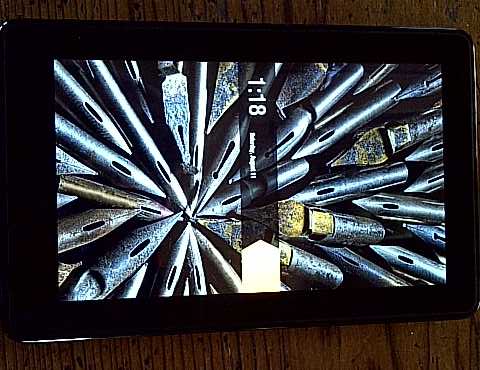
  • 40+ plus years of cleaning eyeglasses comes in handy for getting all those smudges off the Fire’s touch screen. Which, BTW, is bee-yoo-tiful!
  • My dad told me that his kindle is lighter than the books he reads. Which I think means 1) Dad has a different Kindle than the Fire and/or 2) Dad buys bigger book or more hard-backs than I do.
  • YOU CAN FREEZE THE SCREEN! You know, so when you’re reading in bed and you tilt the kindle sort of diagonally, the page doesn’t go all wonky and flip back and forth between portrait and landscape. Thanks to Son for this one.
  • My library system doesn’t yet have enough Kindle books to make me giddy with delight. But I can be patient, because I love my library, as much or more as I love my Kindle. And, you know, there are still print books I can bring home. The nightstand shall not be empty.
  • Apps. Not so much.
  • You have to (sometimes?!) synchronize your Kindle after you download a book. It doesn’t always show up automatically. Then, again, sometimes it does. I can handle the confusion.
  • The battery lasts a nice, long time, but not always long enough for…you know, a reading addict. And the charging cord they ship with the Kindle is just barely long enough.
  • It drives my son nuts when I put down the Kindle without putting it to sleep. Driving my son nuts=just an added benefit, right?

Pretty much, all good. Pretty much, ALL GREAT. My cover is on the way, so any day now, Son and I can quit getting mixed up about whose is whose, and I’ll be able to prop the thing up in any orientation I want when I’m reading at the table. Which,you know, is a lot of the time.

What about you? Are you an e-reader owner yet? Fan? Not so much? Feel free to share your “learning points” in the comments!

Posted in Uncategorized

Friday Five: Things I Learned This Week While Plotting

Tuesday, I got back to plotting the YA historical. I’d gotten on a roll while on vacation, and I know all too well how, if you don’t jump back on the wheel relatively soon, it’ll go flat and be that much harder to get spinning again. So I took a couple of hours in the morning and a couple of hours in the afternoon, and I worked. Those big chunks of time are magic, as I’m remembering, and I felt like I got to new points of understanding for my story and for how I like to plot.

A few things to share:

  1. Sometimes, sitting and staring actually works. Along with actually letting your brain roam at least loosely over the story possibilities.
  2. The system of assigning a +/- or a -/+ to a scene card makes you think about a) the fact that story is action and change, together b) which direction you want your hero’s pattern of failure & success to shift in each individual scene, and c) what you’re going to make happen to cause that shift.
  3. There really is a story reason for every action or event. Be patient and look for that reason (see #1 above). Believe me, you will know when something feels forced, coincidental, or unbelievable. And you’ll know, as you move things around and look at possible causes and connections, when it all makes sense and works.
  4. This whole Act I, Act II (in two parts), Act III thing is pretty cool. When you move a scene from one Act to the other, you can feel the shift in balance, weight, and power of that moment, the whole story. Once again, I’m remembering how much I worship structure.
  5. I really do like Scrivener scene cards more than paper index cards. I can jot down all my notes and thoughts, without any space limitations. I can do that jotting by typing, which means I can actually read what I’ve written. I can cut and paste and delete, without inked-up scribbles making the whole card a useless piece of confusion. And I can work with Scrivener’s color-coding, without having to recopy and tear up a card every time I decide that it’s Red, for Daniel’s storyline, instead of bright blue, for Abe’s.
Posted in Uncategorized

Thankful Thursday: My Reading Addiction

So I’ve been musing about this post for a while. Basically, I’ve been thinking about how much I read and where that time comes from and what I get from the actual reading. And I’ve been hesitating about writing up the post, because I was a bit afraid of sounding whiny (about having to sometimes put reading aside to get some other things done), or braggy (about how many books I do read), or defensive (like: it is so not a waste of precious writing time when I pick up someone else’s book).

But then Jennifer R. Hubbard put up a little post about why reading is so absolutely wonderful and necessary, and I thought, Oh, just write the damned thing. And make it a gratitude post, and you won’t be able to whine. Much.

I think this whole thought-path started when I decided to keep count of how many books I read this year. I see other people talking about that on their blogs, and I got a bit curious about what my number would actually be. So on January 1st, I started keeping track. I’m not counting picture books, not because they don’t count–value-wise–just as much as a novel, but it takes me such a short amount of time to read one, I felt like I’d be cheating just to inflate my count! (Yes, I can go loopy over just about any issue, why do you ask?) And I wasn’t going to keep track of research books, unless I read them cover to cover, rather than jumping around between the topics I really need to learn about. So, basically, that left me with novels and memoirs, many of which I knew would be (and have been) rereads.

As of today, I’m at 151 books.

I read a lot.

  • I read while I eat.
  • I read while I cook.
  • I read when I take a bath.
  • I read in the car (parked!).
  • I read at night before I go to sleep.
  • I read on the couch for luxuriously long sessions.
  • I read instead of doing a better job cleaning the house.
  • I read instead of choosing a complicated recipe that will require me to spend more time at the stove, thinking about what I’m doing.
  • I read instead of meditating.
  • I read, some days, instead of doing yoga.
  • I read instead of writing.

Pretty much the only item in that list that has the potential to bother me is that last one. Because, yes, if I’m tired or stressed or worried about what I’m going to write, I will pick up a book rather than a manuscript.

This is not so good. I don’t actually worry about it too much, because I know how much I get from reading, not just for my sanity but for my writing skills as well. I am halfway through a book that I’m enjoying, but guess what–it’s making me remember that world-building, cool as it is, can’t take the place of action and conflict for too many pages or I start skimming over it. I just finished a book that wrought such a perfect balance between its world-building and its story that I need to put it on the list of books to study. I get inspired by what I read, and I go back to my own writing recharged and remotivated.

Still, if one was crazy enough to look at it in terms of hours, it’d be hard to miss the number of those hours that I would have available to write…if. If I slowed down on the reading. If I set writing requirements for myself, with reading rewards. If I only brought home three or four books from the bookmobile, instead of ten or twelve. If, if, if…

Not going to happen. My husband spends hours and miles on his bicycle, because riding does pretty much the same thing for him that reading does for me. (If you ignore the fact that none of those reading activities I listed actually does a thing for my physical health.) It’s why we back each other’s habits–not just because we’re nice and kind and supportive. Because we know what it would be like to live with the other person if they didn’tget all that time with their bicycle/books.

I shudder to even think about it.

So, yeah, the reading will continue. Let’s just say the voracious reading will continue. Yes, this year, I’ve got some big writing goals, and I know I’m going to push myself to keep at them. So, okay, maybe the reading-to-writing ratio will shift just a little bit in a new direction. Which would be okay.

The house-cleaning, though? Don’t get your hopes up!

Posted in Uncategorized

Photo Blog: Family Road Trip 2012

Okay, so after a careful, thorough,  and extremely scientific analysis, I can tell you that–for me and my family–a vacation consists of an adventure or two (or not, for those who don’t so choose); a lot of late, but large breakfasts; quite a bit of driving; some goofiness; books; and about one museum. Music shops, in the plural. Coffee and candy whenever and wherever they show up. Maybe a movie (Yes, I did go see THE DARK KNIGHT RISES. Overall feeling? Not bad. But..yeah, you can take the Marvel-comics girl into the DC theater, but you can’t make her switch teams.)

I don’t take a lot of photos. Even if you’re just looking at a percentage of the whole count, I don’t take a lot of good photos. But, for your perusal, because we all love travel pics (???!!!), here are a few shots and notes from the trip.

The guys started with a day underground. They spent four happy hours, as the only people other than the guide, doing all the ups and downs and ins and outs of the Middle Earth Expedition at California Caverns. I have no photos, because why? Because I am the claustrophobic one in the family, and no tantalizing descriptions of an underground lake (very cool thought!) and lots of goopy mud requiring you to wear high-top shoes (also pretty cool thought, if only in theory) are getting me into those caves. Or those tiny, tinyvcracks in those caves. If I want to get totally stressed out and anxious and trapped-feeling, I can always reread Nevada Barr’s Blind Descent (which, if you haven’t, you should!).

What did I do instead?

I plotted. I had told myself that this was my chance to get something going on the plot of my YA historical. I was definitely feeling a bit like the book was headed toward a drawer, which wasn’t making me happy, but I was also feeling very not willing to keep bumbling/rambling around anymore. I’d finished Donald Maass’ Writing the Breakout Novel and most of Save the Cat,  and I had lots of story thoughts and notes. I took those and my Scrivener software, and I got lots of scene cards up for Act I and Act II. I still have some way to go, but now that way feels possible. Happy work to come!

The caves are in the California foothills, so we stayed in Angels Camp, which is the town Mark Twain talks about in The Celebrated Jumping Frog of Calaveras CountyAngel’s Camp has a lot of frog statues and art. Personally, I liked this one.

The next morning, we went to our one museum, at Railtown 1897 State Historic Park. If you like trains and/or history, this is the place for you. My husband does like trains (I had to leave him for 3+ hours once at the Sacramento Train museum before he’d had even close to enough time to make him happy.) And I’m pretty good with history these days. My son knew the music shops were coming, so he was very patient. Like I said, not a lot of photos, but does anyone else love how this looks like a big train stable?

And, apparently, I didn’t catch a photo of the water tower from the opening credits, but does this bring back TV memories for anyone of you?

For a better “clue,” go here.

Starting near lunchtime, we drove up and across the state and ended up, very tired but happy, sleeping under the trees in Humboldt Redwoods State Park. If you like redwoods and could skip the bother of setting up a tent to keep out the damp, I can highly recommend the Burlington campground here. Wherever else the fog was, and it was a lot of places, it was never in our campground at the same time we were. So we were able to just put down sleeping bags, curl up, and wake to this view.

Okay, this is actually a better view than I woke to, because, obviously, I wake up without my glasses. But as soon as I groped around and put them on, this is what I saw. Gorgeous. I’ve been around redwoods all my life, but I always forget how amazingly warm and friendly they are. Really.

We pretty much meandered through towns for the next day or two. We had breakfast at the Samoa Cookhouse, near Eureka, where I saw this stove in their museum.

Definitely bigger than Caro’s mother would have had, and I have no idea of the when of this stove, but it was good to see something even similar up close and personal. I liked how the waffle iron was set down into the burner spot–so it was either a burner cover or a waffle iron, depending on your current need. Which, you know, would most likely be waffles.

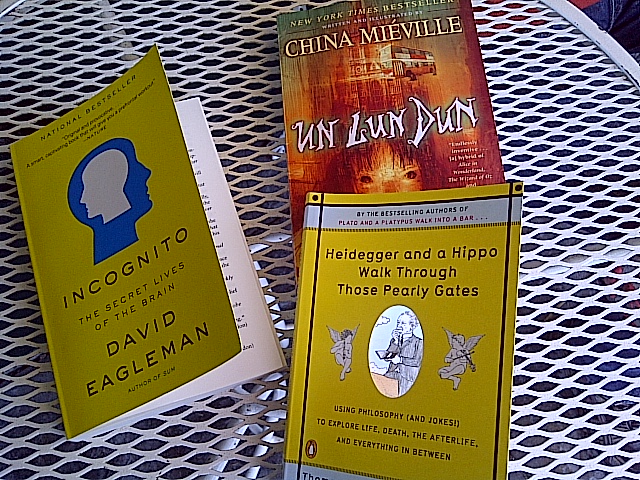
We did bookstores, a little sunshine, and coffee/tea/lemonade in Arcata. The reading selections of the day:

And we drove home. Stopped at one more music store, where my son bought himself a new ukulele–an upgrade from the one he’s had a while and perfect for a traveling-around instrument. We were all pretty tired by the time we saw this, but it always means about an hour left to the trip, so it’s a welcome sight.

And now, as they say, reality begins again. Came home feeling like, yes, I’d been away–which is always good–and that there were good things waiting for me here. (Along with the good things, those two guys, that traveled with me, of course!) I have picture books to draft and revise, and I have a plot to push through to the end. And a novel to write that, finally, feels like it could actually happen.

Life is good.