Posted in Picture Books

Picture Books and Me

If you follow me on Facebook or Twitter, you may have–in the past few days–had your fill of this subject. I’ve been working on the picture book a lot lately and I’ve been posting random updates about it. If it makes you yawn, feel free to click away. 🙂

If you’re not sick of this yet, read on.

I’ve committed to a couple of things lately that come with critique opportunities. (To get, not to give this time!). I know that the YA is SO not ready for this stage, so–because I don’t want to pass up the chance–I’m going to be submitting the picture book. Which means I’m also going to be working on the picture book. No, I’m not deluding myself that I can get it Ready-Ready in time, but I can sure as heck get it a lot closer to Ready. That’s the (one?) advantage of working with a lot fewer words.

Anyway, because the posts here may be a bit picture-book-centric for the next couple of weeks, I thought I’d share a little of my reading/writing history, as it pertains to these shorter works. Just so you see what I’m in for and so you don’t wander around under any delusion that I consider myself an expert in this genre. I took this book on as a learning curve I wanted to tackle–I had an idea I loved (and still love, thankfully), and I promised myself I’d take it to the point where I decided it was ready for submission or that submission was not going to happen. Still working toward the first of those choices.

Anyway, let’s go back a few years. Okay, let’s go back a few decades. Picture me in high school, one with an “interesting” English department that sort of skipped over the standards of English & American lit and offered classes in Sci-Fi/Fantasy, “peasant” lit (I have no idea if that’s a real term or just one teacher’s label, but think Halldór Laxness), and–oh, boy–Russian lit. I read Michail Sholokhov’s And Quiet Flows the Don and I was hooked. In love. Skip ahead a few years to college. Somebody handed me a Dickens novel. Then one by a Bronte. Victorian novels–pages and pages of staying with the same characters. Days, instead of hours, in the same world. (I read fast). I fell in love again. And stayed there through grad school.

Now let’s look at something. A Victorian novel, British or Russian, has anywhere from 500 pages (that’s a short one!) to 800+. They have description out the wazoo–whether you’re talking about a place, a character’s physical appearance, or their familial (and often genealogical) background.  Action? Oh, sure, but you can sometimes expect a half-page paragraph to describe a couple of steps of movement. Dense is a good word for the Victorian novel. Lovely, beautiful, spectacularly flavored dense, but still.

Picture books, not so much. The word is spreading quickly through the genre that some agents won’t look at submissions longer than 500 words. Not pages–words. Description? Okay, you can have a word or two, but that’s what the illustrator is for. Background information? Not if you can’t get it across in a sentence. A sentence. (Can you hear Elizabeth Gaskell rolling over in her grave yet?!) My brain underwent a big twist when I started reading and writing YA, but this picture book thing is tying that twist into an increasingly tighter knot. A fun, challenging one that would be the delight of any boy scout, but still, quite the knot.

And here’s another layer of my history with picture books. I had my favorites from when I was a child, sure. And when my son was born, reading to him was one of the fun parts of mothering an infant. But…I could not wait until we could start reading the longer books. No, I didn’t force Great Expectations into his ears, but when we got to Ruth Stiles Gannett and Roald Dahl, I was in heaven.

What I’m saying is that, if you give me a novel to read, I’m happy. (And like the mouse with the cookie, I’ll be asking you for another.) I put down a lot more books now than I used to, but honestly–if you catch and keep me with voice or character or story, I’ll keep going and I’ll be content. I’ll escape into that world and I’ll be glad to stay there for as long as you let me.

If you give me a picture book to read, and you want me to come back, it had better be good. Really good. You had better give me everything–voice and character and story. This book has to snap me in and not let me pull out for even a split second. Which means, honestly, I have not spent anywhere near as many hours reading studying the picture-book form as I have the novel.

So, yes, I have a long way to go. I am working hard to get my 10,000 picture books under my belt (another plus for that fewer-words thing). I am looking at structure and young heroes with strength and word choices. Oh, yeah–word choices.

And I’m trying to plug it all into MY picture book.

Where is this project going to take me. To publication? Oh, we can hope and dream. And the premise of this story is good enough, that I think it’s a possibility. But I do know it’s going to take me deeper into this genre, into finding and reading more of those really good picture books out there that I have yet to read. Or that I will choose to read over.

And it’s most likely to take me those places, and more, on this blog. Lucky you. If you want to come along, I’m happy to share the journey.

Posted in Book Reivew

Time Passage in Sarah Ockler’s FIXING DELILAH

Fixing Delilah is a wonderful book. The bottom line, for me, is that Sarah Ockler’s prose is smooth, tight, and flowing; her characters are strong and sympathetic; and the story moves along with just enough questions and answers to make me happy. I liked her first book, Twenty Boy Summer, a lot, and Fixing Delilah was just as good–but hit more personal chords for me, so I can recommend it with even more pleasure.

I’m not going to do a full review, because mostly I want to talk about one element of the book that Ockler handles beautifully, from a writing craft point of view, something I’ve been thinking about how to do as I plot my second draft. That element is the transitions, or rather the lack of transitions, from scene to scene. From moment-of-time to moment-of-time.

(If you’re interested in a more complete review, one that gives a good story summary without spoilers, check out this one at A Chair, A Fireplace & a Tea Cozy.)

Okay, on to transitions.

In the old days, one scene followed another in time and space or, if it didn’t, we pretty much got filled in about what happened during the gaps. The best writers did it trimly and succinctly, rather than giving long, rambly passages of telling, but still–there seemed to be a need for writers to explain what had come between.

Today, not so much. I love that authors drop readers into the moment, often in the middle of some action or conflict. I don’t miss the lead-up or the summary. It’s the kind of writing I want to do myself. But it’s tricky. I haven’t quite figured out yet how much time, as a chunk, my WIP will cover, but I do know that I don’t want to cover all the moments or hours, not even all the days. I want to find a way to write the important scenes and the scenes that make connections, without leaving the reader confused about when they are.

Which is why, after having thoroughly enjoyed the library copy of Fixing Delilah, I’m off to buy my own copy. Because Ockler has managed to do this flawlessly, and I want to read the book through a time or two again–to study, analyze, dissect why and how it works.

The story takes place over an entire summer. Almost three months. 10-12 weeks. 70+ days.

With 34 chapters. One of which contains a single line of dialogue, and other sets in which multiple chapters take place on the same day.  Sometimes, Ockler skips hours between a scene, sometimes days, at least once–I’m sure–she skips weeks. And it’s all smooth.

The book feels just like school vacation–when you can barely say what you did for six days in a row, the an afternoon in the treehouse or hiking to a mountaintop stands out in clear, memorable relief. You get a sense of time passing–summer time, made of warmth and laziness with passages of sadness and anger and love and excitement. It’s time set away from the rest of the world, which is what–I think–makes Delilah’s story possible. This book had to take place over time, because the characters need that time–and some of that peace–to change and heal. And Ockler gave them–and us–that gift.

Lovely.

Posted in Friday Five

Friday Five: Random Info that Might Possibly, Someday, Be Useful

Write what you know. I’ve talked about that concept before, how I really think part of creating a story that we love writing (and others hopefully love reading) is stretching ourselves beyond what we know. Still, all of us have histories and worlds that we’ve lived in that could, possibly, add a layer of something extra to a WIP, whether that’s one we’re working on now or one we haven’t even got the idea for yet. The thing is, we never know what that is until and if we need it.

I thought it’d be a fun Friday Five to share pieces of my past that might, in some happy time, be the thing that adds that layer–the detail that flows into a setting, adds a quirk to a character, twists a plot, or amps up some dialogue.

And then I want to hear from you. 🙂

1. I know what happens when you step on a bathroom scale holding a dog that tops out just under 100 pounds. Awake. And moving. And I know just how big the window of time is  before you either drop the dog or, with the dog still in your arms, go over backward in a big, big thud. (Luckily, I also know what it feels like to hold a newborn, and I mean newborn, puppy in your hands and rub its belly to get it circulating and wriggling and happening.)

2. I know what an avocado looks like when a possum has been at it. Think vampire.

3. I know what it feels like to drive through Hollywood on your way to the graveyard shift you’re working, and realize the thin girl walking along the sidewalk is not on her way home from ballet class. At 11:30 at night. In a not-so-great neighborhood. Gut punch.

4. I know what it feels like to get way too much sand and salt water in your face, bodysurfing in Mexico. And then be stung by a jellyfish. In the elbow. The one you might, you know, just possibly want to bend, sometime before the end of the day.

5. I know that peacocks, perched on a fence in the rain, are no more attractive or appealing than a bunch of turkeys in the same position. And that you have to be just as careful where you put your feet, when you walk near them.

There. How about you? Don’t take the easy route. Push yourself to think of things that you can actually imagine in a book or an article, that little tidbit that only you know. Or at least that not everybody on the planet knows.  Go ahead–I want to see what you come up with!

Posted in Uncategorized

Guest Post: Jennifer R. Hubbard on Keeping Focused

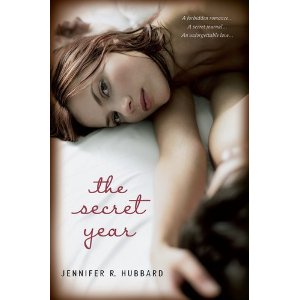
Jennifer R. Hubbard is the author of the young-adult novel, The Secret Year, a lovely book with one of the best portrayals I’ve read of a teenage boy who chooses not to share his feelings. If you want to read a great story and see really strong use of point of view, pick up a copy. Jennifer is also one of the most intelligent bloggers I’ve found to read; her discussions of the writing craft and writing process always get me thinking. She blogs at http://jenniferrhubbard.blogspot.com/ and http://writerjenn.livejournal.com/.

When Jennifer said that she was looking for bloggers to swap posts with, I jumped at the chance. Here’s Jennifer’s post–enjoy!

Keeping Focused

There are millions of writing tips floating around: in books, at conferences, on the internet. Reviewers offer lists of what they want to see more and less of. The market offers its own pressures (Vampires are it! No, werewolves! No, angels! etc. …) A writer can sit down with a head stuffed full of write-every-day/kill-the-adverbs/raise-the-stakes/begin-at-the-beginning/ditch-the-prologue/don’t-go-straight-to-flashback/switch-present-to-past-tense, and so on and so on.

For me, the best use of tips and advice is as a toolbox from which I may, at any time, need to select a tool. Of all the tips floating around, one will be the one I need to hear at that moment; it will help me fix the particular problem in front of me. A week from now, I’ll have a different problem and need a different tool. I concentrate on one thing at a time.

As for the lists of what we should and shouldn’t write about–well, they call to mind the anecdotes writers tell about well-meaning friends who say, “You know what you should write about?” or “I’ve got a great idea for a story!” We all know we can’t write those stories. We write the stories that set off a blaze inside us, stories whose energy will drive us through the long rigorous process of drafting, multiple revisions, critique and review. When too many external voices compete for our attention and we’re no longer sure what to write, we can turn our eyes to the inner flame, and ask ourselves: What lit that spark? What keeps it glowing?

Posted in Critique Groups, Critiquing

The Possibilities of Critiquing

When I talk about the basics of developing a critique, I recommend that–in their critique feedback–readers offer writers an explanation, an example, and a suggestion. An explanation of what’s not working, an example (or two) of that not-working element from the manuscript, and a suggestion for what the author might do differently.

Here’s what a suggestion is not. It’s not an instruction. Not a command. Not a directive set in stone.

Here’s what a suggestion is. It’s a possibility.

I use a lot of possibility-speak when I critique. I might say something like, “What if George misses the shot at the tee and has to take a second swing. That might make the events of the scene seem less easy, less convenient.” Or I might write, “Could the eagle have a broken wing? Be one-legged? Then Mary has to figure out what to do with this wild animal, and she’s immediately got a big problem.”

Much of the time, my ideas come from the story I’m reading—something the writer has seeded themselves, either without realizing it or without having (yet) developed it strongly enough. Sometimes, I think of ideas the writer hasn’t played with, at least not in the text I’m reading. Either way, I think possibilities are an important part of a critique.

Here’s why:

  • Sometimes, a possibility hits the nail on the head. The writer hears your idea, snaps their fingers, gives you a huge hug, and runs home to weave the new thread into their story. Everybody’s happy.
  • Sometimes, a possibility gets close. It’s not quite right, doesn’t mesh with the writer’s own strong view of the character or the scene, but it opens up a door to a new direction, one they hadn’t realized was there. With a little time, a little more thinking, they will figure out the change that works for them.
  • Sometimes, a possibility is pretty off-target. The suggestion you make doesn’t fit at all, from the writer’s point of view; they see no way to work it into their story. BUT…what it might do is clarify the explanation you already gave them, make sense of why the examples you pointed to aren’t working. Just like a picture sometimes is worth a thousand words (just not one I’ve drawn), an example can be the piece of the critique that the writer gets.

Sometimes, a possibility does none of these. And sometimes, yes, there is a writer in a group who completely ignores, forever, every possibility offered by their critique partners. Overall, though, I think it’s worth it to make the attempt, to offer those suggestions as they come to you. You can’t always track a revision change directly back to a specific comment, and–if you hold back–you’re missing the chance to see that magic happen. You’re missing the chance to watch the sharing of a critique group transform a story.

Posted in Uncategorized

Beginnings

I’m sitting at the coffeehouse, having just dropped my son off to do volunteer work (his first day) at the little science center in town where he, many years ago, took after-school classes. I’m having semi-mushy thoughts about how far he’s come, thinking about the two friends he still has, with whom he took those classes, and thinking about how far they’ve come, too. (Their mothers and I, of course, have not aged a day.)

So here I am, thinking about paths and milestones and the beginnings of all those, when I bump into two blog posts in my Google reader, and I realize there must be something in the air.

Kelly Fineman is posting about the fallow periods in her writing, but she warms us up with some thoughts about how she got started on her writing path. I love that Kelly makes a distinction between when she started and when she committed.

And Robin LaFevers is at the start of a new novel and is letting us into her world with a post about how she begins a project. If you haven’t read any of Robin’s process posts, now would be a great time to tune in. And, tell her, yes, we want more of these!

I began writing so long ago I can’t remember; I thought I had committed fifteen years ago, but no that it really didn’t happen until about three years ago when I was hit with the idea for my MG mystery and got serious, in terms of both hours and revision; I started this WIP about a year ago.

Really, you know, it all blurs together, except for moments like today, when I looked at the bike rack by the science center. It’s one of those racks that’s a single tube of metal curving up and down and up and down–one of those that’s perfect for little kids to climb all over, to swing on and between. And I realized that not my son, not one of his friends, would fit on or in it anymore. I’m not sure it would reach up to their knees.

On the writing path, too, there are moments. Kelley’s talked about hers. Mine are the memories of laying on my bed as a young girl, writing a story into my notebook in that curly, loopy cursive we all experimented with at some time or another. Coming to the early meetings of my first real critique group, drinking tea and sharing words. Sitting in the workshop, half-listening to the teacher and half-scribbling notes about Joel & Victoria, the two cousins in my mystery. Reading the passage about the suffrage march in Washington, D.C., when the white suffragists asked Ida B. Wells to walk at the back of the parade and knowing that I had the next story I had to work on. Realizing, as I finished the first draft, that I still wanted to tell that story, but that it was not the one I was working on at the moment. Having instances of revelation and astonishment about story, when I wanted to dance around the room and/or type words into my computer so fast that the CPU would start smoking. More instances of revelation and astonishment, this time about the writing craft–a way to sharpen a character or heighten plot tension–and finding a way to weave all that into whatever book I was working on.

Where am I today? In the middle of all that, still, and knowing there’ll be more to come. We hear it a lot today, and probably enough that it loses some meaning, but there’s a truth in this statement: It’s all good.

What are your beginnings? Your moments?

Posted in Capitol City Young Writers

Capitol City Young Writers Literary Journal

For the past few months, I’ve been involved in a project that I think is pretty cool. Some of you may know Verna Dreisbach as an agent, but she’s much more than that. Sometimes, when I just think about all she’s doing with her life these days, I get exhausted and have to go curl up for a nap. 🙂

One of her projects is Capitol City Young Writers, an organization to support and encourage teen writers, not just in Sacramento (our capitol), but nationwide. Heck, probably worldwide, knowing Verna. This year, the group is putting out their first literary journal, with teen editors and a few of us no-longer-teen writers doing some mentoring with these editors. I’m working with the editor for book reviews, and she is pretty much amazing me with her focus and commitment.

One of the things we worked on is the submission guidelines for the book reviews, and the other editors and mentors have been doing the same for their sections of the journal. The submission guidelines are now up at the CCYW website. If you are or know any teen interested in writing–pretty much in any or all genres—please check out the site and pass the word. Note the deadline: March 15—time to get writing!

Posted in Critique Groups, Friday Five

Friday Five: Flexible Critique Groups

True story: I’m in a yoga class years ago. I’m trying the poses, feeling the stretch, even though–at no point when they’re supposed to–do my fingers get anywhere near the floor; at many points when I’m supposed to be standing with balance, I’m tipping over & bumping into the wall. There is a woman a few mats away from me who can, pretty much without trying, touch her nose to her knees and twist so that–I swear–she’s all the way around facing the mirror at the front of the room again. Most of the rest of us are fighting back jealous; a few perhaps even plotting revenge.

The teacher gets the sense of what’s going on. And she takes time to explain that, even though we think this woman has it easy, in reality it’s harder for her to learn the poses, because–basically–her body flops over so loosely that she has to work harder to actually be in the pose, hold the pose, etc. And then the teacher–who I really do love–says, “On the other hand, Becky has an easier time/better chance of getting the stretch that the pose should give you.” Or something to that effect. I know my name was said, I know everybody turned to check me out, I know the teacher meant well, and I know that it all added up to the fact that I was the least flexible person in the class.

Well, you know, that wasn’t exactly news. 🙂

Not me.

Of course, there are also some people whom, if you asked, would theorize that I’m not always the most emotionally flexible person either. And I’m okay with that, too.

But…TRANSITION: I believe that being flexible in your critique group is a must. The Writing & Critique Group Survival Guide is full of tips for building a group, for holding meetings, for developing critiques, but the thing is–the bottom line is that we need to run a critique group in a way that works for us. We need to run a critique group in a way that helps us put more writing on the page, helps us support each other with strong, deep feedback and as-needed hugs. We need to run a critique group so that every member wants to be there, wants to submit, and feels like–yes–they can revise this mess they’re making.

So, after that very long wind-up, here are five ways you can keep your group flexible.

1. Be flexible about reading submissions of varying length–from a two-page scene to a full manuscript. And if you’re the author with the full manuscript, be flexible about how fast you expect your critique partners to read that big pile!

2. Be flexible about who gets to submit. I know there are groups that assign specific dates to specific group members. If you miss your window, because you didn’t have a chapter ready, you have to wait till your next turn. If you have chapters ready for three meetings in a row, you might not be allowed to submit for all those meetings, because it’s not your time slot. I really believe that when a writer in our group is being productive, we should support them by basically standing with our arms open ready to catch all the pages they can throw at us. Yes, of course, if it’s more than people can really read–if members’ critiquing time starts cutting too much into their writing time, there might need to be a “discussion” about maximum pages, but I’d rather see the auto-pilot response be “Yes, sure,” instead of “No way.”

3. On the flip side of that coin, be flexible about the times when a group member isn’t submitting. I know writers who need to write a first draft without being critiqued, because feedback at that stage can just open the door to their nasty inner editor and, basically, stall out their writing. Sometimes, life just rears its ugly head and gets in the way of a writer’s progress. That’s not a happy time, but it’s also not a time when a critique group should make things harder for that writer. They’re still coming to the meetings; they’re still critiquing other people’s work; they’re still a big part of the group. Support everybody’s different processes.

4. Be flexible about when you critique. I’m a big advocate of submitting pages for critique before a meeting (for in-person groups), rather than reading and critiquing at the meeting. I actually think it’s a very important part of having time to really read deeply & think about a manuscript, to develop a strong, helpful set of feedback. BUT…if the members of your critique group really don’t have time to set up this kind of schedule, to take those extra hours out of the week, do not let this stop you from setting up your group or from going on with one you’re already in. Do your best to spend that concentrated time at the meeting reading carefully and thoughtfully and share your feedback clearly. Sometimes we can’t manage the ideal, so we manage the next best…as well as we can.

5. Be flexible about life’s changes. When I started with my first group, I wasn’t married & I wasn’t even thinking about motherhood. While I was in the group, all that changed. Those first months of mommyhood were not easy ones for me, and my group made it that much easier by totally supporting me in bringing my son with me to the group for a few sessions, until I worked out a babysitting situation I was happy with. It meant so much to me that I didn’t have to step out of the group or miss those sessions that were one of the huge highlights of my month. I talk a lot about commitment to your critique group, but membership is not a black-and-white, ground-in-stone rulebook. If your group members are worth critiquing with, they’re worth accommodating when that new baby comes, when a job schedule changes, when an elderly parent needs attention and assistance.

Yes, there good ways to run a critique group, and there are not-so-good ways. To grow a group that you trust, that makes you feel safe and motivated, that helps you move forward with your writing, we need to be flexible about those various ways.

It’s an important thing, and it’s one that gets results. Results that are more than worth any aches & pains that the extra stretching brings you.

Posted in Uncategorized

For Jama Rattigan: It’s Michael Bond’s Birthday!

I love Jama Rattigan’s blog, and it’s not JUST because she posts pictures of food that makes me want to go out and gain twenty pounds in two days! It’s because she loves Paddington Bear as much as I do–if you go by the number of Paddington’s sharing her home, you’d have to guess even more.

Today, Jama is celebrating the birthday of Michael Bond, the man who created Paddington, with all his good intentions and not quite-as-good follow-through, with his love of marmalade, and the always necessary, if not quiet, baths that result from said marmalade-overdoses.

Jama and her Paddingtons sent me a special hug today, so I couldn’t not send one back.

To Jama & her bear family and to Michael Bond, with huge thanks,  from MY Paddington family & friends.

Posted in Uncategorized

When’s Your Best Writing Window?

And what do you do when that window isn’t there?

Debbi Michiko Florence is on a writing roll. If you haven’t been reading her blog or following her on Facebook, you might have missed the fact that she is facing and hitting writing deadlines right & left these days. It’s pretty inspirational to watch!

This morning, she’s got a post up about writing in the mornings and what happened last Friday, when she couldn’t focus and missed that window. Lately, I’ve been watching my son deal with lots of homework and busier days, and I’ve been wondering what–in an ideal world–would be his best working time. I’m pretty sure it wouldn’t be until after 11:00 in the morning! 🙂

For me, it’s morning. Not early–I’m not a bright-and-chipper, up-before-the-sun kind of person. In my happy place, I roll out of bed at 8:00 or so, have breakfast, and then bring my mug of tea to the computer. Occasionally, I do get a spurt of writing juice after dinner, where a scene just rolls onto the screen–and, oh, I love those times.

The thing is, life is just not always that accommodating. Debbi had a morning where the focus didn’t come—so she pushed herself & got things to work in the afternoon. My son’s school starts before lunchtime (go figure!) every day, and–while he might at some point find out that he does his best work between nine p.m. and midnight, that’s just not going to happen with homework these days. My mornings aren’t seamless flows from bed to computer–I don’t know many moms (and probably not a lot of dads) for whom they are.

So…we make it work. These days, I try to get to my writing as soon as I can after dropping my son off at school. It’s true that, if I get into anything else, even one phone call to schedule an appointment or ten minutes to get laundry moving, my focus shifts from writing to a whole slew of other need-to-dos.

In your ideal world, when would you write? Are you a night owl who gets their words out while everyone else is sleeping? Or are you able to wake up before the birds and get a chapter out? In the real world, when do you carve out the hours to get the best focus you can…to get that time to create?