If you haven’t seen this post, take a look. Good books in these genres were the hardest to find when my son was young. These look so wonderful, I’m putting some on my to-read list just for myself.
Author: beckylevine
Review: Just Right – Searching for the Goldilocks Planet
I have a bit of an infatuation with nonfiction picture books. Yes, I love them, but infatuation implies a sense of distance, of something out of reach. At this point, writing a nonfiction picture book feels out of my reach. In a good way–yes, someday I might write one–but for now I get to experience that feeling of awe on top of the admiration.
So I pick up nonfiction picture books here and there, let myself read and enjoy them, but I don’t buy a lot. I’m writing fiction, and I need mentor texts, so that’s usually where I spend my money.
Occasionally, though, I read a nonfiction picture book that is so incredibly well done, so gorgeous, that I need to own it. Just Right: Searching for the Goldilocks Planet, written by Curtis Manley and illustrated by Jessica Lanan, is one of these books. The writing and the art are amazing, conveying perfectly both the facts and the magic of space exploration.
Note: I apologize profusely to the author and artist for the way my phone wiggles the lines of texts and absolutely distorts the colors in the illustrations. Definitely go get your own copy so you can read and see this book for yourself. To get a much better understanding of how the story and art weave together and to see the actual physical beauty of the book, take a look at this trailer on Lanan’s website.
Manley’s writing is, like the book title, just right. He presents the information with clarity and the flow and pacing of a good story, bringing us on a journey from the discoveries of the past, to the understanding we have today, to the possibilities pf what we will learn in the future. He does a beautiful job of taking us far out into space–the definitions, the technology–then bringing us tightly back to how that all connects to Earth, to the work our scientists are doing, to how each one of us. His language ranges seamlessly from poetic to concrete and active.

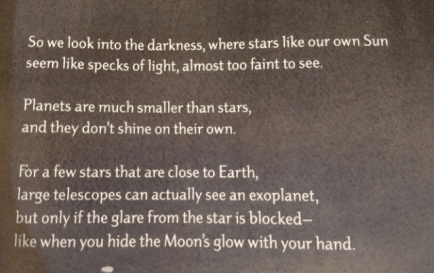
Manley chooses to write with the second person you, and it’s wonderfully effective. After reading this page (and seeing the art below) children will run outside to put their hand up to the sun, see what happens for themselves, and let their mind roam out to the “specks of light” they’ll see in the sky that night.
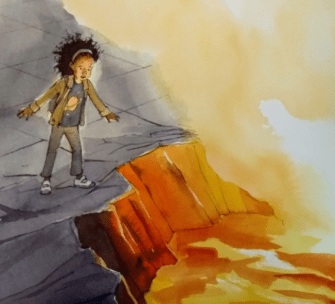
Lanan has picked up on that you in her art with a beauty that, frankly, stunned me. Here’s the illustration that accompanies the words above.

Lanan’s illustrations show the story of this girl and her family on a visit to an exhibition on exoplanets, and–while we basically follow the whole family–the parents and young sibling quickly become ancillary to the girl’s experience. She is the child reader; she is who Manley is writing for. The rest of the family is interested in the exhibition; the girl is completely immersed. She explores pieces of the exhibition her family passes by; she lingers behind in rooms from which her parents are already moving on. Her fascination simultaneously leaps off the page and pulls us deeper into a connection with what she is feeling.

And whoever worked on the layout of the book got it “just right.” (Despite the way my phone is showing it below!)


The words that fill the left page of this spread, which pull us out to the stars visible through only the most powerful telescopes, are balanced with the smaller chunk of text on the right–Manley even uses the words tiny and small to emphasize the comparison. The art on the left side shows the vastness of space; the right focuses our attention on our own smallness and the immediacy of the impact this view has on the girl.
No spoilers about where this book takes you at the end, but I can tell you that I was on the edge of tears when I finished reading it for the first time. This book needs to be in every family and in every classroom, and I hope whoever is reading it has the sense to do so outside with a clear view into the sky.
Peace & Quiet, Plus Family, Food, and D & D
Just got back from a few lovely days of vacation, in one of the most restful places I’ve been. We traveled North to Oregon and stopped about an hour from Bend, outside the little town of Sisters. We picked up our son on the way and met up with my siblings and their families, plus my parents, and distributes ourselves into a few different rental houses. And then, for three days, we each did a bit of this and a bit of that, some things together, something apart.
Basically, each to his own, whatever felt good. And it was lovely.
We ate a lot. Gumbo, bbq, and fajitas–with each sib and sib’s family taking charge one night. An amazing blackberry jam, brie, and bacon sandwich at Spoons in Sisters. Marion berry pies from Sisters Bakery.
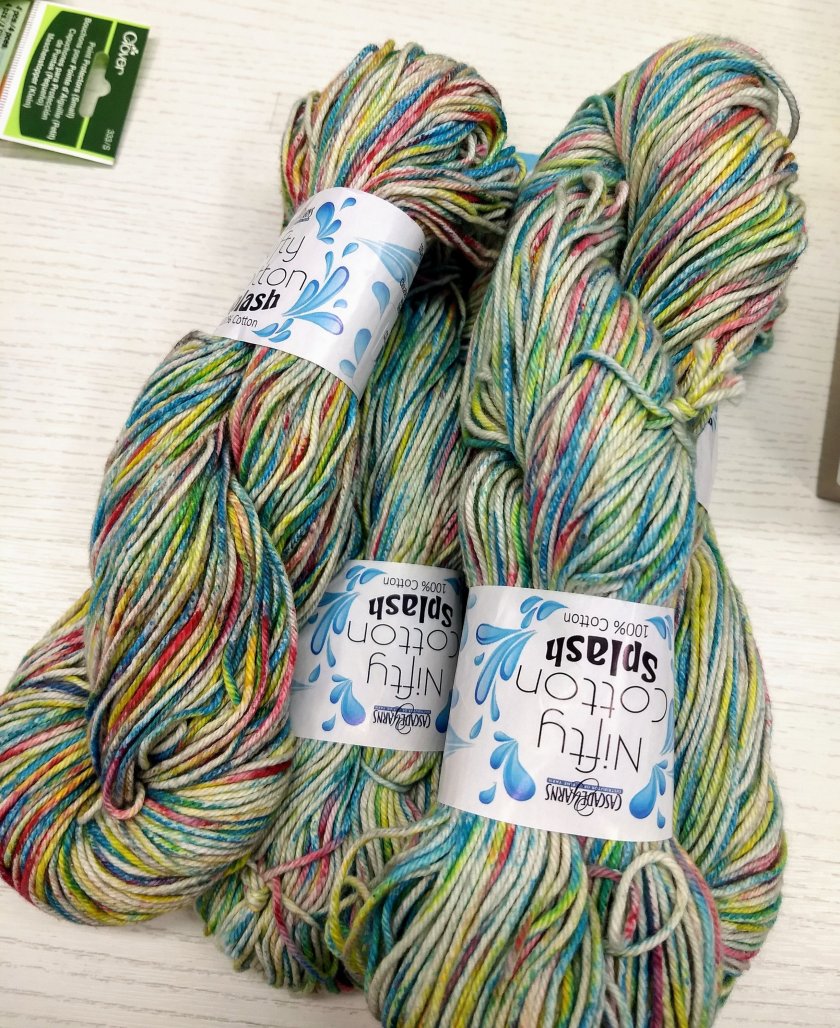
We shopped a little. I bought myself my own copy of The Rabbit Listened by Cori Doerrfeld at Paulina Springs Books, and found some gorgeous yarn at The Stitchin’ Post that will become a baby blanket.

I knitted and read. I got in some revision…not where I want it to be, but a good start. I had quiet one-on-one talks with family members and small-group conversations that, by default, got louder. I played my first group D&D campaign with my son, nephews, sister, and brother-in-law. (I unlocked the cage of monsters before the other adventurers were ready, but I made up for it later by realizing I had a torch and flint in my pack that might be more effective than all the spells and sharp objects flying around.)
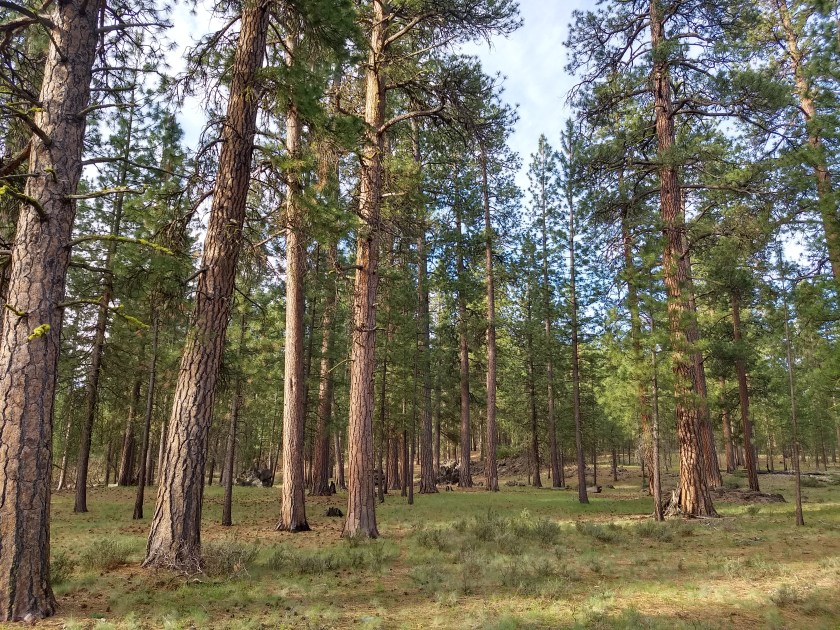
The area in which we stayed was possibly the most quiet place I have ever been. Not a lot of people around–every now and then I’d think I heard a car, then realize it was just the wind. We saw a baby deer so small it had us arguing between deer and rabbit. I did a lot of just sitting and letting my mind drift.
And looking out at this view.

Review: The Remember Balloons
I don’t remember why I put The Remember Balloons on my to-read list. I’m very glad I did, though. The book, written by Jessie Oliveros and illustrated by Dana Wulfekotte, is a lovely story that does an absolutely beautiful job depicting the magic relationship that can exist between a child and their grandparent, what it looks like when that grandparent experiences dementia, and the loss we all feel when that happens. But the particular thing this story does is explore the way that loss can get mixed up with confusion, hurt, and anger–maybe especially, if you’re a young child.

I didn’t actually know what the book was about when I opened it this morning. In fact, the first page–where a young boy tells us that he has “way more [balloons] than my little brother”–made me think it was going to go down some path about sibling rivalry. The next page wiped that away, as the boy shares with his little brother what’s in his favorite balloon–the fun memory of his last birthday party. At this point, I thought the idea of balloons as memory holders was nice, but I wasn’t expecting the power that Oliveros and Wulfekotte give to the metaphor.
Warning: Some spoilers after this point.
Starting with the comparison of his balloons with his little brother, the boy follows that comparison to the fact that his parents have many more balloons then takes us to his grandfather–who has the most balloons of all. They go further, then, showing us how those balloons hold amazing memories–memories that the boy asks to hear about again and again. And then one step further, to a very important balloon–a silver one.

He has the same balloon. It holds a memory of “the day we stood on the dock till the sun went down, feeling tug after tug on our lines. Grandpa and I must have caught a thousand fish.”
Having the boy tell the story, in first person, was the perfect choice, I think. His voice is simple and clean, but words like I and my and we keeps the story close and personal–the reader really is strongly drawn into the boy’s feelings. I, as an adult reader, recognize those feelings, and I think a young child going through a similar experience will recognize them, too.
“Grandpa’s balloons start floating away, faster and faster.
Running down streets and up hills, I watch the balloons grow smaller.”
And then, after a perfectly placed page turn and given a full two-page spread…

I’m not going to spoil the ending, but the crisis is absolutely perfect and the ending resonates with the hope of finding another, new way to connect with someone you don’t want to lose. Not every child will have the opportunity to take the step the boy does, and not every child will feel able to. But books like this aren’t here to present a one-size-fits-all solution, and they shouldn’t–life doesn’t always come with a solution. What this book does do wonderfully is show the thing one child tries, and–by doing so–opens up the possibility that another child–the child outside the book–will find something they can try as well.
There are a lot of books out in the world, created by people who want to help children understand the big, and sometimes bad, things that happen to them. And–let’s face it–to help the adults who are struggling to explain something they don’t fully understand. They’re hard books to write and hard books to illustrate–hard books in which to balance story and support.
The Remember Balloons succeeds on all counts.
Knit-Thinking
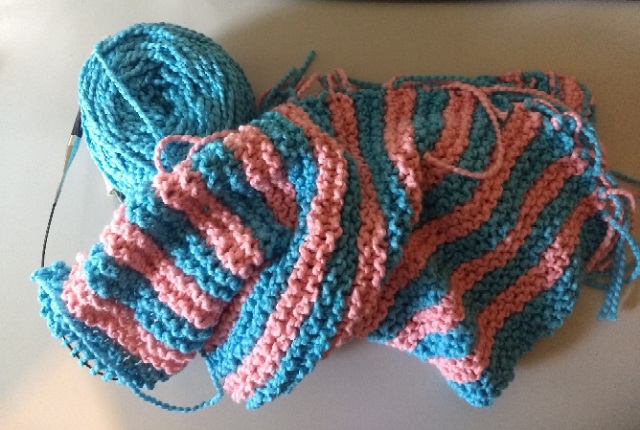
Knit-thinking is what I’m calling my writing sessions during which I use yarn to get me away from my actual computer, making brain-room for actually brainstorming ideas about whatever isn’t working in a WIP.
For years, I’ve heard other writers talk about the activities they do to clear their head so their minds can wander around and some writing problem. A lot of people garden. Not me. Others cook or bake. Nope. Many go for a walk. I love walking with a friend, not so much just me and my brain. So I kept sitting at my computer, forcing myself to keep my fingers off the keyboard for a while, trying to just…think. It wasn’t and still isn’t a completely unsuccessful technique–I do get the occasional idea, and some even work out. But it can be painful to just stare at the screen or off into space, waiting for something to come.
Then one morning, I was really stuck on a WIP and I was craving some knitting time. I decided I would see if I could do any actual thinking, while my hands and eyes were focused on the current knitting project. I put on some music that I wouldn’t be able to sing along to–maybe The Duhks, maybe it was some Klezmer. (I can bop along to music with lyrics when I’m actually typing words onto a page, but not while I’m thinking about what those words should be. The Duhks aren’t lyricless, the words blend in so well with the music, it amounts to the same thing. And I don’t speak Yiddish.) And I pulled out the yarn and needles.

And it worked! It is still working–beautifully. Oh, of course, there are days when I stay stuck, and there are days when I get distracted and mess up on the knitting so badly that I have to let the writing thoughts go and catch all the stitches that are threatening to drop. But the majority of days, I have to keep a notebook and pen handy (along with my morning tea, sometimes a bit of breakfast, and the cat–it becomes a pretty crowded couch). Because the ideas come. When I’ve collected enough, I schedule myself some writing-without-knitting time, take myself back to my computer, and see where the new thoughts take the story. Sometimes they go nowhere, which can mean more knitting, or–if the wall I’m pounding my head against feels particularly hard–picking up another WIP to play with. Which also means more knitting.

I think, even when I don’t make a lot writing progress, I’m still less frustrated. Knitting has become something relaxing for me to do, a bit meditative. And even when I don’t spark with new story ideas, I do make progress with my knitting. (Despite the dropped stitches.)

Do you have a “thing” that keeps your hands busy and your brain active that lets you escape the tension of BIC? What’s your equivalent of knit-thinking?
A List of Books I Couldn’t Find
Yesterday, I went book shopping. I went to one of my favorite stores, where they are wonderful and helpful and where I almost always find something I haven’t seen that looks like something I want to read. I was looking for a book to give as a gift.
But it’s not a big store, and they only have so much shelf space, and I was–for various rambling reasons (some about the giftee, some about me)–looking for a very specific type of book, one that met a list of requirements I had decided on.
Those requirements were:
1. The book had to at least look like it would be written well.
2. The book had to be nonfiction, preferably Science or History.
3. The book couldn’t be heavy or dark. One of the purposes of the gift was to serve as a distraction/escape from today’s heavy and dark.
4. If the book was a history book, it had to be about a woman or multiple women, and it had to be written by a woman. If it was a science book, it had to at least be written by a woman.
Guess which one was the stumper.
Were there history and science books about women?
Yes.
Were there history and science books by women?
Yes.
Were there history and science books about AND by women?
A few. And the ones I found didn’t meet the first three requirements. Was it a sign of the times that I got more and more frustrated at all the books I found about women that were written by men? Absolutely? Was it fair? In some ways yes; in some ways no–I had much less of a problem with finding books about men written by women (although there were a lot fewer, so…you know.) Do I think men should be able to write nonfiction about women and women should be able to write nonfiction about men. Sure. I can instantly give you examples of two excellent books that fall under that umbrella: ‘They say’: Ida B. Wells and the Reconstruction of Race by James West Davidson and Assassination Vacation by Sarah Vowell.
Still. None of this helped my frustration last night. So I did some browsing, and the giftee is going to Chrysalis: Maria Sibyalla Merian and the Secrets of Metamorphosis by Kim Todd. It’s going on my to-read list as well.
And I came across some other titles that, while I haven’t looked to see if they meet requirements 1 and 3; they do meet requirements 2 and 4. And I decided to post a list of these books, the ones I couldn’t find last night, to make me happy and–possibly–to help someone else on their search.
Science
Black Hole Blues and Other Songs from Outer Space* by Janna Levin
The Sixth Extinction: An Unnatural History* by Elizabeth Kolbert
Biomimicry: Innovation Inspired by Nature by Janine M. Benyus
Mapping the Heavens: The Radical Scientific Ideas that Reveal the Cosmos* by Priyamvada Natarajan
A Big Bang in a Little Room: The Quest to Create New Universes* by Zeeya Merali
Venomous: How Earth’s Deadliest Creatures Mastered Biochemistry* by Christie Wilcox
Dark Matter and the Dinosaurs: The Astounding Interconnectedness of the Universe* by Lisa Randall
Storm in a Teacup: The Physics of Everyday Life* by Helen Czerski
Pandemic: Tracking Contagions: from Cholera to Ebola and Beyond* by Sonia Shah
The Epigenetics Revolution: How Modern Biology is Rewriting Our Understanding of Genetics, Disease, and Inheritance* by Nessa Carey
Trespassing on Einstein’s Lawn: A Father, A Daughter, The Meaning of Nothing, and the Beginning of Everything by Amanda Gefter
*I found very few lists that included only women writers of science, so I want to give credit to the one excellent one I did find. These books are all from Swapna Krishna’s Bustle post, “9 Science Books Written by Women To Read When You Need A Break From Fiction.”
History
Hidden Figures by Margot Lee Shetterly (The bookstore did have this, but I figured it was high odds the giftee would have already read it.)
Sisters in Law: How Sandra Day O’Connor and Ruth Bader Ginsberg Went to the Supreme Court and Changed the World by Linda Hirshman
Set the World on Fire: Black Nationalist Women and the Global Struggle for Freedom by Keisha N. Blain
Ada The Enchantress of Numbers: Prophet of the Computer Age by Betty A. Toole
The Witches: Suspicion, Betrayal, and Hysteria in 1692 Salem by Stacy Schiff
Flâneuse: Women Walk the City in Paris, New York, Tokyo, Venice, and London by Lauren Elkin
When Women Ruled the World: Six Queens of Egypt by Kara Cooney
Girl Sleuth: Nancy Drew and the Women Who Created Her by Melanie Rehak
Irish Nationalist Women: 1900-1918 by Senia Paseta
The Hemingses of Monticello: An American Family by Annette Gordon-Reid
Mother is a Verb: An Unconventional History by Sarah Knott
Better Questions This Time Around
I’ve pretty much spent the last year in picture-book revision mode–before the Big Sur workshop to get ready and after the workshop to integrate the feedback I got. I’m sending these stories through my new critique group and then using their comments for yet more revision. But, as I submit to the group and wait for our meetings, I’m finding I have time to play with new ideas and write some early drafts.
The good thing about all this is revision is that I have learned a bit. (As one does.) No, my first drafts aren’t suddenly works of beauty. No, I don’t understand what my hero wants on the first go.
But I’m asking better questions. Questions that, on previous manuscripts, I didn’t think to ask until draft four or draft six or draft nine. Questions that I knew all about from working on novels, but that I hadn’t yet woken up to applying to picture books.
Questions like:
- Who is this character, that they have this specific-to-them want? What does the want say about them?
- What “universal” childhood experience/feeling does that want touch on?
- How does the character approach their attempts to get what they want, and how do they respond to their failures?
- How does each failure lead into the next attempt; how does the big failure shift the character into a new, different story step?
- What powers the character out of the dark place to push, one more time, for their own success? (Thinking again about what that original want said about them.)
And then there’s the biggie that perhaps isn’t/shouldn’t be an active part of early drafts, but that is starting to claim its place in the back of my brain even as I start to put the first words on the page.
What can I do with this story to give it that something extra,
that will turn it into a book a child ask for again and again?
I’m not sure if having a stronger toolkit of questions is going to make my writing process easier or reduce my revision time. But I feel like I’m getting to step into the water at a deeper spot, like I can take my feet off the ground to swim at least a ways out of the shallow end of the pool. I’m leaving the swim noodle behind.
KidLit Craft: Elements of a Picture Book
Aimee Haburjak and Kristi Wright wrote a post over at KidLit Craft that presents a nice, detailed breakdown of the picture book elements they found Wordy Birdy (written by Tammi Sauer, illustrated by Dave Mottram.
Check out the post here.
Keith Negley’s MARY WEARS WHAT SHE WANTS
I love good nonfiction picture books, but I don’t purchase a lot of them–I’m writing fiction, and so most of my book budget goes toward good examples of that genre. Every now and then, though, I come across a nonfiction book I can’t leave at the store.
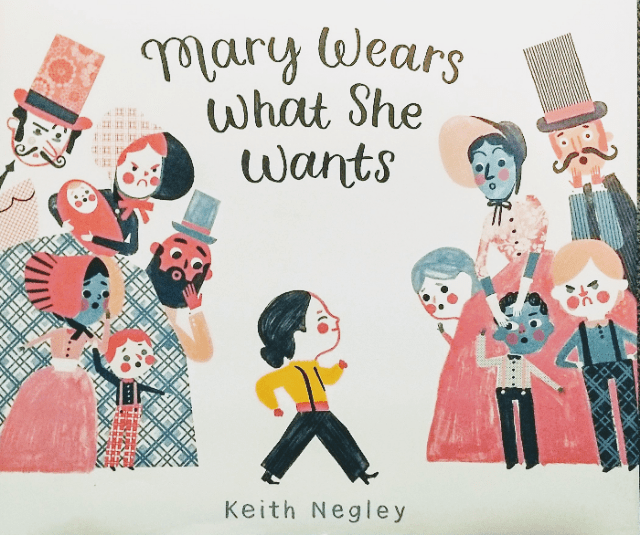
Keith Negley’s Mary Wears What She Wants was one of those–telling, as it does, a snippet of the life of Mary Edwards Walker. The title caught my eye–because it focuses on the fact that Mary is doing what she wants to do, as opposed to the fact that she is wearing pants instead of dresses. As soon as I pulled the book off the shelves, the art caught and held me. Look at that cover–I loved Mary as soon as I saw it. She strides along, head held high, looking straight ahead & not giving the naysayers a speck of her attention. And you could pull me into a debate about her facial expression, but I think she’s wearing a very small smile of determination and freedom.
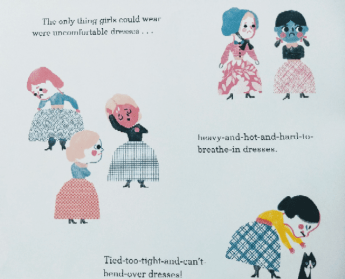
This book seems, to me, a wonderful example of words and art supporting each other. Negley is a writer-illustrator, so maybe it’s a bit easier to leave yourself room for art, but I’m guessing it’s just different. Still, however it is all working inside his head, Negley weaves together text and illustrations magically. Some places, he uses gorgeously concrete words with sparse illustrations, like this page early on, where Mary and other girls face all the problems that come with wearing a dress. (I apologize for what my phone camera does to the font–it’s nice and sharp in the book!)

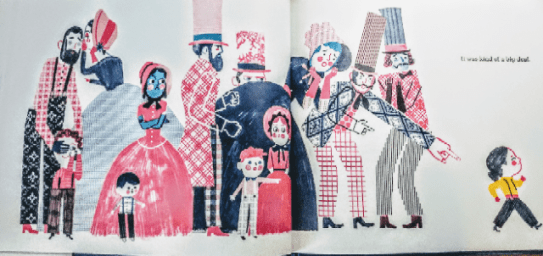
In other places, he flips the balance completely, filling a page or two with art and just a few words. The sentence on the spread below–“It was kind of a big deal.”–is essentially a mike drop (even though the story continues when you turn the page.)

And the story has tension. Despite the look on Mary’s face–and the certainty she has about there being no reason she shouldn’t wear pants–Mary does worry and she is a bit afraid. Mary meets every obstacle head-on, with force and power. I think, though, that–as you read–it becomes clear Mary would be happier if she didn’t always have to be fighting.
Obviously, I think every child needs this book–no matter what gender they identify with, no matter if they are happy or not wearing the clothes people give them. It’s a book about crossing boundaries, opening eyes, and resetting “truths.” Mary Wears What She Wants sets as a standard the right to think for yourself and make your own choices. And shows a path for doing just that.
A Cookie Would Be Nice
First you decide it’s time to do “a little bit” with your website. You look through a few templates and browse some pictures. Then, of course, you find the picture you want, but can’t find a template where the picture will fit. And once you manage to do that, then you are faced with what you already knew but were avoiding–that your content is totally out of date. And the next thing you know, the sun is down, your eyes are tired, and there are still a couple of things you want to do.
It’s like If You Give a Mouse a Cookie, except…right. No cookie.

Still…it’s acceptable, and–as far as I can tell–nothing’s going to blow up. For your reading pleasure, here’s the very useful (as usual) FAQ post from Jennifer Laughran that got me thinking about doing an update in the first place.