Posted in Uncategorized

My New Kindle and What I’ve Learned So Far

Here it is! The guys (yes, per my instructions, but–hey–subtlety is highly overrated)bought it, wrapped it, and presented it to me on my birthday! Let me tell you, that wrapping didn’t last long.
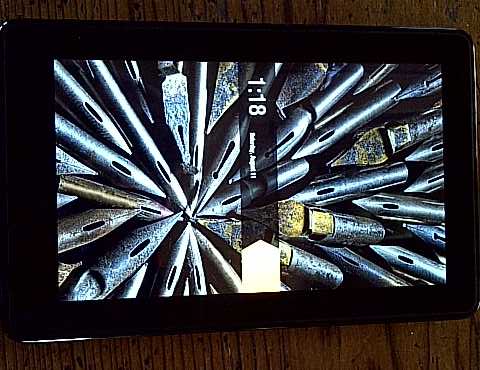
First thing I learned. I adore it!

I read two books on it over the weekend (hey, it was my birthday!), which pretty much verifies that this reading addict, at least, can feed her habit via paper or electronics.

Other things I’ve learned so far:

  • You can take it in the bath. Carefully.
  • Eoin Colfer’s final Artemis Fowl book, The Last Guardian, rocks the series.
  • You can only loan a book out one time. Which means that Son and I got to read The Last Guardian on our own kindles, but–if/when Husband gets one, he won’t be able to. Because, you know, we never pass a print book around through the whole family. Yeah, right. I understand the business model the publishers are using, but…come on, guys! You’re really not going to get me to buy multiple copies. This, you could change.
  • 40+ plus years of cleaning eyeglasses comes in handy for getting all those smudges off the Fire’s touch screen. Which, BTW, is bee-yoo-tiful!
  • My dad told me that his kindle is lighter than the books he reads. Which I think means 1) Dad has a different Kindle than the Fire and/or 2) Dad buys bigger book or more hard-backs than I do.
  • YOU CAN FREEZE THE SCREEN! You know, so when you’re reading in bed and you tilt the kindle sort of diagonally, the page doesn’t go all wonky and flip back and forth between portrait and landscape. Thanks to Son for this one.
  • My library system doesn’t yet have enough Kindle books to make me giddy with delight. But I can be patient, because I love my library, as much or more as I love my Kindle. And, you know, there are still print books I can bring home. The nightstand shall not be empty.
  • Apps. Not so much.
  • You have to (sometimes?!) synchronize your Kindle after you download a book. It doesn’t always show up automatically. Then, again, sometimes it does. I can handle the confusion.
  • The battery lasts a nice, long time, but not always long enough for…you know, a reading addict. And the charging cord they ship with the Kindle is just barely long enough.
  • It drives my son nuts when I put down the Kindle without putting it to sleep. Driving my son nuts=just an added benefit, right?

Pretty much, all good. Pretty much, ALL GREAT. My cover is on the way, so any day now, Son and I can quit getting mixed up about whose is whose, and I’ll be able to prop the thing up in any orientation I want when I’m reading at the table. Which,you know, is a lot of the time.

What about you? Are you an e-reader owner yet? Fan? Not so much? Feel free to share your “learning points” in the comments!

Posted in Uncategorized

Friday Five: Things I Learned This Week While Plotting

Tuesday, I got back to plotting the YA historical. I’d gotten on a roll while on vacation, and I know all too well how, if you don’t jump back on the wheel relatively soon, it’ll go flat and be that much harder to get spinning again. So I took a couple of hours in the morning and a couple of hours in the afternoon, and I worked. Those big chunks of time are magic, as I’m remembering, and I felt like I got to new points of understanding for my story and for how I like to plot.

A few things to share:

  1. Sometimes, sitting and staring actually works. Along with actually letting your brain roam at least loosely over the story possibilities.
  2. The system of assigning a +/- or a -/+ to a scene card makes you think about a) the fact that story is action and change, together b) which direction you want your hero’s pattern of failure & success to shift in each individual scene, and c) what you’re going to make happen to cause that shift.
  3. There really is a story reason for every action or event. Be patient and look for that reason (see #1 above). Believe me, you will know when something feels forced, coincidental, or unbelievable. And you’ll know, as you move things around and look at possible causes and connections, when it all makes sense and works.
  4. This whole Act I, Act II (in two parts), Act III thing is pretty cool. When you move a scene from one Act to the other, you can feel the shift in balance, weight, and power of that moment, the whole story. Once again, I’m remembering how much I worship structure.
  5. I really do like Scrivener scene cards more than paper index cards. I can jot down all my notes and thoughts, without any space limitations. I can do that jotting by typing, which means I can actually read what I’ve written. I can cut and paste and delete, without inked-up scribbles making the whole card a useless piece of confusion. And I can work with Scrivener’s color-coding, without having to recopy and tear up a card every time I decide that it’s Red, for Daniel’s storyline, instead of bright blue, for Abe’s.
Posted in Uncategorized

Thankful Thursday: My Reading Addiction

So I’ve been musing about this post for a while. Basically, I’ve been thinking about how much I read and where that time comes from and what I get from the actual reading. And I’ve been hesitating about writing up the post, because I was a bit afraid of sounding whiny (about having to sometimes put reading aside to get some other things done), or braggy (about how many books I do read), or defensive (like: it is so not a waste of precious writing time when I pick up someone else’s book).

But then Jennifer R. Hubbard put up a little post about why reading is so absolutely wonderful and necessary, and I thought, Oh, just write the damned thing. And make it a gratitude post, and you won’t be able to whine. Much.

I think this whole thought-path started when I decided to keep count of how many books I read this year. I see other people talking about that on their blogs, and I got a bit curious about what my number would actually be. So on January 1st, I started keeping track. I’m not counting picture books, not because they don’t count–value-wise–just as much as a novel, but it takes me such a short amount of time to read one, I felt like I’d be cheating just to inflate my count! (Yes, I can go loopy over just about any issue, why do you ask?) And I wasn’t going to keep track of research books, unless I read them cover to cover, rather than jumping around between the topics I really need to learn about. So, basically, that left me with novels and memoirs, many of which I knew would be (and have been) rereads.

As of today, I’m at 151 books.

I read a lot.

  • I read while I eat.
  • I read while I cook.
  • I read when I take a bath.
  • I read in the car (parked!).
  • I read at night before I go to sleep.
  • I read on the couch for luxuriously long sessions.
  • I read instead of doing a better job cleaning the house.
  • I read instead of choosing a complicated recipe that will require me to spend more time at the stove, thinking about what I’m doing.
  • I read instead of meditating.
  • I read, some days, instead of doing yoga.
  • I read instead of writing.

Pretty much the only item in that list that has the potential to bother me is that last one. Because, yes, if I’m tired or stressed or worried about what I’m going to write, I will pick up a book rather than a manuscript.

This is not so good. I don’t actually worry about it too much, because I know how much I get from reading, not just for my sanity but for my writing skills as well. I am halfway through a book that I’m enjoying, but guess what–it’s making me remember that world-building, cool as it is, can’t take the place of action and conflict for too many pages or I start skimming over it. I just finished a book that wrought such a perfect balance between its world-building and its story that I need to put it on the list of books to study. I get inspired by what I read, and I go back to my own writing recharged and remotivated.

Still, if one was crazy enough to look at it in terms of hours, it’d be hard to miss the number of those hours that I would have available to write…if. If I slowed down on the reading. If I set writing requirements for myself, with reading rewards. If I only brought home three or four books from the bookmobile, instead of ten or twelve. If, if, if…

Not going to happen. My husband spends hours and miles on his bicycle, because riding does pretty much the same thing for him that reading does for me. (If you ignore the fact that none of those reading activities I listed actually does a thing for my physical health.) It’s why we back each other’s habits–not just because we’re nice and kind and supportive. Because we know what it would be like to live with the other person if they didn’tget all that time with their bicycle/books.

I shudder to even think about it.

So, yeah, the reading will continue. Let’s just say the voracious reading will continue. Yes, this year, I’ve got some big writing goals, and I know I’m going to push myself to keep at them. So, okay, maybe the reading-to-writing ratio will shift just a little bit in a new direction. Which would be okay.

The house-cleaning, though? Don’t get your hopes up!

Posted in Uncategorized

Photo Blog: Family Road Trip 2012

Okay, so after a careful, thorough,  and extremely scientific analysis, I can tell you that–for me and my family–a vacation consists of an adventure or two (or not, for those who don’t so choose); a lot of late, but large breakfasts; quite a bit of driving; some goofiness; books; and about one museum. Music shops, in the plural. Coffee and candy whenever and wherever they show up. Maybe a movie (Yes, I did go see THE DARK KNIGHT RISES. Overall feeling? Not bad. But..yeah, you can take the Marvel-comics girl into the DC theater, but you can’t make her switch teams.)

I don’t take a lot of photos. Even if you’re just looking at a percentage of the whole count, I don’t take a lot of good photos. But, for your perusal, because we all love travel pics (???!!!), here are a few shots and notes from the trip.

The guys started with a day underground. They spent four happy hours, as the only people other than the guide, doing all the ups and downs and ins and outs of the Middle Earth Expedition at California Caverns. I have no photos, because why? Because I am the claustrophobic one in the family, and no tantalizing descriptions of an underground lake (very cool thought!) and lots of goopy mud requiring you to wear high-top shoes (also pretty cool thought, if only in theory) are getting me into those caves. Or those tiny, tinyvcracks in those caves. If I want to get totally stressed out and anxious and trapped-feeling, I can always reread Nevada Barr’s Blind Descent (which, if you haven’t, you should!).

What did I do instead?

I plotted. I had told myself that this was my chance to get something going on the plot of my YA historical. I was definitely feeling a bit like the book was headed toward a drawer, which wasn’t making me happy, but I was also feeling very not willing to keep bumbling/rambling around anymore. I’d finished Donald Maass’ Writing the Breakout Novel and most of Save the Cat,  and I had lots of story thoughts and notes. I took those and my Scrivener software, and I got lots of scene cards up for Act I and Act II. I still have some way to go, but now that way feels possible. Happy work to come!

The caves are in the California foothills, so we stayed in Angels Camp, which is the town Mark Twain talks about in The Celebrated Jumping Frog of Calaveras CountyAngel’s Camp has a lot of frog statues and art. Personally, I liked this one.

The next morning, we went to our one museum, at Railtown 1897 State Historic Park. If you like trains and/or history, this is the place for you. My husband does like trains (I had to leave him for 3+ hours once at the Sacramento Train museum before he’d had even close to enough time to make him happy.) And I’m pretty good with history these days. My son knew the music shops were coming, so he was very patient. Like I said, not a lot of photos, but does anyone else love how this looks like a big train stable?

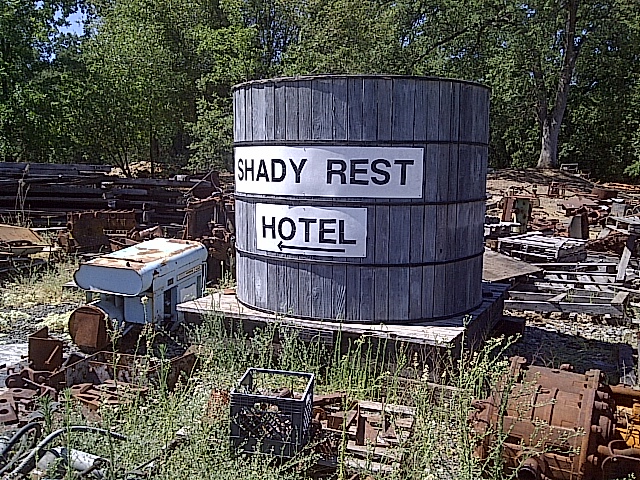
And, apparently, I didn’t catch a photo of the water tower from the opening credits, but does this bring back TV memories for anyone of you?

For a better “clue,” go here.

Starting near lunchtime, we drove up and across the state and ended up, very tired but happy, sleeping under the trees in Humboldt Redwoods State Park. If you like redwoods and could skip the bother of setting up a tent to keep out the damp, I can highly recommend the Burlington campground here. Wherever else the fog was, and it was a lot of places, it was never in our campground at the same time we were. So we were able to just put down sleeping bags, curl up, and wake to this view.

Okay, this is actually a better view than I woke to, because, obviously, I wake up without my glasses. But as soon as I groped around and put them on, this is what I saw. Gorgeous. I’ve been around redwoods all my life, but I always forget how amazingly warm and friendly they are. Really.

We pretty much meandered through towns for the next day or two. We had breakfast at the Samoa Cookhouse, near Eureka, where I saw this stove in their museum.

Definitely bigger than Caro’s mother would have had, and I have no idea of the when of this stove, but it was good to see something even similar up close and personal. I liked how the waffle iron was set down into the burner spot–so it was either a burner cover or a waffle iron, depending on your current need. Which, you know, would most likely be waffles.

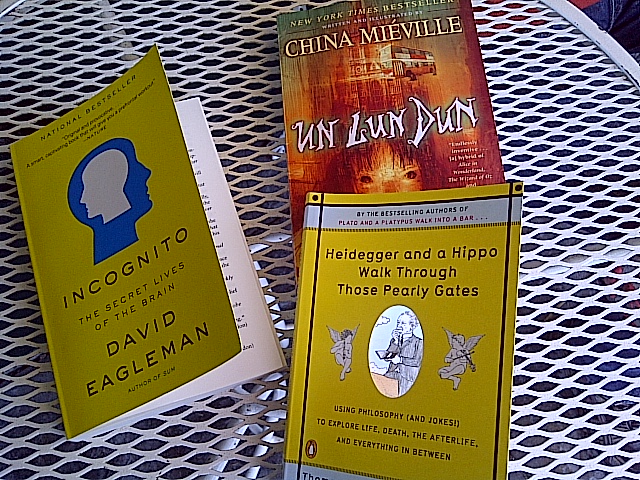
We did bookstores, a little sunshine, and coffee/tea/lemonade in Arcata. The reading selections of the day:

And we drove home. Stopped at one more music store, where my son bought himself a new ukulele–an upgrade from the one he’s had a while and perfect for a traveling-around instrument. We were all pretty tired by the time we saw this, but it always means about an hour left to the trip, so it’s a welcome sight.

And now, as they say, reality begins again. Came home feeling like, yes, I’d been away–which is always good–and that there were good things waiting for me here. (Along with the good things, those two guys, that traveled with me, of course!) I have picture books to draft and revise, and I have a plot to push through to the end. And a novel to write that, finally, feels like it could actually happen.

Life is good.

Posted in Uncategorized

Five Things I Learned at Work this Week

Okay, honestly, two weeks–my first two weeks on the new development/grant-writing job.

  1. When you’re “of a certain age,” the best desk chair is the one that makes you sit up straight.
  2. Budgeting can actually be fun, when you’ve got a workshop teacher who sees said budgets as “telling a story.”
  3. A seven-minute commute is just as stupendously fantastic as you predicted it would be.
  4. Your teenage son can (totally and easily) survive fewer hours of your scintillating presence than he is used to being tortured graced with.
  5. New [people, places, tasks: take your pick!] shake up and wake up your brain.

Here’s to change–the good kind, anyway!

Posted in Uncategorized

Critique Comments: Remembering to Give them Time

Yes, I’ve written about receiving a critique. I’ve spoken to groups about receiving a critique. I’ve received critiques. Time and time again. You’d think I would remember, right up at the front of my writing and revising brain, the most important parts of the process.

Oh, if only I were that good.

Here’s the rule: Don’t always assume your initial reaction to a critique comment is going to be your final reaction. Or even just your second and third. So, so often, feedback from one of your critique partners makes you shake your head vehemently (to yourself, of course!) and scream a silent, internal, “No!” They suggest a character or plot change, a major shift in voice, and all you can think is how wrong they are. How absolutely crazy wrong.

Um…

Don’t lock the door on that belief. Don’t drop it into a pile of wet concrete and let everything harden around it. Because, odds are, you’re going to get to a point in revision where you want to take it out again and look at it. Closely.

It happened to me (again!) last week. I’d had a critique session on a new picture book, and one of my wonderful critique partner had talked about getting the action to more fully and accurately bring out the theme of the story. Now, it’s just possible that, in all our years of critiquing together, I may actually have never mentioned my aversion to the word theme. Yes, I know it’s important. Yes, I know stories have them. Yes, I know it’s something I should be at least understanding about my writing, even as I carefully work not to hit the reader over the head with whatever it might be for any particular book.

That doesn’t mean I have to like it.

Anyway, so of course, unbeknownst to my critique partner, my hackles were up at the first sound of the word. Which may have had something to do with my initial (internal!) reaction to her description of what the theme was in the picture book.

Critique Partner: So the theme is …..

Becky: The theme is SO NOT….!!!!

Hopefully, I kept my face blank and/or semi-smiling so she didn’t get the full blast of that response.

Anyway, you can see where this story is going. I sat down over the weekend and did my usual first step of revision: reread the critique comments. When I got to this critique partner’s notes about the theme, I was still shaking my head, but it was a milder shaking–with a bit of an amused and tolerant smile as accompaniment. Hey! You’re going to have these feelings. You’re going to turn into an intolerant, conceited, patronizing jerk when you get feedback, and it’s okay…as long as you do it in private! It’s a defense mechanism, we all have them, and they need to be let out occasionally–off-leash–or they get really cranky.

So I put the comment aside, and I started thinking through the other problems I knew were there, as well as the other more head-nod-provoking suggestions from this critique partner and the others. And pretty soon, I was doing what all good critiquers get their pet authors to do: asking myself questions about the story. Questions like: How can my little hero direct more of the action? Why does that secondary character react differently to him than everyone else does? What is that other guy’s problem, and what is he afraid of?

And pretty soon, despite (or probably because of) that one comment about theme, my brain circled back to it–this story’s theme. With a slightly different take at first, but one that, ultimately and totally connected up with the original definition from my crit partner.

What did I do?

  1. I sighed.
  2. I thunked my head a few times on my desk.
  3. I posted a paean of gratitude (AKA a buried apology) to my critique partner on Facebook.
  4. I took more notes about the new (and better) revision path.

The moral, once again, is sometimes your gut reaction is not the best one to follow for your writing. Yes, trust yourself. Yes, value your own experience with and understanding of your story. But listen to the people who have come from outside your story to read it and help you with it. Whether it’s the newness of an idea, the shock to the system of a direction so totally different from where we thought we were going, or even just an irrational fight-or-flight response to something we’re not sure we can handle…there are lots of reasons we react negatively to critique feedback.

And, believe me, there are lots of reasons to take a second look.

Posted in Uncategorized

And the Writing Path Takes Another Curve

I’ve actually known this curve was coming, for, oh….more than ten years. This is the curve I promised myself all that time ago, when it made sense–sanity-wise–for me to stop working as a tech writer and do the staying-home thing with my son. Yes, I kept busy, obviously. I wrote my fiction, and I did some freelancing, and–you know, wrote The Writing & Critique Group Survival GuideI always knew, though, that unless my writing really took off (and I mean really, as in something like being the next J.K. Rowling), I’d be going back to work.

Last Monday was the first day at my shiny, brand-spanking new job.

I’ve spent the last year doing volunteer development work for a local museum made up or an Art museum and a History museum. This summer, we all agreed that it was the right idea for me to transition out of volunteer and into employee, with–of course–more hours.

It’s time. I hadn’t realized until Monday how ready I am for this. I love my fiction, oh, yes, I do, and it’s not going anywhere. But I’d forgotten the energy of actually being busy from a deadline. From multiple deadlines. I’d forgotten that feeling of accomplishment as one task after another gets done and checked off the list. I’d really forgotten the feel of working with more than one person, face-to-face, rather than over email. I’ve been getting a taste of it for the past year, but it really hit full-force this week. In a good way.

Years ago, I was a docent at Ashlawn, James Monroe’s historic home in Charlottesville. At that time, I thought I’d come back to California and get a job in another historic building, but that didn’t happen. Closed-captioning and technical writing came along instead. The thought, though, has always been at the back of my mind. And now? I’m spending my work hours either in an old, adobe fire station or a mill annex, the first building in the town. Life comes in a circle, sometimes. And did I mention both buildings are less than 10 minutes from my house, giving me about the best commute I could ask for in the Bay Area.

Some things are still a bit surreal. How long eight hours really is, and how short a time it can be when you’re truly busy. How much older my back has become in the intervening years since my last “job.” As far as I can tell, I snapped my fingers, no time passed, but my back became suddenly much pickier about chairs. I’ve got yet another email inbox. The to-do list feels just a little bit like The Blob–expanding at an amazing rate. I’m home less and, with it being summer, seeing my son less. It’s a part-time job, which is working well, but still…this last week, it was him staying home and me going out. Yeah, weird.

And then, to be honest, yes: there is a bit of anxiety and panic about my own writing. It’d be easy to look at the last years and then look at myself and say, “Well, you didn’t really do much with that window of time, did you?” It’d be easy to look at the future and ask, “Exactly when/how do you expect to get your fiction done and published now, if you couldn’t before?” The Evil Editor has a twin: The Evil Life Planner. Well, my goal is to pay them both equal amounts of inattention. Because if there’s one thing I’ve learned, it’s that panic is pointless. Wait…picture it on an embroidery sampler: Panic is Pointless. I will write. And I will revise. And, somehow, I’ll fit it in with all the other things I need and want to get done. There’s been a bit of talk around blogs and Facebook lately about how the phrase A Writing Life has two, equally important, elements: writing and life.

And, frankly my dears, I plan to have them both.

Posted in Uncategorized

EYE OF THE STORM: All the Things Kate Messner Did Right

I just finished reading Kate Messner’s Eye of the Storm. Great read. It’s a fast-paced adventure story, a well-done dystopian, and an excellent exploration of real choices that real kids have to make. I was going to put it down for a while Sunday morning and get some of my own writing done, but I couldn’t. So, yes, I blame Kate for my not digging into a picture-book revision this weekend, but, hey–she got me thinking, once again, about possible revisions for my middle-grade novel, so…it’s all good.

Anyway, I’m not going to go into much talk about the story itself. You can check out the blurb here, at Kate’s website. What I want to talk about is Kate’s writing craft, which impressed me so much on every page. As I read, I just kept thinking, Wow, a different writer would have done this, or another writer would have backed off from this…So today I’m blogging about all the things I think other writers would have done with this story, things that would have made it weaker, more cliché, less tense and less engaging. Basically, I’m going to tell you everything I think Kate did REALLY, REALLY right–but in reverse.

Side note: I want to make clear that I am totally including myself in that category of writers who wouldn’t quite have managed what Kate pulls off so beautifully. That middle-grade novel I mentioned has been sitting on a shelf for quite some time, basically stagnating from one big flaw. One BIG flaw. I know what it is, I know what’s missing, but I haven’t yet figured out how to revise to get rid of that flaw. I’m not saying I’ve got it down, but reading Eye of the Storm definitely showed me how someone else (yes, Kate) addressed and solved the issue in her book. And while I know she did that for her own story, not mine, I’m seriously grateful.

Anyway, for a Monday morning, here’s me thinking about what other writers would have done…

  • Other writers would have forgotten the little, concrete details about how life is different in Jaden’s world, where the weather has gotten so extreme that people’s lives are basically ruled by the threat of massive tornadoes. Not Kate. There’s a beautiful moment when Jaden gets a new bike, and she has a great memory about the one friend who insisted on riding her own bicycle long after everyone else gave theirs up–even though the only safe way to do it was by staying on your own street, riding a few yards one way, then turning around and heading back. Tiny circles. Beautiful.
  • Other writers would have chucked friendship and intelligence for tension and conflict. Now, we all know I’m a big fan of tension and conflict, but…when characters act like idiots just to achieve that conflict, nope. I don’t want to give any spoilers, but another writer would have made Jaden’s friend Risha jealous of Jaden’s successfully budding romance with Alex. Kate didn’t. Another writer would have put the stepmom and the mother in conflict, just because, well…stepmoms are always bad, right? Nope. Kate didn’t. She let the characters stay intelligent and stay supportive. And it all felt real.
  • Other writers would have stopped the crisis a lot sooner, made the bad stuff take up one page or two in the middle of one scene, and then be quickly resolved so that the world could turn happily again. Sometimes, I think, we get a bit caught up in turning our heroes into superheroes, who just need to get to the right moment, snap their fingers, and make everything right again. Kate didn’t. The crisis escalates and gets worse and gets her heroes in deeper. It doesn’t feel contrived, it doesn’t feel too long, and–believe me–it’s why that picture-book revision didn’t get started.
  • Other writers would have taken more responsibility off the hero’s shoulders. Not Kate. As things get bad, Jaden makes things worse. REALLY WORSE. She already feels like the big problem of the story is, in part her fault, and in the crisis scenes, she makes that belief come true. Which pretty much means that there is only one person who can fix it–yep. Jaden.
  • Other writers would have forgotten the dog. Sorry, you don’t get an explanation of this one, because I’m not giving things away, but I’ll just tell you that Kate knows exactly how to make a problem really matter, at the emotional level. The level at which a character has to take action.
  • Other writers would have drawn out the decision-making, the time spent on getting the character to take that action. You know–more waffling, more dithering, more back and forth of should-I, shouldn’t-I. Not Kate. She gives just the right amount of time to Jaden’s indecision–the amount that is reasonable and realistic, given what’s at stake for Jaden when she does decide. And then, yeah, she hits Jaden with the absolute perfect thing to push her over the line, to make her say “Yes,” and move forward. Exquisite.
  • Other writers* would have made the conflict a lot farther away from home. Again, I’m getting close to a spoiler here, but let’s just say that the bad guys in this story aren’t separated from Jaden by geographical or emotional distance. What the bad guys do doesn’t just matter on an objective, save-the-world level, or even just on a here’s-a-puzzle-to-solve level. The bad guys’ actions hit Jaden hard, personally, which pretty much adds all the conflict I could ask for and keeps that story-tension running high, high, HIGH.
  • Other writers would have let people off the hook at the end, to get that happier ending. Kate gives everyone what they’ve got coming. There’s a very real satisfaction to the consequences of the story, not a feeling of revenge or just desserts, but of having it all make sense. And be believable. Kate understands that her readers understand–she gives them credit for the same intelligence she weaves into her characters, and it all works.

*This is my biggie. This is the thing I’ve been struggling with on my MG, and this is the thing that just jumped out at me from EYE OF THE STORM to shout, “Hey, look how Kate did it!”

There you have it. Go out, pick up a copy if EYE OF THE STORM. And let Kate show you what she’s shown me. And, for a little more from Kate, check out her summer blog series on online lessons: TEACHERS WRITE!

Posted in Uncategorized

Friday Five: The Birds

No, I’m not talking about the Hitchcock movie. I’m talking about our back deck.

Every morning, my husband takes out a cupful of bird seed and scatters it along the deck railing. On the table. Along the ground. Then he whistles.

And they come. Oh, do they come. Our regular are:

1. Stellar Jays. Or as we affectionately refer to them: Pig-Birds. These guys come to gobble up whatever we put out there, although I’m not sure how they can eat, what with the squawking and squabbling they do. They land and take off rapidly, they hop at each other to establish some kind of temporary dominance, and they turn their back on the woodpeckers (see below) as if they think this means the other birds can’t see them. Definitely my husband’s favorite.

2. One Scrub Jay. Yes, just one. Okay, maybe there are two, but we never see them at the same time. I know a lot of people prefer the Stellars, in terms of sheer amazing beauty, but–believe me–after fifteen minutes of loud, boisterous, gorgeously BLUE Stellar Jays trying to assert power, one solitary Scrub Jay brings along a subtlety that has its own kind of appeal.

3. Acorn Woodpeckers. These guys hold the true power among the birds, as much as the Stellars try to pretend otherwise. It must be the beaks, right? Because they’re no bigger than the Stellar Jays, and they come nowhere near to outnumbering the Jays on our deck, at least. But, boy, an Acorn Woodpecker lands, and the Jays take off. Yes, they come back, but there’s a space around each woodpecker that they don’t venture into. I guess, if you’ve been sharpening your beak on an oak tree for your whole life, you’re not too worried about a Jay with attitude. Because, for you, it’s only attitude.

4. Juncos. These are my favorite. I leave the attention-demanding Jays to my husband. The Juncos have an intelligent quietude toward them. They don’t get squawked at or chased away much by the Jays, and–for their part–they don’t bother the Jays. They hop around the railing and down on the ground, and they’re perfectly content to hang around into the afternoon to check whether there’s anything left from the morning feeding. They also hang out in the plants at the front of the house, just outside my office window, rustling leaves and doing little flits of movement that I can only just catch out of the corner of my eye while I work. The last week or so, we’ve seen a few juveniles. They hang out with Dad, and–I think–he helps to feed them, even though they’re as big as he is. At least, I think that’s what he’s doing when they touch beaks. Maybe, though, they’re just friendly little parent-child kisses. Whatever–very sweet!

5. Doves. I won’t go on, because I know everyone loves doves. Not me. Ever since I had about a gazillion of them outside my bedroom window, my last year of college, when I lived on Balboa Island, that cooing has driven me crazy. The Jays try to chase the Doves off, and–frankly, I’m cheering the Jays on–but it doesn’t work. They are just too stupid to get that they’re being pushed around. Or to stop cooing. Sheesh.

We have a couple of other occupants on that deck. We sometimes get a couple of Black-headed Grosbeaks and an occasional California Towhee, who I love–such a beautiful pinky brown and hard to watch for any amount of time, because he takes off quickly. We have ONE SQUIRREL that has found its way to the feeding party, and let me tell you, that squirrel does not leave much for the birds. Once he’s there, even the woodpeckers don’t mess with him (HOW does a squirrel outrank a woodpecker beak?). And while the birds peck and grab, that squirrel is like the most powerful vacuum cleaner you’ve ever owned. He pretty much moves along the railing and hoovers up everything there. I wish I could get my pots and pans that clean. I like the squirrel better than the doves, but still…I wouldn’t mind him sharing just a little more, so the Juncos would have more to come back to in the afternoon.

The last member of the deck club? My cat. If she gets herself established out there, usually in the shade under one of the chairs, the birds will show up and nobody bugs anybody else. They must realize she’s there, right? But she’s old and deaf enough to just lay there and enjoy the sun and the view, and the birds keep eating along and hanging about. Animal dynamics: Go figure.

I don’t consider myself a birder. The idea of a life list fills me with intimidation and panic. But something about having lived in this house for almost 20 years and watching the comings and goings, the new arrivals, makes me feel at least a little connected to “our birds.” At least enough to keep buying that bird seed.

Posted in Uncategorized

Summer Time

A while ago, I wrote a whole post here about the difference between time in the summer and the rest of the year. The Internet ate that post (with a little help from me), but I keep having reminders of this feeling: that time moves differently during the summer. Sometimes slower, sometimes faster, but really not the same as in the other seasons.

June was two weeks straight of camp, then a busy 4th of July week with people coming and going, including me, and son practicing for his first band gig that Saturday. Where are we now? Camp is over, summer homework is starting to rear its semi-ugly head, and I’m just letting myself transition gently into yet another pace of living.

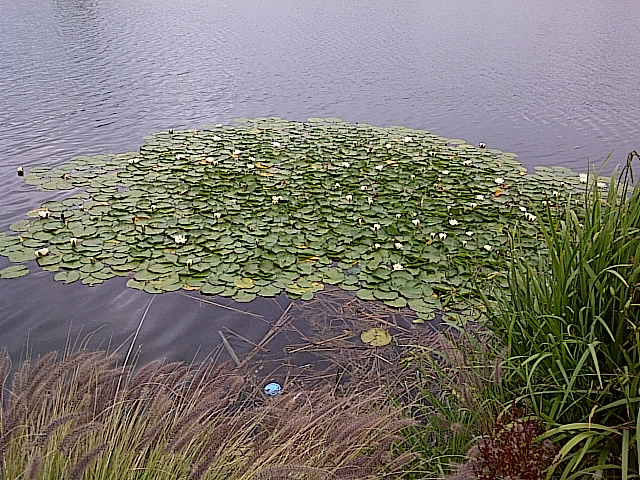
Which, this week, means walks. I’ve got three Walks With Friends on the calendar, and I’m hoping all of them come off. It’s a good indication to me that I’ve been just a little too introverted, maybe even just a little too focused on head-calming-yoga, when all of a sudden I both want to get out and stretch my legs and reconnect with…oh, everybody. Today, I got up just a little early and met with Terri Thayer, one of my critique partners, to get in a creek-trail walk before our meeting. We walked a creek trail that we’ve often walked before, and we talked and talked. This is why Walks With Friends work so well for me–I don’t even notice the exercise. Sometimes, I don’t even notice the scenery, especially when it’s a familiar path and I can trust my co-walker to navigate. (I can get lost anywhere/anywhen if I leave the directional decisions to myself.) Today, though, I did notice. And I saw this.

A huge mass of lilypads. Now I must have seen lilypads before. In fact, someone in my family is going to say, “DAD has lilypads in his pond.” But I have never come across yards and yards of them, with those huge, amazing flowers (which you can barely see) all over them. It was one of those surprise moments, one that pulls you out of the talking place, out of the hand-waving, laughing, story-telling, ignoring-all-nature place and says, “LOOK!” And, for all I know about lilypad blossoms, one of those moments that could only happen in the summertime?

What’s different about the pacing, the moments, in your summer. And what do you do to make sure you enjoy whatever it is?