Posted in 2021

My Word for 2021: Surf

My word for this year, Surf, started off as a joke on social media, when I was commenting on the challenge of picking a word for a year that seems filled with unpredictability. Once I’d tossed it out there, though, the word kept coming back to me. And the more I thought about it, the more I liked it. That very unpredictability we’re facing makes me want a word that will help me do a better job of taking things as they come, riding whatever wave I’m on at the moment, and not taking a header every time a big one hits.

Last year’s word was Happy, and I thought about taking a do-over on 2020 and using the word again for 2021. But there have been plenty of times in 2020 when I was happy and–along with that–very aware of how my happiness was in direct contrast to the lives so many other people have been living. Happy has a weight for me right now that it didn’t at the beginning of the year. It has layers that are hard to deal with, layers that–when I am tired or stressed–I’m not up to looking at directly. So, while I expect and hope for more happiness in 2021, for everyone, Happy is a word with too many tangles for me to re-choose.

2021. I am fairly certain that we will have a new President & Vice-President on January 20th, and I am fairly certain that vaccines will continue to be distributed. But beyond that, I’m not making any guesses. 2020 has been a sharp reminder of how much I need to work on staying in the moment, because the rabbit holes I could, and did, go down were more dark and twisted than any I remember. For me staying in the moment means being staying flexible and looking just far enough ahead to make choices that will help me stay balanced. So…Surf.

In her post today, Erin Dionne broke out a few areas of her life where she wants to direct her word (Invest). I liked that a lot, so I’m stealing her idea for my post. In 2021, here are some of the waves I want to ride:

News and Politics

The past four years, I’ve been more aware and more involved than ever before. And, for all the stress, this has been a very good thing for me. It’s important to me that I don’t drop this engagement. I have all my fingers and toes crossed that Georgia will elect Warnock and Ossoff to the Senate but, even if they win, it’s going to be a hard, hard road. I want and need to stay on top of things, to step up whenever I can, to speak out and be heard. But this is also the wave that, more than any other, challenged me in 2020. I may not be able to hang 10 on this one, but I think I can keep from being bonked in the head with my own board.

Family and Friends

I have been incredibly lucky–my family and friends are staying healthy, and they’re staying financially stable. It has been hard not seeing them in person, but I am grateful that they are all taking this pandemic seriously and doing their very best to be safe. With the vaccines out there, I can feel my hopes rising–I’ll be able to visit my parents and sisters in 2021! And I can feel the hopes dip–maybe I will, maybe I won’t. We have Zoom, we have telephones. If/when the numbers decrease, I may feel comfortable doing socially distanced walks with a few friends. But this is a wave like no wave I’ve ever been on, and I need to ride it gently.

Writing

I know so many writers who have struggled with getting writing done this year. For me, after the first few months, my writing became the gentle wave that felt almost like standing on the sand. It gave me something to escape into, to spark my mind, and to feel hope about. I came up with ideas and stories that are stronger, in their foundations, than anything I’ve written before–it is so reassuring to know that I am actually learning and strengthening my craft. I’m staring 2021 off by paddling my writing board out to the bigger waves. Tomorrow is Day 1 of Storystorm, I’ll be signing up for my first year of 12 X 12, and I’m starting a multi-week picture book workshop in a couple of weeks. It’s going to be a windy ride, but it’s also a wave that, if I wipe out, I’ll know I’ll land in warm water and easily climb back on my board.

Health

I was going pretty well with keeping up my yoga practice for most of 2020 (thanks in good part to Adriene), but–as usual–I’ve slipped a bit over the holidays. I learned long ago that if I tell myself I have to do any physical exercise on certain days at certain times, my brain basically says, “No, I don’t,” and the surfboard just stays in the closet. I am aiming for 2 or 3 days of yoga, more days of simple things like push-ups and squats, and as close to daily meditation as I can get. But each day will be a choice, based on how I feel and what sounds best.

I had a mini-scare a few months ago when I did some routine lab work and my sugar numbers came back too high. I found a dietician who I click with. She’s knocked me out of the certainty that I have to eat fewer and fewer calories to be “healthy.” She’s gotten me to add a LOT of fiber to my daily eating (now’s the time to buy stock in beans, folks!). She’s checking my progress with BMI (pinches, not math formula), and I’m not getting near a scale. I’m finding that each meal is its own wave–one on which I make food choices that feel right at that moment, rather than deciding ahead of time that I have to eat this way or that. So far, the results have been good, and I haven’t felt deprived once. I am determined to stay on this board.

My life has been a progress from holding tight to what “should” be happening to learning to loosen my grip and face changes as they came. I am freer and more relaxed now than I ever was as a teen or young adult. 2021 seems the right year to take that progress a step further, ease up even more on the control, and respond to each wave as it comes.

I wish you all the happiest of New Years, and share my hope that 2021 will be a year of release and relief.
Posted in Uncategorized

Knit-Thinking

Knit-thinking is what I’m calling my writing sessions during which I use yarn to get me away from my actual computer, making brain-room for actually brainstorming ideas about whatever isn’t working in a WIP.

For years, I’ve heard other writers talk about the activities they do to clear their head so their minds can wander around and some writing problem. A lot of people garden. Not me. Others cook or bake. Nope. Many go for a walk. I love walking with a friend, not so much just me and my brain. So I kept sitting at my computer, forcing myself to keep my fingers off the keyboard for a while, trying to just…think. It wasn’t and still isn’t a completely unsuccessful technique–I do get the occasional idea, and some even work out. But it can be painful to just stare at the screen or off into space, waiting for something to come.

Then one morning, I was really stuck on a WIP and I was craving some knitting time. I decided I would see if I could do any actual thinking, while my hands and eyes were focused on the current knitting project. I put on some music that I wouldn’t be able to sing along to–maybe The Duhks, maybe it was some Klezmer. (I can bop along to music with lyrics when I’m actually typing words onto a page, but not while I’m thinking about what those words should be. The Duhks aren’t lyricless, the words blend in so well with the music, it amounts to the same thing. And I don’t speak Yiddish.) And I pulled out the yarn and needles.

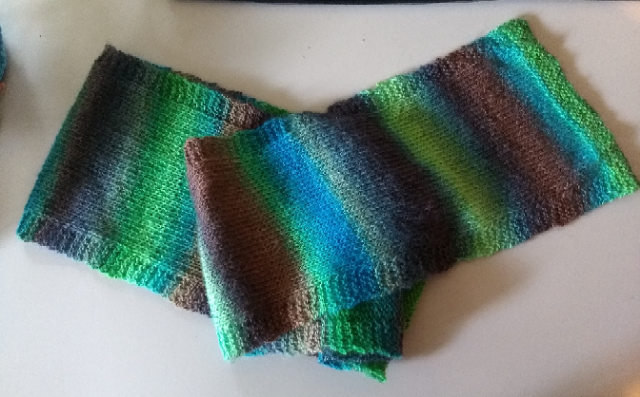
scarf

And it worked! It is still working–beautifully. Oh, of course, there are days when I stay stuck, and there are days when I get distracted and mess up on the knitting so badly that I have to let the writing thoughts go and catch all the stitches that are threatening to drop. But the majority of days, I have to keep a notebook and pen handy (along with my morning tea, sometimes a bit of breakfast, and the cat–it becomes a pretty crowded couch). Because the ideas come. When I’ve collected enough, I schedule myself some writing-without-knitting time, take myself back to my computer, and see where the new thoughts take the story. Sometimes they go nowhere, which can mean more knitting, or–if the wall I’m pounding my head against feels particularly hard–picking up another WIP to play with. Which also means more knitting.

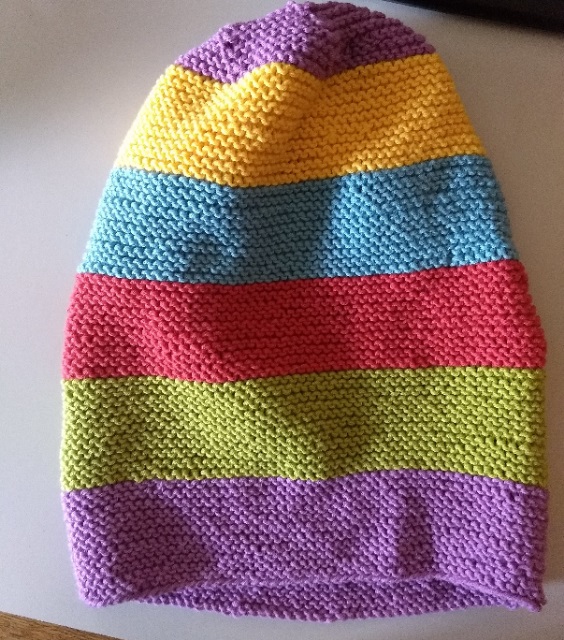
hat

I think, even when I don’t make a lot writing progress, I’m still less frustrated. Knitting has become something relaxing for me to do, a bit meditative. And even when I don’t spark with new story ideas, I do make progress with my knitting. (Despite the dropped stitches.)

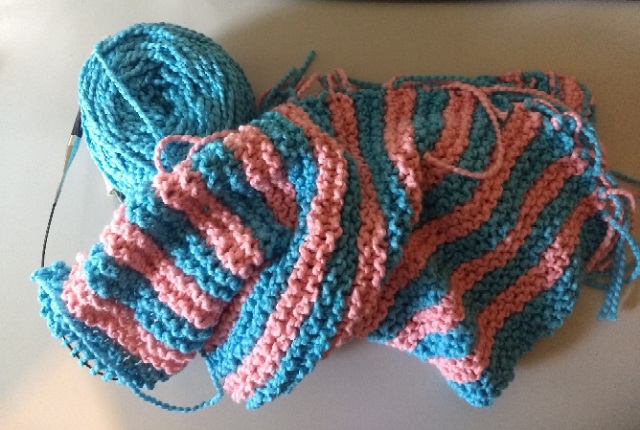
blanket

Do you have a “thing” that keeps your hands busy and your brain active that lets you escape the tension of BIC? What’s your equivalent of knit-thinking?

Posted in Uncategorized

Revision Progress

In January, I wrote a review of Jeannine Atkins’ Views from a Window Seat and talked about how motivated I was to turn back toward my picture book revisions. I was so inspired from reading about Jeannine’s focus on sitting with a story, with its characters and its words, all at different stages but always with the same sense of giving the story time and room to reveal itself.

As I get back into my revisions, I’ve been working (hard) to stay with that inspiration, to remember how I want to do this. I’ve pushed away self-criticisms of how long I’ve been working on each of these stories. I’ve stuck in metaphorical earplugs to shut out the noisy thoughts of how much longer I might still be working on them. I’ve (tried to) put a lid on all the fantasies about what will happen when I do get them done. And I’ve spent a lot of time in non-story files, typing in thoughts as they occurred to me, listing questions for which I didn’t yet have answers, and then just thinking about those thoughts and questions.

Yesterday, while I was working on one of the revisions, actually at the point where I was changing words and sentences around, pulling the threads of the action and dialogue a little closer around the theme/purpose/point whatever, I heard a small, but solid thump. And I looked at what I had left to do in that revision, at least before I sent it off to my critique group for the nth time, and it was a lot less than I’d thought. Things had, without my realizing it, become more connected and cohesive. The pieces of the story had moved themselves into the right spots, and the characters had picked some good things to do and say. I had, with so much less agony and stress (not with less time or work!), come to the next “ready” place. Off went the critique.

And this morning, I picked up my folder for one of other picture books in the revision pile. It has been several weeks, at least, since I’ve looked at this one, and the first thing I did was read through the latest comments from my critique group. I didn’t open my laptop, not at first. I just read the comments. And suggestions I remember shaking my head at and feeling skeptical about suddenly made SO MUCH SENSE. I had been approaching the story, yet again, with some fear, but because I let myself start slowly and just get reacquainted with the critique comments, laptop unopened, no pen in hand, something else went thump. In a nice way.

This time, it was almost easy not to immediately open the story file. I started a new file called  something like “What to Do With…” and I put in the two most important words that came through to me from the critique. I typed in a couple of questions, then a couple of ideas. Not really even possibilities yet. Just ideas. Thoughts. More to sit with.

Oh, of course, the other voices are still there, talking at me about mythical life deadlines, goals, self-esteem, productivity. But they’re clamoring a little less loudly, their vehemence softened, I think, by my going with Jeannine’s reminder–the reminder that we’re here because we choose to be. We are touching down with a story because at least that little bit in love with a character or a plot twist and because we want to see what we can do with it. Why run away from it? Or rush through it?

Yes, the tortoise eventually won the race. But I think he also enjoyed the feel of the ground under his feet, the sunshine on his shell, and all the sounds and smells of his journey.

Posted in Uncategorized

Compressed Time

Sometimes, I think getting older is really all about remembering, or re-learning, things I’ve already known.

Years ago, I played tennis on my high-school team. The first year I did it, life became a bit crazy. I’d always been (and still am, in many ways) someone who prefers lots of open time in her days, time to relax in between tasks and even take the doing of those tasks at a leisurely pace. Suddenly, I had practice after school every day, THEN chores, homework, and the rest of life. I loved the tennis, but when I look back I see that year as a whirlwind of racing from one place to another, of doing things–even breathing–much more quickly than I was used to. And in much more concentrated blips of time. If I remember correctly, I was pretty darned effective in those blips. Okay, not in my math classes, sure, but you could have given me 20 more hours a week of math time, and it wouldn’t have helped.

There have been other times in my life when this happened again–when I became suddenly busier, or hit a stage in which my days felt scattered and crazy, when I hadn’t yet fallen into a more organized pattern. My first year of college, my first full-time job, when I first joined a critique group. Most of these times were also accompanied by an increase in productivity, or focus, even with the fewer available hours.

And here I am again.

When I knew I was going back to work, one of my concerns was how I’d keep my writing going. “If” was not an option. I had been volunteering at the museums for about a year, and I’d been doing that work from home. I had expected that they’d want me to keep doing that–the museum office space is not what you’d call “huge.” But, no, they wanted me on-site, and it’s turned out to make a lot of sense–for the organization and for me. I’m much more productive there, without the distractions I have here. And when I do work an occasional day at home, the change helps me focus and get everything done. I can be on-hand for meetings or for those let-me-just-grab-you-for-a-quick-question moments. There’s a lot of work, so I have to stay open to bringing some of it home, but…

I have days off. Typically without much, if any, museum work to do.

Which means…writing time.

Obviously, no, not all day. Life stuff that isn’t getting done on work days waits for me. Yoga must be fit in. So, yes, off-days are more relaxed than work days, but…they’re still relatively compressed when you compare them to the days I used to have. With hours I could have just filled with writing. Day after day. After day.

I so wasn’t.

Not recently. Part of this was that my YA historical was haunting me in the bad ways–it would pop out of corners just to remind me that it was actually pretty scary, that I had no clue how to make it happy. Part of it was feeling a bit divided about whether I should be working on the YA, or the picture book, or even looking back at another project for revision. (With, I remind you, probably enough free time that I could have been working on them all!) And a big part of it, I now realize–all over again–was that my time was not compressed.

Since I started work, I have taken a hotel day to plot out almost all of the YA historical. I have finished revising a picture book and started it on its rounds. I have started revisions on two other picture books, submitting drafts to my critique group. I am grabbing at chunks of time so small I would have scoffed at them before, as “not enough,” and I have opened up a file and thought, or played, or written a few more words. I have made more progress in the past month than I had in the three months before I started the job.

Once again, life is showing me that change is good, busy is good. As long as you’re willing to make it so.

And, because I couldn’t resist, and in honor of Jerry Nelson, who passed away last week:

Posted in Monday Map

Monday Map

Okay, I’m trying something new. (AKA: something that may show up this one time and never appear again, so don’t get your hopes up.) Early last week, I posted about my writing plan–what I was going to achieve with my fiction.

Guess what?

It worked. Pretty much. I didn’t get started on the antagonist, but I did finish up the secondary characters. And, seriously, I did it because I’d said I would. Here. Publicly.

So, I’m going to play with this for a while. I’m going to put up a quick post each Monday, mapping out my fiction goal(s) for the week.

I’m just doing a fiction goal, because–as I’ve said before–the other stuff all gets done. At least, that’s how it seems to work for me.  And, no, I don’t expect any of you, or the Internet in general, to be my accountability, but there is something about stating a goal–a manageable goal–that reminds me of its importance, and its doability.

So, this week’s goal:

  • Work through Donald Maass’ worksheet on the antagonist, in Writing the Breakout Novel Workbook. Yes, I’m giving myself the whole week on this one, because the big problem with my antagonist (who happens to be my MC’s mom) is that she is not a problem. Or not the right kind. She’s kind of bitchy and whiny, and hyper-reactive, but she doesn’t do anything. She doesn’t create obstacles, she doesn’t move along her own path to conflict with Caro’s, and she doesn’t have any depth. So I need this week. Boy, do I need this week.

Feel free to leave your writing goal for the week in a comment. Or if you’d rather do your own Monday Map post, why not share the link? Motivation is contagious, right?

Have a wonderful, productive writing week.

Posted in Uncategorized

Comfort? Here? No way!

This morning, on Facebook, Jeannine Atkins posted a quote by someone named Josh Simpson. The quote was:

“It’s important for an artist to find his comfort level—and stay out of it.”

I laughed out loud. Why? Because I had just said to my husband that this morning, I was going to spend an hour with my YA WIP, the one that is distressing and depressing me. Yes, despite the fact that it’s making me feel that way. I worked on it for a while yesterday, and the image I took away was a picture of me, spinning in circles in the same tiny space in the middle of a desert. Yep, there’s me, in the center of a little dust storm, just burying myself deeper and deeper into a tight, barren spot.

Fun? I don’t think so.

But this quote hits it. What am I supposed to do, quit? Boy, there are parts of me that want to. I’ve been musing a bit about my goals/direction for next year–what I want to attain, and it flashed through my head that next year may be the year of a decision about this book, about whether I DO keep working on it, or whether I put it aside until what…until I’m ready to handle it? Until I get a lightening-bolt breakthrough from somewhere unknown? And maybe that’s what I will decide.

It’s not what I want to do, though, and it doesn’t feel right to my gut. Yes, it’s partly that whole doctrine against quitting that I was raised with, but there’s more. If I quit, where am I supposed to go next? Back to that comfort zone? Some safe place where I’m not struggling with my writing?

You know, safety is not all that comfortable either, in my experience. It contains a lot of looking out at all the cool things going on around you…without you. It comes with some knowledge that you’re backing off, letting the fear control you, keeping away from some goal you really want.

No, I think there’s only one thing to do when you’re out of your comfort zone. Keep pushing through. At some point, I think–I hope–you push past that plateau you’re stuck at (the one with all the sand and cacti and circling buzzards), and you reach a new perspective. One that comes with the things you actually did learn in that stuck place, one that has a vista with maybe a palm tree and some water, or a little peak with pine trees and deer. And space to move and actually create.

For a while anyway. Until you hit that next uncomfortable zone.

Rinse and repeat.

Thanks, Jeannine, for the reminder that there is a reason to keep pushing on. *Hugs!*

Posted in Book Review

THE PENDERWICKS AT POINT MOUETTE: Problems That Do Matter

I just finished reading The Penderwicks at Point Mouette, by Jeanne Birdsall. I love all the Penderwick books–they take me back to reading Edward Eager’s books and Mary Nash’s Mrs. Coverlet books when I was young. They also make me think of Elizabeth Enright’s books, which I didn’t find until I was in my forties (thanks to Jen Robinson), but which have the same flavor. It’s partially the pleasure of nostalgia that makes me lose myself in Birdsall’s books, but it’s also more than that.

It’s the writing.

I have to say I think this latest book is my favorite. It’s kind of different, because the story opens with Rosalind getting ready to spend two summer weeks with a friend, separated from the rest of the family–who are all heading off to a little house in Maine. Rosalind isn’t really in the book, which is an absolutely necessary plot device to put Skye–my wonderful impatient, frustrated, girl-with-a-real-temper Skye–in charge as the OAP (Oldest Available Penderwick). A job she SO does not want.

I’m not going to go into a full review of the book–I recommend the whole series wholeheartedly, but I also think you could just pick up any one of them and fall in love, especially this one.

What I want to talk about is something I think Birdsall does especially well in the Point Mouette book–she writes a fun, charming, easy book…with stakes.

I have one of those books in a drawer–the ones we write & write on and revise & revise, then submit and, in the long run, get rejections for. I love this book, which is how I suspect most of us feel about our drawer books. But I also know what’s missing. You guessed it: stakes.

Several agents and editors were nice enough to explain that the book was perhaps too quiet, that they didn’t feel the things the characters went through mattered enough–not necessarily, I don’t think, that the events weren’t big enough, but that they weren’t getting the feel of how important these events were to the hero. As the book sits in the drawer, it also sits in the back of my mind, and every now and then–as I work on more current projects–I wonder about what it is I can and should do to revise–yet again–and amp things up for my hero.

I’m not going to get into spoilers, but Birdsall achieves just what I want and need to for my book. I don’t think anyone would call a Penderwick book heavy,–I think light is a much better and probably most often applied adjective. Light in a good way–that you smile a lot as you read her books, that you laugh out loud, that the story moves quickly (even with the nostalgic feel), and that it is a sheer, happy pleasure to be immersed in the stories.

And yet…Skye REALLY doesn’t want to be OAP. The humor around her taking on the job Rosalind has carried for five years is absolutely brilliant and wonderfully funny. Skye’s worries and fears also are woven in with humor, but at the same time, you GET why she doesn’t want this responsibility, and why it isn’t easy for her to handle. That’s real. The same with Batty’s missing Rosalind and the nighttime fears she doesn’t share with anyone except Hound, the family dog. Very sweet, very charming, and–again–very real. Batty doesn’t remember their mother; Rosalind has carried that role for as long as Batty knows. And it’s hard for her to be separated from her biggest sister. Truly hard. And we feel that. The scenes total maybe 5 or 10 pages in the entire book, but we feel what Batty’s feeling in every word.

And then the Big Thing. No, I’m not going to give away what the Big Thing is–I’m telling you, go read the books. The Big Thing doesn’t come along until very close to the end of the book (unless you’re a much smarter reader than me, which–in terms of plots & secrets–isn’t actually hard to be), but when it hits…BOOM. It is intense. And hard. And, once more, so absolutely real.

It matters. Suddenly all the light reality that has made us love these characters so much gets completely transformed into anxiety and heartache and hope. Yes, because it’s a huge deal and, yes, because the outcome could go either a good way or a bad way, but mostly, I think, because of the work Birdsall has done before. The realness she has woven into every scene, every moment, has created characters that we care about–that we sympathize and empathize with. With the perfect touch, never forgetting to charm us and make us smile, she has shown us that the things that happen in this world–small or big–matter to these people.

So, yeah, they matter to us.

Posted in Uncategorized

That Stupid Thing Called Fear

I always think I’m pretty good about the fear thing. I do pretty well at working on my projects, facing the fear that they may never “make it,” tucking that away into the little box where it belongs, where it won’t get in the way of the actual writing. I do pretty well, too, working through a yucky first draft, opening up the little box again and dropping in the worry that yucky is the only adjective I’ll ever have to describe the story.

Where fear seems to hit me, though, is when I haven’t been working on a project for a while. Sometimes, it’s a vacation that takes me away, sometimes it’s the job-work that makes it hard to get to, sometimes–like recently–it’s that I’ve been working on some other writing project, like my picture book.

Whatever the reason, there comes a time when I have to transition back.

Here’s how I was feeling this week about stepping back into my YA historical:

  • This second draft just isn’t really much further along than the first draft. (There’s a good reason for this, which I talked about here, but still…)
  • I was really having fun writing a funny picture book, you know? I was smiling a lot.
  • Oh, boy, are there some not-cheerful research books I need to be reading.
  • What was I even writing last time I worked on the YA?
  • I so don’t have enough clue about my protagonist yet.
  • I think there are probably about a bajillion pages I should just cut.

And so on.

Then I spent a few minutes–seriously, fifteen? last week just looking at the last few chapters I’d written in the YA. And–as usual–I saw stuff that, yeah, made me gag, and I saw stuff–as usual–that was…good. And I started to see where, in the future, I’l need to compress events, edit too-modern language, and you know…revise. I’m not ready to do that, obviously, but the consensus between me, my brain, and my anxiety was pretty much: Hey, this isn’t all bad.

And some of the fear went away.

I spent another few minutes–three, this time? thinking about the next scene. Which is one I’d actually written for the first draft, but that still has a place in Caro’s new story. And I thought of some changes that would make things happen more quickly, make Caro more angry at another character, and show her at least trying to take charge.

One more little bubble of fear popped up. You probably know this one: Are these really the right changes to make?

Well, because I’d dropped myself back into the book the day before, I was able to take that bubble of fear, pop it, and drop the residue into the box. And slam the lid.

And I was able to sit down and write.

And fall in love all over again with this story and this world and, most of all, this hero.

The moral of this lesson is 1) Try not to stay away from a writing project for longer than you have to and 2) Try even harder not to listen to the fear.

It’s not only destructive; it’s wrong. Put on your armor, heft your shield, draw your sword. Then get back into the arena and write.

Posted in Uncategorized

Pacing: Some Thoughts from Me and a Few Others

Pacing.

I haven’t talked a lot about it here, because, well…it’s hard. Pacing feels a lot like voice to me: I can recognize (and love) strong pacing when I see it, and I sure as heck know when the pacing is off. But how to achieve the strong and avoid the weak? That gets a little trickier to figure out and to explain.

So I thought I’d take a little stab at it myself, and then share some links from other writers giving their take on it.

Anyway,pacing sounds simple, right. Action, action, action…think. Action, action, action…think. Well, sure, at some level, you can make a basic equation out of it, and I think-in today’s fiction–action is going to be a bigger part of the equation. But the simple formula doesn’t account for the magic that happens when someone gets it right. Or the clunkiness when they don’t. (And please note I’m not talking only about high-suspense, gun-fighting novels. Every book has its own pace–oh, dear, that’s another whole topic!–and within that pace, every book will have scenes or more action and less.)

Maybe the magic happens when we get out of the formula and into the scene. Into the narrator’s head. I’m thinking that maybe point of view and pacing are intertwined–so that when you’re as close to the narrative character as you need to be, then you can see the scene as they see it and share it, from that close perspective, with the reader. So you know when they’re feeling tense, and you know when they feel like they can take a breather. You know when they’re in conflict mode, ready to take on the world, and you know when they need to retreat into their quiet place and let the world go by for a bit. Of course, this doesn’t take into account distant third point of view, or even that old standby–omniscient point of view. And of course, it doesn’t tell you how to get there!

As an editor, as a reader, I can see pacing that’s rushed or that’s too slow. Prose that feels too fast, to me, often steps too far away from the narrator’s thoughts and feelings, too close the author’s outside point of view. The dialogue in a rushed scene often comes in a quick back-and-forth, with no space or time being given to dialogue beats. It only takes a few words to give us physical response or a panicked thought. And those few words can make the story, the pacing, feel layered and full. Without taking us out of the drama.

Pacing that feels too slow can do the reverse–cause us to spend too much time in the narrator’s thoughts/internal reactions. It can read as though the character herself, not just the reader, is stepping out of the action to think about it, to analyze the problems they’re facing, to look too far ahead into future possibilities. Slow pacing takes us further into response than the character has time for–often, the narration starts to feel like it’s coming from the author, not the narrator. Really slow pacing shows up, I think, when the author lets himself and the characters get pulled out of the in-the-moment scene. Yes, you need a bit of that background story, but you don’t need it at a time when the conflict and tension are running high, when they should be running high. Save it for later, for that moment of retreat and shelter, when everybody-especially the character–has time for a little peace.

I think pacing may be one of those elements that we can really help by reading a passage or a scene or a whole manuscript out loud. When I critique, I’m obviously further outside the story than the author has been while they were writing it. Reading out loud seems, to me, to be a way of taking ourselves closer to that outside point–closer to wearing our own editor hat, than just staying under the writer’s chapeau. Try it with your manuscript and see what you hear–and what you don’t!

All right–those are some of my thoughts. Pretty rambly and not necessarily helpful. Let’s see what a few other people have to say.

  • Some good tips from Heidi M. Thomas at The Blood Red Pencil.
  • Here’s a vlog on pacing in the YA novel that Sara Zarr did for WriteOnCon.
  • Excellent, specific advice from Holly Lisle.

Any thoughts of your own? Happy pacing!

Posted in Uncategorized

Summer Writing

Well, we’re not even a week into summer vacation, and I can already feel the shift in patterns–the patterns of the day and the patterns of my writing. Things are slowing down, which is wonderful, but which I also have to remind myself to roll with–let my brain unwind along with the schedule. We’re not taking any big trips, but we’re scheduling plenty of Summer Fun around the bay area, and that takes a different kind of planning. There’s sleeping in and staying up later, board games and reading in the sunshine. It’s all good.

As long as I don’t let the writing drift away on the clouds of relaxation. 🙂

  • I thought I’d throw out a few tips for keeping the writing going during the summer and invite you all to drop your ideas into the comments. Between all of us, we can manage to have a fun and productive summer. Sleep in, but not too long. If we don’t have anything planned, my son will sleep till 11:00 at least, and, oh, there are so many mornings where I could just lie in bed and daydream or read. I’m working on getting myself up and about an hour or so later than usual, and letting myself move more slowly than I do during the school year. I figure I’ll get better at this as the summer goes along!
  • Take your work to a new place. I’m getting outside a lot more this week. I’ve got a nice new laptop, with a more powerful battery, and there’s always an extension cord if I need it. Maybe you’ll need to schedule a few evenings out a the coffeehouse to write–maybe I will, too. There are a couple of Netflix movies still lying around the house that I”m not that excited to see–maybe the guys need a movie night without me around!
  • See about reducing some of that social networking. This one is big challenge for me, especially when summer can feel more like tiny pockets of time that lend themselves to dawdling, more than to intense productivity. But I’m working on it. I’m going to try & chunk out the time I spend on Facebook & Twitter and keep it away from my concentrated writing. I’ll probably also reduce the number of blog posts I put up–it’s writing time, yes, but it’s not BOOK time.
  • Don’t wait for kid-time to just come along and rear its head. Around here, that leads to a lot of gray time where I and my son aren’t really doing anything–separately or alone. If I make the tiniest effort to pull something together for us–guess what? We both have fun, and whatever we’re doing adds that little bit of structure to our day that lets us relax and enjoy the rest of the day. (Hey, kind of like plotting!) Like I said, we’ll play board games, get our books out together, do some easy outings, and–yes–check off a few chores on the list. And I’ve decided that one summer goal for me is to get better at Mario Kart. Since this pretty much entails learning to keep Yoshi on the road, improvement should be possible. Hand-and-eye coordination, folks. And video games together are more social than video games alone.
  • Stay present. Again, this is a biggie for me–since I tend to live a good percentage of my life in the future: worrying, planning, just thinking “out there.” If you’re one of Terry Pratchett’s Discworld characters, there’s probably some value in this, or at least humor. Not so much in this world. My goal this summer is to enjoy what I’m doing while I’m doing it, and move as gracefully and happily from one thing to another as the day rolls. And one of those things will be writing.

What about you? What tricks do you use to enjoy the summer and get your writing done? What works best for you?