Posted in History

Sad News: Hull-House Closes

One more social service bites the dust. I could let this post become a rant about the economy and the state of the nation and the government, but I’m not going to go there. Mostly because the sadness I feel is less practical. It’s not like I don’t know what cuts are doing to people who really need help, all over the place–not just in Chicago. It’s not like, if you listen to the news, see what’s going on, that this would even come as a surprise.

Still…gut punch.

I’ve spent the last few years doing research, reading, about Jane Addams and Hull-House. I visited the museum (and the museum is not closing) a couple of years ago, and was delighted to find myself not in a stuffy, dark old building, but a light, airy place that I could easily imagine still reflected Addams’ taste and personality, where I could pretend Addams herself might come down the stairs at any minute.

So my response to the news is kind of self-centered, or at least Addams-centered. I’m thinking about how she would have felt to see this end, to see all she worked for–against all odds–go away. As wonderful and well-deserved a memorial as the museum is, I really don’t think it was Addams’ end goal–to have a museum. Her goal was to get to know all these people, the neighbors she “settled” near when she started Hull-House, and to help them. And today, the thing she built, the thing that–if I were talking about someone with less vision than Addams–I would say grew beyond anything she could have imagined, that thing is gone.

Except I can hear her scolding me as I type this, shaking her head, maybe even smiling and laughing at me just a little. Because it’s not gone. You know that everybody involved in Hull-House is miserable about this; you know that they and all the services in Chicago are going to be working to connect up with all the people who still need help.  Yes, Jane Addams was a phenomenon, an inspiration, but caring and action didn’t start with her, and they didn’t end when she died. I know this.

Still…such a loss.

This article in the Chicago Tribune talks about the closure, and you can listen to a brief piece on NPR about it, as well. If you want to know more about Hull-House and Jane Addams, of course, you should read her book Twenty Years at Hull-House, if only to hear Jane’s own voice talk about her venture. Another wonderful book is Hilda Polacheck’s memoir I Came a Stranger: The Story of a Hull-House Girl. I also highly recommend Louise W. Knight’s Jane Addams: Spirit in Action, which is one of the most interesting biographies I’ve ever read, talking as it does about the people Addams met and the works she read, then dissecting and analyzing how they played into her ideas and idealogy.

Finally, of course, if you’re in Chicago, do stop in at the Hull-House museum. Touch base with Jane Addams, and all that she meant, if only for a few minutes.

Posted in Historical Fiction

Historical Fiction: The History Part

I think I’ve told the story here of how I started writing historical fiction. I was reading a nonfiction book about the 1913 Suffrage March in Washington, D.C. I read a scene about the march and knew, instantly, that I wanted to write a hero who was part of that scene. Of course, that turned out, eventually, to be the other book I still have to write, but still…that was my entry into a genre I never thought I’d be part of.

I was, honestly, never a big fan of history. Maybe it started with the high-school history class where we were given copies of a page in the text, on which certain words had been whited-out, and our job was to read the page, then fill in the blanks. Yes, really. Anyway, when I decided to write this book, I had to face reading a lot of stuff I thought I wouldn’t really enjoy. What I found out, though, is that (duh!) there are good writers of history* and not-so-good writers of history, just like in any genre. (Side note: For one of the best examples I know of one of these good writers, go pick up a copy of Amy Butler Greenfield’s A Perfect Red. You will not be able to put it down.)

And I learned something else. For me, history is people. Not wars, not political parties, not socio-economic statistics. People. Individuals. Yes, sure, I’ll read about the impact those people had on their times, and the impact their times had on those people. But if you don’t catch me with how the person actually ticked, how they thought and how they behaved…well, you won’t catch me.

Which, hey!, fits pretty well into writing historical fiction. Because, again, fiction for me is about people. Aka characters. How they act, why they act, and how they interact with/off each other.

This weekend, I wrote a scene, in which the people of history and the people of my story finally came together. There is really one reason why the book I thought I was working on has been put in second place on the writing shelf. That reason is Jane Addams.

When I started reading about Chicago in the early 1900s, I was so blown away by how Addams was everywhere, doing everything, and by the person everybody and their great-nephew’s-cousin’s-sister-in-law described her to be, that I was lost. Or maybe found. But I haven’t been sure whether I would really write Jane Addams into my book. It’s the story of a teenage girl, the daughter of an immigrant mother who lives her live in a too-narrow world of fear. The girl finds Hull-House, finds the world that the settlement residents move in every day, and has to break out of her mother’s shell to become part of the settlement life.

Anyhoo…Like I was saying, I knew that Hull-House would play a big part in the story. Huge. But by 1910, Jane Addams wasn’t always around Hull-House. She traveled, she spoke, she had a finger in just about every pie inside and outside the United States, let alone Chicago. And I didn’t want to force her in, just to give her the cameo.

But Saturday, she stopped by. Just like she did so many times in real life, dropping into a class that was being taught for a few immigrant girls, in one of the many Hull-House rooms that were always full and busy. She talked to the girls, she stayed to help, and then she was drawn away by another resident with another demand on her time. All with grace, warmth, and ease.

I think I got close. I think I may have painted a TRUE picture of who this woman was, who I see her to have been. A woman who always had time for her neighbors, for the people who were the reason she built a Settlement House, the reason she settled onto Halsted Street in Chicago, in 1897. A woman whom people not only respected and admired, but truly loved.

And I think, after all, she may very well stay in this story.

Posted in Research

Fast Friday Five: A Long Time Ago, in a Chicago Far, Far Away

I wasn’t going to post a Friday Five, but I’m reading some fun ones around the blogosphere & feeling JUST a bit left out! So…five fun facts I learned during research and writing this week. Step back with me, if you will, to 1913 Chicago. It’s a cold, windy year, even for that city, so bring those winter layers. (I know some of you are still wearing them, anyway!)

1. You can, apparently, spread diptheria with classroom pencils.

2. Maybe because you’re being required to turn your pencils in at the end of the class, or the end of the day. Personally, I think I’ll keep my son stocked with his own!

3. More girls were staying in school and going on to college thanboys. Pretty much because they weren’t ever going to make as much $$ as the boys, so if the boys got out of school and worked, the family could support the girl through college (increasing her earning power SOME), but if she quit, she couldn’t earn enough to help get that boy through school. Wait, I’m sorry, did we just tesseract between 1913 and 2010?

4. Nope, still there! Moving on. One of the reason big electric companies had a bit of a battle spreading their services around Chicago, is that it was so easy to set up your own, personal power-station and then sell your extra electricity to your neighbors. Okay, PEOPLE weren’t doing this, but fancy hotels and businesses that wanted to “dress to impress” with bright lights were.

5. Some rich people put just a few electric bulbs into their otherwise-gas-powered chandeliers, and then would light those bulbs for big parties or when the “Joneses” came over.

 Happy Friday. Happy Writing!

Posted in Family, Research

Chicago in Pictures

Edited Monday night, due to moral obligation. Before I left California, I stated that one of the things I would be doing in Chicago was seriously beating (again!) my identical twin nephews in Pictionary, despite their great psychic bond. Son and I have done amazingly well against them in the past. Tonight, though, I am forced to confess, as publicly as I bragged before, that they whooped us well, fair and square.  Congrats, guys. Until next time!

So the research trip is over. I had a great time in Chicago–parts of it look completely new and metallic-shiny, as if the sinking wooden streets and the women in long skirts never existed. Other parts have had asphalt and cement added around them, but the buildings are the same that people lived in 100 years ago, including my grandmother.
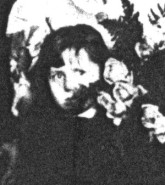
Selma_JennyMosesAnniversary

She’s sitting on her mother’s lap at her parents’ 25th anniversary party. We think she’s two or three. The roses her mother’s holding are right in her face, and she’s being asked to pose for the photographer which, even when I knew her, she never liked doing. She’s also the one who, many decades later, identified 35 out of 45 of the people at the party, giving my sister, my sister-in-law, and me the start of the many ancestry hunts we’ve been doing. Obsessively. If any of you know where to find Nuchka Krupnick in 1920, send me a line, will you?

This is the house my grandmother lived in.
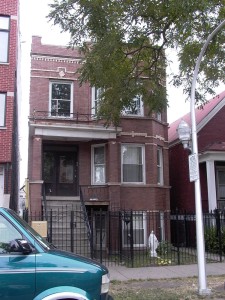
SelmaHouse01

The story is that she and her twin sister would sleep on the balcony when it was too hot inside. Some of the houses also had balconies in the back–we drove around to try and find out if “ours” had one of those, but both my sister and I are navigationally challenged, and, honestly, we had some problem figuring out which back went with which front. So I’m saying, here and now, that this is the balcony my grandmother slept on. 🙂

We actually did family stuff on the last morning in Chicago–finding this house and heading out to a Jewish cemetery in Forest Park. A HUGE Jewish cemetery that, way back when, was 300 LITTLE Jewish cemeteries. They are SO organized. Everyone’s in their computers; they can tell you lot number, section number, row number, and grave number. And whether your relative has a monument. Ours did.
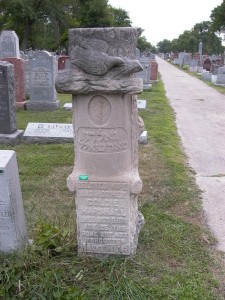
GoldieMarshallsGrave01

This great-aunt died in 1918 in the influenza epidemic. She was about 25; my grandmother would have been seven.

Okay, yes, we did do non-family historical research, too.

Our first stop when we got to Chicago was at the Spertus Institute of Jewish Studies.
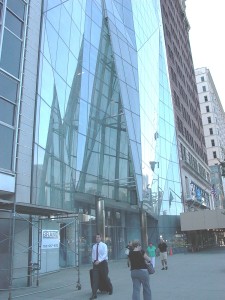
spertus01

See what I mean by new and shiny?

I had called ahead, a couple of weeks ago, just to check in about stopping by, and the librarians already had books pulled for me, including an unpublished memoir by a man who grew up in Chicago during the time my book is set. The librarians also gave me several other titles to look for AND showed me how to get into the historic archives of the Chicago Tribune.

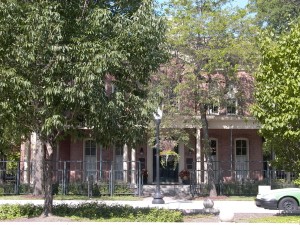
The next morning, we headed over to the place I’d been looking forward to most–the Hull-House museum.
hull-house01

First surprise? The photos I’ve seen of Hull-House are pretty dark–those black & white ones we all know so well. So I’ve had an image in my head of it as a dark, kind of foreboding place. That, you know, Jane Addam’s personality made bright & cheerful. (If you haven’t yet seen the early b-day present my sister bought me here, take a look.

Lovely, pinkish-red brick. You just don’t think about/imagine houses built of brick when you grow up in California. (Earthquakes + bricks = bad.)  Hull-House doesn’t allow photos inside, or I’d be able to show you the tall, spacious rooms with light walls and lots of windows. The house was also smaller than I expected. (This is the original house, during the years Hull-House was open, it expanded to include an entire block of buildings–most of those are gone now.) Being a reader of British mysteries, and living now in the world of Silicon Valley McMansions, I was expecting country-house huge. Instead, when you walk in, you are in a main entry room, with stairs heading up to the 2nd floor, flanked by one other room on each side, and a small room in the back. In the building next door, which used to be attached, the dining room downstairs and the music room upstairs probably fit about 100 people. When Hull-House first opened, club meetings and dances were held in the two outer rooms in the main house–NOT big enough for the hundreds of club members and dancers I had been visualizing.

I’m not sure how all this will affect my story. I do know that I have a feeling of a cozier, more intimate settlement house than I did before, and I know that will make changes in the scenes I’ve written and the ones I’ve only imagined. In a good way, I think. Seeing my grandmother’s house and other up-and-down buildings with two or three apartments in them is making me reconsider who lives where and how far they all have to travel to get to each other. And what happened in their pasts, before they moved into these new places. I found out in Hull-House that tenements were not the big sky-scrapy buildings, with hundreds of apartments (and thousands of people) inside them, but smaller structures–originally built to house two or three families, eventually over-crowded by putting several families into each apartment space. The bigger buildings came later–maybe after WWI? Again, this shifts the images in my mind into something less modern, maybe more interconnected, but–in a way–just as cramped and crumbling and wrong.

One big question for me about this trip was and still is–is there some way in which all this family stuff weaves into my writing of this story. When I started with this idea, there were no connections for me–my MC wasn’t even Jewish. I come from a family with a long history of secular, cultural Judaism–not religious, which has–in some ways–been comfirmed by the trip and by the ancestry hunting my sister and I have been doing. I have no idea, yet, how/if any of that will play out in this book. Today, I say no. But, six months ago, I had no idea that I’d be driving through Chicago, hunting for the #871 on house addresses or walking through an old cemetery searching for the name Goldie. Most likely, the ties between Caro’s story and mine are going to stay inside me, somewhere in feelings and genetic memories, rather than in the words on the page. I suspect, though, that the common threads will pop up every now and then and surprise me and–hopefully–add a depth to this book that I will welcome with heartfelt thanks.

One “for instance”–what do you all think of Clara, instead of Caro? Just sayin’.
Posted in Research, Uncategorized

I’m Baaaaaack…

Well, I’m not in California, but I am in Urbana, at my sister’s house. Chicago was wonderful.

And check out what my sister got me for my birthday!

janeaddamsdoll

Look closely. That’s a copy of Twenty Years at Hull House in her hand and the Nobel Peace Prize Medal around her neck.

Yes…it’s a Jane Addams doll!!!

Stay tuned. More to come in the next few days.

Posted in Research

I’m Off!

This’ll be me tomorrow morning—bright, early, and probably surprisingly chipper!

airplane01

We kind of go down, over & up, then down again (if you’re looking down at the map, that is!), with lots of layovers, so we probably won’t get to Illinois much faster than if we WERE in this little plane. But we’ve got books, music, podcasts, a deck of cards with Gin Rummy instructions, and–best of all–anticipation! Son is probably looking forward to midwest-cousin time as much as I’m looking forward to Chicago, so we’re both going to be in great moods.

Hopefully, those moods will last through security checks, over-crowded flights, and a dearth of free airplane peanuts.

I’ll most likely be off-blogs and Twiter/FB for a few days. Just think of me walking museum halls, burying myself in research stacks, and eating Chicago pizza to find out WHY it’s so different from California’s.

Have a great week, everyone!

Posted in Research, Uncategorized, WIP

Friday Five: Chicago Countdown

1. In four mornings, son and I will get on a plane–okay, THREE planes–to Urbana, Illinois, where my older sister & family live.

2. In five mornings, I will hug son good-bye and travel with my sister (in her cool Prius; think she’ll let me drive?) to CHICAGO, where we’re staying for two nights, basically two days, and many, many research stops.

  • Hull-House museum (the ORIGINAL house from which Jane Addams grew the incredible undertaking that was her settlement house.)
  • Chicago History Museum
  • Spertus Museum & Library
  • Chicago Public Library (1913 Chicago Tribune ON MIRCOFICHE!)
  • The house my grandmother lived in until she came to California. We won’t go in, but we will DEFINITELY see the balcony she and her twin sister slept on during hot summers.
  • MAYBE the cemetery where her older sister is buried, the one who died during the big influenza wave. I have some phone calls to make about this one.
  • Macy’s. NO, I’m NOT just going shopping (note the JUST). This Macy’s is in the building that was the original Marshall Field’s department store in Chicago–total glitz and glamor.
  • Who knows WHERE else.

3. We’ll probably eat, too. Any can’t-misses in downtown Chicago? Chicago foods I HAVE to try? Throw recommendations into the comments!

4. In 7 days, we will drive back to Urbana, where I will spend the next few days hanging with nephews (and TOTALLY owning them at Pictionary, thank you very much!) and trying to process all the information I collect in Chicago. Can you say BRAINTWIST? I will also post MANY photos on my blog, assuming I can get them from camera to laptop.

5. In 11 days, I will get back on three planes and come home. In 11 days, it will also be my birthday, and I can’t think of any better way to celebrate than to come back to California, full of history and images and FEELINGS to weave into my WIP.

Excited? Me? Oh, no. 🙂