I braindumped a new picture book idea a couple of weeks ago, and I need to start thinking about how to turn it into an actual story that kids will fall in love with. So I pulled a few mentor texts off my shelves.
The story elements I wanted to look at today were:
Two characters interacting
An unexpected event or person with a problem
I found those elements. And, as often happens when I really dig into a story I’ve read before, I found other elements and qualities I want to keep in mind.
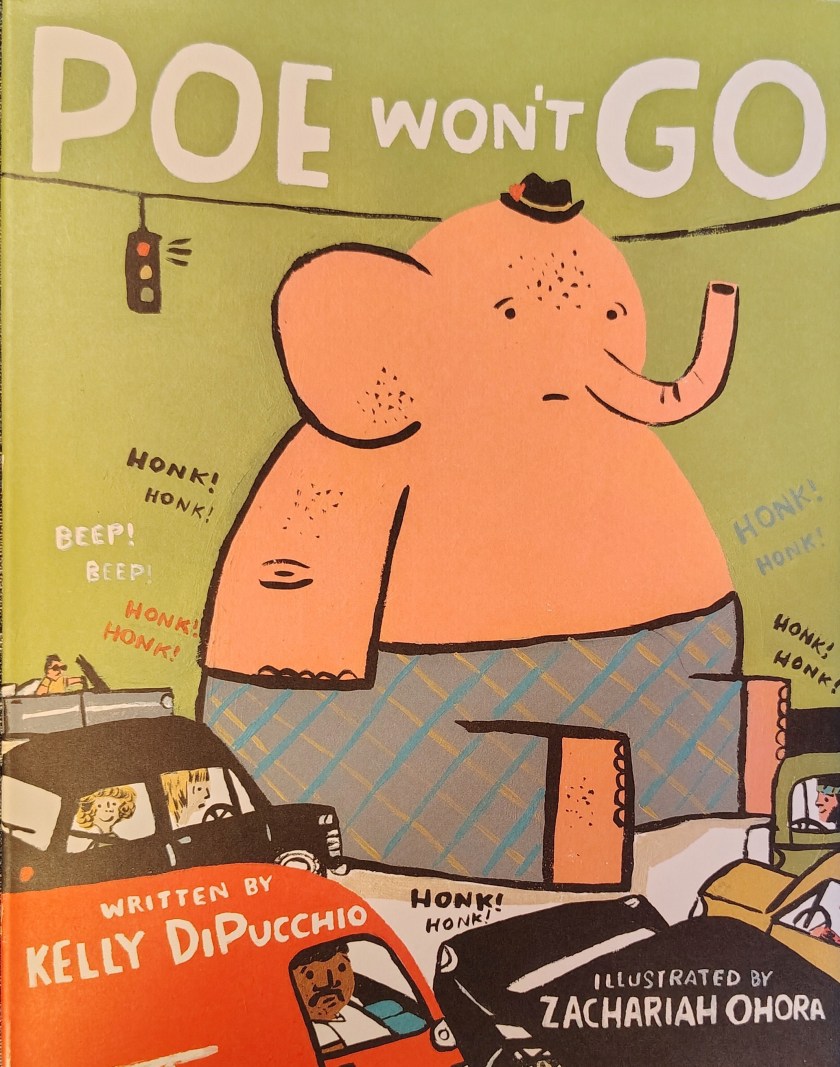
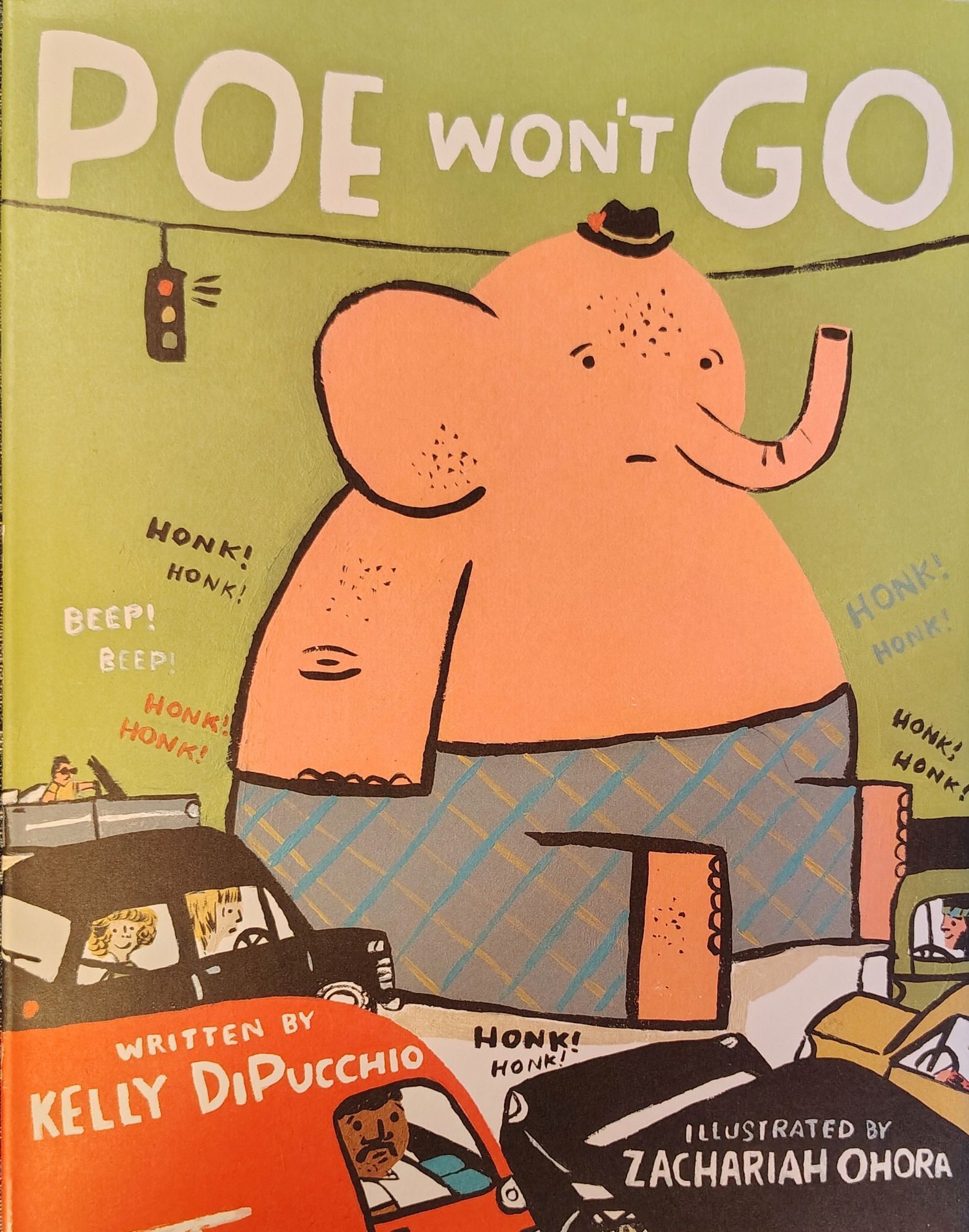
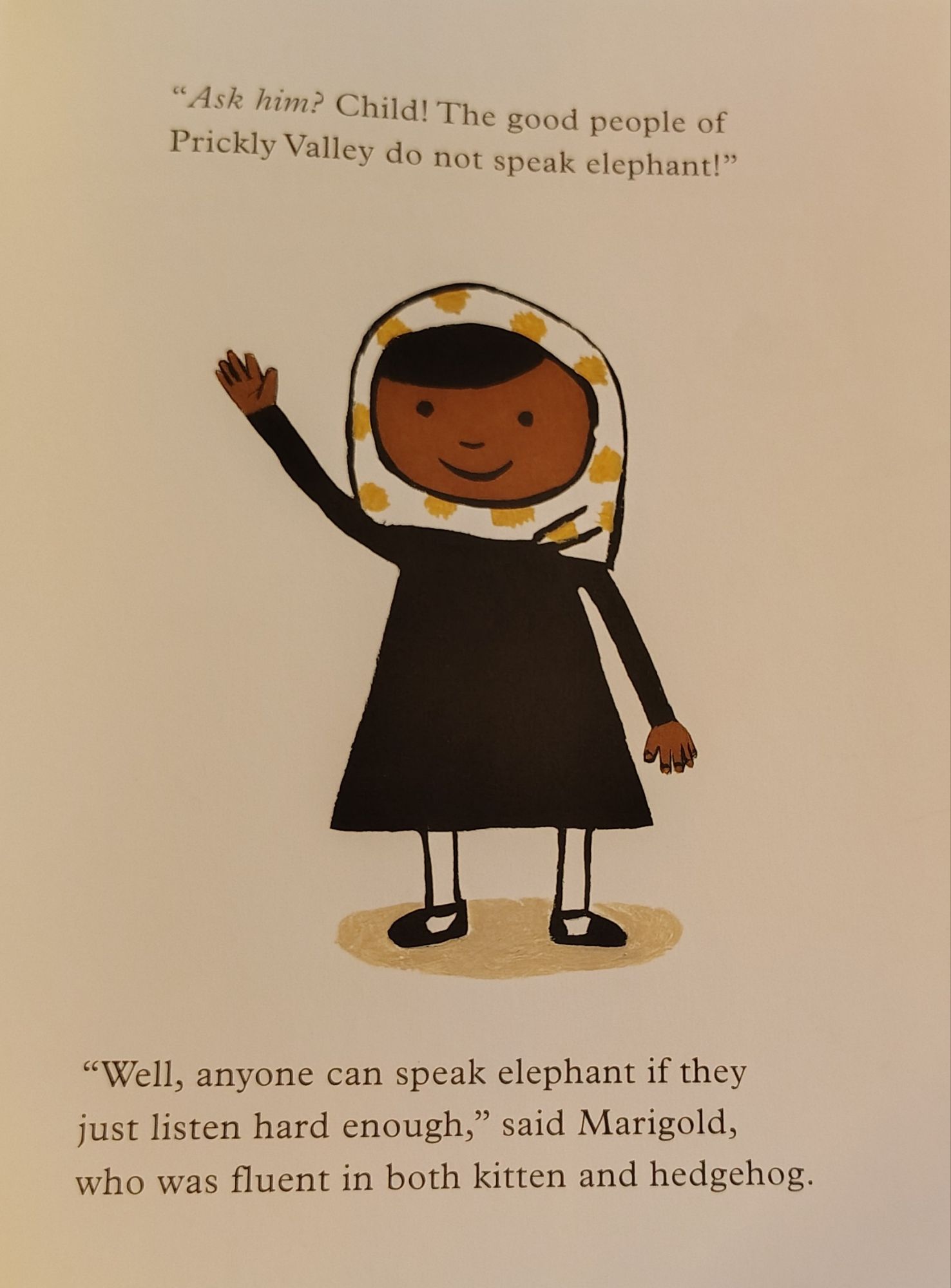
I have read POE WON’T GO (written by Kelly DiPucchio, illustrated by Zachariah Ohora) many times. I always think of it as a simple story (in a really good way). And, in terms of the plot and characterization, it is. But today I realized where the power in that simplicity comes from.
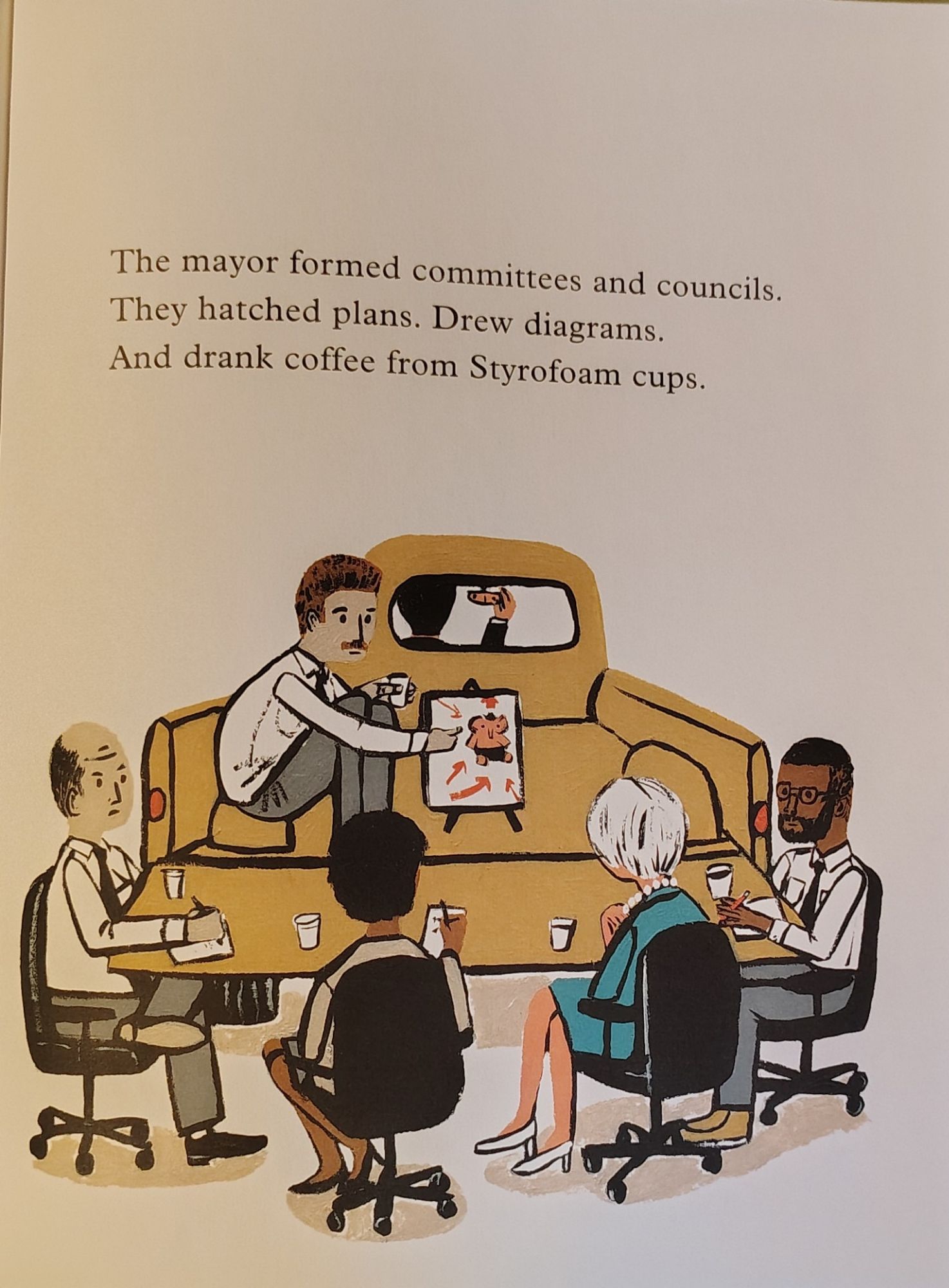
Specificity. I can’t even guess how many times Kelly DiPucchio looked at each word in her text and considered and reconsidered and changed and put back and changed again. And used the BEST active verbs.
Look at those word choices. Hatched. Paper cups. Fluent. Hedgehog! The paper cups make the scene. And “hedgehog” could so easily have been “puppy.” Nope. Not in this story.
I knew there was a reason I’ve kept POE WON’T GO on my shelves. (And Zachariah Ohora’s art is perfect!)
Writing a picture book with an animal protagonist hasn’t exactly been a goal of mine, but I’ve certainly played around with it several times, for various story ideas. While playing, I spent some time wondering about when and why authors choose to put an animal in the starring role. In some books, the text is specific enough that it’s pretty clear the writer made the choice. But I’ve also heard writers talk–almost always in a good way–about getting art back and finding out the illustrator has drawn the main character as an animal.
This year, I finally ended up writing a story with an animal in the lead role. I started out with a human child, but–no matter what perspective I brought to the story–it felt like trying to fit the proverbial round peg into the square hole. I knew what I wanted the story to be about, but every time I tried to write it, I bumped up against all the assumptions, expectations, and baggage that come with being a human child in a human world. Then, in one of those moments we all live for, I saw the story with animals–animals that interact in nature for real and that brought their own comedy to the story. I’m still revising, but this is a manuscript I’ll keep working on until it’s ready. And every version carries the humor and heart that making this choice brought to the first draft.
The Capybaras (written & illustrated by Alfredo Soderguit) is one of the most artistically and emotionally beautiful books I’ve ever read. It takes on the harsh reality of refugees fleeing from danger in their home countries and the cold, often cruel way they are received by people to whom they turn for safety and support. This is an incredibly important story, but also a BIG story with a LOT of layers to write for children. By choosing to “people” his book with capybaras and chickens, the author was able to take a complex idea and write a story that children can access, understand, and empathize with. (And remind us adults about what really matters.)
Margaret Chiu Greanias’ How this Book Got Red (illustrated by Melissa Iwai), accomplishes a similar result, but with a completely different approach. If you haven’t read Margaret’s book, she writes some of the best humor out there, and her comedy always opens a window for kids to recognize and explore challenges they already live with in their worlds. The top layer of plot shows a red panda being frustrated (and hurt) that all the panda books are about the other kind of panda, but the story layers in the big ideas of representation and self-esteem and being an ally. The book offers a smile or laugh on almost every page, but will also open important conversations between grownups and kids and–more importantly–between kids and kids.
The Bear Must Go On (written by Dev Petty, illustrated by Brandon Todd) puts a shy, self-conscious bear into a scary situation–one that shy, self-conscious kids have to deal with all the time. In the midst of ridiculously chaotic comedy, Bear is the only character in the story who would (very much) rather not get on stage. I believe there are emotions and stories that, when shown with human characters, can hit a bit too close to home for some children to be comfortable with. By making the protagonist a bear, Petty has given children the freedom to root for him, because they are experiencing just enough distance from their own anxiety and fear.
And then there are times when the main character has to do something a child can’t do–either because they would never have the opportunity or because they would get in trouble if they did. In Ryan T. Higgins’ Norman Didn’t Do It! (Yes, he did), Norman’s best friend, Mildred, is a tree. Norman gets so jealous when another tree comes between them that he completely removes that second tree from the equation. Triangles are hard. What child hasn’t wished that a third kid would just go away–that they could make the kid go away? But they pretty much don’t have the power to make this happen and, if they even try, some adult is going to find out. Watching a porcupine dig up a tree; take it far, far away; and then have to think about what they’ve done lets kids play with familiar problems and solutions–good and bad–without risk to themselves.
I have a lot of picture books on my shelf–possibly too many! They’re all great, and they all bring something to the table for my learning & craft. And, obviously, every picture book is a read-aloud.
But there are some books that just sing to me as a reader–I can hear the rhythm or voice in my head, and I can see myself reading it happily and easily to a crowd of children (well, maybe a small group!).
Federico and the Wolf – Written by Rebecca J. Gomez, Illustrated by Elisa Chavarri (2020).
I’ve never been a huge fan of the original Red Riding Hood story, but this is one of the most delightful fairy-tale retellings I’ve seen. The rhyming and rhythm work so well together, and the prose and dialogue has an energy that transfers itself into the reading. And on top of that, it’s funny! This is a must-have to share with kids.
Nobody Hugs a Cactus – Written & Illustrated by Carter Goodrich (2019)
I laughed out loud in the bookstore when I opened this one. The text is spare and tight, with a lot of dialogue. And that dialogue is absolutely filled with attitude, especially Frank’s. It is SO much fun to read a rude character. And the art! On every page, after I read the text to the kids, I’d be pointing to Frank and saying, “Look at his face!” Pretty soon, they’d probably be saying it before me.
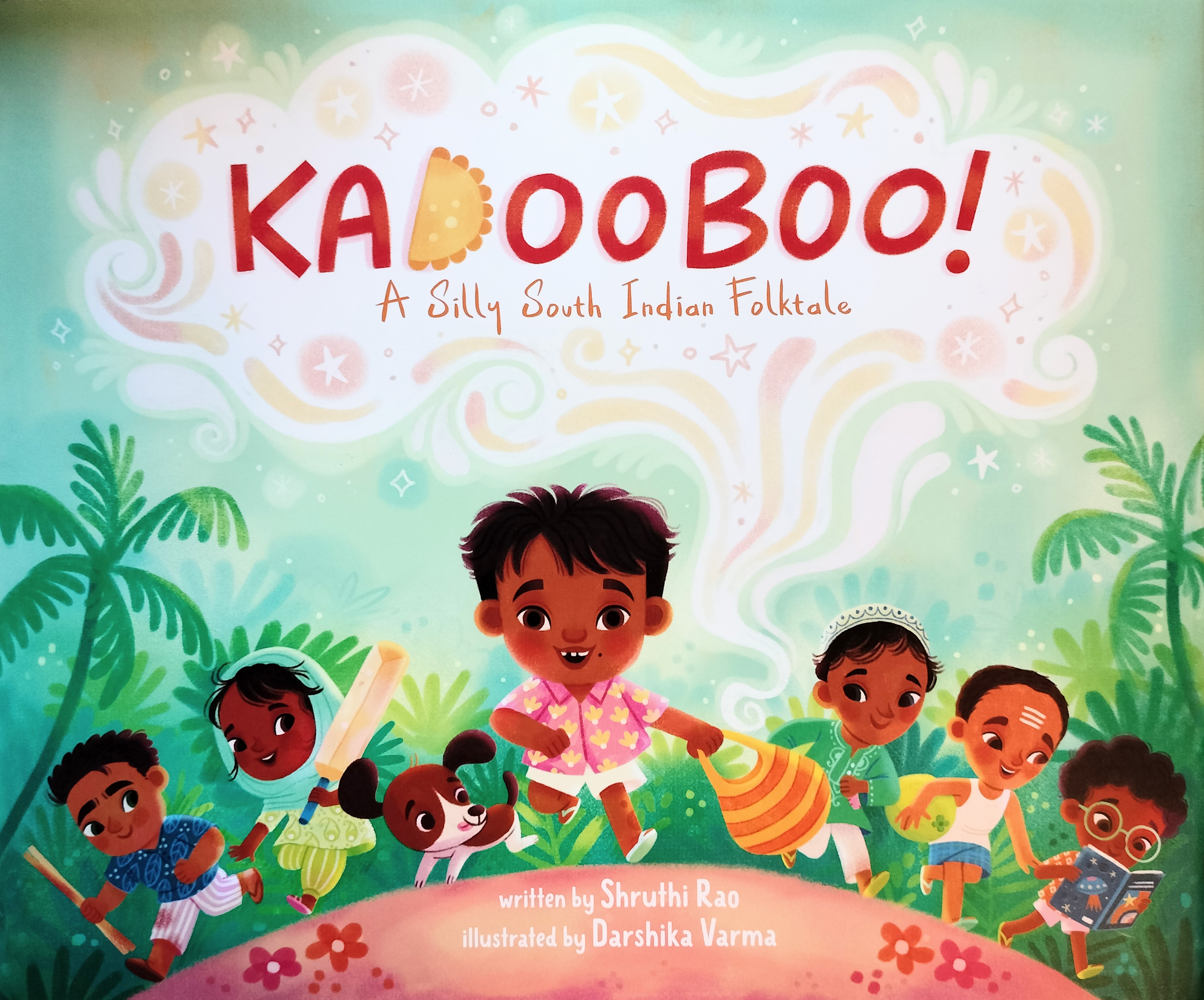
Kadooboo! A Silly South Indian Folktale – Written by Shruthi Rao, Illustrated by Darshika Varma (2024).
Full transparency: I know Shruthi, but that doesn’t change how I feel about this book. It’s a lovely, simple story. Kabir has to get the kadooboo home to his Amma before it rains. But the harder challenge is telling everyone what he’s carrying…and remembering how to say the word. The mistake words are fun & funny, and the artist has brought them out of the main text in a large, bold font that would make it easy for a child to find. And the gaps in Kabir’s teeth–such a small thing, but it adds so much to the illustrations. I love the idea of reading this to a classroom of kids who have all been losing their baby teeth.
Don’t Hug Doug (He Doesn’t Like It) – Written by Carrie Finison, Drawings by Daniel Wiseman (2021)
The confidence and energy this book exudes is amazing. The rhyming is great, and the word choices will make you laugh. And at the end of each scene comes a matter-of-fact reminder not to hug Doug, plus a chance for Doug to reiterate, offer alternatives, and move the story forward in a new way. The illustration of Doug with the megaphone, shouting, “Who here likes hugs?” and giving everyone on the next page (and listening to the story) a chance to answer is a powerful, joyous moment of self-positivity.
I updated my Pinterest page with a few new books, if you want to take a look!
Two of the best picture books I’ve read in July play with what I’d call more traditional styles, stretching my brain a bit and showing me what can be done (really well) by pushing past expectations.
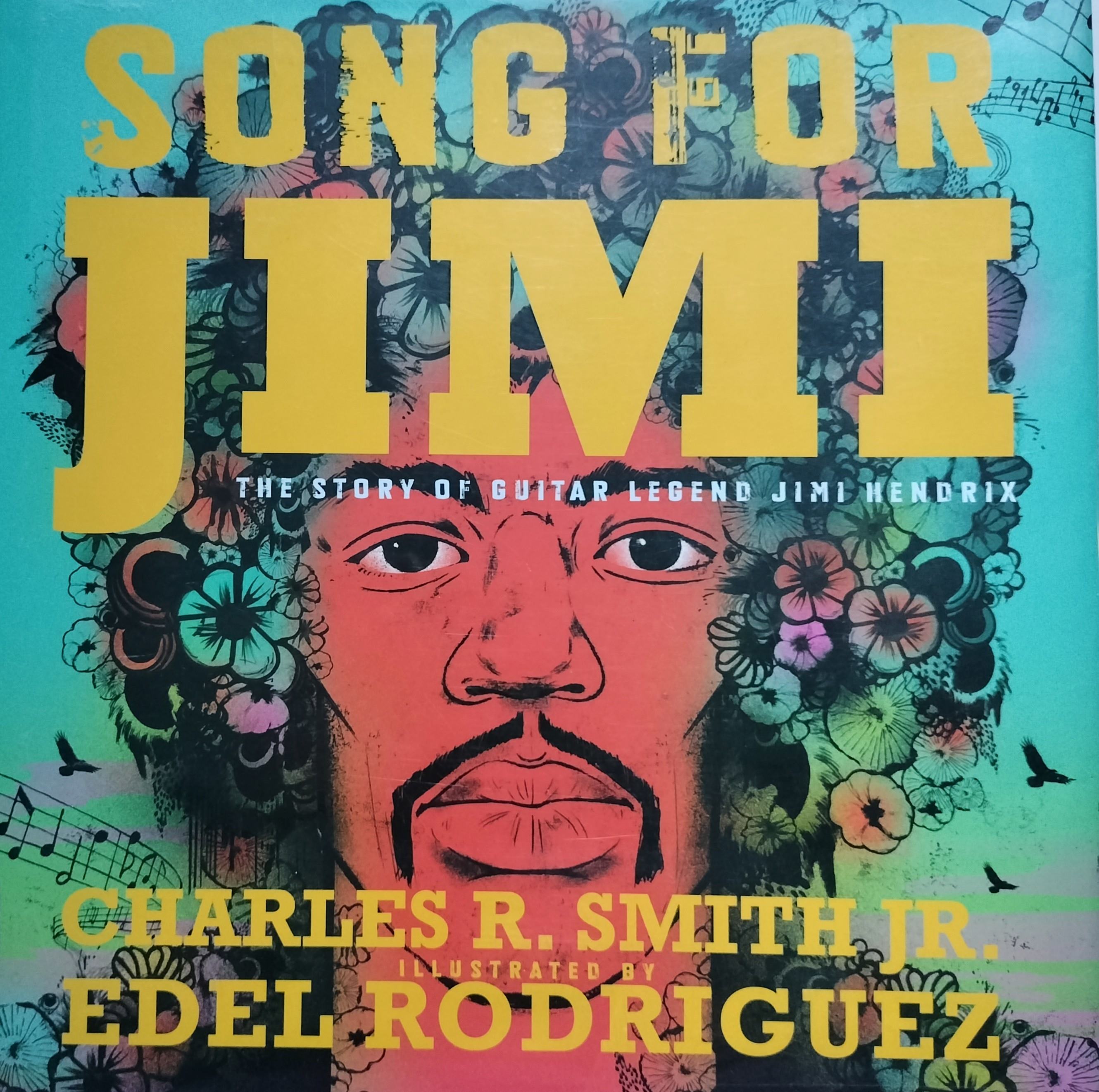
Song for Jimi: The Story of Guitar Legend Jimi Hendrix (written by Charles R. Smith Jr. & illustrated by Edel Rodriguez) is stunning. The art carries all the passion and power that Jimi’s music does. And the writing comes in a series of verses that also get to the heart of who Jimi was and the not-like-anything-else way he played guitar.
Small Things Mended (written by Casey W. Robinson & illustrated by Nancy Whitesides) explores grief, but–unlike so many books with this theme–the story starts after the loss. And while there are hints in the illustrations as to what the loss is, the text doesn’t address it. This story is about recovering from grief, and that’s the journey shared with the reader. And it’s beautifully done.
Based on some comments from an agent or two, and things I’ve been hearing about a shift in the picture book biography market, I’m currently playing with a new version of my pb bio manuscript.
What I’m hearing is that agents & editors are not as interested in “cradle-to-grave” biographies–picture book bios that start their story at the subject’s birth or youth and continue through to their death or a relatively late post in their adult years. Some of these stories also have structures that can feel a bit more “this happened, then this happened,” as opposed to “because this happened, this happened.”
I’m noticing two types of bios replace the cradle-to-grave stories. Note: I’m not changing my manuscript simply because the market may be calling for it–I’m also seeing the additional power and child-engagement that these different styles can create.
One of the different styles is the story that starts later in the subject’s life, usually at the moment just before the inciting incident kicks off the big change/new direction of their life–the thing they did that the author really wants us to know about. After that point, the story tends to follow the familiar arc of the hero’s journey, but one that is built around the pursuit of this new direction.
The other type of bio I’ve found often starts at a more traditional point in the subject’s childhood. It may also follow the hero’s journey structure, although sometimes more loosely. The shift I see in these stories is that the scenes are all tightly structured around a theme–maybe a specific way the subject views the world, a skill set that directs their actions, or a passion that drives their choices.
As I’ve heard Kirsten Larson say–one common take-away of a PB bio, especially in a cradle-to-grave story, is persistence. I’m starting to see that these other types of biography can bring us closer to a more concrete kind of persistence–one particular to this individual. To me, a child reading these books has a better chance of recognizing themselves (Hey, maybe I could…) or of being drawn to something that makes them curious (What would happen if I…). With both kinds of stories, a young reader will still learn something about the subject, but I think they’ll also make a stronger personal connection with that subject. And connection is critical.
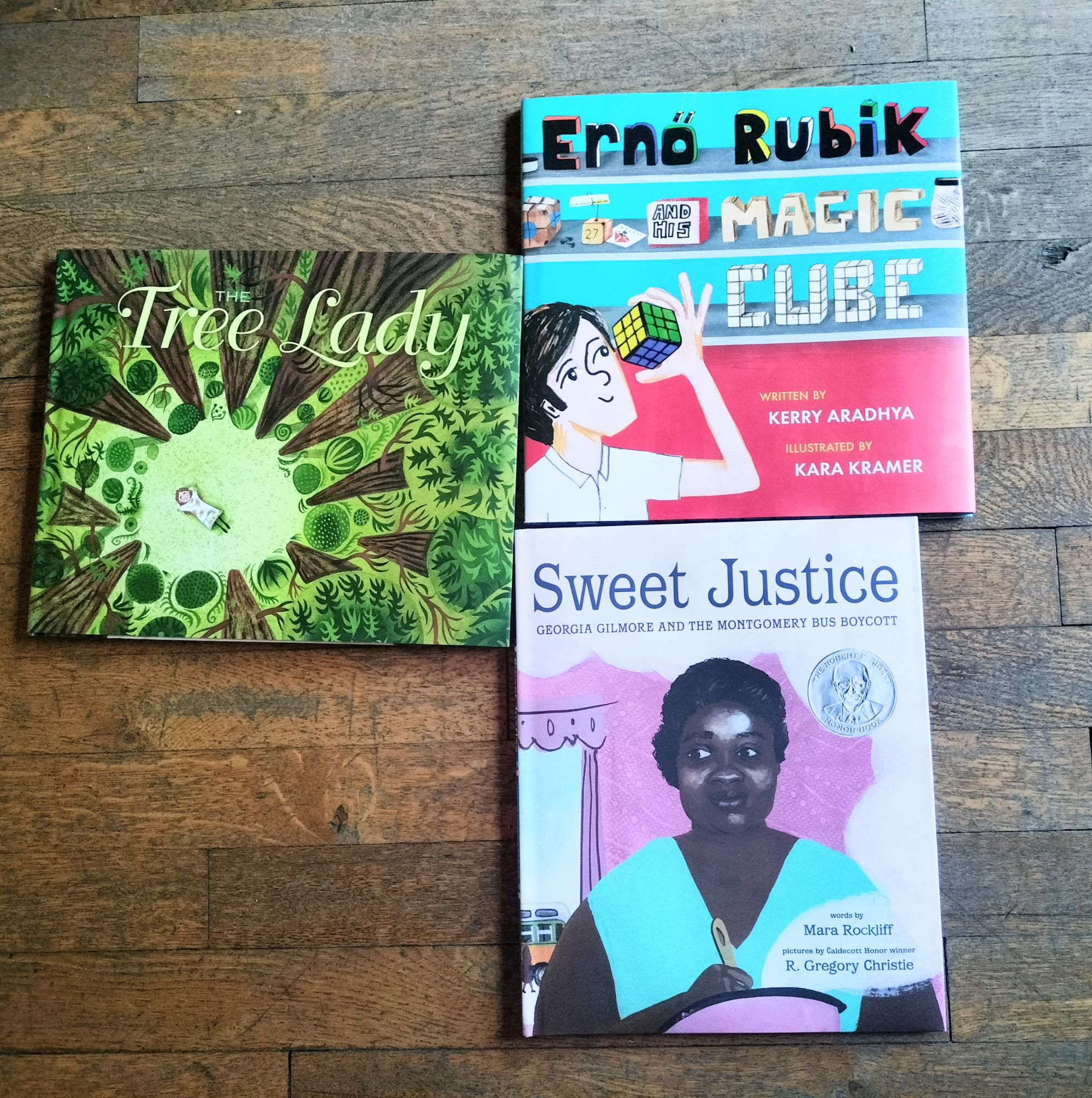
So these are the types of stories I’m looking for, and these are the types of books I picked up at my Indie Bookstore yesterday.
Sweet Justice: Gloria Gilmore and the Montgomery Boycott (written by Mara Rockliff; illustrated by R. Gregory Christie) fits the first type of new bio. Rather than start with Georgia Gilmore’s childhood, the story drops us in the very moment when she hears that Rosa Parks was arrested for not giving up her seat on a city bus. In the next scenes, we see Georgia stop riding the bus, participating in the growing boycott, and cooking & baking to raise funds. This is one of the most beautiful pb bios I’ve ever seen–both the wonderful writing and the absolutely gorgeous illustrations.
Both Ernö Rubik and his Magic Cube (written by Kerry Aradhya; illustrated by Kara Kramer) and The Tree Lady: The True Story of How One Tree-Loving Woman Changed a City Forever (written by H. Joseph Hopkins; illustrated by Jill McElmurry) begin in the subject’s childhood, but neither Ernö no Kate Sessions stay young for many pages. And pretty much every scene that moves the story forward connects tightly to a specific theme–for Ernö, that’s his love of puzzles; for Kate it’s her passion for trees and her use of science to find the right kind of trees to transform the then-desert of San Diego. I’m not saying we don’t get background and history of the protagonists, but the tight structure means even those passages support the theme. These are both very fun books that get us into the heads of a unique individual so we can feel what they’re doing and why.
I still have a big place in my heart for cradle-to-grave bios, and there are some amazing ones currently being published. But I know my love for this style is rooted in my own long-ago childhood, when these were the bios being published and the bios I read. Times have changed and one of the biggest and best changes is that we are now very clear we are writing our children’s stories for children. Bottom line: it’s because we care about those kids and want to give them books they will love, hopefully books that will contribute to them becoming life-long readers. And even if the reality is that grownups are the people buying the books, the kids are the people who will demand (or not!) that a book be read over and over and over again. And it’s that demand that grownups talk about with their friends and communities. Word of mouth sells books–which takes us right back to getting more good books into the hands of more children.
Luckily for me, I enjoy research. I like doing a quick search and seeing if I hit anything interesting on the first try. I like going down rabbit holes. And I like pulling my discoveries together into some kind of recognizable order.
All of which is a good thing. Because, as I started getting serious about agent research this month, I remembered that it is a particularly twisty-turny rabbit hole.
It’s pretty easy to find a list of picture book agents. It’s pretty easy to find an interview or a quote that tells you a tiny bit about the agent, what they like, and if/where you might connect. It’s pretty easy to start popping their names into a spreadsheet.
And it’s pretty easy to find a reason why you won’t be querying them.
I took a bit of time to set up a spreadsheet, with a tab for research and another tab to actually track queries. I know lots of people like QueryTracker, and I may go back to it when I actually start sending out queries. But I’m not very visual, so it helps me to see all the info in one place. If you decide to use a spreadsheet, obviously, you’ll set it up for the info you want to track. But I did this a little differently than the last time I was querying, so I thought I’d highlight some of the columns that I added this time around.
I have two columns for Publishers Marketplace rankings. One is for the agent’s ranking, and the other is for the agency ranking. This will let me watch for newer agents who may not have a lot of sales yet, but who are working at an established agency and who may have support from the more experienced agents there. I want to sort by this column, so for any agent/agency I can’t find a PM ranking for, I’m just entering 1,000, so those rows will filter down to the bottom of the list.
I have a column for whether or not an agent represents picture book, and I’m making sure to separate out those agents who are looking for authors and not just author/illustrators. Because I can barely draw a stick figure!
I have another column for whether or the agent is currently open to queries. This column was really frustrating me. I felt like I just kept bumping up against agent after agent who are not open to querying. I knew QueryTracker information included this info for each agent, so I posted in the 12X12 Facebook group and found out that the QT info is almost always accurate and up-to-date. So I did a filtered search there and came up with a list that only includes open agents. It was a decent length and has me feeling much less discouraged.
I added a column for the most recent date on which I’ve added research info for each agent. I remember, last time, not doing this and finding out that I was definitely not carrying that factor around in my memory.
I put in one more column for my own ranking of agents on a scale of 1-5, 1 being the agents that go to the top of my query list (and get added to the tab for actual querying and tracking). 4 is for the agents I would love to query, but who aren’t open right now or aren’t taking any more picture book authors. 5 is for the agents I don’t see myself ever being a fit with; again, if I delete them, I won’t remember that I’ve already researched; this keeps them on the spreadsheet, but out of sight. 2 and 3 are kind of nebulous, more a gut feel where I think the agent falls after my #1-ranked agents.
This is really getting into the weeds, and you may be reading it and saying, “Duh!” But I remember when I was first starting to do this, years ago, I felt like there was a lot of info floating around out there, and I wasn’t sure how to best organize it, and I kept finding info that didn’t fit into my spreadsheet. I’m feeling better about this one, even though I’m sure I’ll keep modifying it as I go.
So if you’re already set, my best wishes to you for a successful query path. If you find this helpful, I’m glad to have tossed it up here!
Even before January, I knew what my word for 2022 would be. In the midst of all the chaos, anxiety, and uncertainty of the past two years, writing has been the eye of my personal hurricane. I know, for many writers, the pandemic and their own experiences with it have made writing hard, if not impossible. As in so many other ways, I’ve been lucky. My ideas, my stories, have stayed with me, and I’ve been able to make steady progress toward my goal: to get enough picture book manuscripts to the place where I feel ready to query them. To be honest, this has been my goal for 2 or 3 years, but this is the first year I’ve felt certain enough to name it.
My word for 2022 is Query.
I’ve been musing on this for the past couple of weeks, and I’ve decided that–as part of this querying year–I would come back to my blog. Primarily for my own accountability, I want to use this space to set out the process I’m following, including some of the specific steps I’m taking, to get my work out there for agents to see. I’ll be using tags so that anyone specifically looking for this kind of conversation can find the posts, but I’m going to hold off on linking to them on social media. If I start to feel like I’m writing anything truly useful for others (and if I stick to posting at all!) then I’ll revisit that plan.
Anyway, if you’ve found your way here…
Photo by Henri Mathieu-Saint-Laurent on Pexels.com
I hope you discover something to help you or, at least, to make you feel less alone on this stage of your writing journey.
To get started, here’s a summary of where I am, followed up by the next big steps I’ll be taking.
I have three picture book manuscripts “this close” to ready. I have sent them all through my excellent critique group multiple times, and I have workshopped them with other writers & a few agents. (One agent ended our conversation with “keep me posted” and agreed that, assuming I could revise the manuscript as we discussed, I should query her. Guess who I’m sending it to first!)
I will be sending these three manuscripts through my critique group one more time. I am hopeful that, even if they don’t shout, “OMG, SEND THIS OUT NOW!,” the changes I will want to make from their feedback will be minimal. I am not going to restart any of these three or make any changes that mean an entirely new revision pass. I truly believe that it is time for me to get these stories out into the query world.
What do I base that belief on? Well, all the things I’ve noted above, but there’s one other big factor: the feedback I have gotten, and my own sense of the stories, tell me that I will not be burning any bridges by send them out. They may not resonate with everyone who reads them; some agents may feel like they need more work than they’re willing to contribute. I may get no requests for more; I may get no response at all. But nobody will be putting my name onto a list of Never Read Anything from this Writer Again.
My critique group meets monthly. One of the manuscripts is in their hands for January, and I’ll send the other two to them in February and March. As I get feedback, I’ll do a pass to integrate their comments, and then each manuscript will go into the Ready pile. (Oh, yes, you can bet I’ll proofread each again before I send it out!)
While all this is going on (and I’m trying not to be buried by my day job!), I need to also be working on these steps:
Set up a spreadsheet to track my queries. I’ve done this before–I queried a middle grade manuscript YEARS ago, and I sent out a couple of picture book manuscripts when I first made the shift to this genre. Still, it’s fun to start fresh & someone on Facebook posted about how they code their lists with idea for different colors of hearts. I may steal that!
Start populating that spreadsheet. I have been playing around in query tracker, and while it’s a good place to see a list of agents, to see who’s open and who wants what, it’s a little clunkier than I want to use for actually tracking things. I’ll start my list off with the agent who said to query her, of course, and in second place is an agent I took a fantastic workshop from, who also represents one of my critique partners. I’ve also done research on both of these that confirms I want to query them. Hmm…maybe I’ll do a post on research. 🙂
Work on my pitches for all three manuscripts. Honestly, I hate this part, but I’m going to make myself do it. Different agents say different things about pitches & query letters in general – some read them and weigh them, some seem to skip them completely. But I’m not going to put out a sloppy pitch and risk having the agent stop reading before they even get to the manuscript. I just signed up for my second year in 12 X 12, and I will be posting my pitches in the forum for feedback (and giving feedback to others, of course). I may also post some on the Sub It Club Facebook page.
Keep revising. Keep writing. I have a fourth manuscript that everyone has “liked,” but it has a major darling that has to be killed before I do the next revision. After final revisions on the other three stories, revising this manuscript is the next writing work on my list. Last year, in 12 X 12, I managed to writer or revise a draft in 10/12 months, and I will be keeping up with that as best I can. I’m halfway through Storystorm, and I already have a few ideas that are actually calling to me.
Okay, so that turned into a long post, but I’ve laid out where I’m at and where I want to be going. If you’re new to my blog and want to know who I actually am, you can read a bit about me here. If you think this post or upcoming posts would help someone you know, feel free to share.
Okay, sometimes life is like being inside a snow globe. It’s an odd metaphor for a summer, but it’s a summer where things have been shaken up, settled briefly, then shaken up again. In July, we “hosted” my husband’s kidney stone about three weeks. (Go get a big glass of water. Right now. I’ll wait.) Then the heat wave hit, and now California is basically one big firestorm. I’ve been able to get things done at work and make some decent progress on a writing project, but concentration and focus haven’t been my friends for a while now.
When my snow is “settled,” I’m good with having a lot of writing projects up in the air. I can shift back and forth, letting one simmer while I move forward on another. When the snow is whirling, though, having that many first drafts and revisions in my head is like being in a blizzard. (Not that I’ve ever been in a blizzard.)
This morning, after I checked the news on the fires, I took a few minutes to sit and breathe (the smoke has been better at our house for a couple of days!). The wind in my head quieted down a bit, and my mind wandered over to my current writing projects: a new picture book idea I’m excited about, three revisions I have some good thoughts on, and whatever continued writing I want to do on my chapter book wip after the Highlights workshop at the end of this month.
Needless to say, the thought of all those projects waiting for me kicked up the wind, and my mind was back in the snowstorm. I reminded myself that, at times like this, it’s good for me to step back into a sheltered place, line up my goals neatly by the fire, and make some decisions about what comes next, then next after that, and then next again. A row of “nexts” is much better than a swirl of “NOW!”
I put my row in this order:
I want to write another chapter on the chapter book WIP. I’d been putting that on a shelf, because it isn’t required for the workshop, and who knows what direction I’ll be going when I’m on the other side of all that learning. But I realized this chapter is calling to me, I can see my MC struggling and coming out (temporarily) ahead by the end. This sounds fun, and fun is good. Assuming the snow settles a bit, that’s the writing I’ll do this weekend.
I’ll plot and think and brainstorm and get a first draft out of the new idea. When this year started, I had what I thought was four picture book manuscripts worth revising for (eventually) querying agents. Since then I’ve drafted and revised two new ideas into stories with a lot more potential. It’s clear to me that only one of those original ideas is good enough to revise right now, and the other three need to go on a shelf. I think this newest idea is another good one, and I want to get it drafted. Then I’ll be back to a stack of four, and a much stronger hope that I can turn them into something ready to show agents.
After the workshop, I ‘ll move into revision-only mode on my picture books. Four is enough, and I want to keep doing the hard work and getting more feedback from my critique group. I never say never, but at this point, I may not go on another idea hunt until Tara Lazar’sStorystorm comes around in January. (Which, the way time has been feeling lately, is right around the corner!) My goal is to start querying, and revision is going to be the best path toward that goal.
I’m not making any hard decisions about the chapter book until after the workshop. I may find out that this story idea just doesn’t have the potential for today’s market. I may find out that I’m on the right track, and I may “depart” from Highlights as or more excited about the story as I am right now. If the latter happens, then I’ll toss that ball into the air and have it handy to work on anytime I need to let all four picture books simmer for a few days.
Believe me, I’m perfectly aware that this list is my brain’s attempt to glue my snow globe to a shelf and keep anything else from shaking it up, and I’m even more aware that actuality is out of my control. But I’m looking at my plan as being like a snow shovel. If I don’t pick it up and do some clearing while I can, I’m never going to be able to get my car out of the driveway. (Not that I’ve ever held a snow shovel.)
How are you handling the chaos these days? Feel free to share any tricks and tips in a comment!
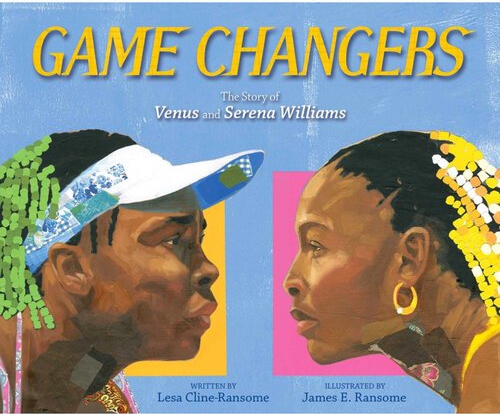
Picture book biographies of one person require the author to wander through mounds of research, sort out big stories and little stories, delve into personality, and find a way in that will engage a young reader and keep them engaged. And that’s true when you’re writing a biography of one person. I think the most amazing thing about Game Changers is the way Lesa Cline-Ransome weaves the complexities and layers of two amazing women into the book. She never drops down into over-simplification, but somehow integrates every element seamlessly into the forward-moving story.
If I had to say, in a few words, what this book is about, I’d say it’s about the love of Venus and Serena for the sport of tennis and the love Venus and Serena have for each other. Not only does Cline-Ransome achieve absolute balance between the two threads, but she manages to capture what I imagine is a truth of the Williams’ lives.
Serena and Venus Williams have shown their absolute commitment to playing their best possible game of tennis every time they step on a court. Simultaneously, each is dedicated to being their sister’s best friend and strongest supporter, even when they are standing on opposite sites of the net.
Cline-Ransome achieves the book’s balance by a sort of “take-turn” structure that, I think, intentionally mirrors the pace of two players warming up before a match. She spends a few words, a page or two, focusing in tightly on the tennis thread–the hard work that started when the women were young children, the determination with which they put in hour after hour on the court. Then she shifts to the way the sisters were constantly together, excluding their individual names from many pages and using instead the plural they. And throughout the book, she touches lightly but firmly on pieces of their story that are not easy and, often, not complimentary to the world of tennis.
The story builds with the women’s success, to a climax of three matches they played in 1998, 2000, and 2002. Venus beats Serena in the first match at the Australian open. They play doubles together in the 2000 Olympics and walked off the court with two gold medals. And in 2002, Serena beats Venus at the French open. Reading the pages feels like you’re in the stands, watching a three-set match, if an imaginary match in which the second set ends in deuce. A match where Cline-Ransome’s “ball” goes back and forth between the two woman as smoothly as one of their rallies.
Yes, I, too, can occasionally resort to sport metaphors.
At the very end (spoiler alert), Cline-Ransome brings the two loves–the loves of sport and sister–together in three incredible paragraphs.
…Venus served big for the second set and took the lead, but Serena broke serve and won. The second set was hard fought, and the sisters rallied with down-the-line combinations, skidding from sideline to baseline until the final match point, when Venus cracked the ball into the net and the moment belonged to Serena. In two sets of 7-5 and 6-3, a victorious Serena stepped out of the shadow of her sister.
Turn the page…
Venus ran off the court as the curious eyes of the crowd followed her. High into the stands Venus sprinted, snatched up her bag, and pulled out a camera. “Nothing can keep me from celebrating when my best friend wins a match,” Venus said proudly.
I closed this book with a sigh of utter satisfaction.
A note about the illustrations: I wish I knew enough to describe what James E. Ransome has done with his art. Every page shines with beauty and energy and emotion. It’s hard for me to choose a favorite, but this one stunned me when I first saw it and continues to draw me back to look at it again and again.
I’ve been saying for a long time that, someday, I want to write picture book biographies. In a recent Duh! moment, I realized that isn’t going to happen until and unless I get serious about reading and dissecting them. So I’m starting a new series on my blog featuring picture book biographies and my thoughts about why and how they work. I’m starting the series with a book I love and that happens to be very handy, sitting right there on one of my picture book shelves. That book is Evelyn the Adventurous Entomologist: The True Story of a World-Traveling Bug Hunter, written by Christine Evans and illustrated by Yasmin Imamura.
Full disclosure, I met Christine at an SCBWI event and picked up her book to browse through it. I was already loving it when I came to these words,
Many years later, Evelyn applied to veterinary college. She longed to help sick animals.
And the next page:
However, it was the early 1900s. Women couldn’t vote. They rarely went to college. And they certainly weren’t allowed to be vets.
Then and there, I bought two copies–one for me and one for my mom. My mom also wanted to go to vet school and, in the 1950s, but was told by a school counselor that might not be possible. But vet schools had just started to admit women. My mom knew it wouldn’t be easy. But she “went anyway.”
Fifty years earlier, Evelyn Cheesman wasn’t able to vet school. But many, many other times she was told she couldn’t go somewhere, but–in a lovely repetition of phrase in Evans’ book–“…Evelyn went anyway.”
One of the things I love about this book is the way Evans doesn’t try to force the facts or her language. She uses “Evelyn went anyway” when it’s accurate–when Evelyn did go. In places where Evelyn was unable to pursue a specific dream, Evans shows us the other ways in which Evelyn persisted, pushed forward. In the book, Evelyn says yes to every opportunity and, when one isn’t presenting itself, she makes her own. She dives into everything she tries, making it her own with creativity, hard work, and–I think–a love of being in charge of her own world. By making clear the many bumps in Evelyn’s path, Evans shows us beautifully the ways in which Evelyn got past those bumps–sometimes walking around, sometimes climbing (literally), and sometimes pivoting in a new direction. But she never once stops moving forward.
Evans also does a fantastic job of weaving in the perfect amount of information about the time in which Evelyn lived. The focus is always on Evelyn–the things she chooses to do, the adventures she takes, the way she seems (to me) to always be on the lookout for something new she can learn, something new she can explore. But mixed into Evelyn’s story are bite-sized tidbits about Evelyn’s world. We don’t need this context to know that Evelyn was special, but the contrast of her actions with what she was supposed to do, allowed to do, highlights the power of her personality and the strength of her commitment to herself and her dreams.
A note about the illustrations: I really love the art in the book. The colors are all earth tones, evoking Evelyn’s love of the outdoors. Evelyn’s energy, focus, and action are brought out in every illustration of her. And somehow, as we see Evelyn across various ages, she is always Evelyn. Beautiful.
I would give this book to any child as an introduction to picture book biographies, but most especially to a child who sees the world in a slightly different way than those around them or to a child who needs to know that stubbornness can be a strength. I would also, of course, give this book to anyone (child or adult) who loves bugs.









 Becky Levine