
Posted in First Drafts, Getting Organized, Organization, Outlining, Plot, Scenes

Thursday’s Target-A Rainbow of Sticky Notes

Yesterday, I reread Robin LaFevers post on index cards. Then I went out and bought some sticky notes. Two packs. Five colors each.

Because I’m confused.

Not from Robin’s post. From my own plot. Too confused to know what to write next. So I’m trying something that occasionally works for me, but only occasionally–going visual.

My MC has three (maybe four) possible paths. Well, in all likelihood, she’ll follow all the paths somewhere in the story. I think. At the end, though, she has to choose one. I know this. I even know WHICH path she’ll choose. I also know (darn it!) that I can’t just lay these paths out sequentially or in parallel, which is how they’re feeling in my brain right now. No, I have to weave them.

Which means I need connections. Overlaps. Characters with more than one role. Layers.

I know, these come in revision. And I’m still on the first draft. Well, actually, I’m just a bit stalled on the first draft.

I think writer’s block may actually be this kind of stall–and maybe more aptly named writer’s jam. It’s not that I don’t have any ideas. It’s not that I can’t see my MC acting, going places, talking to people. It’s that I have LOTS of ideas, lots of action, people, and places. But they’re all crowded together, like I’ve poured them into one of those cake-icing bags–the ones that narrow down to a tiny hole. And all the ideas are trying to get out that hole…at the same time.

So I’m going to play with my sticky notes today, on my whiteboard, and try to come up with some pattern that shows me what to focus on. What to pull out of the hat next. I’m going to use a different color for every scene on one of those three (four?) paths and then try to move things around. (Yes, I know I said I had 10 colors. Hey, you never know!)  Hopefully, I’ll get THE idea that lets me move forward.

What do you do when you need a “lightbulb moment”?
Posted in First Drafts, Getting Organized, Outlining, Plot, Research, The Writing & Critique Group Survival Guide

When the Itch Hits

Do you scratch it?

I’ve been talking a lot online about the research & planning I’m doing for my YA historical novel. It’s been going great. I’m learning tons about my characters, about their wants and their conflicts, about their back-story and their future. I know there’s more I can learn.

Except I’m itching to put all this aside and get writing.

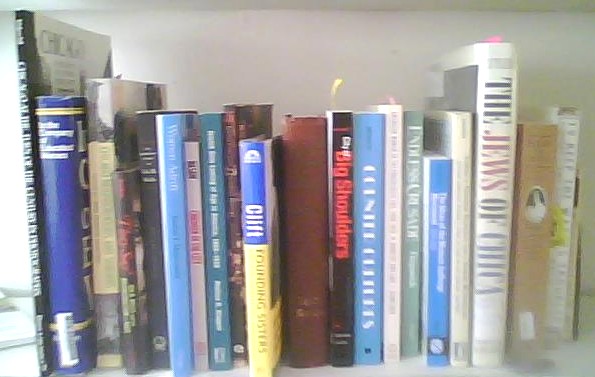
I promised told myself I would finish Donald Maass’ Writing the Breakout Novel Workbook before I started writing. I said I would do a bit of plotting before I dug in. There are at least a third of these

researchbooks

that I haven’t read yet, and more I need to add to the shelf.

I can hear you all now. “Just write it!”

And here are your very good reasons:

  • I’ll learn more about your characters as you draft their stories.
  • The plot will change no matter how much time I spend on it.
  • I’ll narrow down my research needs as I write.
  • If I do too much planning, I’m putting handcuffs and chains on my muse.

Yep. So I’m going to write.

Soon. I’m still learning from Maass, but I’m giving myself permission to go a bit more quickly through his worksheets. I’m putting a few more tags on pages that need to wait until I have a draft to revise. And I’m letting myself relax away from the research a bit, so I can keep my actual characters at the forefront of my brain, instead of too many historical details/facts. And, since I still will have revisions to do on the critique book, I’m telling myself that any plotting I do has to be fit in between those changes. I’m not allowed to put the writing off, just because the whole outline isn’t complete and comprehensible.

When? I’m thinking June. A few other writing friends have first drafts looming, and we may all hit the keyboards together.

I’ll be MORE than ready.

So when do you start? What’s your comfort zone between knowing any/all of your story and needing to get those people on the page and moving? I’d love to hear how you do the balancing act?

Posts may be a bit thin on the ground the next few days–we’re in the middle of spring break over here. I’ll be back in force next week, though, and I’d love to start doing a little more talk about critiquing and critique groups. So if there’s a topic you’re “itching” to dig into, let me know that, too!

Posted in Outlining

Outline: What’s Your Definition?

Today’s post is in honor of all the NaNo writers out there, and all variations thereof, who may or may not be writing from some kind of outline. To all of you: Go, go, go!

Outlines. Think back to school–junior high, high school, even college. You had a paper to write, an analysis of a book you’d been assigned. You were organized, you’d learned the method, so you started with an outline. You know: Thesis, Topic Sentences, Supporting Details, Conclusion.

Remember?

It’s a useful technique. I kept at it when I became a technical writer, and I use it today for my nonfiction. It’s a great map to write from, and it gives me a starting point to go back to, if I get distracted or off track, to re-organize things a bit, get my new focus down on paper. And, yes, it’s got that basic form: Chapter 1, Heading 1, Heading 2, etc, etc.

Not so my fiction. Probably because there are too many layers to fiction. If I try to fit them all into headings and subheadings—my brain will implode. Messy. So how do I outline?

I start with Martha Alderson’s Scene Tracker. The Scene Tracker has several columns of information that you fill out for every scene. I add columns of my own, things I tend to forget about unless they’re right in front of me. And I’m sure I fill every column out with a LOT more text than Martha expects. I don’t trust myself to remember big ideas from a word or two, so I end up using a teensy font and get these very skinny, very TALL columns to squint at later. But the system keeps me organized, which keeps me calm and (relatively) sane.

I also always have gaps. I find it too hard to “outline” my story all the way through, without getting down to doing some writing. The outlining process stirs ideas that go beyond details and facts–scenes, character moments, tensions–and I need to start writing.

Before I write any real scenes, though, I usually take things one step further. I open a file for those scenes–starting with the beginning of the story. In that file, I write the basic action that I visualize in the scene–what the hero does, who and what they run into that makes their life difficult, and where, by the last page, they need to be heading. I get down the goal of every major player in the scene, and I try to come up with a plan to put those goals in conflict. I also throw in a lot of fairly random thinking about theme, tension, setting, and various connections I’m starting to see.

When I’ve done this scene planning as long as I can stand it, I start writing.

Do I stay with the “outline” I’ve plugged into my Scene Tracker? Do I stick to the goals and actions I gave my hero in the scene basics?

Sometimes, yes; sometimes, no. I said that I use my nonfiction outline as a guide, as the original drawing board that I often go “back to.” Why should my fiction plan be any different? Would I love to know everything ahead, have the story perfectly drawn out in my head and on paper, so I could just write and write and write? I’ll admit it: Yes, I would.

I just don’t think its possible. And I don’t think it’s a good goal for the writer to shoot for. Every time I lose myself off the outline, I come up with something new and exciting, something that either turns the story in a new, better direction or something that adds a layer, a depth, that simply didn’t exist before.

Here are a few more blogs and articles I found about the variations of outlining:

What about you? What’s your definition of outline these days?