Posted in Book Review, Picture Books, Read-Aloud

Four Fantastic Picture Book Read-Alouds

I have a lot of picture books on my shelf–possibly too many! They’re all great, and they all bring something to the table for my learning & craft. And, obviously, every picture book is a read-aloud.

But there are some books that just sing to me as a reader–I can hear the rhythm or voice in my head, and I can see myself reading it happily and easily to a crowd of children (well, maybe a small group!).

Federico and the Wolf – Written by Rebecca J. Gomez, Illustrated by Elisa Chavarri (2020).


I’ve never been a huge fan of the original Red Riding Hood story, but this is one of the most delightful fairy-tale retellings I’ve seen. The rhyming and rhythm work so well together, and the prose and dialogue has an energy that transfers itself into the reading. And on top of that, it’s funny! This is a must-have to share with kids.

Nobody Hugs a Cactus – Written & Illustrated by Carter Goodrich (2019)


I laughed out loud in the bookstore when I opened this one. The text is spare and tight, with a lot of dialogue. And that dialogue is absolutely filled with attitude, especially Frank’s. It is SO much fun to read a rude character. And the art! On every page, after I read the text to the kids, I’d be pointing to Frank and saying, “Look at his face!” Pretty soon, they’d probably be saying it before me.

Kadooboo! A Silly South Indian Folktale – Written by Shruthi Rao, Illustrated by Darshika Varma (2024).
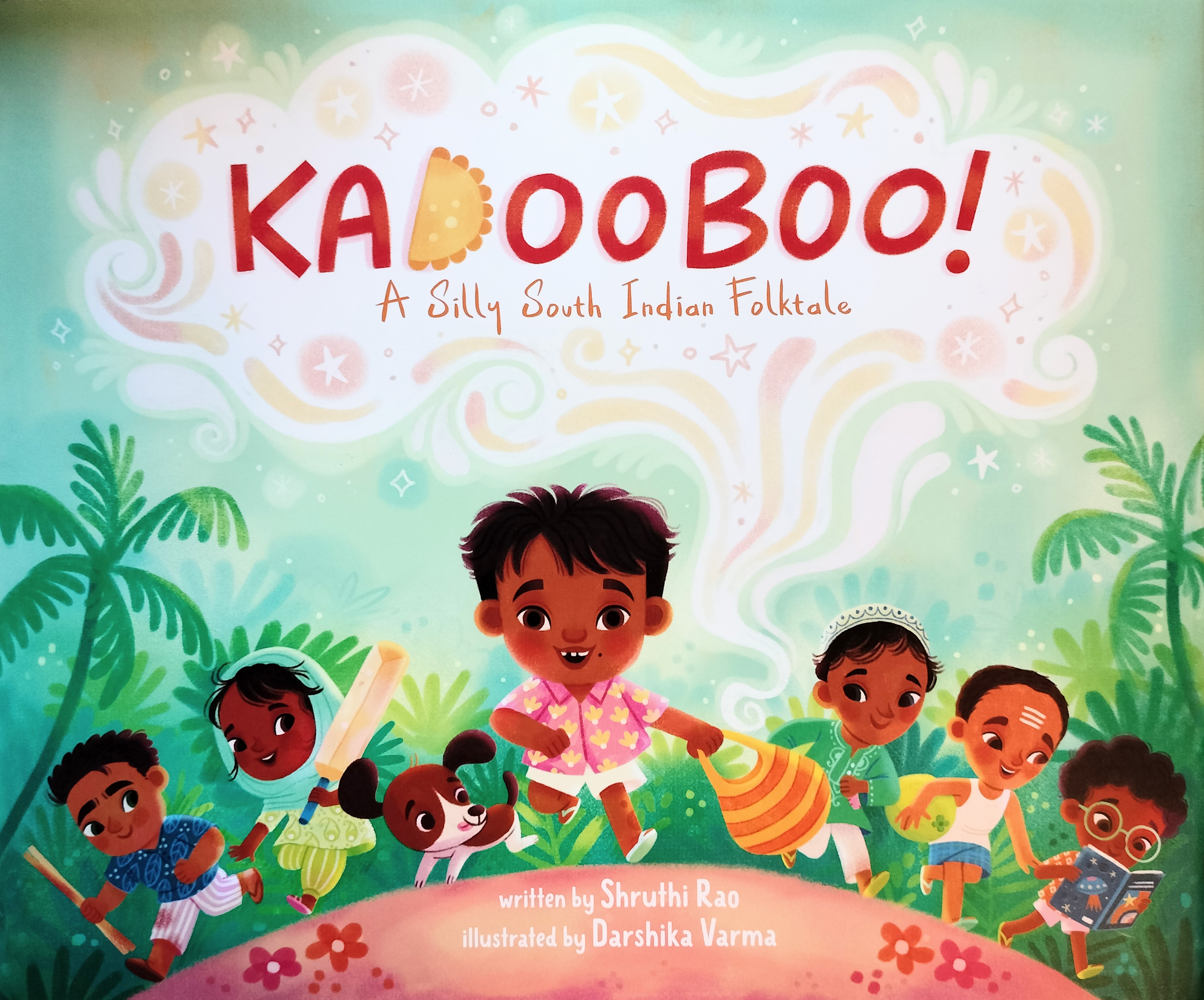

Full transparency: I know Shruthi, but that doesn’t change how I feel about this book. It’s a lovely, simple story. Kabir has to get the kadooboo home to his Amma before it rains. But the harder challenge is telling everyone what he’s carrying…and remembering how to say the word. The mistake words are fun & funny, and the artist has brought them out of the main text in a large, bold font that would make it easy for a child to find. And the gaps in Kabir’s teeth–such a small thing, but it adds so much to the illustrations. I love the idea of reading this to a classroom of kids who have all been losing their baby teeth.

Don’t Hug Doug (He Doesn’t Like It) – Written by Carrie Finison, Drawings by Daniel Wiseman (2021)


The confidence and energy this book exudes is amazing. The rhyming is great, and the word choices will make you laugh. And at the end of each scene comes a matter-of-fact reminder not to hug Doug, plus a chance for Doug to reiterate, offer alternatives, and move the story forward in a new way. The illustration of Doug with the megaphone, shouting, “Who here likes hugs?” and giving everyone on the next page (and listening to the story) a chance to answer is a powerful, joyous moment of self-positivity.

Posted in 2024, Authors, Book Review

Ruth Stiles Gannett Kahn

Or…as you might know her, Ruth Stiles Gannett, the author of MY FATHER’S DRAGON.

I loved this book when I was a child, I loved reading it to my child, and I still pick it up every few years and read it again–just for the joy of it.

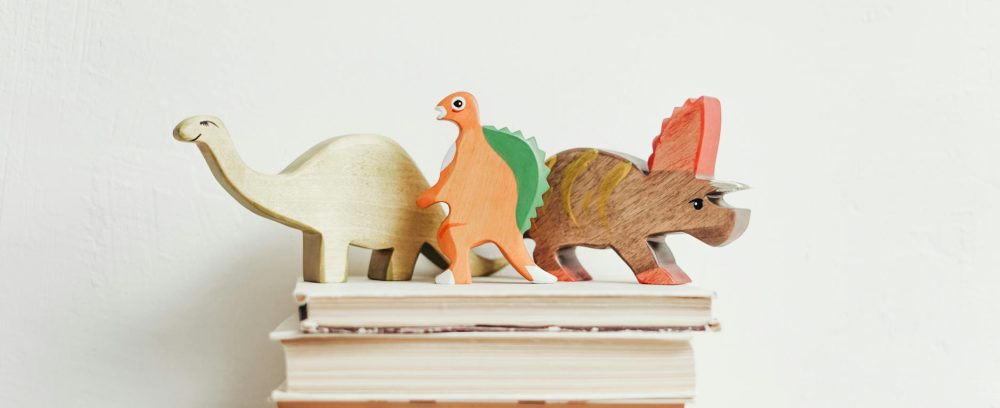
I even picked up this toy years ago, because it reminds me so much of the dragon in the story.

There’s a reading “stage” for some children (many children?) when they are ready for a very special kind of book. They may still love picture books–either listening to someone read them or just curling up and spending time with a favorite. They may have started on some beginning readers–with some help or by themselves. But sitting still for someone to read them a novel is still a little tricky, when even one page may have more words than they’re used to, and a lot of pages don’t even have one picture on them.

This is when, I think, episodic books are wonderful. These are books that may have the same page count as one for older children, but don’t ask the child to carry all the pieces of a long story in their head. Instead, each chapter is a story in itself, with things like setting and characterization staying consistent across the entire book.

When my son was young, I couldn’t find many recently published books that had this structure.* So I went back to some of my favorites–Mrs. Piggle-Wiggle, Homer Price, Amelia Bedelia (short chapters, but lots of word play).

And MY FATHER’S DRAGON. Unlike some of the others, it has an overarching plot that the author touched base with, lightly, at the beginning and end of each chapter, so the child didn’t have to remember that bigger goal. This left them free to focus on the goal of each chapter… typically to get past or away from animals of various scariness. And she handled the scary parts so beautifully. She would show the danger with a sentence or three, then drop the reader right back into Elmer’s ingenuity and resourcefulness, dropping the tension just enough that the child could stop worrying about if Elmer was going to escape and start wondering how he was going to escape. Such good writing.

I had no idea that, until last month, Ruth Stiles Gannett was still alive. She died on June 11th.

Here’s a link to her obituary, if you’d like to read more about her.

*If you have any good episodic books for young children that have been published in the last few years, I’d love to find out about them.

Posted in Book Review, Picture Book Biographies, Picture Books

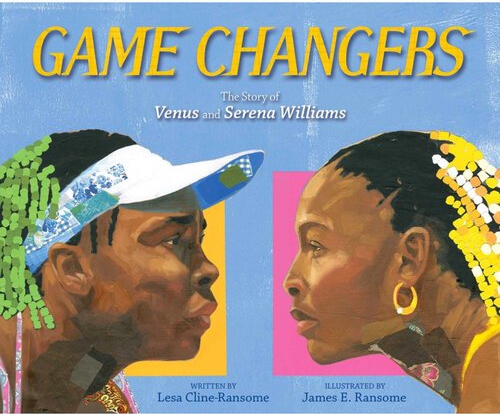
PB Biographies – Game Changers: The Story of Venus and Serena Williams

I added Lesa Cline-Ransome’s and James E. Ransome’s Game Changers: The Story of Venus and Serena Williams to my first bookstore orders of pb biographies, and I am so glad I did.

Picture book biographies of one person require the author to wander through mounds of research, sort out big stories and little stories, delve into personality, and find a way in that will engage a young reader and keep them engaged. And that’s true when you’re writing a biography of one person. I think the most amazing thing about Game Changers is the way Lesa Cline-Ransome weaves the complexities and layers of two amazing women into the book. She never drops down into over-simplification, but somehow integrates every element seamlessly into the forward-moving story.

If I had to say, in a few words, what this book is about, I’d say it’s about the love of Venus and Serena for the sport of tennis and the love Venus and Serena have for each other. Not only does Cline-Ransome achieve absolute balance between the two threads, but she manages to capture what I imagine is a truth of the Williams’ lives.

Serena and Venus Williams have shown their absolute commitment to playing their best possible game of tennis every time they step on a court. Simultaneously, each is dedicated to being their sister’s best friend and strongest supporter, even when they are standing on opposite sites of the net.

Cline-Ransome achieves the book’s balance by a sort of “take-turn” structure that, I think, intentionally mirrors the pace of two players warming up before a match. She spends a few words, a page or two, focusing in tightly on the tennis thread–the hard work that started when the women were young children, the determination with which they put in hour after hour on the court. Then she shifts to the way the sisters were constantly together, excluding their individual names from many pages and using instead the plural they. And throughout the book, she touches lightly but firmly on pieces of their story that are not easy and, often, not complimentary to the world of tennis.

The story builds with the women’s success, to a climax of three matches they played in 1998, 2000, and 2002. Venus beats Serena in the first match at the Australian open. They play doubles together in the 2000 Olympics and walked off the court with two gold medals. And in 2002, Serena beats Venus at the French open. Reading the pages feels like you’re in the stands, watching a three-set match, if an imaginary match in which the second set ends in deuce. A match where Cline-Ransome’s “ball” goes back and forth between the two woman as smoothly as one of their rallies.

Yes, I, too, can occasionally resort to sport metaphors.

At the very end (spoiler alert), Cline-Ransome brings the two loves–the loves of sport and sister–together in three incredible paragraphs.

…Venus served big for the second set and took the lead, but Serena broke serve and won. The second set was hard fought, and the sisters rallied with down-the-line combinations, skidding from sideline to baseline until the final match point, when Venus cracked the ball into the net and the moment belonged to Serena. In two sets of 7-5 and 6-3, a victorious Serena stepped out of the shadow of her sister.

Turn the page…

Venus ran off the court as the curious eyes of the crowd followed her. High into the stands Venus sprinted, snatched up her bag, and pulled out a camera.
Nothing can keep me from celebrating when my best friend wins a match,” Venus said proudly.

I closed this book with a sigh of utter satisfaction.

A note about the illustrations: I wish I knew enough to describe what
James E. Ransome has done with his art. Every page shines with beauty and energy and emotion. It’s hard for me to choose a favorite, but this one stunned me when I first saw it and continues to draw me back to look at it again and again.

Posted in Book Review, Nonfiction, Picture Books, Uncategorized

Review: Just Right – Searching for the Goldilocks Planet

I have a bit of an infatuation with nonfiction picture books. Yes, I love them, but infatuation implies a sense of distance, of something out of reach. At this point, writing a nonfiction picture book feels out of my reach. In a good way–yes, someday I might write one–but for now I get to experience that feeling of awe on top of the admiration.

So I pick up nonfiction picture books here and there, let myself read and enjoy them, but I don’t buy a lot. I’m writing fiction, and I need mentor texts, so that’s usually where I spend my money.

Occasionally, though, I read a nonfiction picture book that is so incredibly well done, so gorgeous, that I need to own it. Just Right: Searching for the Goldilocks Planet, written by Curtis Manley and illustrated by Jessica Lanan, is one of these books. The writing and the art are amazing, conveying perfectly both the facts and the magic of space exploration.

Note: I apologize profusely to the author and artist for the way my phone wiggles the lines of texts and absolutely distorts the colors in the illustrations. Definitely go get your own copy so you can read and see this book for yourself. To get a much better understanding of how the story and art weave together and to see the actual physical beauty of the book, take a look at this trailer on Lanan’s website.

Manley’s writing is, like the book title, just right. He presents the information with clarity and the flow and pacing of a good story, bringing us on a journey from the discoveries of the past, to the understanding we have today, to the possibilities pf what we will learn in the future. He does a beautiful job of taking us far out into space–the definitions, the technology–then bringing us tightly back to how that all connects to Earth, to the work our scientists are doing, to how each one of us. His language ranges seamlessly from poetic to concrete and active.

hand-text-use.png


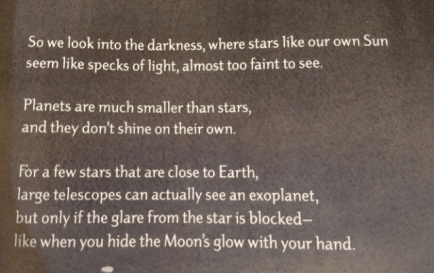
Manley chooses to write with the second person you, and it’s wonderfully effective. After reading this page (and seeing the art below) children will run outside to put their hand up to the sun, see what happens for themselves, and let their mind roam out to the “specks of light” they’ll see in the sky that night.

Lanan has picked up on that you in her art with a beauty that, frankly, stunned me.  Here’s the illustration that accompanies the words above.

hand art brighter

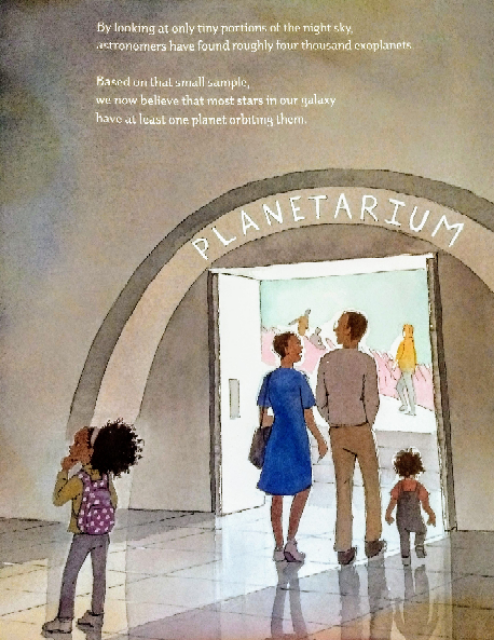
Lanan’s illustrations show the story of this girl and her family on a visit to an exhibition on exoplanets, and–while we basically follow the whole family–the parents and young sibling quickly become ancillary to the girl’s experience. She is the child reader; she is who Manley is writing for. The rest of the family is interested in the exhibition; the girl is completely immersed. She explores pieces of the exhibition her family passes by; she lingers behind in rooms from which her parents are already moving on. Her fascination simultaneously leaps off the page and pulls us deeper into a connection with what she is feeling.

fascination

And whoever worked on the layout of the book got it “just right.” (Despite the way my phone is showing it below!)

left spread one more time

right spread really use

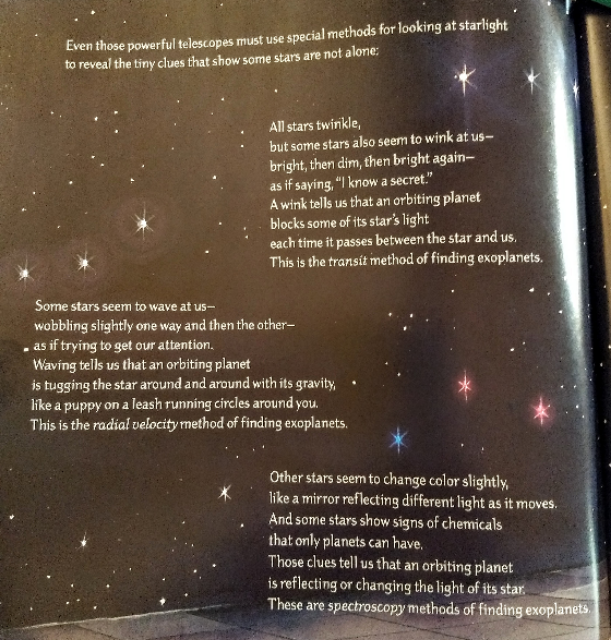
The words that fill the left page of this spread, which pull us out to the stars visible through only the most powerful telescopes, are balanced with the smaller chunk of text on the right–Manley even uses the words tiny and small to emphasize the comparison.  The art on the left side shows the vastness of space; the right focuses our attention on our own smallness and the immediacy of the impact this view has on the girl.

No spoilers about where this book takes you at the end, but I can tell you that I was on the edge of tears when I finished reading it for the first time.  This book needs to be in every family and in every classroom, and I hope whoever is reading it has the sense to do so outside with a clear view into the sky.

Posted in Book Review, Picture Books, Uncategorized

Review: The Remember Balloons

I don’t remember why I put The Remember Balloons on my to-read list. I’m very glad I did, though. The book, written by Jessie Oliveros and illustrated by Dana Wulfekotte, is a lovely story that does an absolutely beautiful job depicting the magic relationship that can exist between a child and their grandparent, what it looks like when that grandparent experiences dementia, and the loss we all feel when that happens. But the particular thing this story does is explore the way that loss can get mixed up with confusion, hurt, and anger–maybe especially, if you’re a young child.

Bright lost silver balloon

I didn’t actually know what the book was about when I opened it this morning. In fact, the first page–where a young boy tells us that he has “way more [balloons] than my little brother”–made me think it was going to go down some path about sibling rivalry. The next page wiped that away, as the boy shares with his little brother what’s in his favorite balloon–the fun memory of his last birthday party. At this point, I thought the idea of balloons as memory holders was nice, but I wasn’t expecting the power that Oliveros and Wulfekotte give to the metaphor.

Warning: Some spoilers after this point.

Starting with the comparison of his balloons with his little brother, the boy follows that comparison to the fact that his parents have many more balloons then takes us to his grandfather–who has the most balloons of all. They go further, then, showing us how those balloons hold amazing memories–memories that the boy asks to hear about again and again. And then one step further, to a very important balloon–a silver one.

Bright silver balloon

He has the same balloon. It holds a memory of “the day we stood on the dock till the sun went down, feeling tug after tug  on our lines. Grandpa and I must have caught a thousand fish.”

Having the boy tell the story, in first person, was the perfect choice, I think. His voice is simple and clean, but words like and my and we keeps the story close and personal–the reader really is strongly drawn into the boy’s feelings. I, as an adult reader, recognize those feelings, and I think a young child going through a similar experience will recognize them, too.

“Grandpa’s balloons start floating away, faster and faster.
Running down streets and up hills, I watch the balloons grow smaller.”

And then, after a perfectly placed page turn and given a full two-page spread…

Bright cover

I’m not going to spoil the ending, but the crisis is absolutely perfect and the ending resonates with the hope of finding another, new way to connect with someone you don’t want to lose. Not every child will have the opportunity to take the step the boy does, and not every child will feel able to. But books like this aren’t here to present a one-size-fits-all solution, and they shouldn’t–life doesn’t always come with a solution. What this book does do wonderfully is show the thing one child tries, and–by doing so–opens up the possibility that another child–the child outside the book–will find something they can try as well.

There are a lot of books out in the world, created by people who want to help children understand the big, and sometimes bad, things that happen to them. And–let’s face it–to help the adults who are struggling to explain something they don’t fully understand. They’re hard books to write and hard books to illustrate–hard books in which to balance story and support.

The Remember Balloons succeeds on all counts.

Posted in Book Review, Nonfiction, Picture Books, Uncategorized

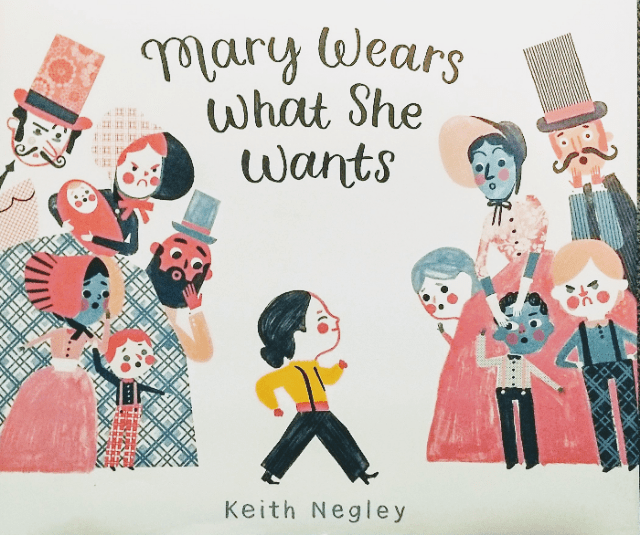
Keith Negley’s MARY WEARS WHAT SHE WANTS

I love good nonfiction picture books, but I don’t purchase a lot of them–I’m writing fiction, and so most of my book budget goes toward good examples of that genre. Every now and then, though, I come across a nonfiction book I can’t leave at the store.

Keith Negley’s Mary Wears What She Wants was one of those–telling, as it does, a snippet of the life of Mary Edwards Walker. The title caught my eye–because it focuses on the fact that Mary is doing what she wants to do, as opposed to the fact that she is wearing pants instead of dresses. As soon as I pulled the book off the shelves, the art caught and held me. Look at that cover–I loved Mary as soon as I saw it. She strides along, head held high, looking straight ahead & not giving the naysayers a speck of her attention. And you could pull me into a debate about her facial expression, but I think she’s wearing a very small smile of determination and freedom.

This book seems, to me, a wonderful example of words and art supporting each other. Negley is a writer-illustrator, so maybe it’s a bit easier to leave yourself room for art, but I’m guessing it’s just different. Still, however it is all working inside his head, Negley weaves together text and illustrations magically. Some places, he uses gorgeously concrete words with sparse illustrations, like this page early on, where Mary and other girls face all the problems that come with wearing a dress. (I apologize for what my phone camera does to the font–it’s nice and sharp in the book!)

Mary 3a

In other places, he flips the balance completely, filling a page or two with art and just a few words. The sentence on the spread below–“It was kind of a big deal.”–is essentially a mike drop (even though the story continues when you turn the page.)

mary 4

And the story has tension. Despite the look on Mary’s face–and the certainty she has about there being no reason she shouldn’t wear pants–Mary does worry and she is a bit afraid. Mary meets every obstacle head-on, with force and power. I think, though, that–as you read–it becomes clear Mary would be happier if she didn’t always have to be fighting.

Obviously, I think every child needs this book–no matter what gender they identify with, no matter if they are happy or not wearing the clothes people give them. It’s a book about crossing boundaries, opening eyes, and resetting “truths.” Mary Wears What She Wants sets as a standard the right to think for yourself and make your own choices. And shows a path for doing just that.


Posted in Book Review, Fantasy, Uncategorized

Humiliation in Joe Abercrombie’s Shattered Sea Trilogy

I know, right? Humiliation? But I have been hunting for the right word as I try to explain to my husband what these books are like, and, really…the thing that is making them feel like something new is the way Joe Abercrombie humiliates his heroes. Or, if I’m looking at it from more of a craft perspective, the way  he uses humiliation to force his characters to change and grow.

I’m only halfway through Book 2 of the trilogy–Half the World. But Abercrombie used the technique in Book 1, Half a King, and I don’t see any reason to expect he’ll stop using it in Book 3, Half a War (which is on my nightstand, next in line to be read). So far, the protagonists have changed with each book, although Yarvi–the half a king from Book 1–has a major role in Book 2. While still young, barely a couple of years older than Book 2’s heroes, Thorn and Brand, he spent Book 1 growing comfortable with the person he is and learning to move, as that person, with power and impact on the world. So far, Thorn and Brand seem to be working their way along that same character path.

In Half the World, Thorn is the only girl to practice on the battle field, determined to be so good that she is sent to war with the boys. Brand is one of the three boys assigned to fight her together and to contribute not only to her being ousted from the army, but being thrown into jail for murder. Brand, trying to be the person who stands in the light, tells the truth about what happened. He, too, has his dreams of glory and wealth taken from him, as well as his determination to stay in the light. He takes to drinking and ends up, all too often, vomiting in back alleys. Yarvi steps in and pulls both out of what seems to be the lowest moments of their lives….only to make them consider whether they were wrong about that, too. Their journey with him to seek allies for their king slams them down, then down again, then down AGAIN.

Skifr has been hired to train Thorn into the fighter she already believes she is. A training session:

…Thorn dodged, wove, sprang, rolled, then she stumbled, lurched, slipped, floundered. To begin with she hoped to get around the oar and bring Skifr down, but she soon found just staying out of its way took every grain of wit and energy. The oar darted at her from everywhere, cracked her on the head, on the shoulders, poked her in the ribs, in the stomach, made her grunt, and whoop as it swept her feet away and sent her tumbling.

And it keeps getting worse. Brand, too, is embarrassed by Skifr, but he manages to stay firm to his dreams of glory until he has his first actual battle. He continues to have nightmares about the man he kills and, between that and the misery of the journey itself, his dreams are scrubbed clean.

…There was nothing in the songs about regrets.
The songs were silent on the boredom too. The oar, the oar, and the buckled shoreline grinding by, week after week. The homesickness, the worry for his sister, the weepy nostalgia for things he’d always thought he hated….The chafing, the sickness, the sunburn, the heat, the flies, the thirst, the stinking bodies, the worn-through seat of his trousers, Safrit’s rationing, Dosduvoi’s toothache, the thousand ways Fror got his scar, the bad food and the running arses, the endless petty arguments, the constant fear of every person they saw and, worst of all, the certain knowledge that, to get home, they’d have to suffer through every mile of it again the other way.

But here’s the thing. For both Thorn and Brand, and for Yavri in Book 1, humiliation acts as a crucible. It burns all away all the things they thought they were and all the things other people thought they should be, leaving only the reality of who they truly are. And, most importantly, who they want to be. And at that point, Abercrombie builds them back up. He takes the strengths they already have and make them stronger. He shows them their flaws in full clarity until they come to accept them instead of fighting or hiding them. He hones them like one of Skifr’s swords–so sharp and so fast that she could, if she wanted, slice you open without your seeing or–for a second–feeling it. And from that new place, they become critical contributors to their team, dangerous threats to their enemies, and true friends to their companions.

For the first half of Book 1, I was merely intrigued. I’m used to flawed characters who get trashed because of their flaws, then have to meet and beat obstacles so that they can grow. But I’m not used to the flaw being a self-perception that, on the one hand borders on cockiness and, on the other has a core of self-anger and self-doubt. I’m not used to an author taking their egos down a notch at a time and managing to do that with both humor and empathy. And I am so much more than intrigued. I am fully immersed, cheering on Brand and Thorn, and welcoming the solid and true character that Yavri built himself into in Book 1.


Posted in Book Review, Middle-Grade Fiction

Peter Brown’s THE WILD ROBOT: Seeing Yourself in a Book that is Totally Not About You or For You

I just read Peter Brown‘s The Wild Robot. By the time this post is live, I’ll have discussed it in a virtual book club this weekend, but we come at our books as writers looking at the craft and I don’t think that discussion and this post are going to overlap much. Because, as good as it is to learn from the books we read, it’s also good (or at least important to me) to simply have an emotional response, fall in love, and share that love.

Honestly, I am intrigued by The Wild Robot. I said to my husband, explaining why the book is going to land on his nightstand once I’m done with the book club chat, “It’s a different little book.” He is not a big reader of children’s books, although–of course–he reads more of them now than he did before he met me. 🙂 But I think he may like this one–I’m sure in a different way and for different reasons than I do. But I think this book, in its pretty unique little package, might have a broad appeal–it might be intriguing for a lot of people other than me.

It’s a wonderful adventure. It’s great science fiction, it’s a coming of age book, it’s a nicely woven social commentary. Okay, now I feel like whoever wrote the trailer cards for the original Miracle on 34th Street, but I really do think the book is all those things.

For me, it’s a lovely little story about being a parent.

I know, right? Because Peter Brown sat down in his studio one day and said, “You know what? I’m going to do something different from a picture book. I’m going to write my first novel, and you know what else? I’m going to write it for and about a middle-aged woman, her journey from being the inexperienced mother of a newborn baby all the way up to the time that baby reaches young adulthood and departs for his first season of college.” Peter Brown so totally did that.

He so totally did not. The Wild Robot is a middle-grade novel, written for middle-grade kids. In some sense, I think it targets the young end of that spectrum–Roz the robot is super cool, Brightwing the gosling and his friend Chitchat the squirrel are engaging and entertaining, and the other animals act at once true to their animal natures and completely fantasized as a community that would never coalesce in real life. This book is written for kids, and I think many kids would love it. It’s a much more complex story, with many more layers than Ruth Stiles Gannett‘s My Father’s Dragon, and ‘yet something about the voice and the clarity of prose remind me of that book (which is an all-time favorite of mine).

But…

  • When Roz first finds Brightwing the baby gosling: “The robot gently cradled the fragile thing in her hand.”
  • When the other animals start to lecture Roz about how to take care of Brightwing: “Yes, I do want him to survive,” said the robot. “But I do not know how to act like a mother.”
  • When Brightwing can’t go to sleep in his new nest: “Roz held him. The robot’s body may have been hard and mechanical, but it was also strong and soft. The gosling felt loved. His eyes slowly winked closed. And he spent the whole night quietly sleeping in his mother’s arms.”
  • When Brightwing has his first swimming lesson, and Roz can’t go in the water with him: “Roz pointed to the flock. ‘I cannot swim. Go have fun with the other geese. You will be safe with them.’…Roz spent the morning watching her son swim around and around the pond.”
  • When pre-adolescent Brightwing flies away to a place Roz has told him he is too young to go: “Brightwing had never run away–or flown away–and suddenly Roz was computing all the things that could go wrong. A violent storm. A broken wing. A predator. She had to find her son before something bad happened.”
  • When Brightwing leaves to migrate for a season with the other geese and Roz stays behind: “The island was quiet. The migratory birds had all left, the hibernators were asleep, and everyone else had begun their simple winter routines. Everyone but Roz. Now that she was alone, she didn’t know what to do with herself.”
  • And there’s one more at the end, but that would be a spoiler. Plus, it might make you cry.

Now, of course, I had friends before I was a parent, but I made new friends when my son was born, and some of them are still the best friends I had. I never covered myself with leaves and twigs and learned animal sounds to fit in better with the bears and the birds and the badgers, but if you’ve ever carried a relatively new baby into a pre-arranged playdate with other moms you’ve never met–it’s really not all that different. And while Roz’ limits of understanding and abilities come because she is a robot who’s programming wasn’t designed to parent, oh, wait–that’s exactly what being a new parent is like.

I do believe that Roz is the hero and the protagonist of the story. She steps out of the normal world of her crate, and she adapts and learns and grows and makes that world better-for herself and those around her. And, at the end…oops, never mind, spoiler. And I think kids will see her as a hero and love her, and I think that most will connect with the mother/robot-child relationship. But I do think they will connect with the coolness of the robot, too, in a big way.

Me, I connected with the uncoolness of the mother, the mother who had to parent and learn about parenting all at the same time, who–despite making the choice to raise the baby–went into it with no knowledge, no experience, and no preparation. And who stumbles, goofs up, worries, and frets. Brown does a beautiful job of showing the learning possibilities of artificial intelligence. He also does a beautiful job of showing the learning that we parents of “real” intelligence just hope we succeed in doing.

Posted in Book Review

Ann M. Martin’s BETTER TO WISH

As usual, I’m a little behind. I found Ann M. Martin’s Better to Wish, Book 1 in her Family Tree series, on the bookmobile shelf, but apparently, Book 2, The Long Way Home, already came out in October. Which makes me happy, because I can keep reading that much sooner.

I didn’t have huge expectations for Better to Wish. I knew it would be a well-written story, because, hey, it’s Ann M. Martin. But between the cover–which I think makes the book look younger and also more simple/simplistic than it is–and the idea of a series highlighting a girl in each generation of a family…well, I just thought it would have more of historical emphasis, that the books would each be used to focus on, even teach, about a period in time, and that the characters in the story might get relatively short shrift.

Not so. Sure, I could tell you that Abby’s story starts during the depression and takes us up and into WWII, and, sure, that has some bearing on the story and the people, but the weight of the book is very much on the characters. And, despite the cover art that makes Abby look pretty bland and boring, she and the rest of the characters are portrayed with strength and depth.

Take Abby’s father. I realize that I am pretty harsh toward story parents who, in my view, fail their story kids. I do find myself wondering whether, as a twelve-year-old girl reading this book way back when, I’d have cut Abby’s dad a little more slack or even veered off, in worry or fear, from the anger he made me feel. I think, though, that Martin has done such a wonderful job drawing him that, even back then, I would have disliked him. Hated him. Wanted to have more power so I could help Abby deal with him. He really is an awful man, with narrow views and a self-centered perspective. And he has the authority to make those views and perspectives the law in his family. To some serious destruction. But he’s not flat. He’s not a moustached villain rubbing his hands and gloating. Martin has played with heroic flaws in reverse–she’s given this villain just a couple of moments in the story when something decent, if not completely good, shows through. These moments don’t make me like him, but they certainly make me believe in him as real.

And Abby herself, in her responses to her father and in her own world views, is real, too. So many of her qualities are “good girl” traits, and that’s a big part of who she is–partially, I felt, because she is the oldest child in a family that needs that role to be filled by someone responsible, but also partly because that is who Abby is. Whether it comes from her mother who, while not strong, does have a kindness Abby’s father lacks, or whether it’s something she is born with, you see Abby taking care of people: her sisters, her mother, and as best she can–her friends. She is living in a world of limits, both because of the era and because of her father. She doesn’t scream and shout; she doesn’t dramatically break down the barriers around her, but she makes little choices and creates little moments that push against them. Until she makes the big one, at which point, the reader is completely and enthusiastically cheering her on.

The other wonderful surprise, for me, was the way Martin has told a story that, despite covering the years from 1930-1945, despite being introduced by older-Abby-of-the-future, and despite a few interjections about this Abby’s memories of the past, doesn’t feel episodic. That was another one of my expectations, as I started reading and saw the structure Martin used. But that expectation soon disappeared. Martin has done a beautiful job of building a plot out of the family’s problems and emotional themes, and of Abby’s growth along those themes. Fifteen years feel tightly strung together and connected, gaps of multiple years bring us right back to the crux of who Abby is and the journey she is on.

This is a highly recommend, folks. Start reading!