Posted in Uncategorized

Saturday Six: Where I’ll Be the Rest of the Year

Thought I’d post the places I’ll be speaking & giving workshops for the rest of  2010. I’m pretty much covering Northern California, so if you’re local, come and say “hi!” Hopefully, next year, I’ll be going further afield and may drop into your neighborhood.

Capital City Young Writers
CCYW Summer Workshop Series
Monday, August 2, 10 a.m. – 12 noon
Capital Public Radio
Sacramento, CA

Central Coast Writer’s Conference
September 17-18, 2010
Cuesta College, San Luis Obispo, CA
Special Early Bird Info: Sign up by July 29th

East of Eden Writers Conference
September 24-26, 2010
Salinas, CA

California Writers Club, Sacramento Branch
October 16, 2010, 11:00-2:00 p.m.
Luau Garden Chinese Buffet. 1890 Arden Way, Sacramento, CA

California Writers Club, Marin Branch
November 21, 2010, 2:00-4:00 p.m.
Book Passage, The Marketplace
51 Tamal Vista Blvd., Corte Madera, CA

California Writer’s Club, Redwood Writers
December 12, 2010, 2:30-5:00 p.m.
Flamingo Conference Resort & Spa, Courtyard Room #1
2777 Fourth Street, Santa Rosa, CA

Posted in Blog Contest, The Writing & Critique Group Survival Guide

6-Month Anniversary Prize Winners!

First, thank you to everybody who came and celebrated with me. What a party! (Come on, you know we all love the ones where you don’t have to get dressed up or leave your own home.) So many people wished me good thoughts & entered the contest, it was like having ice cream every day–with extra sprinkles. And chocolate sauce. And two cherries. And…Well, you get the picture.

So last night, I managed to drag my son away from the couch, the cat, and his book (A. Lee Martinez’ In the Company of Ogres, in case you’re wondering), and get him to draw the names. Yes, TWO names. Because you guys went so crazy with your comments.

Here’s the prize package again:

  • A signed copy of The Writing & Critique Group Survival Guide
  • A set of the critique goodies I put into my raffle bags, including…

  • A first-chapter critique of your manuscript, or a full picture-book critique.
  • One other writing-craft book of my choice, yes, STILL to be decided!

 Impatient yet?

The winners are…

  • CHRISTI CRAIG
  • KIM BAKER

Ladies, please send me an email at beckylevine at ymail dot com, so I can say “Yay” in person, get your snail mail address, and get organized about the critiques! Congratulations and THANKS to you both!

Posted in Critique Groups

Critique Groups: Keeping the Spark Present

So I didn’t work on my WIP all last week. I had deadline for an article, and I was focused on pulling it together into something more interesting than just a bunch of data points and dry information. Because, really, who’d want to read that?

Anyway, so I took a week off from writing the YA, and then yesterday headed off to critique group to share my feedback about my crit partner’s work and hear their comments about the one scene I’d managed to send off to them before the break.

Lots of stuff was said, good and not-so-good, as per usual. They liked stuff I hoped they would and caught problems I hadn’t even thought about, which is why I love them. And they asked questions, one of which was…did my hero like a particular young man. As in, you know…like like.

And my basic answer, at the time, was lots of groans and a bit of head-pounding against the table.

Then, last night, I was reading through some more of my current research book, which did not have to do with love or crushes or romance or kindred spirits. And all of a sudden, I knew exactly how my hero feels about this boy at the start of the book, why she rejects him, what she discovers about him as the story progresses, and why she….

Oh, no, no, no. You’re not getting the rest of that sentence until this book is finished.

Anyway…my point is that after my critique partner (I can’t remember which one!) asked the question, it sat in the back of my brain, even though I hadn’t thought about my story in a week. It simmered and bubbled, and the minute I turned the focus back to the WIP, even toward a totally different part of it, the spark caught. The lightbulb glowed, and the answer pushed itself to the top of my brain and…out.

THIS is what a critique group does.

Posted in Publishing, Self-Publishing, Somebody Else Says

Somebody Else Says: Jane Friedman at CCYW

Quick Reminder: There’s plenty of time to enter my contest for a copy of THE WRITING & CRITIQUE GROUP SURVIVAL GUIDE, a critique, and other goodies. Click here to comment & enter, but make sure to come back and read the good stuff at today’s post, too. 🙂

Yesterday, at the Capital City Young Writers conference, I heard Jane Friedman talk about publishing. Jane is a wonderful speaker, with enough energy and enthusiasm to keep the kids completely hooked in, as well as those of us non-kids who were–most likely–hoping for some golden drops of wisdom, some absolute, about the future of books.

And, of course, what Jane told us is that there is no absolute. Not today and, even if there is one down the line, nobody knows what it’s going to be. Not yet.

The cool thing was that Jane is excited, upbeat, about this. And it’s infectious. To her, it’s not scary or intimidating or worry-inspiring. It’s exhilarating and mind-whirling. It’s the amusement-park ride you want to be on.

I’m going to do my best to summarize a couple of Jane’s main points. Hopefully, if I get these wrong, she’ll stop by to correct me!

Basically, the old world order is crumbling. The power of the gatekeepers–the publishing companies–to direct readership is going away, and it’s being replaced by…us. I’ve been hearing this angle for a while now, and I’ve resisted it, because so many people come at this with a bitterness and an well-those-powermongers-deserve-it attitude, and I truly believe that publishing is NOT just made up of $-hungry greedyguts, but by many editors and book-readers who love what they’re doing and want to bring us stories we’ll like as much as they do. Really. Yesterday, Jane was able to make me see this change outside the let’s-get-revenge attitude, more as just a fact of the world, a wave that’s growing with every blog review, tweet about books, or entry at GoodReads that we each put out there. It’s just happening. And, really, those editors and book-readers are just trying to figure out what to do with it, about it, as much as we all are.

She talked about the complaint people make that all this self-publishing ease will do is put more “bad” books out there, and the worry people have about how they’ll filter through it and find the books they want to read, not to mention the thinking writers should be doing about how, once published, they’ll get their titles TO readers. They’re not going to come buy it at your website, folks, if they don’t know it’s there. Jane pointed us to this law:
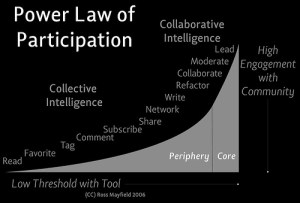
 If you look up at the top end of the curve, this is the end we need to be aiming at to actually get our books read, not just published–WHETHER we publish traditionally or for ourselves. And you’ll see that the top end if narrower (don’t ask me to use mathematical-graphy terms, because that’s not going to happen), because this is the harder work to do, and fewer people will do it and get their books/sales up into that corner. It’s a goal, though! 🙂

Jane’s other big point is that we should not let ourselves be intimidated by the fact that nobody knows where this is all going. The title of her talk was (I think I’ve got this right), “We Are Experiencing Revolutionary Difficulties: Please Don’t Wait.” In other words, grab that merry-go-round ring, whichever one you’re looking at today and wondering about whether it’s worth reaching for. Don’t let fear or uncertainty stop you.

As usual, when I listen to Jane, I was thinking, Wow! That is so RIGHT. And then I was thinking, and how does this apply to me. What do I want to do with this information, this angle. I don’t actually have answers to those questions yet. Go figure. :)What I do know is that I think Jane’s absolutely on track with her attitude–that this is exciting, that we should open our ears and eyes and brains to everything that’s going on in Publishing today (yes, another item on your to-do list!), and that we should be ready, with knees bent and jumping muscles ready, to GO when we see the opportunity we want.

The best place I know to get this kind of info is Jane’s Writer’s Digest blog, There Are No Rules. If you’re not reading it yet, start. And maybe add this book she recommended to your reading pile: Here Comes Everybody, by Clay Shirky. I’m going to.

Enjoy the excitement, guys. It’s going to be here for a while!
Posted in Blog Contest, The Writing & Critique Group Survival Guide

Happy Six-Month Release Anniversary…to Me! And a Contest for You!

Six months ago, my book, The Writing & Critique Group Survival Guide, officially hit the shelves. It was one of those days of excitement and nerves and a lot of disbelief. I did the launch day thing, and a few weeks later, had my party. It was all MORE than good, and the last six months have been quite a ride. A wonderful ride. Busy, busy, busy!

But not to busy to celebrate some more. I’m a big believer in marking milestones, and I didn’t want this one to just slip by quietly, without paying it a bit of attention. Or without saying thank you to everybody who has supported me, cheered me on, read this blog, spread the word, and just made me happy to be out here talking with you all.

Sounds like a contest to me!

Here are the details. All you have to do to enter is leave a comment here, at this post, between now and next Wednesday night, July 21. If you’d like to leave a happy critique story along with your basic entry, that will be the frosting. (On the cake. The anniversary cake. Get it?) I’ll pull the name of the winner and announce it on Thursday, the 22nd. PLEASE come back and check if you won! I’ll inflate some virtual balloons for you and toss imaginary confetti in your hair.

You probably want more than that, though. And I don’t blame you! Well, here’s what I’ll be handing you, on that big, gold, sparkly platter (okay, in the mail), when you win.

  • A signed copy of The Writing & Critique Group Survival Guide
  • A set of the critique goodies I put into my raffle bags, which does, indeed, include chocolate
  • A first-chapter critique of your manuscript. (If you’re a picture book writer, I’ll totally count that as a chapter.)
  • One other writing-craft book, still-to-be-decided-and-you-won’t-know-what-it-is-until-your-prize-arrives-because-it’s-a-surprise!

What do you think?

Drop into that comments section and leave your name. If things go crazy and I get GOBS of entries, I may have to put together more than one prize. Just to keep you all happy.

And to celebrate!

Oh, for pete’s sake, what am I going to do in another six months?

Posted in Critique Groups

Let’s Be Honest: Life Changes…and So Do Critique Groups

So I was trolling for blogging ideas on Twitter and Facebook this morning, and Jane Friedman wrote:

 “Here’s a question: what if you have a long-standing member of a critique group who … just doesn’t fit anymore. Yet they don’t seem to understand this themselves. How can you gently get them to move on? (Maybe this is a psychology question rather than a writing question … !)”

Jane’s right–this is a psychology question, but so much of the critique process is about how people interact that I think it’s a good topic to discuss. It also happens to be a question I get asked a lot–what do you do when someone in the group is not working out. “Not working out” can mean anything from slamming others with harsh critiques, to not submitting any writing for months, to overloading the group with hundreds of pages while baring showing up with comments for everyone else’s work.

I know, shocking, but it happens. 🙂

Sometimes, the problem isn’t even a problem. As Jane says, it may just be that one writer “just doesn’t fit anymore.” You may never experience the kind of horror-story situation that is the stuff of critique-group urban legends. At some point, though, I can almost promise you–your critique group will come across a time when they have to make a change. Perhaps most of the writers have achieved publication, and the other–while close–feels left out or left behind, even intimidated. Or maybe half the group has time to spend six hours a day writing and critiquing, while the other half are still working full-time jobs and feel overloaded by the group’s demands. The shift in the group can be something as small as one writer moving an hour further away from the meeting place, to a writer shifting gears from heavily-graphic sci-fi novels to rhyming picture books. You name it; change happens.

What do you do?

Now, I have to tell you, here’s what happens most often when someone asks me about problems in their group. Everybody’s very nice; there’s rarely any whining, but the conversation goes a lot like this:

Writer: “There’s this person in my critique group, and they’re doing (or not doing) X.”

Me: “Have you tried talking to them about it?”

Writer: “Um….” [Sheepish Grin]

So, yes, the first thing is to try and talk things out. Whether someone’s causing a real problem, or–as Jane says–just not feeling like they mesh with the group anymore, they can’t know that you’re unhappy with their behavior or their “fit,” if you don’t tell them. Okay, sure, unless they’re psychic, but if that were the case, we wouldn’t be having this conversation, would we? I don’t know if it’s human nature, or the training we get, but most of us will too often choose bury our heads in the sand and fuss silently, than move to directly confront a problem. Well, sand burns your eyes and silent fussing causes migraines.

Try talking about it.

Again, this conversation can range from simple and straightforward to a complete dissection of the way the group operates. If you’ve got someone new to critiquing who didn’t realize they were pushing a bit hard, or someone who’s still learning to dig for more than commas and spelling–a few pointers and reminders can get them headed in the right direction and bring peace and happiness back to the group. If someone has been slacking off, they may recommit to showing up and critiquing full-force; maybe they just needed the reminder.

On the other hand, it may be that different writers have wildly different goals and that–within the group–these goals can’t be reconciled. Sometimes the discussion itself is a way to point out to someone that they aren’t happy in the group anymore, that the group isn’t providing them what they need, and they will make the choice to leave. If not, one or more of you may have start your own break-away group, or you may have to ask another member to step out of the existing one.

Easy? Hah. This can be one of the hardest things you’ll ever do–as I said, most of us shy vehemently away from confrontation and conflict. Remember, though, that you are placing your writing (and your critiquing) up near the top of your priority list. Remember that you have had a core group with a wonderfully cohesive and productive dynamic. Remember that, if you do not take this step, the sore spot of the group will fester and damage that entire group, not just its individual members.

Be polite. Be respectful. And, if you need to, be firm.

Posted in First Drafts, Writing

Five Writing Things I’ve Thought about This Week

1. Letting the first draft be the wind-up draft, knowing that the action/big stuff is stating way late in the story. Imagining myself borrowing my husband’s HUGE new shopvac and just SUCKING that slow, padding away in the next revision.

2. Reactions. When something happens in a story, the characters–ESPECIALLY the point of view character–has to react. Sometimes the reaction needs to be as big as the event, sometimes it needs to be hidden and buried from all the other characters, but it has to be there. Otherwise, you’ve got readers turning pages back and forth to see if they missed something…a big HUH??!! thought-bubble over their heads.

3. Setting, setting, setting. How to get SO inside the world that you write it fluidly onto the page, barely conscious of the specific details you ARE using, rather than sitting back, picturing things, and sticking images down like mismatched Lego colors.

4. Anger. Having it be part of the character, be a piece of their essence, be natural & righteous & strong. Instead of writing words like “gasped” and “tensed” and “reddened.” But being semi-okay with those words for, you know…the first draft.

5. The reader. Me, the writer. And what might possibly be the thread that connects us, through the story.

What writing thoughts have been on your mind this week? I’m thinking we have to celebrate them all, as part of why we do this, even when they are frustrating and challenging and potentially mind-blowing in NOT so good a way!

Happy weekend, everybody.

Posted in Historical Fiction

Thoughts on History and Historical Fiction

So many times, as I sit down with a history book these days, one I’m reading for WIP research, I get this mixed feeling of…

  • Wow, things were really different back then.
  • Wow, has anything changed?

Okay, maybe this is because I’m reading a lot about things like women’s roles in society, working women getting less money than men, poverty and crime, anti-immigrant sentiment.

See what I mean?

Sure, I could get depressed. Sure, I could get frustrated, and impatient, and–oh, yeah–just a bit angry. And, sometimes, I do.

But…I think this sameness, actually, is what’s at the heart of good historical fiction and is the extra element in a well-written story that really hooks a reader. Especially, maybe, a teen reader. (Yes, that’s the sound of fingers crossing that you hear.)

It’s pretty hard, I think, to have our emotions triggered by things that are truly in the past, completely over and done. I think we do, at least, respond in a milder degree about injustices or tragedies that are finished, taken care of, “fixed.” When we read about something, though, that was wrong in 1913 and is still pretty much happening in 2010, then we get pissed. The reaction that says, “This is horrible,” is doubled, maybe even tripled, by the recognition of its continuity, its sameness nearly 100 years later.

One of the things I hope to have resonate for my MC is some of that feeling–that the world her mother lived in when she first came to America still exists–the tenement slums, the work conditions, the fear–even if her mother has escaped from it. I want my readers to see this sameness. I also want, though, for them to see the continuity between my MC’s problems and choices, and their own. The narrow world she grows up in–the choices she must make about building her own life and separating herself from those who would stop her from doing that–I want this to “click” with the teens I’m writing for.

Because when I think about having no control of your life, about being pushed in a direction that is not right for you, about constantly hearing you “shouldn’t” and  you “can’t”–I don’t think these things were specific only to the teens of the early 20th century. I think they’ve pretty much stuck around for our kids today, obviously to varying degrees of force and wrongness. And I think the choices teens faced in the past, the times when the pushing went too far, are very, very close to the choices they face today.

So, I guess, for me, this is what young-adult historical is about. The goal…somehow…is to layer in the history, tell the specific story, and make that connection.

Posted in Deadlines, First Drafts

Writing: The Gift of Little Pieces

I may have mentioned before that July seems to be a month of (wonderful) deadlines, and August is setting itself up to be that way. It would be easy, but depressing, to just let my fiction go and give into the panic worry that maybe there isn’t enough time for it all.

I’m trying to respond to that temptation with one word: Nonsense!

Not nonsense as in I’m Wonder Woman (whose new costume, I LOVE, btw!) and being able to do it all. But nonsense as in reminding myself that if I just take that hour of panic worry that I can easily use up in a single day, and give it to my fiction, well, hey, look: presto-magico…progress! And no depression. 🙂

And-as usual-I’m making a discovery along the way. This first draft I’m working on has its own moments of panic (yes, this time, PANIC) about where I’m going and how much I don’t know and how much I will have to weave together even when I DO know it and, oh, I could go on and on…. But guess what? The panic drops when I’m just working in little bits of time and pages.

I take one morning to plot out a new scene. All sorts of questions rise up to haunt me–“Oh, yeah, and where is THIS going to lead?” “You DO know this means you’ll be rereading those books about fancy-schmancy department stores?” “You’ve decided to write about a sabbath dinner after all, because…why?!”

Well, guess what? All I have to do that morning is plot that one scene. That evening, or the next morning, I can write it…or half of it. That afternoon, read just one chapter on department stores, for now. The next morning, plot that scene. And so on. When I’m not looking at hours of plotting and writing–all in one fell swoop–when there’s only so much time (and, oh, yes, panic) I can give to my fiction that day, it’s…easier.

Maybe it’s not the best way to immerse myself in the story, maybe it’s not the best way to get hundreds and thousands of fiction words onto the page. On the other hand, maybe it’s exactly how I need to be doing it this month.

Do you work best in small chunks or in long, dedicated hours? Are there times when one style works better for you than the other?

Have a wonderful writing week!

Posted in Uncategorized

Friday Five: What I Did on My Summer Vacation

Or at least on the last few days of it.

On Sunday, we dropped our son at the drop-off point for his two weeks of sleepaway-somewhere-in-the-Sierras-(we-think)-camp. And then we took off for our own trip. A few months ago, my husband had suggested a few days in the gold country–which is Californian for the cute little towns in the foothills of the Sierras, originally populated by gold-prospecting miners. I love this area–I had a great-aunt who lived here for years, and it’s the closest geographical location that gets some sort of season–leaves change color in the fall, it gets pretty warm most summers, and that same great-aunt put her back out at 90 when she decided to shovel the winter snow out of her driveway. I haven’t been there for years, though, and my husband’s suggestion sounded like the perfect trip.

And it was. Here are a few of the things we did.

1. We stayed here, at The Outside Inn, a restored motor inn at the top of the hill that is downtown Nevada City. This is our room.

Celestial Room

Yes, those are glow-in-the-dark stars on the ceiling. I can’t recommend this motel enough, if you’re ever visiting this area. It was seriously inexpensive, spotlessly clean and wonderfully quiet, had Adirondack chairs in a lovely little garden space, and a bowl of jelly bellies in the office. Plus, they leave chocolates in your room, but good things like mini Snickers and Milky Way bars, not those skinny little mints on your pillow!

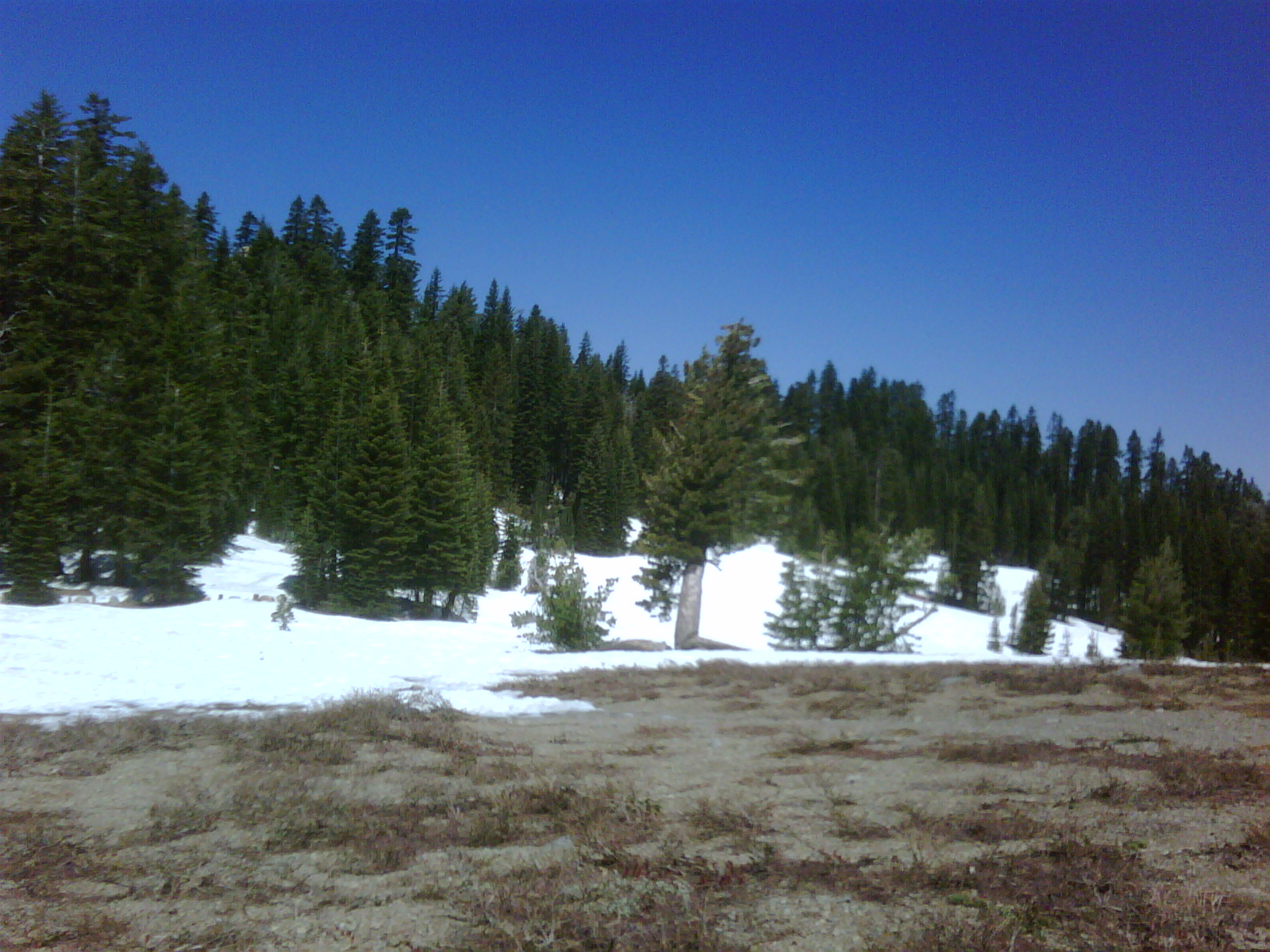
2. We hiked. The first day there, we went DOWNhill almost to a river (husband went all the way down, but my knees said, “Wait here,” and I listen to my knees) and then back up. I sat for close to an hour at this beautiful spot just at the edge of the path, with no poison oak and no mosquitos, looking out at the river and up at the cliff and watching butterflies play in the breeze. I had my book, but I barely opened it; it felt so good just to rest. The third day, we drove partway down a dirt road toward a trailhead, but after getting stuck once in the snow (yes!), we parked the car and just walked the rest of the way in, had lunch, sat some more, and walked out again. Walked may be the wrong description, since mostly I schlurshed–which is my word for what my nice, thick hiking boots do on big patches of snow and ice. This was our lunch view.

3. Ate. And ate. And ate. Nevada City is a small town, maybe three blocks long, with sort of one and a half main streets. We didn’t make it into every restaurant, but we did make a nice big dent in the eating establishments. My husband and I don’t always agree, but our consensus was that the very best of the great meals we had was at Lefty’s Grill. What’d we eat? Crab & Shrimp Cake Louis; Pear, Balsamic, Gorgonzola Pizza on Flat Bread; and Bourban Pecan Pie. Triple-nom.

4. Wrote. Kind of. I have a sort-of-in-the-drawer novel that I know I can’t and shouldn’t work on right now, but that I’m not ready to let go of completely. And I had a critique from a very helpful set of fresh eyes that I hadn’t been able to spend any time with. So on the morning that husband went off for his first mountain bike ride, I took the manuscript and the critique and a notebook to the coffeehouse, and I read and I thought and I scribbled notes. And there is hope. I’ve read it out here so many times–the idea that there’s a time to put a book away for a while and a benefit from doing so, and whoever all has told me this, you’re right. No perfect solutions yet, but ideas and ideas and ideas. And some insight to the most important questions that either I thought I had answered, or that I had over-optimistically swept under the writing carpet. I’m not sure where I’m going with this, or when, but it will be somewhere. Meanwhile, I’ll put some more hours into reading and thinking & try to write myself a pretty strong, directed revision letter. For future use. 🙂

5. Relaxed. The older novel was the only writing I took. July is going to be a busy month with several have-to projects and continued progress on my current WIPs. I needed those few days with nothing that had to be done, nothing that carried even a whiff of schedule or deadline or pressure. I read two books–but slowly and in small pieces, and I sat with my eyes closed, and I lay down, and I napped.

Pretty much what vacation should be about, as far as I’m concerned.