
I saw a reference to Rebecca Mead’s post, “The Percy Jackson Problem,” a while ago, skimmed the article, thought oh, that’s ridiculous, and then moved on because how many times can we argue with these people. But then I started working on a post about just my reading habits and…yep, I started veering right off into a justification of reading for entertainment and escape, and I knew that it was in part because my brain has been simmering (possibly even steaming) about this post.
Plus, Kurtis Scaletta reminded me about it in this post on his blog.
Let’s just take a moment and try to get past sentences like this, “Riordan has come up with a clever conceit, which is amusingly sustained” and “That slangy, casual style is a hallmark of the Percy Jackson books, which often read like a faithful transcription of teen uptalk,” the condescending reductionism of which make me want to ask Mead if she even read the same books I did and to, perhaps a bit immaturely, double-dare her to try to achieve anything close to what Riordan has.
So let’s look at the main problem here. Mead talks about the debate between the any-reading-is-good-reading camp and the “those”-books-will-keep-our-kids-away-from-the-“better”-books camp. I haven’t read the Gaiman piece she quotes from, but as far as I can tell, Gaiman is truly saying that reading is about reading, different books for different kids, while she seems to hear him saying that it’s okay for kids to read anything because “those” books will ultimately lead kids to the “better” books. She worries that Gaiman is wrong to view any kind of book as a gateway to some kind of higher reading, while I don’t think Gaiman–from the bits in here–is actually worried about there being or not being any gateway.
Neither am I.
I was an English major in college, and I loved most of the books that my professors deemed worthy of teaching in their classes. I loved, until I hit grad school, hashing out the meanings of those books and writing essays about them. I see huge value in those books, although I would argue that that value lies primarily in the entertainment of their stories, the escape which their wonderful writing provides us, and their power to create and sustain the reader in all of us. I’d say Rick Riordan’s books pretty much hit the bullseye on all those targets.
I do not agree that those “better” books have some intrinsically greater value for whatever reason. The best and most important purpose of a book, any book is to be something someone wants to read. The most amazing power of a book for children is to not only be that book but to turn the child reading it into someone who wants to read more…and more…and more…and more. And the most evil thing for which a book can be used is to try to make that same child read “up.”
A small selection of our population need to be able to competently and comprehensively analyze literature. Those people will become teachers and professors. And, yes, much gratitude and appreciation to those who choose that path and share their selection of books with their students. But…I truly believe that the most important thing we can give all the other kids, to carry them through life, is a love of reading. And, yes, any reading. Kids who love books will experiment. They’ll try something new, even if only occasionally, because–hey, it’s a book. That new book doesn’t have to be something defined (by whoever) as a classic–it can be a comic book, it can be a mystery instead of a fantasy, it can be a book with a male versus female protagonist, it can be a diverse book, it can be poetry, it can be a joke book, it can be a movie review, it can be an article in the Smithsonian or in Mad Magazine. A kid who is forced into groove after groove carved out by someone else…um, yeah, that’s not going to work. If your goal is to turn kids off books, yeah, sure. But not if your goal is to keep kids reading.
This is getting a little long, as rants do, but one more thing. I keep thinking about the reader I looked like in high school and college, the reader my teachers probably thought I was. And I think about the person I am now, and how many people assume that I am up on all the latest literary fiction, or that I go back all the time to reread Dostoyevsky and Tolstoy (I had a real Russian-Lit binge going for a few years). And when I tell them what I do read–at least 90% kids’ fiction–they just don’t get it. Like Mead.
So here’s the reader I really was, as a kid, the one that did take the path through classic novels for a while, and then through mystery novels, and always in and out through my childhood favorites, and ultimately–at least for now–to the kids’ books being published today.
I was the kid who:
- Read and loved classics like The Secret Garden, Little Women, Anne of Green Gables
- Brought 10 books home from the library and then often read/reread only the comfortable favorites and took back all the “unknowns” without even getting to page 1.
- Fell in love with Shakespeare because, yes, reading Polonius’ lines (NOT Ophelia’s) in Hamlet was so much fun, but also because–let’s face it–I had a total teen crush on actor Byron Jennings who played both Richard II and Richard III at PCPA.
- Was told by my father that he wasn’t going to pay for any more Harlequin Romances. (He did not, because he’s an awesome dad, tell me to stop reading them, and of course I didn’t, not for a while.)
- Went to college as an English major because, yes, I wanted to read Victorian Novels for four years.
- Got completely burnt out on reading those Victorian novels and others, because of the seemingly inseparable task of writing literary analysis that justified these novels as “better books.” For almost a year after I got out of grad school, I would go into a bookstore and not find a single book to read. Scariest. Time. Of. My. Life.
- Still has her collection of this series by Phyllis A. Whitney and will rank them right up there with her beloved Dickens, Austen, and Brontës any day of the week, for the brilliant genius of their rightness. As I do Rick Riordan.
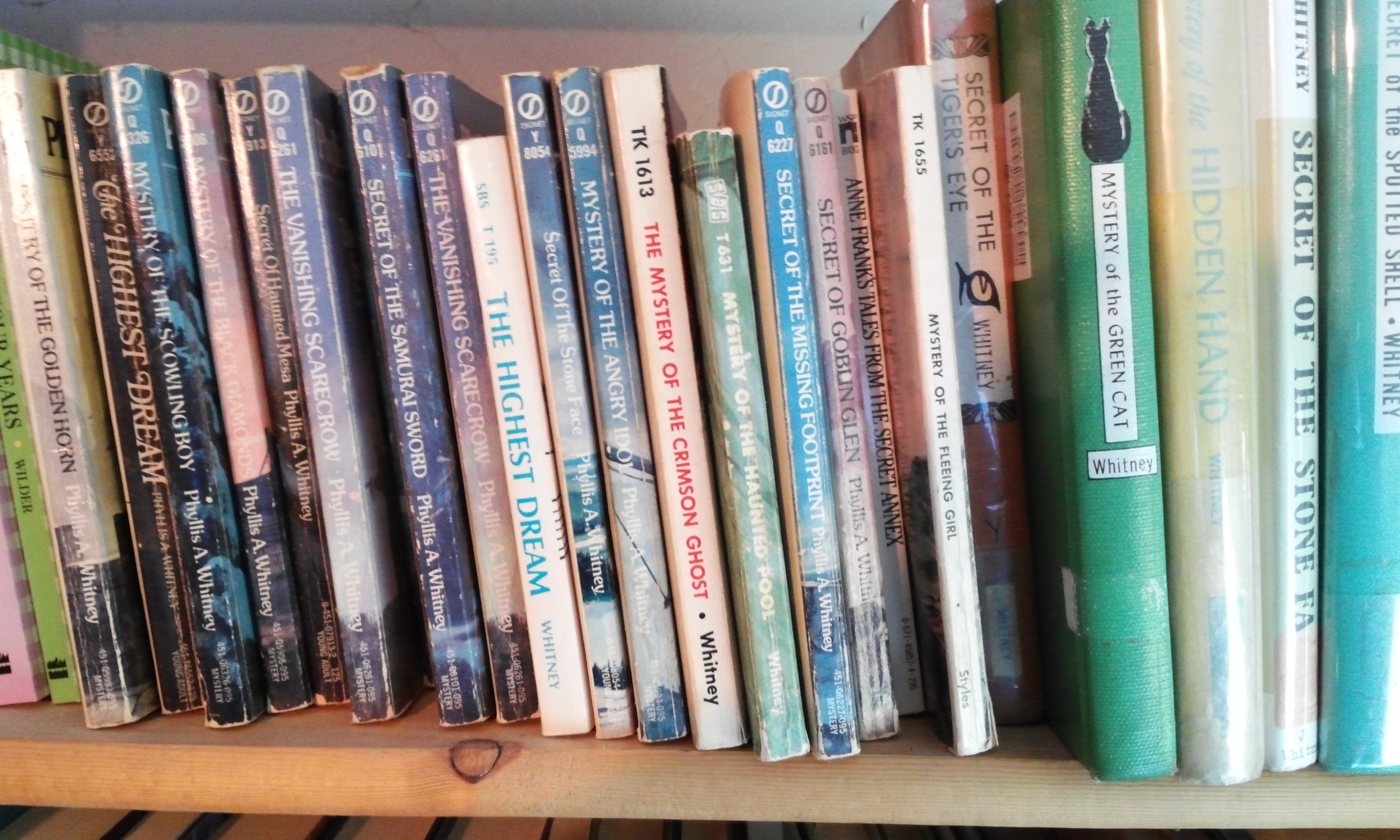 What I read as a kid was a mix of “those” books and “better” books. The only time I ever risked becoming not a reader was when I lost the balance of that mix for too long, when I put myself in a position where choice was completely taken away from me for too many years. And, yes, giving kids insufficient time to read assigned books and other books is taking away their choice. These days I read kids’ books, I read memoirs, I read mysteries and fantasies, and–when the craving hits me–I dip into Austen or Dickens or one of the Brontës. And I am happy.
Let’s just let our kids read.

 Becky Levine