Posted in Uncategorized

I Don’t Know…Ten Whole Dollars?

Death Valley looked like this.

And it looked like this.
DVWriting

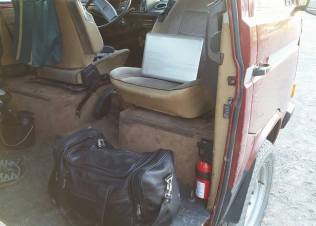
My writing station. Yes, that’s a fire extinguisher in the corner. We took a 1987 water-cooled Vanagon to Death Valley; you think we wouldn’t bring a fire extinguisher?

Anyway, for the two mornings we were there, my husband and I split off for Writing time. Or Riding time, depending which one of us you are asking. David would get on his bike at about 7:30 and head out to the gravel road he wanted to explore (and, on Day 2, explore a little further.) And I would get set up at my luxurious writing spa and, as I’m focusing on these days, “do the work.” Day 1 was spent figuring out more about Draft 3 of my MG novel, but Day 2 was for picture books.

Picture books without art notes. I had promised myself I would read each of my PBs out loud, without art notes, to see what…oh, just what came about. And it was good, if you call realizing that what you thought was “done” is so not “done,” but at least the realization comes with ideas and revision possibilities.

Except for on one of the PBs. This one, without the art notes, was kind of a big blank. Not like the other one that needs a strong trip back to the drawing board. At least I don’t think so. This one, I THINK, is asking to be an art-told story, with the pictures carrying the melody and the words bringing in the harmony. (And if that is a TOTALLY failed music metaphor, I really don’t want to know, okay?)

And, of course, I can’t draw.

No, I’m not fantasizing about suddenly becoming a great artist and turning myself into an author-illustrator. Yes, okay, never say never, but that’s about the same odds as never, so it is not the plan. But I started thinking–IF I could at least make myself happy enough with my own drawing ability to at least sketch the art story out on the page, then MAYBE MAYBE MAYBE MAYBE, I could come at what the words need to be doing from a slightly different/new/more productive angle. MAYBE.

So I went to the office supply store to look at sketch books and pencils. Note, I do not say I went to the office supply store to BUY a sketch book and pencil. Because, even as I pulled into the parking lot, even as I stepped through the doors and wove my way through the aisles, I was not ready for that level of commitment.

If I hadn’t just read Elizabeth Gilbert’s Big Magic, I might have stayed in the car, or backed out of the entrance, or decided not to purchase.

(Side note: Elizabeth’s sister, Catherine Gilbert Murdock is one of my favorite YA writers. Have you read her Dairy Queen books? Maybe the two of them don’t even get along, but I can’t help imagining these late night sessions between the two of them, after everyone else has gone to bed, where they’re like: I don’t know, maybe THIS word is better. I think they’d laugh more if you said THIS. Oh, yeah, that’s PERFECT.)

Okay, okay, back to the office supply store. There I am, acting all cool, looking at the art supplies, pretending that nasty little voice isn’t saying ot me, “You can’t draw. What difference does it make if you like the feel of that paper better than the other. You’ll NEVER fill an entire sketchpad. YOU’RE GOING TO SPEND $10.00 ON ART SUPPLIES?!”

Luckily, thanks to Gilbert of the Big Magic ideas, I am very much in anti-nasty-voice mode. Yes, Gilbert says I should be respectful and kind to the voice, greet it as part of myself and ask it to sit quietly in a corner until it can make an actual positive contribution, but maybe I’m not quite there yet. I’m kind of at the F.U. stage with it. Also, I am remembering that I don’t actually have to judge myself if I buy the tools and don’t use them. I don’t have to judge myself for how WELL I use them. I only had to bring them home and see if I DID use them.

Today, I used them. And I enjoyed them. And I drew something. I drew, and I erased, and I drew, and I erased, and I drew. And it was recognizable. Well, not as a character in the story, even though it started out that way, but as a something. Which felt good.

And THAT, my friends, is the Magic.

Posted in Plot, The Writing Path

There’s Plotting and there’s Planning…and Then There are Surprises

I’m a plotter, never a pantser. Would I love to be (more of) a pantser. Oh, heck, yes. In writing and in life. In life, I’m a planner, although I will stake a claim to have loosened up at least somewhat in the last decade or so. But I love and use lists and calendars, and if they’re not crutches, they are definitely tools.

Still, I’m learning to welcome surprises, even when they sneak up on me without too much warning. As I headed into Asilomar two Fridays away, I knew that I hadn’t really identified what I wanted to get out of the conference. I had hopes and dreams, as we always do, but I hadn’t done much visualization or intentionalizing–probably fear of failing at those dreams was getting in my way. It turned out well, though, because the big surprise (for me) was how resoundingly I responded to all the motivational and dream-based talks I hears. Typically, I am looking and hoping for craft support–specific writing tools and how-to’s. I surprised myself with some of my workshop choices, and I surprised myself by how well I came back from down moments and by how deep into my heart I felt the happiness of the weekend.

When I look at where I am on my writing path, there are surprises there. Oh, sure, there are some that feel more like disappointment than happiness, but there are some pretty good ones, too. If you’d told me ten years ago, even five, that I’d have switched my agent search from agents who represent Middle Grade and Young Adult to those who rep MG and picture books? I’d probably have laughed, you know, in a nice way. Picture books? Seriously?

Well, yeah. I started that part of my journey while I was writing The Writing & Critique Group Survival Guide, with an idea that I wanted to follow through outside the book. And now I have four picture books that, well, while they’re not as ready as I thought they were before last weekend, they’re pretty darned good and I am definitely in love with them. With the characters, the stories, and–oh, yeah–the writing process of bringing them together. Young adult? Doesn’t feel like anything I want or need to be writing. Twists and turns, and surprises.

Who knew? When I started this blog, I knew logically that the writing path I was going to talk about would be one of curves and hills, fallen trees and patches of quicksand. But as I move along it, continuing the climb, I understand the challenges of the route at a deeper level. And I know, too, that there’s always the possibility I’ll come around a corner and catch a glimpse of a rainbow, maybe even the shimmer of that pot of gold.

Because there are always surprises.

Posted in Conference Report

Highlights & Thoughts from the 2016 SCBWI Golden Gate Conference at Asilomar

I’ve been watching this conference for a decade. I have heard wonderful things about it, but–since it’s not cheap (well, staying at Asilomar isn’t cheap; the conference itself is more than reasonably priced), I felt like I needed to have some work to show before I went. So this year is it. It was a wonderful, wonderful weekend. And, although so many things are still circling around in my head, in no particular order yet, I wanted to get a few randomy thoughts done before I forget them.

  • I wasn’t sure what I needed this weekend to be. Turns out I needed it to be about rejuvenation, recharging, and–most of all–recommitment. And it was. Obviously, I need to sustain this feeling and act on it, but I came away feeling that, yes, my writing is going to land at the top of my priorities list once again. Everybody I met and listened to contributed a lot to this feeling, but Deborah Underwood‘s talk about getting rid of obstacles to our creativity really hit a home run for me.
  • You think you’re ready, and you’re not always ready. That includes the state of your manuscripts, your receptivity to hearing critiques about them, and your understanding of what they need to improve. But if you smile and breathe and give things a few hours to sink in, they usually do, and you find yourself thinking the critiquer much more sincerely later in the day, because you now do have some next steps to follow. AND you can see why they’re necessary and important.
  • Clare Vanderpool is not only a wonderful writer and a speaker with a lot of important things to say, she is very possibly the funniest person on the planet. If you are a conference organizer, invite her. If you have a chance to attend a conference where she’s on faculty, go. And be ready to nod and nod and then LAUGH AND LAUGH.
  • I’m pretty sure I’ve never been to a conference where tears were shed during so many talks. It may have been the theme: Live Your Story, but people shared so openly and honestly, the keynotes and workshops stopped being just about my work and your work and became about our work and our worlds and our lives.
  •  Rhyming picture books DO get me. Who knew? Go get Deborah Underwood’s  and Meg Hunt‘s Interstellar Cinderella and Corey Rosen Schwartz‘ and Rebecca J. Gomez‘ and Keika Yamaguchi‘s What about Moose?, and you’ll see what I mean.
  • We had power outages that faculty laughed and spoke through, even though, literally, the power was going off, on, off, on, off, on, like a badly out of sync strobe light, and must have been driving them crazy.
  • I remembered that calendars have power. Every weekend, I will be calendaring my weekday writing into its after-work time slots. And I will be printing a monthly calendar to check off all the days during which I put in writing time. I have promised myself I get to go back to Asilomar in 2017, IF I DO THE WORK. Guess what? I’M GOING TO DO THE WORK.
  • The deer at Asilomar barely look up when you walk near them. Okay, they look up, but they keep chewing away and just let you ooh and ah at them. Because we are no threat. Now we all just need to work on expanding that safety and peace beyond our relationship with deer and beyond the gates of Asilomar.
  • There was a quilting conference going at the same time as ours. I never did get a chance to sneak past their classrooms and see all their work, but I chatted with some while we were in line for meals, including the cousin on one of my absolutely favorite picture book authors. Yes, I asked her to tell her cousin how much I loved her book. Random and special.
  • I have some work to do with my art notes. Or maybe I should say without my art notes.
  • Some of us had to take off after the last sessions, but some of us lingered, joining each other for one last long talk around the lunch table in the dining room. As the last of us pushed away our chairs and started to head toward our cards, one of us said that it felt like leaving summer camp–making sure you gave and got hugs, exchanged emails, shared good and powerful wishes for the next year. I understood what she met, but it felt different for me. I never wanted to go back to summer camp. I DO want to go back to Asilomar.

And I will.

Posted in Uncategorized

Why I Want Hilary Clinton to Win

Quick note, in case you missed it, the title is not about why I’m voting for Hilary. A week or so ago, Kurtis Scaletta wrote an excellent post about his reasons for voting for Clinton, but that’s not where I am. Yet. Or not yet.

I still haven’t decided. Luckily, or unluckily, out here in California, I still have time. I’m going to watch some more debates, I’m going to read more posts and articles like Kurtis’–both about Clinton and Sanders, and I’m going to think. A lot. (I’m also going to give myself breaks from thinking about this, because frankly I need them.) And I can tell you one thing: I WILL VOTE IN THE GENERAL ELECTION FOR WHICHEVER ONE OF THEM WINS THE DEMOCRATIC NOMINATION, BECAUSE COME ON, PEOPLE, HAVE YOU LOOKED AT THE OTHER CHOICES?

Anyway, this post is about the fact that, given all my reasons for voting for one or the other of the two Democratic/Socialist candidates, there is a massively huge part of me that really wants Hilary Clinton to win.

Yes, because she’s a woman. And because, while I may not agree 100% with the preferences Courtney Enlow expressed in her ALL-CAPS EXPLOSION, I do agree with her anger and disgust and frustration at all the crap that’s being thrown at Clinton, yes, because she’s a woman, and at the fact that some people are still accepting that crap as okay. (And, yes, I’m looking very closely at my own vacillation to see if there’s any crap at its roots.) I am in complete sympathy with Enlow’s CAPS and her swearing, because, holy moly, people, it’s 2016, and it is BEYOND TIME that we have a woman president. It is BEYOND TIME that we are capable of electing a woman, of not giving her a hard time for needing to use the restroom during a debate, of recognizing that part of the reason she is the way she is is that SHE HAS HAD TO BE to get where she is.

I want us to be there so badly it hurts. Not just for me, but for older women in my  life who have waited even longer for us to get there, who see us on the cusp–FINALLY!!!–of something so important, and get to watch us being all, whoa….wait a minute…whoops…not yet! What Gloria Steinem and Madeleine Albright said about and to younger women was wrong, wrong, wrong. It was dismissive and petty and, I think, pretty immature, and I would  like to think that SOMEDAY we will understand that feminism is supposed to give women equal CHOICE as one of our equal RIGHTS. I make no excuses for either of them, but…do you know how long they have been fighting for this? DO YOU KNOW HOW LONG? Is it any wonder they slipped?

So why am I not sure about my vote? Lots of reasons, and I think (and hope) that my reasons are about the individuals, not the gender. I may end up voting for Hilary Clinton because she is experienced, competent, whip-smart, and will, I know, hold the line for me on most of my biggest issues, even if I don’t think she will push other (also important) issues as far as I want her to. I may end up voting for Bernie Sanders because he shares more of my ideals and because this country does need a revolution, and because, hey, I would be almost as happy to see the first Jewish atheist in the white house as I would be to see the first woman there. I may vote for Sanders even if I don’t think he has enough of a plan to make much of his stuff happen.

Like I said, I don’t know. I don’t know yet how I’m going to vote. What I’m coming to realize, though, is that even if I do end up voting for Bernie, and even if he wins, I’m not going to be completely happy. I will be amazed, stunned, celebratory, probably even jubilant. But I will also be disappointed, angry, frustrated beyond belief, and most likely in miserable tears.

And ain’t that just rainbows and unicorns?

Posted in Uncategorized

Things I’m Counting as “Writing” These Days

We all know it. We know “writing” is about so many more tasks than sitting at your computer, or with a notebook, and writing actual words and sentences and paragraphs and pages of that 1st or 2nd or nth draft.

We know it logically.

Still, there’s something in many, if not all of us, that places judgment on those other tasks. It’s not even so much that we get caught up in word-count tallies, I don’t think. I think it’s that we (rightly) associate writing with creativity, and we associate creativity with the new and fresh things that come when our story and prose are on a roll. We don’t always remember that creativity is stepping back and taking a new look at the colors in your painting, the ones you put down on the canvas last week. We don’t always remember that creativity is tasting the soup or the cake batter and thinking about what spice is still missing.

And even when we remember, we sometimes let doubt override the knowledge.

We “should” at ourselves. You should be getting more pages done. You should be getting started on the next draft. You should be in the zone.

Yeah, well, really I should be getting the things done that need to be done. I should be acknowledging that writing, drafting, revisng—it’s is not just typing–it’s organizing, it’s reviewing, it’s questioning, it’s brainstorming, it’s shifting puzzle pieces around and seeing how the fit here…and here…and there. It’s getting back in touch with our story any way we can.

So here’s what I’m counting as “writing” for a while.

  • Getting all the chapters I’ve written into a binder.
  • Organizing and then reading through my critique groups feedback on all these chapters.
  • Adding as many bullets as I want to my Ginormous List of Things That Still Need to Go into This Story.
  • Reading posts like this one by Jennifer R. Hubbard and reminding myself that, if I’m sitting at the computer (or typewriter) with my hands on the keyboard, my brain is expecting me–even telling me–to write, to produce fresh words.
  • Going through my Ginormous List of…with the full manuscript in front of me and using colored pens and sticky notes to scribble things like “Stick brother in here!” and “Ooh! Good place for the big question!”
  • Experimenting with plotting and organizing tools–will it be Scrivener’s scene cards again, or do I want a timeline spreadsheet. Or both.

Yet again, I realize that the book I affectionately refer to as “the one that almost killed me” put a big dent in this understanding for me, an understanding I think I had before the almost killed part. So I need to renew my lessons, rebuild habits I lost somewhere for a while. And that renewal, I think, means reaquainting myself with all the non-writing writing acts.

And perhaps bringing flowers and chocolate to keep that silly “should” voice busy and quiet.

Posted in Uncategorized

Tiny Virtual Book Club: My Father’s Dragon

There were a couple of really fun conversations going on over at Facebook today. Erin Dionne shared a question from a class discussion she was having: Whose story is Charlotte’s Web? There were several opinions!

Then Melissa Wyatt (and several other people) posted a link to a Bustle article about people’s first literary crushes, and that got a few of us talking about who was not on the list.

Anyway, I jumped in with my two cents (Wilbur’s! Calvin O’Keefe!) a few times, then got back to work.

But the fun has stuck with me. So tonight, right here, I’m putting up a Tiny Virtual Book Club post. I say “tiny,” because for all I know, it’ll just be me. And maybe you. But probably we won’t break any fire codes with the crowds. And whether I do this again, with another book? Who knows, we’ll see, making no commitments and applying no pressure.

Tonight, we’re going to talk about one of my favorites, a book I consider perfect for what it sets out to do and what it accomplishes. We’re going to talk about Ruth Stiles Gannett’s My Father’s Dragon, illustrated by Ruth Chrisman Gannett.

!!!dragon

You haven’t read it yet? Well, that’s okay. Go pick yourself up a copy. We’ll wait…

Now, this is not a book review, and lucky for you, because it would be such a gushy one, you’d need a heap of tissues just to mop up after me. I should mention, also, that I have never succeeded in participating in a non-virtual book club, so this may not become a book discussion either. But you never know, so here we go: Questions for discussion. Place your thoughts in the comments. And if there are more than one of you, take a look at the other comment(s) and drop in a reply.

  • Why do you think Ruth Stiles Gannett used Elmer Elevator’s son as a first-person frame narrator?
  • What story elements does Stiles Gannett use to keep the young reader engaged until we get to the island?
  • Once we get to the island, the chapters become more episodic. Why do you think Stiles Gannett chose that structure? What effect do you think the structure might have had on the young reader?
  • Can you think of any books published in the past 5-10 years that you would liken to My Father’s Dragon? Think about the structure and the length and the balance of language level with story complexity. Or do you think Stiles Gannett’s book is a “genre” of the past only?
  • What happened to the cat? (You may have to use your imagination on this one!

There you go. Don’t be shy–jump on in. Not sure yet if I’ll simply comment with my own take on these questions (yes, obviously I have a take on the questions), or whether I’ll wait and respond as comments (possibly) come along from others. But you’ll hear from me one way or another.

Enjoy!

Posted in Uncategorized

A Brainful of Ideas

Over the end-of-year break, I decided to jump ahead a bit and start plotting the next draft of my middle-grade magical realism novel. Usually, I really want to write to the end, but I had realized that the ending chapters from my first draft were really as complete as I could make them, at this point. And I had lots of ideas about what to change/add in the beginning and middle that I wanted to start getting down on paper.

So I sent the final chapters to my critique group, and I started work in a plotting spreadsheet. Mostly, right then, I was just trying to get the important scenes down with some general notes & thoughts. And I wanted to hear what my critique group said about the ending.

The good news: They liked it. They had lots of thoughts & suggestions (because they’re Super Critiquers), but they were totally on board with the main direction. So, yay!

And the not-so-good news isn’t really not-so-good. It’s just my internal doubt machine saying, sure, yeah, the ending works, but do you really know how to get there yet? Do I have ideas? Oh, I have ideas! I have ideas out the wazoo! Some of them are on sticky notes attached to the previous draft. Some of them are in the spreadsheet I started. A couple of the really important ones are on even bigger sticky notes stuck to my monitor. And some of them–a whole lot of them–are bopping around in my brain. I can tell you about the themes. I can tell you about each character’s big problem, including all the secondary characters. I can tell you ways those problems will interact with my hero’s big problem. I can even, finally, tell you about a few of the bad things I’ve come up with for my hero to do.

But can I see how it all goes together, seamlessly, beautifully, into that novel I want to write, that novel I want kids to read?

Not yet.

When I expressed this at my critique group, one of my friends told me this means I’m exactly where I’m supposed to be. Where I feel like I know too much, even if that feeling comes with not knowing what to do with it all. I think she’s probably right. I think I’d be saying the same thing to her if she was at this stage. For all I know, I have said it!

I’m totally excited about the Middle Grade Intensive I’m attending this weekend, in Oakland. I’m really happy it’s a one-day event, on a Saturday, because I plan to drink lots of coffee on Sunday and get myself to my desk and absorb what I’ve learned. And then…all those ideas pin-balling inside my mind?

I’ll see what I can do with them.


Posted in Uncategorized

Picture Books for Presents

This Xmas, I asked for and got three pictures books–three of my favorites that I’d read in the past year. (Thanks, Kathy!) Typically, I get picture books at the library–I go grab a stack, bring them home, read them, and see if there’s anything I can learn from the ones I like. Then, back they go.

And, of course, when I buy one as a gift, I carefully and delicately read it first.

But my actual at-home collection isn’t huge. It is made up of those I love, just because I love them, and those I love that also have some craft element done so beautifully I want them in my study-to-learn pile.

So this year, I decided it was time to add to that pile. And to share a little bit about each one with you.

Sophie’s Squash by Pat Zietlow Miller, illustrated by Anne Wildorf

I’ve bought Sophie’s Squash for several young friends, because I just love this book. Sophie is, if not my all-time favorite picture-book hero, definitely in the top 10. She is stubborn, but not in a nose-in-the-air, la-la-la, I’m-not-listening kind of way. She simply knows what is going on with Bernice (her squash), knows what she wants for Bernice, and knows what she should do to get it. And she does, calmly and peacefully and happily. Even the one time she asks for help from someone other than herself, she responds positively because their suggestion resonates with things already deeply within her own self, not because the idea rings totally new and revolutionary.  And, wonderfully, Zietlow Miller has given Sophie parents who trust and respect Sophie’s sense of self, her personal strength. They are not enemies, not even obstacles. They are grown-ups with some different views than Sophie, as well as some extra experience and knowledge, but they nudge a bit and then stand back and let Sophie find her course. I love them all. The art is also fantastic. It’s obvious Anne Wildorf “got” Sophie, because the pigtails? They are SO Sophie!

Those are my reader responses. As a writer, I’ll be going back to Sophie’s Squash for lots of learning. Zietlow Miller’s dialogue is brilliant–she does so much, with so few words. I love this interchange between Sophie and her mother, after Sophie has lost her temper, just a little bit, with a boy at the library who calls  Bernice a “spotty thing.”

“‘Maybe Bernice should stay home next time,’ Sophie’s mom
suggested.

‘Why?’ Sophie asked. ‘She wasn’t the one being rude.'”

Perfect.

Sparky! by Jenny Offill, illustrated by Chris Appelhans

My one-word review for this book would simply be: ❤

Okay, I’ll give you a little bit more. The sweetness of this story is beyond belief. The hero of the story, an unusual and wonderfully done first-person “I,” researches the only kind of pet her mother will let her have: one that “doesn’t need to be walked or bathed or fed.” And so, of course, she gets Sparky. A sloth.

First, let me say that I think Chris Appelhans must live with a sloth. Or several. Or have spent weeks and weeks studying them at a zoo. Because his art is not only absolutely beautiful but completley and gorgeously catches Sparky’s slothdom in all its not-moving-ness.

When I read this book again, just after Xmas, I was struck by something. And that is, as far as I can tell, the hero doesn’t actually win any of her battles. She seems extremely content with Sparky as her own pet, but there is judgment from outside, and that judgment is much more critical than, say, Sophie’s parents in Sophie’s Squash. And the hero does step out of her own, everything-is-okay-in-here space, to try and prove to the hater (one Mary Potts, who pretty much succeeds at everything and brags about it) that she is wrong. And, despite our hero’s attempts, Mary goes away unconvinced that Sparky succeeds at anything.

And I don’t see any huge moment of revelation for the hero at the end of the story. Any learning she does, over the course of her journey, isn’t obvious and certainly isn’t loud. I think what we end up (no spoilers) with is a very quiet, almost still, return to just our  hero and Sparky and what they have together. And I think that’s enough. Both for them and for the reader.

I want to go back to this book again (and probably again and again) and take a closer look at the storyline and the characters and see if I’m write about what the author, and very much the illustrator, have done here. And I want to go back again and again just to immerse myself in the love that is at the heart of the whole book.

Stuck by Oliver Jeffers

Product Details

This book was the first one I discovered by Oliver Jeffers, and–as usual–I was filled with awe (and, yes, a little jealousy) at the ability of anyone to write and illustrate this wonderfully. I bought this for the son of a friend, because I could just hear the little boy laughing and laughing at the story. It’s still my favorite of Jeffers’ books that I’ve read, and I still keep buying it for kids whenever I can find it.

And I finally have my own copy!

This book is simply silly. In the best, best way. The basic plot is that Floyd gets his kite stuck in a tree and then tried, for page after page after page, to get the kite out of the tree. By throwing things at it. Ridiculous things, none of which I’m going to mention, because any item would be a spoiler. The fun and goofiness of the story comes in watching what Floyd runs for next and of seeing it land in the tree and get….yes, stuck.

Plot? I’m not sure there is much of it, but it’s one thing I’m going to go back and study. Yes, there’s one action that creates a resolution, and there are a few adorable and even sillier twists along the way. And Floyd’s facial expressions–watch for when Jeffers adds that one extra line that shows the tiniest bit of extra surprise or frustration. At the Charles M. Schulz museum (a don’t-miss if you’re ever in or near Santa Rosa, California), you can look into the recreated studio and watch a video of Schulz’ hand drawing a character (Charlie Brown, I think). His pen flicks a line here and a line there and one more there, and all of a sudden you see not only the character, but a clear and complete emotion as well. I think Jeffers must have drawn Floyd like this–two or three lines and there he is, fully manifested on the page. Again…awe.

So I’m not sure yet what I’ll learn from this book, when I go back to it. I think, for now, it may be an example of when (and how) to break some rules. To step out of the pattern of threes, to not worry too much about bringing in different obstacles, to let humor override the need for increasing tension. We’ll see. One thing I’m sure of, I’m not going to tire of reading this book to myself, or of bringing it out to share with any visiting young readers.


Posted in Uncategorized

Happy New Year: May 2016 Be Filled with Magical Surprises

I’m actually pretty excited about 2016. Why? I don’t know! And, possibly for the first time in my life, I’m looking forward to that…to not knowing.

Yeah, weird.

Of course, I have some plans for the regular, day-to-day stuff. Still loving my job, and still loving the WIPs I’m working on. I’ll keep heading into work and writing my grant proposals and crossing my fingers until we hear about them. I’ll keep making progress on the MG magical realism story–I’m getting started on the 3rd draft plotting already this week. And I’ll revise picture books and most likely write some new ones. Beyond that? I think it’s going to be a surprise.

In November, I read Suzanne Braun Levine’s Inventing the Rest of our Lives: Women in Second AdulthoodIf you were following my posts on Facebook, you know the book struck some major chords with me. Levine (no relation, as far as I know, but there are a lot of us!) tells the stories of woman after woman who felt/feels the way I’ve been feeling this year, which pretty much comes down to one question: What next?

Quick caveat: I know that it’s not just women who go through this. My husband and I have had and are having many conversations in which we both wonder about that question and not just about my life. But Levine concentrated on women in her book and, to quote Ms. Reddy, I am Woman, so that’s the persepective I’m going with for now.

For the past year, I’ve been feeling as though my antennae are out, doing an Uncle-Martin (Ray Walston, not Christopher Lloyd) scan for the next big thing on my Life’s To Do list. I’ve been incredibly lucky in the last many years–I found the partner I wanted, we found our house together, and we raised a son we love who is moving forward with health and happiness.

Believe me, I am very aware that the same Life for which I have a list could strike my luck with a big, old lightening bolt at any second. But for now, the good place is where I am, and if I have learned anything in the past decade, it’s to (try to) live in that place, not in the possible lightening-bolts place.

Anyway, I have checked off all the items that I placed on my list, lo those many years ago. And now, where the next item(s) can go, there’s a big old blank spot.

Oh, don’t think I didn’t spend a few months trying to “grasp” at something new, feeling like I should turn on my laser-pointer and ZING!…identify and target the new goal. Whatever that was supposed to be. I’m not that good yet.

Luckily, the mindfulness I’ve been working on has a pretty hefty kick to it, and in some moment when I must have been actually listening, I heard: STOP IT! And I realized I was looking at some of this backward. Sure, this is the first moment in many, many years, when I haven’t had a specific goal, something I needed to make sure happened and happened successfully. But it’s also, O.M.G, the first time in many, many years WHEN I HAVEN’T HAD A SPECIFIC GOAL, SOMETHING I NEEDED TO MAKE SURE HAPPENED AND HAPPENED SUCCESSFULLY. Maybe I should sit back and enjoy that for a while. You think?

Levine (the other one) talks about this stage as a “fertile void,” with all the possibilities and all the fear that implies. She spoke with woman after woman who, when they reached this age or this place, for reasons good and bad, thought they would just “go back” to the woman they were in their first adulthood. They thought they would pick up the things that, for another whole set of reasons, they’d dropped back there.

Guess what they found out? They didn’t want to. If Levine has a mantra in the book, it is her assertion that we are not simply who we were before, only older. Yes, that statement takes some parsing, but once you get there, you’ll see that it is perfectly worded. Because why would we be? And, me, personally, I say: Thank goodness I’m not.

Besides, honestly, I can’t even remember what things I was doing in my first adulthood. Yes, of course, one was my writing. And I have kept that going, and I will always keep that going, and it has its own stages and styles and discoveries. But, for me, it’s not new. Because it has always been here for me (since I was at least 12), it doesn’t answer the question: What next?

Right now, I still have only one answer to that question: I don’t know. How can I know, when I’m still figuring out who I, in this second adulthood, am? Or who I’m becoming? And I’m holding onto Levine’s idea that this void will actually be fertile. I’m looking forward to the magical surprises that are coming my way.

Many authors pick a word for their year. In 2016, as I try to stay mindful to what is going on around me, I’ll be paying attention to my reactions and responses. I want to know what attracts me and what I’d rather push away. I don’t want to make any choices yet. My word for 2016 will be Listen. I’ll be listening to, and for, myself.

Happy New Year, and may the best of all possibilities come your way!

Posted in Uncategorized

The Wrong Voice or Just Too Much Voice?

“Petulant.”

That’s the word that has been coming out of the mouths of my critique partners lately. No, not about me, although I’m sure there are times they’ve been tempted. But it’s Charlie, my hero, about whom they’ve been using it. The hero of my MG novel. Charlie’s “petulant.” He pouts. He kind of makes it all about him.

This is so not what you want to hear about your hero.

Except, you know, it is, because if you don’t hear it, you can’t do anything about it. The writer’s critique mantra, right?

So I heard it, and I listened, and I’ve been thinking. And, mostly, honestly, what I’ve been thinking is, “stupid voice.” As a reader, I love voice. Voice puts the magic into a book for me–you can give me a great plot, you can give me funny dialogue, you can give me characters I care about who have something to lose. And I’ll love you for all of them. But voice…you will woo me and never lose me with a strong, distinct, gorgeous voice.

As a writer, I struggle with it. Over and over and over. Not so much on my picture books, or maybe I just haven’t recognized that struggle yet, but in my novels, oh, yeah. When I get it to work (when other people say, “I love the voice,”), I couldn’t tell you what I’ve done to get there. Which is only the littlest bit frustrating.

But I keep trying. So I heard “petulant.” And I tried to get myself to think beyond “stupid voice.” I thought about the MG books I love that do have great voices, and I thought about how those authors succeed at pulling me into their heroes’ thoughts and feelings without letting those heroes whine. I got close to sitting down again with The Wednesay Wars and Okay for Now (never a chore!) and seeing if I could figure out how Gary D. Schmidt does it.

And then I realized that the plan I was contemplating was actually to sit down and plot a few scenes of Schmidt’s. Plot? But I was struggling with voice. Why was I thinking about plot? I’m still not sure when/why my brain made that leap, and I’m still not sure it was the leap I needed it to make. But I realized I was thinking about all the things Schmidt packs into one scene, all the actions that provoke and evoke his hero’s thoughts and emotions. And I was thinking about how many more things Schmidt put into any one scene than I’ve been doing.

Am I just spending too much time in Charlie’s mind? Am I giving him so much time that his voice is getting taken over by the “me, me, me” of his problems? I wasn’t sure. I’m still not sure. But I was and am sure that I haven’t been making enough happen. I haven’t been getting Charlie to do enough.

So today I sat down to write a scene where Charlie doesn’t think. Or at least not much. I told myself to back way from the voice I’d been trying to get to–what I envision as a quiet voice, the voice of a thinker. I told myself that, if I saw Charlie heading too far down the thinking path (and today’s definition of “too far” was one step), that I had to give him something to do. I told myself to make things happen, to make Charlie act and react, and to see where the voice fell.

I think I got further away from petulant. I don’t think Charlie pouted much. Maybe. I know I got to a moment when I didn’t have enough that was going to happen, and I made something more happen. And I didn’t give Charlie time to do much thinking. I’ll see what my critique group thinks.

Did I hit a better voice? Did I hit any voice at all? If I knew that, I could give you the answer to life, the universe, and everything. (Yes, I know: 42!)