Posted in Uncategorized

Chapter Book Progress

I am having so much fun writing this chapter book. The plot is flowing, I love the characters and am getting to know their dynamics, and I make myself laugh at least once a chapter.

I started out with an outline of 10 chapters, but as I’ve written, some sets of two chapters have merged into one. That’s heading into a younger-reader territory than I’m planning, so the other night I sat down with a favorite mentor text to see what I might be leaving out. If you are even thinking about embarking on a chapter book series, put the Pets Rule! series at the top of your reading list (written by Susan Tan, illustrated by Wendy Tan Shiau Wei).

So it turns out, at least in Pets Rule: My Kingdom of Darkness (Best CB title EVER), every time the hero fails at his goal, he gets an entire chapter to respond to/work through his defeat. Who knew? I will be checking out a few other chapter books to see how they handle this, but it does seem to be one of the elements that makes the series a slightly older book for young readers. (Hey, immerse yourself in the chapter book world and that description will make total sense to you.)

Next up in thinking time: How to write post-defeat chapters that are active and don’t all feel the same. Like Susan Tan does beautifully.

Just not yet. Because if I learned one thing all those years ago when I was trying to write middle grade novels, it is that I need to keep writing the current draft all the way through, not let myself get distracted by rabbit hole detours that end up with me completely lost and directionless.

So I tossed some thoughts into a very preliminary outline for Draft 2, and now I’ll get back to working on Draft 2, Chapter 5.

And keep having fun.

Posted in Chapter Books, Kidlit, KidLit Craft, mentor texts, Online Class, Workshops, Writing Goals

2025 Goal: Write a Chapter Book

Photo by Bich Tran on Pexels.com

At the end of last year, I set myself a few 2025 writing goals. One was to draft my first chapter book. I wasn’t sure when I’d get started or how I’d get an idea or how I’d learn the genre craft (other than, as always, mentor texts). Well, all that has changed.

  • I got started. I read a pile of first books in various chapter books series and fell in love with some, recognizing a bit of what I want to include in a book I write.
  • I got an idea…for a chapter book series. I’m in love with this idea, and–if I can do it–it’s going to be full of adventure and humor and conflict and at least one “aww” moment per book.
  • I’m starting to learn. Yes, yes, yes to mentor texts, but also–with magical timing–I signed up for Marcie Colleen’s two-session workshop on Planning & Plotting a Series for Young Readers, in the Inked Voices community. The class is finished, but if you are even considering playing around with chapter books or early/beginning readers, keep your eyes open for any learning opportunity with Marcie. I learned SO much!

I am in love with this idea and, already, with my characters. I know that first book often (rarely!) make it to bookstore or library shelves, but I honestly believe that my premise, at least, is something kids will love. I realized that I wanted this book/series to be active and energetic and positive and funny. I totally believe that kids need escape stories, especially when they’re learning to read for themselves, and I also totally believe that this author needs escape writing–especially when they’re learning to deal with the next four years. I’m happy when I’m brainstorming ideas for these books, I’m happy when I’m doing character studies, and I’m happy when I’m playing with plot. And I am realizing, as I get further into things, that this is going to be a series which will make kids feel seen and heard, which will validate the importance of anything that is important to them.

So…on I go. I added a Chapter Book Series board to my Pinterest page, with the first book in my favorite series there for you (or the young readers in your lives) to discover. While I was there, I also updated several other boards and added a couple of boards for grownups (slim pickings on these, since I read so little of these books; on the other hand, if a book is on a grownup board, you know it’s GOOD!)

Happy reading & writing!

Posted in 2025, Word for the Year

2025 Word for the Year – Path

My word for 2025 is Path.

I retired just over two years ago, and I feel like I’ve gotten to a place where my retirement “rhythm” is working for me. I’m basically doing what I’ve wanted to do my whole life–writing creatively–what I’ve had to push at least a bit to the side while I did paying-job writing. Obviously, some days/weeks are more focused & productive than others, but overall I feel like I’m keeping stories at the top of my priority list.

But I’ve also reached one of those life stages where other people around me are experiencing their own shifts and transitions. These are people I love, people I want to support, people whose rhythms I have absolutely no control over. So I know my own rhythm is going to get interrupted. My consistency will take some hits. My focus will get pulled away. All of that is good.

But my writing job will be to keep weaving a path for my writing, as these changes come and go. To remember that my writing is waiting for me, to touch base with it when I can, and to remember that picking it up again means forward movement. I think the last two years have set me up for that, and I’m beyond grateful that I’ve had this time to get my own rhythm set.

Posted in 2024, Book Lists, Uncategorized

My 2024 Reading Recommendations

I keep track of my reading in The Story Graph app, which–if you haven’t checked it out–is, IMO, much nicer to use that Goodreads. I’m guessing the community is nowhere as big, but since I don’t really use it for social media, that’s not a problem for me.

Anyway, rather than list every book I read in 2024, I’m just going to list some of my favorites, including rereads I binged for multiple books in a series/by an author. (I did a LOT of rereading this year. Not sure why, although I tend to reread for comfort, and you can guess why I might have needed some of that, especially in the Fall.) You can also see my ongoing lists of favorites at Pinterest.

Picture Books

Middle Grade

YA/Adult (I started to separate these two categories, but when I looked at the list, it’s all crossover.)

Rereads (Links go to first book in the series)

Posted in 2025

Setting My 2025 Writing Goals

I don’t tend to do annual writing goals, but thanks to this post by Christine Evans and Vicky Fang at their Kidlit Survival Guide Substack, I decided to give it a try this year. I’m feeling the need to add a bit of structure to my life, anyway, and this seems a possible starting point. The important piece of their post, for me, is that the goals need to be things I actually have some control over. So even though getting an agent stays at the top of my wish list, I am not setting it out as an actual goal.

So, working under the premise that, if I say it out loud, I actually have to do it, here are my current writing goals for 2025.

  • Revise my current PB WIP to the point where I think it’s ready to query, then actually start querying it. I’d like to say that this is going to be easy, since I’ve already been revising it for the past six months or so, but…if it were easy, everyone would be doing it!
  • Write a first draft of at least one picture book that feels, to me, like it’s worth revising to the query stage. This means I have to love the story premise and/or character, I need to be able to see a path to revision, and the story includes multiple elements that will make it stand out in agent and editor inboxes. One qualifier: I can go back through earlier drafts of stories I’ve let go because they didn’t meet these criteria, in case I see something new and exciting in any of them.
  • Start writing a chapter book. For several years, I’ve been calling myself a picture book writer with aspirations of writing chapter books. Well, time to quit aspiring and actually try to do it. I have some VERY loose ideas, and of course I’m letting myself jot those down. But before that, I need to make some definite headway toward reading 100 chapter books AND breaking them down, chapter by chapter, into each of the main story elements.

Do you set writing goals for the year? Feel free to share in a comment!

Posted in 2024, Picture Books

Animal Protagonists in Picture Books

Writing a picture book with an animal protagonist hasn’t exactly been a goal of mine, but I’ve certainly played around with it several times, for various story ideas. While playing, I spent some time wondering about when and why authors choose to put an animal in the starring role. In some books, the text is specific enough that it’s pretty clear the writer made the choice. But I’ve also heard writers talk–almost always in a good way–about getting art back and finding out the illustrator has drawn the main character as an animal.

This year, I finally ended up writing a story with an animal in the lead role. I started out with a human child, but–no matter what perspective I brought to the story–it felt like trying to fit the proverbial round peg into the square hole. I knew what I wanted the story to be about, but every time I tried to write it, I bumped up against all the assumptions, expectations, and baggage that come with being a human child in a human world. Then, in one of those moments we all live for, I saw the story with animals–animals that interact in nature for real and that brought their own comedy to the story. I’m still revising, but this is a manuscript I’ll keep working on until it’s ready. And every version carries the humor and heart that making this choice brought to the first draft.

I’ve added a new board to my Pinterest page, for picture books with animal protagonists. And I thought I’d talk about a few of my favorites here.

The Capybaras (written & illustrated by Alfredo Soderguit) is one of the most artistically and emotionally beautiful books I’ve ever read. It takes on the harsh reality of refugees fleeing from danger in their home countries and the cold, often cruel way they are received by people to whom they turn for safety and support. This is an incredibly important story, but also a BIG story with a LOT of layers to write for children. By choosing to “people” his book with capybaras and chickens, the author was able to take a complex idea and write a story that children can access, understand, and empathize with. (And remind us adults about what really matters.)

Margaret Chiu Greanias’ How this Book Got Red (illustrated by Melissa Iwai), accomplishes a similar result, but with a completely different approach. If you haven’t read Margaret’s book, she writes some of the best humor out there, and her comedy always opens a window for kids to recognize and explore challenges they already live with in their worlds. The top layer of plot shows a red panda being frustrated (and hurt) that all the panda books are about the other kind of panda, but the story layers in the big ideas of representation and self-esteem and being an ally. The book offers a smile or laugh on almost every page, but will also open important conversations between grownups and kids and–more importantly–between kids and kids.

The Bear Must Go On (written by Dev Petty, illustrated by Brandon Todd) puts a shy, self-conscious bear into a scary situation–one that shy, self-conscious kids have to deal with all the time. In the midst of ridiculously chaotic comedy, Bear is the only character in the story who would (very much) rather not get on stage. I believe there are emotions and stories that, when shown with human characters, can hit a bit too close to home for some children to be comfortable with. By making the protagonist a bear, Petty has given children the freedom to root for him, because they are experiencing just enough distance from their own anxiety and fear.

And then there are times when the main character has to do something a child can’t do–either because they would never have the opportunity or because they would get in trouble if they did. In Ryan T. Higgins’ Norman Didn’t Do It! (Yes, he did), Norman’s best friend, Mildred, is a tree. Norman gets so jealous when another tree comes between them that he completely removes that second tree from the equation. Triangles are hard. What child hasn’t wished that a third kid would just go away–that they could make the kid go away? But they pretty much don’t have the power to make this happen and, if they even try, some adult is going to find out. Watching a porcupine dig up a tree; take it far, far away; and then have to think about what they’ve done lets kids play with familiar problems and solutions–good and bad–without risk to themselves.
Posted in Book Review, Picture Books, Read-Aloud

Four Fantastic Picture Book Read-Alouds

I have a lot of picture books on my shelf–possibly too many! They’re all great, and they all bring something to the table for my learning & craft. And, obviously, every picture book is a read-aloud.

But there are some books that just sing to me as a reader–I can hear the rhythm or voice in my head, and I can see myself reading it happily and easily to a crowd of children (well, maybe a small group!).

Federico and the Wolf – Written by Rebecca J. Gomez, Illustrated by Elisa Chavarri (2020).


I’ve never been a huge fan of the original Red Riding Hood story, but this is one of the most delightful fairy-tale retellings I’ve seen. The rhyming and rhythm work so well together, and the prose and dialogue has an energy that transfers itself into the reading. And on top of that, it’s funny! This is a must-have to share with kids.

Nobody Hugs a Cactus – Written & Illustrated by Carter Goodrich (2019)


I laughed out loud in the bookstore when I opened this one. The text is spare and tight, with a lot of dialogue. And that dialogue is absolutely filled with attitude, especially Frank’s. It is SO much fun to read a rude character. And the art! On every page, after I read the text to the kids, I’d be pointing to Frank and saying, “Look at his face!” Pretty soon, they’d probably be saying it before me.

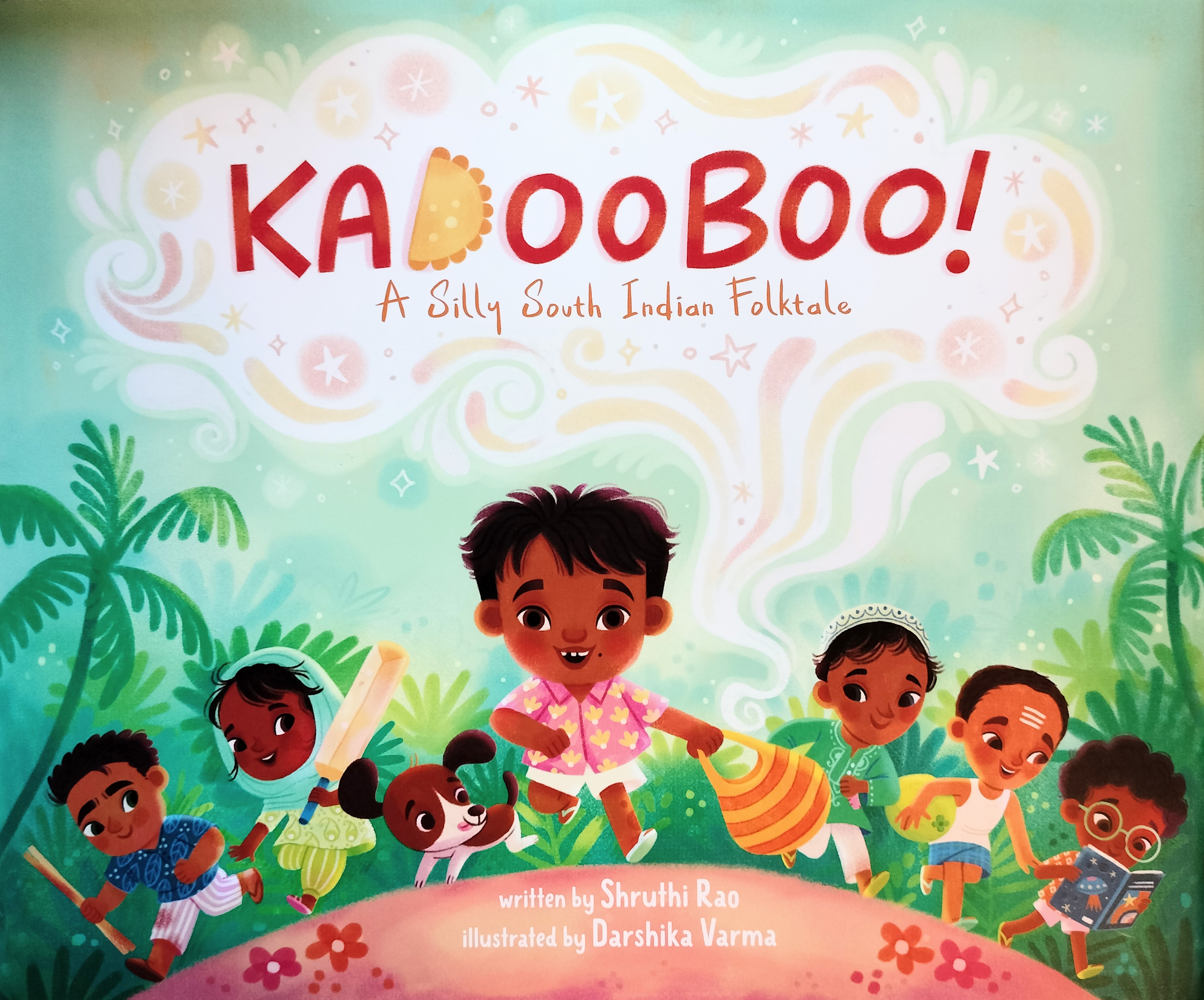
Kadooboo! A Silly South Indian Folktale – Written by Shruthi Rao, Illustrated by Darshika Varma (2024).


Full transparency: I know Shruthi, but that doesn’t change how I feel about this book. It’s a lovely, simple story. Kabir has to get the kadooboo home to his Amma before it rains. But the harder challenge is telling everyone what he’s carrying…and remembering how to say the word. The mistake words are fun & funny, and the artist has brought them out of the main text in a large, bold font that would make it easy for a child to find. And the gaps in Kabir’s teeth–such a small thing, but it adds so much to the illustrations. I love the idea of reading this to a classroom of kids who have all been losing their baby teeth.

Don’t Hug Doug (He Doesn’t Like It) – Written by Carrie Finison, Drawings by Daniel Wiseman (2021)


The confidence and energy this book exudes is amazing. The rhyming is great, and the word choices will make you laugh. And at the end of each scene comes a matter-of-fact reminder not to hug Doug, plus a chance for Doug to reiterate, offer alternatives, and move the story forward in a new way. The illustration of Doug with the megaphone, shouting, “Who here likes hugs?” and giving everyone on the next page (and listening to the story) a chance to answer is a powerful, joyous moment of self-positivity.

Posted in Picture Books

Picture Book – Some New Favorites

I updated my Pinterest page with a few new books, if you want to take a look!

Two of the best picture books I’ve read in July play with what I’d call more traditional styles, stretching my brain a bit and showing me what can be done (really well) by pushing past expectations.

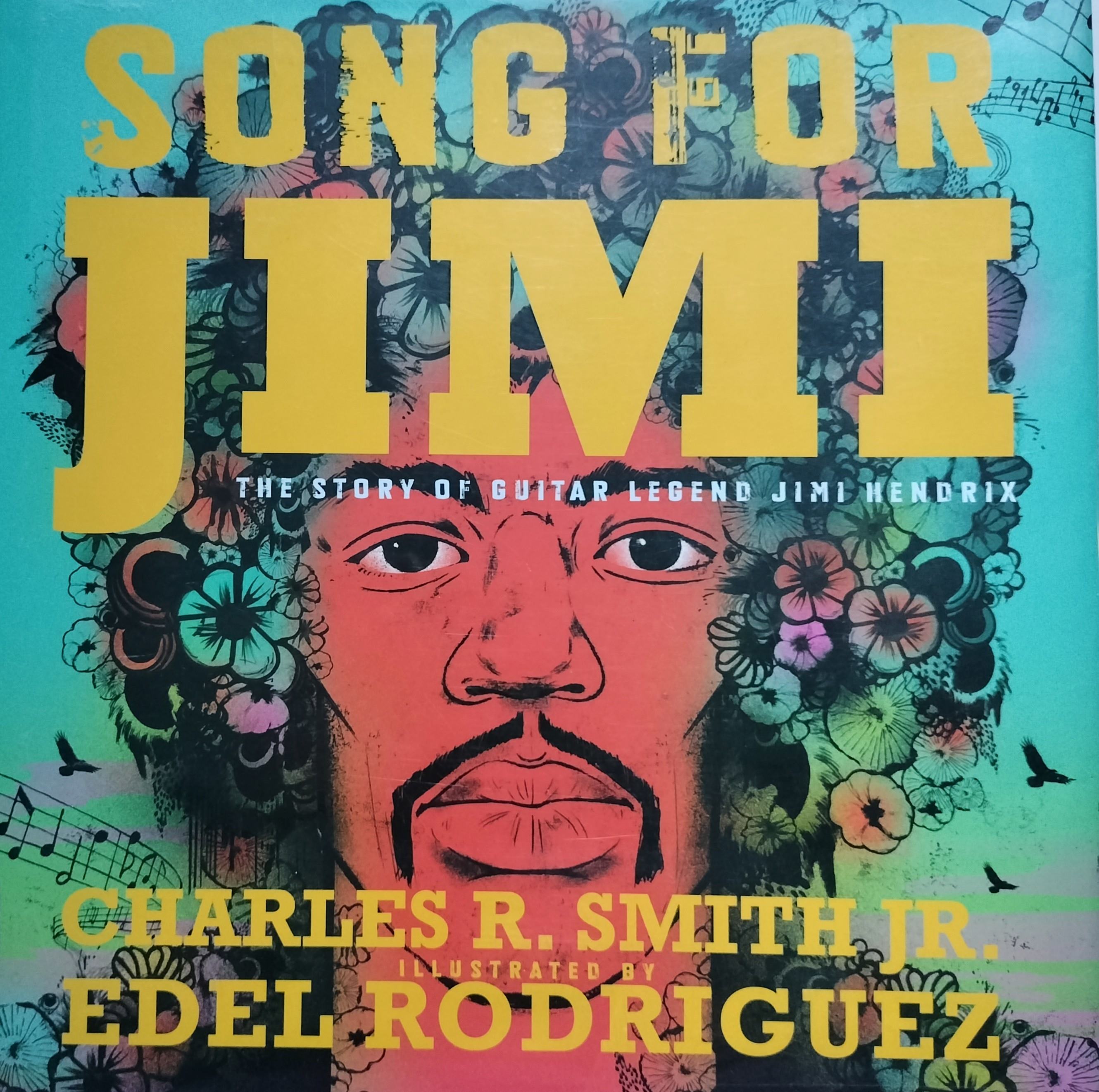
Song for Jimi: The Story of Guitar Legend Jimi Hendrix (written by Charles R. Smith Jr. & illustrated by Edel Rodriguez) is stunning. The art carries all the passion and power that Jimi’s music does. And the writing comes in a series of verses that also get to the heart of who Jimi was and the not-like-anything-else way he played guitar.


Small Things Mended (written by Casey W. Robinson & illustrated by Nancy Whitesides) explores grief, but–unlike so many books with this theme–the story starts after the loss. And while there are hints in the illustrations as to what the loss is, the text doesn’t address it. This story is about recovering from grief, and that’s the journey shared with the reader. And it’s beautifully done.


See what you think!

Posted in Picture Book Biographies, Picture Books

Picture Book Bios – Market Shift

Based on some comments from an agent or two, and things I’ve been hearing about a shift in the picture book biography market, I’m currently playing with a new version of my pb bio manuscript.

What I’m hearing is that agents & editors are not as interested in “cradle-to-grave” biographies–picture book bios that start their story at the subject’s birth or youth and continue through to their death or a relatively late post in their adult years. Some of these stories also have structures that can feel a bit more “this happened, then this happened,” as opposed to “because this happened, this happened.”

I’m noticing two types of bios replace the cradle-to-grave stories. Note: I’m not changing my manuscript simply because the market may be calling for it–I’m also seeing the additional power and child-engagement that these different styles can create.

One of the different styles is the story that starts later in the subject’s life, usually at the moment just before the inciting incident kicks off the big change/new direction of their life–the thing they did that the author really wants us to know about. After that point, the story tends to follow the familiar arc of the hero’s journey, but one that is built around the pursuit of this new direction.

The other type of bio I’ve found often starts at a more traditional point in the subject’s childhood. It may also follow the hero’s journey structure, although sometimes more loosely. The shift I see in these stories is that the scenes are all tightly structured around a theme–maybe a specific way the subject views the world, a skill set that directs their actions, or a passion that drives their choices.

As I’ve heard Kirsten Larson say–one common take-away of a PB bio, especially in a cradle-to-grave story, is persistence. I’m starting to see that these other types of biography can bring us closer to a more concrete kind of persistence–one particular to this individual. To me, a child reading these books has a better chance of recognizing themselves (Hey, maybe I could…) or of being drawn to something that makes them curious (What would happen if I…). With both kinds of stories, a young reader will still learn something about the subject, but I think they’ll also make a stronger personal connection with that subject. And connection is critical.

So these are the types of stories I’m looking for, and these are the types of books I picked up at my Indie Bookstore yesterday.

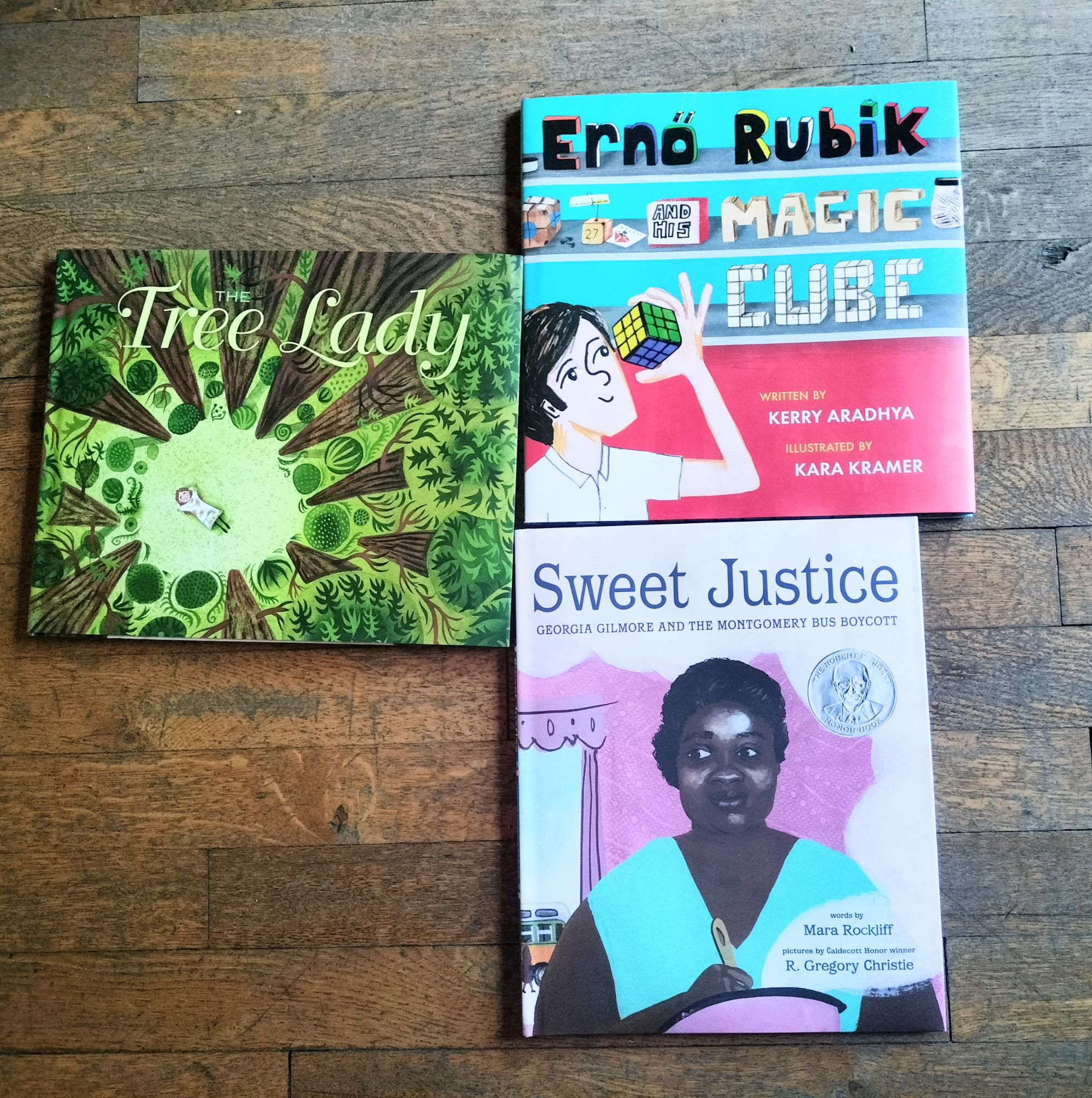
Sweet Justice: Gloria Gilmore and the Montgomery Boycott (written by Mara Rockliff; illustrated by R. Gregory Christie) fits the first type of new bio. Rather than start with Georgia Gilmore’s childhood, the story drops us in the very moment when she hears that Rosa Parks was arrested for not giving up her seat on a city bus. In the next scenes, we see Georgia stop riding the bus, participating in the growing boycott, and cooking & baking to raise funds. This is one of the most beautiful pb bios I’ve ever seen–both the wonderful writing and the absolutely gorgeous illustrations.

Both Ernö Rubik and his Magic Cube (written by Kerry Aradhya; illustrated by Kara Kramer) and The Tree Lady: The True Story of How One Tree-Loving Woman Changed a City Forever (written by H. Joseph Hopkins; illustrated by Jill McElmurry) begin in the subject’s childhood, but neither Ernö no Kate Sessions stay young for many pages. And pretty much every scene that moves the story forward connects tightly to a specific theme–for Ernö, that’s his love of puzzles; for Kate it’s her passion for trees and her use of science to find the right kind of trees to transform the then-desert of San Diego. I’m not saying we don’t get background and history of the protagonists, but the tight structure means even those passages support the theme. These are both very fun books that get us into the heads of a unique individual so we can feel what they’re doing and why.

I still have a big place in my heart for cradle-to-grave bios, and there are some amazing ones currently being published. But I know my love for this style is rooted in my own long-ago childhood, when these were the bios being published and the bios I read. Times have changed and one of the biggest and best changes is that we are now very clear we are writing our children’s stories for children. Bottom line: it’s because we care about those kids and want to give them books they will love, hopefully books that will contribute to them becoming life-long readers. And even if the reality is that grownups are the people buying the books, the kids are the people who will demand (or not!) that a book be read over and over and over again. And it’s that demand that grownups talk about with their friends and communities. Word of mouth sells books–which takes us right back to getting more good books into the hands of more children.

Posted in 2024, Authors, Book Review

Ruth Stiles Gannett Kahn

Or…as you might know her, Ruth Stiles Gannett, the author of MY FATHER’S DRAGON.

I loved this book when I was a child, I loved reading it to my child, and I still pick it up every few years and read it again–just for the joy of it.

I even picked up this toy years ago, because it reminds me so much of the dragon in the story.

There’s a reading “stage” for some children (many children?) when they are ready for a very special kind of book. They may still love picture books–either listening to someone read them or just curling up and spending time with a favorite. They may have started on some beginning readers–with some help or by themselves. But sitting still for someone to read them a novel is still a little tricky, when even one page may have more words than they’re used to, and a lot of pages don’t even have one picture on them.

This is when, I think, episodic books are wonderful. These are books that may have the same page count as one for older children, but don’t ask the child to carry all the pieces of a long story in their head. Instead, each chapter is a story in itself, with things like setting and characterization staying consistent across the entire book.

When my son was young, I couldn’t find many recently published books that had this structure.* So I went back to some of my favorites–Mrs. Piggle-Wiggle, Homer Price, Amelia Bedelia (short chapters, but lots of word play).

And MY FATHER’S DRAGON. Unlike some of the others, it has an overarching plot that the author touched base with, lightly, at the beginning and end of each chapter, so the child didn’t have to remember that bigger goal. This left them free to focus on the goal of each chapter… typically to get past or away from animals of various scariness. And she handled the scary parts so beautifully. She would show the danger with a sentence or three, then drop the reader right back into Elmer’s ingenuity and resourcefulness, dropping the tension just enough that the child could stop worrying about if Elmer was going to escape and start wondering how he was going to escape. Such good writing.

I had no idea that, until last month, Ruth Stiles Gannett was still alive. She died on June 11th.

Here’s a link to her obituary, if you’d like to read more about her.

*If you have any good episodic books for young children that have been published in the last few years, I’d love to find out about them.