Posted in YA Historical Fiction Challenge

YA Historical Fiction Challenge: JEFFERSON’S SONS

Coming in under the wire on the last day of the year, here is my 5th review for YA Bliss’ 2011 Young Adult Historical Fiction Challenge. I said I would read and review five books and, while it was a near thing at the end, I did it.

I picked up Kimberly Brubaker Bradley’s Jefferson’s Sons  a few days ago, in the middle of the afternoon, and I couldn’t go to bed that night until I’d finished it. Action-packed? No. Lots of tension around the physical horrors of slavery? No.

Why couldn’t I put it down?

Three reasons: The characterization is exquisite. Bradley writes in multiple points of view, and each speaker has a completely distinct feel and energy.  In fact, every character in the story is full, real, and layered—whether or not they have a say in actually telling the story.

The premise question is unique. How would it feel to be the child of the man who wrote these words: “We hold these truths to be self-evident, that all men are created equal…” and to be owned, as a slave, by that writer? That father?

The stakes: incredible. I don’t know if this is historical fact, but in Bradley’s story, Jefferson has promised Sally Hemings that he will free all their children as they each turn 21 years old. Will he remember? Will he make a will before he dies, that states this promise? Will his heirs respect the will? Freedom. Life. It doesn’t get much stronger than that.

The anger and disgust I felt as I read must only be the tiniest drop of the emotions Jefferson and Hemings’ children felt. Confusion. Hatred. Love. Respect. Hope. Contempt. The list could go on forever.

And somehow Bradley pulls all that together and writes an incredible book—in a structure that I would have sworn would leave me irritated, but didn’t—that worked perfectly. Bradley starts with the oldest son’s point of view, then passes onto his younger brother, then leaves that point of view for one of an even younger child—but one who isn’t Jefferson’s son, who isn’t going to be freed at Jefferson’s death. There is magic in having the children tell the story, rather than their mother, or one of the older slaves. We see the moment each child comes to the realization of what they are—not just a child, not just a person, but an owned human being—and what that means for their life. The pain of that moment is excruciating. Over and over and over.

The only thing I question about this story is the title. I’m not sure how or why Sons was decided upon as the thing to highlight. Jefferson had three sons who lived with Hemings—Bradley chooses two of them to tell their parts of the story. It works beautifully, and nothing feels like it’s missing, but I do wonder what was behind the choice of not using the third son’s point of view. Also, Hemings and Jefferson had a daughter who lived—Harriet. In this book, Harriet is an incredibly strong and believable character, and she has a different path to walk than all her brothers. Again, she lives on the page—I don’t know what would have been added by telling a chunk of the story in her voice…but I am left with wondering why she isn’t part of the title, why it isn’t Jefferson’s Children. Or Jefferson’s Sons and Daughter. (Awkward, I know, but you get the point.)

That is almost all curiosity, though, because—as I said—I “get” Harriet as wonderfully as I get the other characters. I get her purpose, her acceptance of her mother’s plan for her, and her absolute determination to get out of the world she has grown up in. As I get her brother’s reluctance and fear about the same step, her other brother’s sadness, and her younger brother’s equanimity.

I even get Jefferson in this story. As a character, Bradley has made me believe in the man she envisions could have this split in his personality—an incredibly intelligent, apparently kind man, who kept slaves, who kept his own children as slaves and could not see the cruelty in every smile he gave them. That’s as a character. As a person who truly existed, this story has made me feel more anger and hatred toward Jefferson than I had even let in before. That feeling you have of just wanting to shake sense into someone? I had it every time Jefferson appeared on a page, every time I saw him through these children’s eyes, through their attempts to reconcile all the things that couldn’t be reconciled.

This book stayed with me. Every time I woke during the night after I’d finished it, I was back at Monticello, back with these people going about their daily lives and not knowing what would come to them, not having any control over what that would be. Moment after moment, as I read, I felt like I wanted to throw up. And I mean that as the highest compliment to the author.

A disturbing book? Upsetting? Oh, yeah.

As it should be.
Posted in Book Review, YA Historical Fiction Challenge

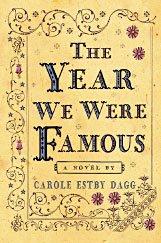
YA Historical Fiction Challenge: THE YEAR WE WERE FAMOUS

Let’s just start out with the basic statement: I loved this book.

I love the idea of two women walking cross-country from Washington to New York in 1896. I love the idea of their doing it with  no cooking utensils, plans to work for food and lodging along the way, and a bet that–if they do it–will win them $10,000 to save their farm, pay for college, and put the frosting on what may be the biggest adventure (exciting and miserable) of their lives.

I really love that it actually happened.

Okay, no, not exactly as Carole Estby Dagg has written it. The author is very clear in her notes about how much she does know about Helga and Clara (her great-grandmother and great-aunt) and what she doesn’t. Which is nice, because by the end of the book, that’s one thing I was definitely curious about.

What Dagg has done, though, and what I loved is to take the bones of a story that has obviously fascinated her for years and turned it into one that kept me reading through every page–every blister, every gully-washer, every gunshot, and every tedious (for the characters only) mile across the U.S.

In many ways, it’s just a great story told very well. Dagg uses the bet’s deadline to set up and sustain tension, as well as all the physical and emotional obstacles the two women face along the way. She explores the relationship between Helga and Clara, a relationship that only makes their trip more difficult, more challenging. She sets up a love-triangle for Clara, amazingly developed, when you figure that the two men involved never meet each other and are never physically involved in the journey for more than a few hours of time.

But what I really loved about this book was the journey. I mean, think about it. At one point in the story, Clara hits another woman with an accusation: “How many miles a day do you walk? Two miles, three?” It’s a wonderful moment, and the woman totally deserves the hit, but–hey–how many of us walk even that short distance unless it comes under the heading of Exercise?And Clara and Helga, as she says, have walked anywhere from twenty-five to fifty miles every day of their trip. In rain. In snow. In heat.

IN CORSETS.

No, I don’t want to go back, not for real. I don’t miss corsets. I don’t miss long skirts. I don’t miss working on a farm or chopping wood for a piece of bread and a cup of coffee.

Oh, I do love reading about it all, though. Especially when someone like Ms. Dagg does such a wonderful job of catching it all on the page for me–the humdrum and the amazing. The reality.

Posted in Flashbacks, Historical Fiction, YA Historical Fiction Challenge

YA Historical Fiction Challenge: Flashbacks in Jacqueline Davies’ LOST (One Spoiler)

I have a thing about flashbacks. Actually, I have a thing about not liking them. Usually. In most cases. I blogged a bit here about making sure they have a function, that they aren’t simply a fallback safety-net when we can’t figure out a better way to weave stuff in. As a reader, though, I don’t typically like being pulled that far out of the story to get background details, whether they’re in a flashback or an info dump.

Except, apparently, when Jacqueline Davies does it.

This is going to be an impossible review to write without at least one spoiler, but I’ll do my best not to give away anything you wouldn’t realize in the first few chapters. And I won’t tell you how anything turns out. Promise

When the story starts, Essie is knee-deep in her daily routine of turning out enough work in her job at the Triangle Shirtwaist Factory. (Yes, that Triangle Shirtwaist Factory, but Lost is anything but yet another story about the fire.) She has to train a new girl who acts as though she’s never touched a sewing machine before, all while getting enough of her own sewing done that she isn’t fired. And then she has to avoid her best friend who wants to walk home together, so she can spend the evening shopping for silk for her little sister’s new hat.

Except…and here’s the SPOILER. Essie’s little sister, Zelda, is dead.

Essie is in major denial. She moves forward during the day as though everything is fine at home, as though it’s her friend Freyda who’s talking crazy, every time she tries to talk to Essie about Zelda. In the evenings, she shops for the silk for hours, coming home after Zelda “is” already asleep and leaving in the mornings before she can find Zelda, who “is” in the middle of her favorite hiding game. Davies writes these moments beautifully and subtly, letting the reader grasp in their own time (and, yes, much more slowly than I’ve let you) what’s going on. Which makes it hurt all the more.

Maybe Davies could have written the book without the flashbacks. Maybe she could have woven in Essie & Zelda’s past in bits and pieces mixed into in-the-moment scenes. Maybe she could have built the tension across the book to the crisis and kept us with her the whole time. She’s a fantastic writer, so those maybes are actually, I’d say, probablys.

But…the flashbacks add things that even Davies would have been hard put to manage without them. We get to know Zelda. Oh, how we get to know Zelda. The child jumps off the page at us as immediately and energetically as she jumps around the family’s tenement apartment. She is a wonder, a ball of fire whom Essie adores so much that we think Mama may actually be right when she accuses Essie of spoiling her too much. She is bright and beautiful, she can sing and dance, she charms everyone who meets her, except perhaps the mothers whose children Zelda tends to roll over like a tiny steamroller. And Essie loves her. Essie loves her more than anything, which we also get to see–with crystal clarity. The flashbacks let us see the depth of Essie’s denial and worry, really worry, about if she’s going to come out of that denial and what will happen if she does.

The flashbacks give a reason, a substantial, specific reason–for why Essie lets go of her old friendship with Freyda (or tries to) and why she needs to build her new friendship with Harriet, the new girl that first day at the factory. Freyda knows about Zelda; Harriet does not. Harriet becomes the only person to whom Essie can speak of Zelda in the present tense; Harriet’s apartment is the only place Essie can relax into the belief that her sister is still with her. Again, I am blown away by the way Davies manages the dialogue between Essie & Harriet when they’re talking about Zelda. Amazing. Yes, Essie’s friendship with Harriet is more than a crutch, much more, but the roots of their relationship are firmly grounded in Essie’s need. Which, again, we wouldn’t understand nearly as well without the flashbacks.

There is so much more to this story than I have touched on. The grimness of work in the factories–of which the Triangle is only the most famous. The risks for children every day–especially for those growing up poor in the tenements. The layers and layers of different kinds of love, different ways of showing that love, and the cruelty and pain tangled between those who withhold it and those who wish for it. Yes, the famous fire is here, but I love that Davies makes sure to use the event as a single, if devastating, plot point, not as the emotional crux of the story.

Because, for me at least, that emotional crux is Essie and Zelda, their dynamic, their love. And I truly believe that, without the flashbacks, that crux would have had much, much, less power.

Posted in YA Historical Fiction Challenge

YA Historical Fiction Challenge: Sherri L. Smith’s FLYGIRL

Some books are so good, it’s actually hard to know where to come at them for a truly thoughtful, analytical review. Sherri L. Smith’s FLYGIRL is, for me, one of those books.

My basic review is…WOW.

Okay, I’ll give you a little bit more.

Ida Mae Jones wants to fly. She already does some, on the crop-duster plane that was her father’s before he died, the plane he taught her to fly in, the plane she plans to keep flying after she finds someone who will give her—as a woman—a pilot’s license. Then World War II breaks over the world, takes her brother as a soldier, and offers Ida Mae the chance to do her part and to fly. She may be able to join the WASP–the Women’s Airforce Service Pilots—if she’s willing to live a lie. A big one. She has to be willing to pass as white.

I have read three books in the last month which have characters who choose, for very specific, believable, and important reasons to “pass”—Flygirl, Diane Lee Wilson’s Black Storm Comin’ (see my review here), and Richard Peck’s The River Between Us. I don’ t know if this is a subject that’s becoming more “okay” to write about, or if it’s one of those reading coincidences that do happen. What I do know is that it’s an incredible world to read about, and all these writers handle it beautifully. Smith’s writing is easy and graceful, and yet she continually keeps up the tension by putting us right in the middle of the risks Ida Mae takes by hiding the truth. Risks to her safety, risks to her family, risks to her own self-identity–her core understanding of and belief in the person she knows herself to be.

The best fiction crosses barriers of experience and draws the reader into a world they know nothing about, then make them believe in and understand that world as well as they can without having lived it. Smith has done this. She shows us all the possible paths for Ida Mae; she shows us the choices Ida Mae faces and makes. WWII America carries a great burden of responsibility for having created situations and dangers that pushed people like Ida Mae to lie, and Smith makes that pointedly clear. BUT, at the same time, she has created a hero who, within that era, is also responsible for her own decisions and who recognizes this–a strong hero who is, yes, justifiably frightened and angry and confused, but who in no way plays out a passive role in her own story.

I love Ida Mae Jones. I want to put her in a plane and fly her into the future, even a future beyond today, where she doesn’t have to have this battle–internal and external. And I want to step back into the past with her and be the one person she can trust with the truth, someone who would support her and walk with her and go up in that second seat of the plane and let her fly me wherever she wanted.

One last word–this comes perilously close to a spoiler, but it’s not going to cross the lines. There are certain types of book endings that are seriously hard to pull off (and I’m not going to tell you what those are!). Many authors fail when they attempt this kind of ending, and I get very frustrated when I have to read them. Smith succeeds absolutely and brilliantly.

And, yes, you’ll have to read the book to see what I mean! 🙂

Posted in Book Reivew, YA Historical Fiction Challenge

YA Historical Fiction Challenge: BLACK STORM COMIN’

For my first read in the 2011 Historical Fiction challenge, I started off by breaking one of my own specs. In the post where I announced that I’d take part, I said, “I’m going to try and focus my search on books with protagonists who are at least 16 years old, at the older end of the YA spectrum.”

Oh, well.

The thing is that, in Black Storm Comin’, Diane Lee Wilson has totally achieved what I am looking/hoping for in the older books. She’s removed the safety net.

Too often, I think, historical fiction for kids and teens places its heroes in dangerous situations, very realistic to the times the authors are writing about, and then…somehow…make those situations feel not dangerous. I think there are various ways this happens–the hero has a powerful adult around for support; the hero doesn’t actually live IN the world where the danger exists and can pretty much escape as needed;  the point of view never gets close or deep enough to show real threat or real fear; the hero’s story gets overwhelmed, and cushioned, with too many details of the historic setting. Whatever the cause, I frequently find myself frustrated with a story that somehow takes me away from the actual pain and hardship I should be feeling.

Not so in Black Storm Comin’.

Colton Wescott may be only twelve, but he is moving through a world in which twelve can and does mean carrying a man’s life on his shoulders, a man’s responsibilities, and definitely without that safety net. The story starts as Colton and his family are traveling with a wagon train on the way to California–at the tail end of that wagon train, because Colton’s mother is black and his father is white, and nobody really wants them there. His mother is “in bed” in the wagon, with her newborn baby, and his father is jittery and nervous, so much that he accidentally shoots Colton with a blast from his shotgun and takes off–fleeing both the consequences and his family. Colton and his next-oldest sibling, ten-year-old Althea, immediately and literally become the adults in the family, barely getting the wagon and their very-ill mother to an outpost with a doctor. And getting them there with just about no money.

That’s when Colton sees the advertisement for Pony Express riders. The idea of becoming a rider pulls at him, both for the money and for the chance to ride–to fly, really–over the land he’s been plodding across for weeks now. His decision is complex, layered with the worry that what he’s really trying to do is desert his family, just as his father did, and with the added complication that he’s light-skinned enough to pass for white–which will let him apply for the job–but the rest of his family is not. He worries that keeping the secret is betraying them, and something in himself. Still, he is an adult, and there are too often, in an adult life, no real choices. He applies for and takes the job.

And what a job. If life as not-quite teenager in 1860 is hard, you should try life as a rider for the express. Colton is assigned the route–you can’t really call it a road, or a trail, or anything other than a direction the horses know by heart–over the Sierras into California. Just as winter sets in. Wilson is a fantastic author; she takes Colton along that route twice. The first time is to set us up for knowing how miserable it is, to show it to us in detail, with the horse barely making it up the mountain and small, skinny Colton barely staying on that horse’s back. The second time is the time of real urgency, with a specific life-or-death letter that Colton must get through. Each pass has its own tension–from the near-impossible physical test and from the urgency of Colton’s task, and each–again–gives no way out for Colton, no extra or unrealistic shelter or aid. Each time, it is Colton and the horse, and that’s it.

As it would have been.

Yes, there are people who help Colton. There are adults who help him get a job that he is, historically, too young to hold, and people who care for him when he is badly injured. The thing is, though, the help is at a par with what any adult would have gotten and comes with nothing extra for him because he is so young. And any aid Colton receives is countered by the help he doesn’t get, from his loving but fatalistic mother, from the old prospector who would all too quickly give away Colton’s secret–just for the fun of it, from the father who definitely does not swoop back into the story at the darkest moment and save the day. All the people in the story are well-drawn, but one of the best secondary characters is Althea, who is thrust into the same role as Colton and given no chance to ride like the wind, to get away from the dreary reality of keeping her mother alive and her younger sister at least safe and fed.

Childhood is not always a safe place, even today, and the best realistic stories, modern or historical, are the ones that do more than talk about that on the surface, that show the weight kids and teens carry, that show the battle they have just to survive.

Diane Lee Wilson has told such a story. Beautifully.

Posted in Historical Fiction

The YA Historical Fiction Challenge–I’m In!

Last week, Joyce Moyer Hostetter at The Three R’s—Reading, ‘Riting and Research posted about the 2011 YA Historical Fiction Challenge. Sab Horande at YA Bliss is hosting the challenge, and you can read all about it here and sign up to participate.

Basically, the challenge is to read 5, 10, or 15 historical fiction novels (depending on the level of challenge you pick), and they  have to be either middle-grade or young-adult. Then you blog about them–with a few basic thoughts or a full review–and each post enters you for all sorts of fun giveaways. The books do not have to be published in 2011, and Sab has thoughtfully included a few book lists to help us get started.

I’m going in at Level 1, which means I will read and blog about 5 books. Honestly, I’m going to use her list to totally stock my to-read pile, but I don’t want to commit to more than 5 review posts. I like to talk about books that really excite me as a story or that show me a wonderful example of some piece of writing craft, so I want to save the review slots for books I really want to share with you. Plus, I’m going to try and focus my search on books with protagonists who are at least 16 years old, at the older end of the YA spectrum. Don’t worry. If I fall in love more than 5 times, you’ll most likely hear about it–if not here, on Facebook & Twitter.

I’m a big believer in reading what you’re writing, so I’m excited and grateful to Sab for setting this up. I can’t wait to see the reviews that everyone else in the challenge comes up with. 2011 is going to be a great year for reading!