
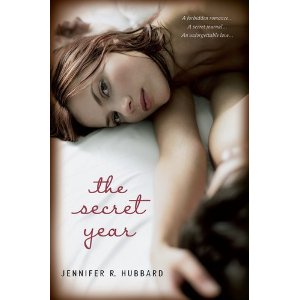
Jennifer R. Hubbard is the author of the young-adult novel, The Secret Year, a lovely book with one of the best portrayals I’ve read of a teenage boy who chooses not to share his feelings. If you want to read a great story and see really strong use of point of view, pick up a copy. Jennifer is also one of the most intelligent bloggers I’ve found to read; her discussions of the writing craft and writing process always get me thinking. She blogs at http://jenniferrhubbard.blogspot.com/ and http://writerjenn.livejournal.com/.
When Jennifer said that she was looking for bloggers to swap posts with, I jumped at the chance. Here’s Jennifer’s post–enjoy!
Keeping Focused
There are millions of writing tips floating around: in books, at conferences, on the internet. Reviewers offer lists of what they want to see more and less of. The market offers its own pressures (Vampires are it! No, werewolves! No, angels! etc. …) A writer can sit down with a head stuffed full of write-every-day/kill-the-adverbs/raise-the-stakes/begin-at-the-beginning/ditch-the-prologue/don’t-go-straight-to-flashback/switch-present-to-past-tense, and so on and so on.
For me, the best use of tips and advice is as a toolbox from which I may, at any time, need to select a tool. Of all the tips floating around, one will be the one I need to hear at that moment; it will help me fix the particular problem in front of me. A week from now, I’ll have a different problem and need a different tool. I concentrate on one thing at a time.
As for the lists of what we should and shouldn’t write about–well, they call to mind the anecdotes writers tell about well-meaning friends who say, “You know what you should write about?” or “I’ve got a great idea for a story!” We all know we can’t write those stories. We write the stories that set off a blaze inside us, stories whose energy will drive us through the long rigorous process of drafting, multiple revisions, critique and review. When too many external voices compete for our attention and we’re no longer sure what to write, we can turn our eyes to the inner flame, and ask ourselves: What lit that spark? What keeps it glowing?
 Becky Levine