
Posted in Books, History, Nonfiction, Science, Uncategorized, Women Writers

A List of Books I Couldn’t Find

Yesterday, I went book shopping. I went to one of my favorite stores, where they are wonderful and helpful and where I almost always find something I haven’t seen that looks like something I want to read. I was looking for a book to give as a gift.

But it’s not a big store, and they only have so much shelf space, and I was–for various rambling reasons (some about the giftee, some about me)–looking for a very specific type of book, one that met a list of requirements I had decided on.

Those requirements were:

1. The book had to at least look like it would be written well.

2. The book had to be nonfiction, preferably Science or History.

3. The book couldn’t be heavy or dark. One of the purposes of the gift was to serve as a distraction/escape from today’s heavy and dark.

4. If the book was a history book, it had to be about a woman or multiple women, and it had to be written by a woman. If it was a science book, it had to at least be written by a woman.

Guess which one was the stumper.

Were there history and science books about women?

Yes.

Were there history and science books by women?

Yes.

Were there history and science books about AND by women?

A few. And the ones I found didn’t meet the first three requirements. Was it a sign of the times that I got more and more frustrated at all the books I found about women that were written by men? Absolutely? Was it fair? In some ways yes; in some ways no–I had much less of a problem with finding books about men written by women (although there were a lot fewer, so…you know.) Do I think men should be able to write nonfiction about women and women should be able to write nonfiction about men. Sure. I can instantly give you examples of two excellent books that fall under that umbrella: ‘They say’: Ida B. Wells and the Reconstruction of Race by James West Davidson and Assassination Vacation by Sarah Vowell.

Still. None of this helped my frustration last night. So I did some browsing, and the giftee is going to Chrysalis: Maria Sibyalla Merian and the Secrets of Metamorphosis by Kim Todd. It’s going on my to-read list as well.

And I came across some other titles that, while I haven’t looked to see if they meet requirements 1 and 3; they do meet requirements 2 and 4. And I decided to post a list of these books, the ones I couldn’t find last night, to make me happy and–possibly–to help someone else on their search.

Science

Black Hole Blues and Other Songs from Outer Space* by Janna Levin

The Sixth Extinction: An Unnatural History* by Elizabeth Kolbert

Biomimicry: Innovation Inspired by Nature by Janine M. Benyus

Mapping the Heavens: The Radical Scientific Ideas that Reveal the Cosmos* by Priyamvada Natarajan

A Big Bang in a Little Room: The Quest to Create New Universesby Zeeya Merali

Venomous: How Earth’s Deadliest Creatures Mastered Biochemistry* by Christie Wilcox

Dark Matter and the Dinosaurs: The Astounding Interconnectedness of the Universeby Lisa Randall

Storm in a Teacup: The Physics of Everyday Lifeby Helen Czerski

Pandemic: Tracking Contagions: from Cholera to Ebola and Beyondby Sonia Shah

The Epigenetics Revolution: How Modern Biology is Rewriting Our Understanding of Genetics, Disease, and Inheritanceby Nessa Carey

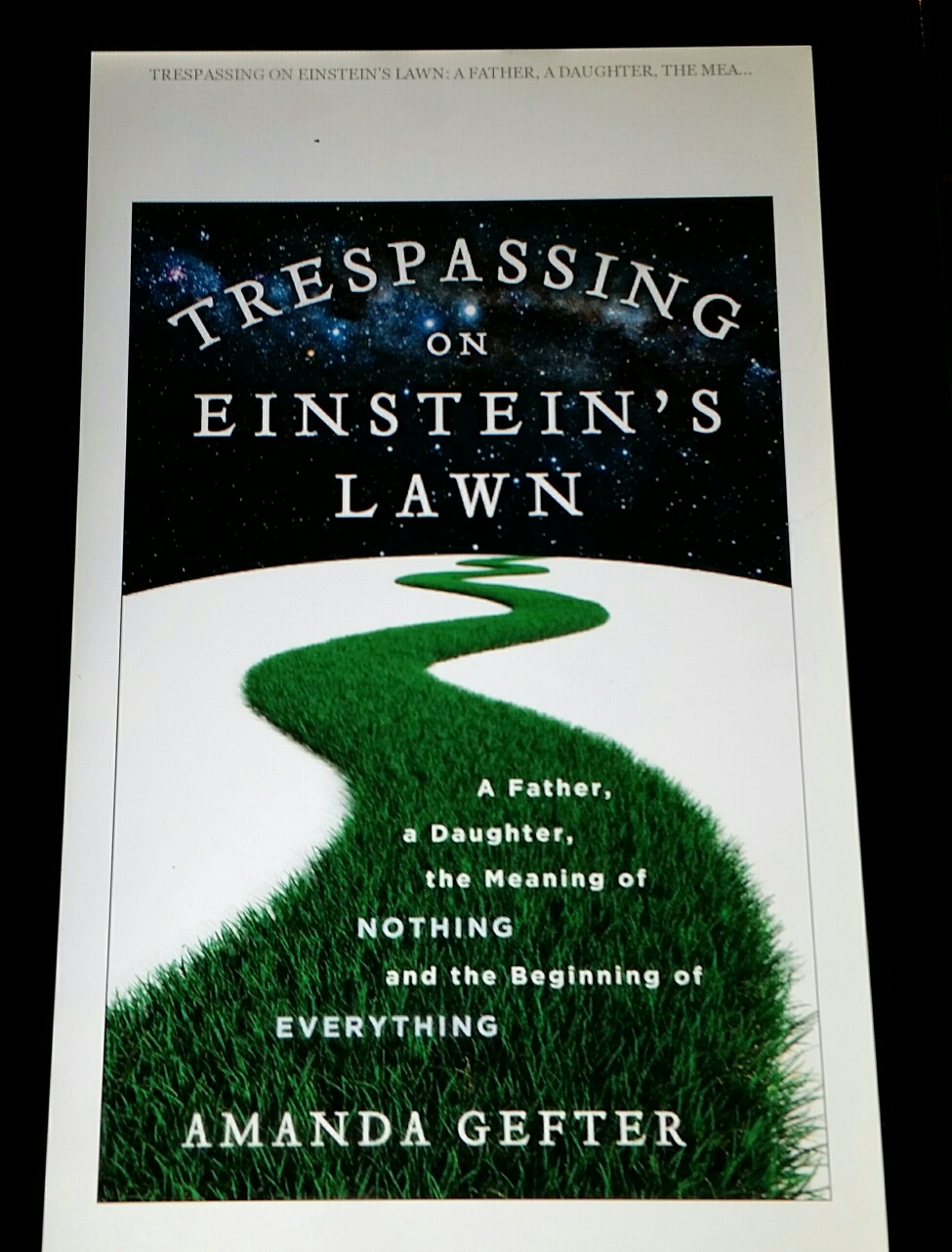
Trespassing on Einstein’s Lawn: A Father, A Daughter, The Meaning of Nothing, and the Beginning of Everything by Amanda Gefter

*I found very few lists that included only women writers of science, so I want to give credit to the one excellent one I did find. These books are all from Swapna Krishna’s Bustle post, “9 Science Books Written by Women To Read When You Need A Break From Fiction.”


History

Hidden Figures by Margot Lee Shetterly  (The bookstore did have this, but I figured it was high odds the giftee would have already read it.)

Sisters in Law: How Sandra Day O’Connor and Ruth Bader Ginsberg Went to the Supreme Court and Changed the World by Linda Hirshman

Set the World on Fire: Black Nationalist Women and the Global Struggle for Freedom by Keisha N. Blain

Ada The Enchantress of Numbers: Prophet of the Computer Age by Betty A. Toole

The Witches: Suspicion, Betrayal, and Hysteria in 1692 Salem by Stacy Schiff

Flâneuse: Women Walk the City in Paris, New York, Tokyo, Venice, and London by Lauren Elkin

When Women Ruled the World: Six Queens of Egypt by Kara Cooney

Girl Sleuth: Nancy Drew and the Women Who Created Her by Melanie Rehak

Irish Nationalist Women: 1900-1918 by Senia Paseta

The Hemingses of Monticello: An American Family by Annette Gordon-Reid

Mother is a Verb: An Unconventional History by Sarah Knott
Posted in Uncategorized

I Can’t Come Up With A Clever Title Because It Might Be Wrong

So if you’ve been reading any of my Facebook posts, you’ll know that I’ve veered off fiction lately and have been reading Amanda Gefter’s Trespassing on Einstein’s Lawn: A Father, a Daughter, The Meaning of NOTHING and the Beginning of Everything.

!!GefterI was going to start this post with some punny/funny title that tied together fiction & physics, and you’ll see (if this post goes as planned) that I am ultimately connecting modern physics with my writing. But every title I came up with might have been right (physics-wise), or it might have been wrong, leaving me open to much criticism that I don’t understand what I’ve been reading.

Duh.

Mostly, I’m happy with keeping my reading at  ~98.999873% fiction. Occasionally, though I like to dig into a few types of nonfiction. Good memoir, I love. And I crave really WELL-WRITTEN history that gets at the people and the puzzles of whatever time I’m reading about–rather than just the leaders and politics and wars and whatever else you want to throw in to make me yawn. (Two examples of the kind of history I love to read–Amy Butler Greenfield’s A Perfect Red and Laurence Bergreen’s Over the Edge of the World.) And then I love science. But…and here’s the rub, folks, the science has to be REALLY, REALLY, REALLY WELL-WRITTEN. Because, even then, I’m not going to understand all of it, and when you get into quantum physics, the percentage I’ll comprehend drops even lower.

Amanda Gefter writes REALLY, REALLY, REALLY WELL.

Gefter gets as excited about physics as I do about, well…fiction. She gets as tangled up in a conversation about relativity and event horizons and the nature of reality as I do about plot points and rising tension and character consistency. I give you, as evidence, her description of what happened when she went to pick up her nametag (and her father’s) at the first physics conference she basically snuck/faked her way into.

As I leaned over to grab them [the nametags], I accidentally bumped shoulders with the man next to me. “Sorry,” I said, glancing up. I blushed and sprinted giddily back to my father. “Oh, my God!” I squealed. “I just touched Brian Greene!”

Pretty much exactly my reaction when I met Bruce Coville (okay, yes, “met” meaning I made it to the front of his book-signing line) and got to tell him how much I wished his Sixth Grade Alien books were still in print.

So, yes, the book is clever and funny and will make you laugh many times over. If there’s anyone in your family who will get any of the physics references, you’ll be reading sections out loud to them to share the laugh and/or the awe. But, more important than that, I think Gefter makes this stuff about as understandable (for me, anyway) as anybody could. How do I know? Well, first, because I’m still reading. But also because every now and then I take a break and summarize what I’ve got to my husband, who has read a LOT more about this stuff than I have, and he doesn’t say, “That fits absolutely nowhere into what I know about physics.” He nods and says, “Okay,” and I go back to the book and keep going.

When i started this book, I hoped I was going to get a better understanding of what we (“we” being the mathematical set that includes all these physicists, not the mathematical set that includes me) know about the universe. I was, I’ll admit it, looking for some facts, facts I could use as building blocks to give me a base from which I could grow my own knowledge. And what Gefter has shown me so well is that I don’t actually have to get those facts. In fact (see what I did there?), there aren’t actually that many facts to learn!

Okay, this is where I may be getting in over my head and where, to anybody who actually does understand this stuff, I may be making that obvious. But here are my takeaways.

We don’t know all that much!

We have theories. Oh, man, we have theories out the wazoo. And we do have a decent amount of mathematical proof for some of those theories–if not in their entirety, for some big chunks of each. And while I can’t do the math, I’m willing to accept that if/when the math works out, this means something.

We also have a whole lot of questions. It seems to me that these physicists are using the scientific method to the max. They are asking questions left and right and then they are creating hypotheses (which often sound a lot like science fiction premises), and then they are testing them. They’re testing with both math and evidence, when and if they can get any evidence. And someone comes up with one answer and someone else comes up with another answer and then they argue for a while until someone else does some more math or finds some other evidence and–occassionally–they prove something. But whatever happens, they keep asking. Boy, do they keep asking. And it’s these questions that are actually what Gefter is helping me understand. No, I’m not going to list them–I told you, I’ll get them wrong, and someone will tell me I don’t understand, and we’ll be back at that Duh. But I promise you; I’m getting them while I read them.

It is amazing. I can’t even really imagine the brains behind these ideas, the brains that go back and forth with each other in almost entirely theoretical conversations and that keep track of everything they’ve read and heard, everything they believe, and everything they’re thinking up as a new possibility right in that minute. Okay, yes, I can do that with the Harry Potter world, and I can give you any number of reasons why Mary Lennox does not (no matter what the movie says) grow up to marry her cousin Colin. But these aren’t black holes and universes that are one-sided coins and the place at which Einstein and Newton’s theories no longer conflict. Just saying.

All right, I promised you a connection between physics and writing. You ready? If these guys can throw out these totally bizarre ideas that stretch imagination to the breaking point, and then they can test them and find the pieces that work and the pieces that don’t, and then they can keep going…I can throw any words and sentences on the page I want and then revise them.

Oh, yes, I can.

But really this post is not about me or my writing (another duh!). It’s about a really fantastic book that, if you can push all those novels to the side for a week or two, you should pick up and read. I’m at 57%, and the last sentence I just read is, “Particles, strings–they were just two ways of looking at the same thing.” Oh, yeah, you can bet I’m going to keep reading to the end.