Posted in 2024, Book Lists, Uncategorized

My 2024 Reading Recommendations

I keep track of my reading in The Story Graph app, which–if you haven’t checked it out–is, IMO, much nicer to use that Goodreads. I’m guessing the community is nowhere as big, but since I don’t really use it for social media, that’s not a problem for me.

Anyway, rather than list every book I read in 2024, I’m just going to list some of my favorites, including rereads I binged for multiple books in a series/by an author. (I did a LOT of rereading this year. Not sure why, although I tend to reread for comfort, and you can guess why I might have needed some of that, especially in the Fall.) You can also see my ongoing lists of favorites at Pinterest.

Picture Books

Middle Grade

YA/Adult (I started to separate these two categories, but when I looked at the list, it’s all crossover.)

Rereads (Links go to first book in the series)

Posted in Picture Book Biographies, Picture Books

Picture Book Bios – Market Shift

Based on some comments from an agent or two, and things I’ve been hearing about a shift in the picture book biography market, I’m currently playing with a new version of my pb bio manuscript.

What I’m hearing is that agents & editors are not as interested in “cradle-to-grave” biographies–picture book bios that start their story at the subject’s birth or youth and continue through to their death or a relatively late post in their adult years. Some of these stories also have structures that can feel a bit more “this happened, then this happened,” as opposed to “because this happened, this happened.”

I’m noticing two types of bios replace the cradle-to-grave stories. Note: I’m not changing my manuscript simply because the market may be calling for it–I’m also seeing the additional power and child-engagement that these different styles can create.

One of the different styles is the story that starts later in the subject’s life, usually at the moment just before the inciting incident kicks off the big change/new direction of their life–the thing they did that the author really wants us to know about. After that point, the story tends to follow the familiar arc of the hero’s journey, but one that is built around the pursuit of this new direction.

The other type of bio I’ve found often starts at a more traditional point in the subject’s childhood. It may also follow the hero’s journey structure, although sometimes more loosely. The shift I see in these stories is that the scenes are all tightly structured around a theme–maybe a specific way the subject views the world, a skill set that directs their actions, or a passion that drives their choices.

As I’ve heard Kirsten Larson say–one common take-away of a PB bio, especially in a cradle-to-grave story, is persistence. I’m starting to see that these other types of biography can bring us closer to a more concrete kind of persistence–one particular to this individual. To me, a child reading these books has a better chance of recognizing themselves (Hey, maybe I could…) or of being drawn to something that makes them curious (What would happen if I…). With both kinds of stories, a young reader will still learn something about the subject, but I think they’ll also make a stronger personal connection with that subject. And connection is critical.

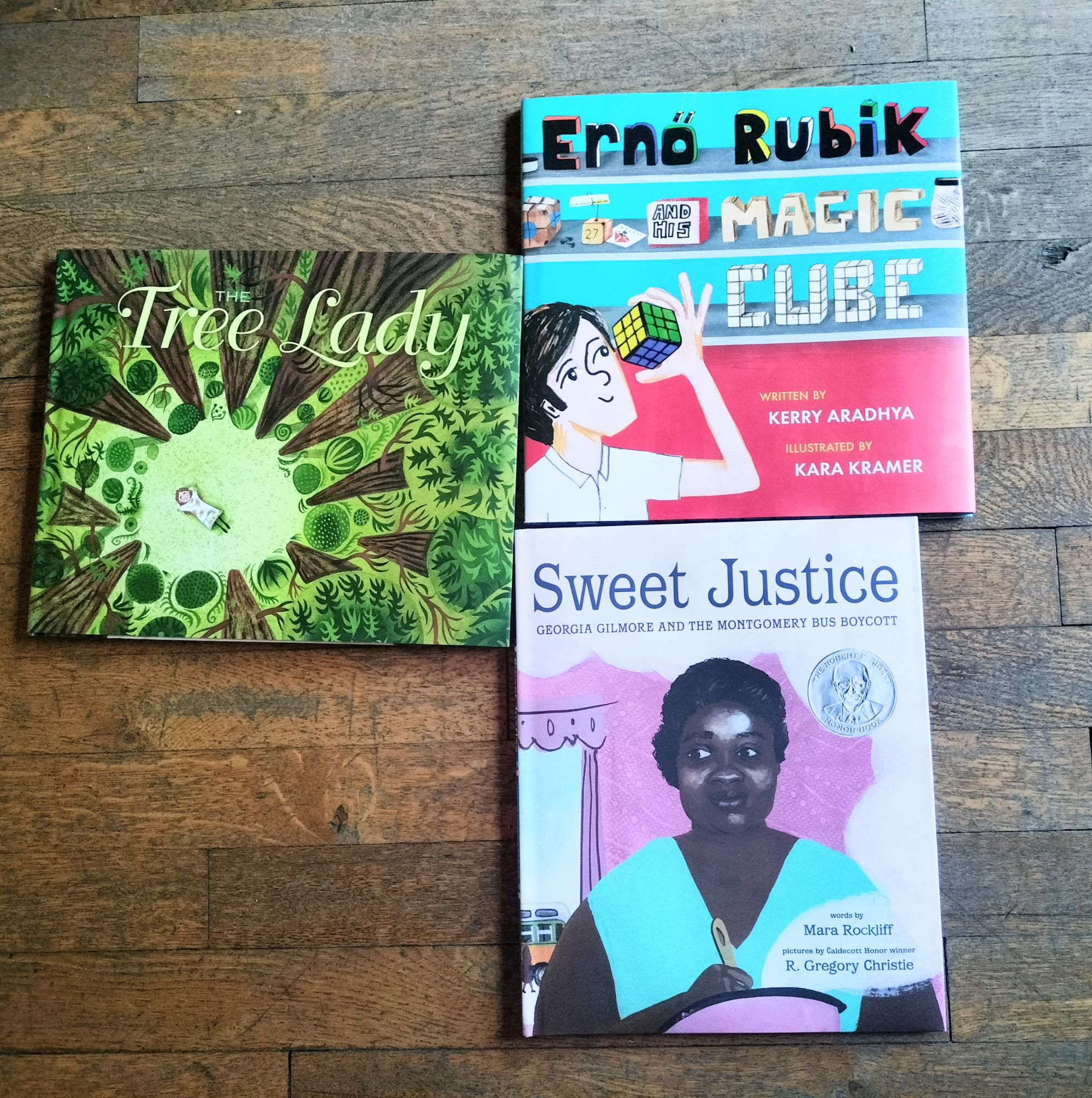
So these are the types of stories I’m looking for, and these are the types of books I picked up at my Indie Bookstore yesterday.

Sweet Justice: Gloria Gilmore and the Montgomery Boycott (written by Mara Rockliff; illustrated by R. Gregory Christie) fits the first type of new bio. Rather than start with Georgia Gilmore’s childhood, the story drops us in the very moment when she hears that Rosa Parks was arrested for not giving up her seat on a city bus. In the next scenes, we see Georgia stop riding the bus, participating in the growing boycott, and cooking & baking to raise funds. This is one of the most beautiful pb bios I’ve ever seen–both the wonderful writing and the absolutely gorgeous illustrations.

Both Ernö Rubik and his Magic Cube (written by Kerry Aradhya; illustrated by Kara Kramer) and The Tree Lady: The True Story of How One Tree-Loving Woman Changed a City Forever (written by H. Joseph Hopkins; illustrated by Jill McElmurry) begin in the subject’s childhood, but neither Ernö no Kate Sessions stay young for many pages. And pretty much every scene that moves the story forward connects tightly to a specific theme–for Ernö, that’s his love of puzzles; for Kate it’s her passion for trees and her use of science to find the right kind of trees to transform the then-desert of San Diego. I’m not saying we don’t get background and history of the protagonists, but the tight structure means even those passages support the theme. These are both very fun books that get us into the heads of a unique individual so we can feel what they’re doing and why.

I still have a big place in my heart for cradle-to-grave bios, and there are some amazing ones currently being published. But I know my love for this style is rooted in my own long-ago childhood, when these were the bios being published and the bios I read. Times have changed and one of the biggest and best changes is that we are now very clear we are writing our children’s stories for children. Bottom line: it’s because we care about those kids and want to give them books they will love, hopefully books that will contribute to them becoming life-long readers. And even if the reality is that grownups are the people buying the books, the kids are the people who will demand (or not!) that a book be read over and over and over again. And it’s that demand that grownups talk about with their friends and communities. Word of mouth sells books–which takes us right back to getting more good books into the hands of more children.