Posted in Uncategorized

Rerun: Review of Les Edgerton’s HOOKED

I try not to run old blog posts too often, but I’m rereading a few chapters of Les Edgerton’s Hooked in preparation for starting to draft the YA, and I’m wowed all over again. So, here you have it–a worthwhile rerun: the review I wrote several years ago, when I first discovered the book.

Back in October, I talked about The Writer’s Journey, by Christopher Vogler. In that post, I mentioned Les Edgerton’s book Hooked: Write Fiction That Grabs Readers at Page One & Never Lets Them Go. I said I’d talk more about Edgerton’s book in another post.

So here we are.

With November and NaNoWriMo ending, and the new year heading our way fast, I thought this would be a good time to pick up this thread. Revision is, in a big part, about structure–about what happens when and which scenes go where. Edgerton’s book is solely and completely about the beginnings of a story, but (pardon the pun) that seems as good a place as any to start.

Edgerton talks about a lot of the same things Vogler does—at least in terms of the early part of the hero’s journey. Edgerton may not call everything by the same names, but in his chapters, you’ll find the ordinary world, the inciting incident, the threshold, etc. The big difference, though, between the two books is Edgerton’s emphasis on how quickly we, as writers, have to get those starting points onto the page.

I write fiction for kids–middle-grade and YA readers. These readers are not known for their patience with authors. You can blame it on action movies and video games, or you can credit these kids with the sense and intelligence to recognize and appreciate a tight, fast-moving opener. As someone who, in the past ten years went from reading (and loving) 700-page Victorian novels to devouring 250-page tense and terse, funny and furious YA books—I can say the decade has been a good education in writing.

Because it’s not just kids’ books that move more quickly today; it’s all books. At first, when you realize just how much Edgerton is asking you to do in the first chapter, first scene, first page, first paragraph, it’s intimidating. And part of your brain may go into the “I don’t have to” whine. But keep reading. And go back to the books you’ve lost most in the past couple of years. You’ll see that he’s right.

It’s not just that we’re told over and over that agents, if we’re lucky, read the first five pages. It’s not just that we know most book buyers skim the first page, maybe the last, then make their decision about whether to buy that book or leave it on the shelf where they found it. It’s that, these days, a good story sucks us in from Page 1, hooks us, and goes racing along so quickly that we have to grab on and ride, just to keep up.

This is the kind of story I want to be writing.

Thankfully, Edgerton doesn’t just point out the necessity of this kind of beginning. He gives thorough, detailed information about the big pieces of this skinny little beginning, and he follows up with seriously helpful (and funny) instructions for how to put those pieces together.

If you haven’t read Hooked, take a look. Especially, if you’re looking at a revision, post-NaNo or not, take a look. I think you’ll be glad.
Posted in Writing Books

Friday Five: Favorite Writing Books

I’ve written about some of these books here, but it felt like time to just toss up a list. As of today, and in no particular order, these are my top 5 books on the craft of writing. If you’ve got some other favorites, add them to the comments, where everybody can see!

I have to mention one other book, which I haven’t actually read yet, but which I have on order–after listening to Merrily Kutner explain the diagramming method for picture books that the author teaches.  I’m pretty sure I’m going to seriously love  Eve Heidi Bine-Stock’s How to Write a Children’s Picture Book, Volume I: Structure. I’m pretty sure I’m going to like Volumes II and III, too, but I’m going one at a time for now!

Posted in Revising, The Beginning, Writing Books

Les Edgerton’s Hooked

Back in October, I talked about The Writer’s Journey, by Christopher Vogler. In that post, I mentioned Les Edgerton’s book Hooked: Write Fiction That Grabs Readers at Page One & Never Lets Them Go. I said I’d talk more about Edgerton’s book in another post.

So here we are.

With November and NaNoWriMo ending, and the new year heading our way fast, I thought this would be a good time to pick up this thread. Revision is, in a big part, about structure–about what happens when and which scenes go where. Edgerton’s book is solely and completely about the beginnings of a story, but (pardon the pun) that seems as good a place as any to start.

Edgerton talks about a lot of the same things Vogler does—at least in terms of the early part of the hero’s journey. Edgerton may not call everything by the same names, but in his chapters, you’ll find the ordinary world, the inciting incident, the threshold, etc. The big difference, though, between the two books is Edgerton’s emphasis on how quickly we, as writers, have to get those starting points onto the page.

I write fiction for kids–middle-grade and YA readers. These readers are not known for their patience with authors. You can blame it on action movies and video games, or you can credit these kids with the sense and intelligence to recognize and appreciate a tight, fast-moving opener. As someone who, in the past ten years went from reading (and loving) 700-page Victorian novels to devouring 250-page tense and terse, funny and furious YA books—I can say the decade has been a good education in writing.

Because it’s not just kids’ books that move more quickly today; it’s all books. At first, when you realize just how much Edgerton is asking you to do in the first chapter, first scene, first page, first paragraph, it’s intimidating. And part of your brain may go into the “I don’t have to” whine. But keep reading. And go back to the books you’ve lost most in the past couple of years. You’ll see that he’s right.

It’s not just that we’re told over and over that agents, if we’re lucky, read the first five pages. It’s not just that we know most book buyers skim the first page, maybe the last, then make their decision about whether to buy that book or leave it on the shelf where they found it. It’s that, these days, a good story sucks us in from Page 1, hooks us, and goes racing along so quickly that we have to grab on and ride, just to keep up.

This is the kind of story I want to be writing.

Thankfully, Edgerton doesn’t just point out the necessity of this kind of beginning. He gives thorough, detailed information about the big pieces of this skinny little beginning, and he follows up with seriously helpful (and funny) instructions for how to put those pieces together.

If you haven’t read Hooked, take a look. Especially, if you’re looking at a revision, post-NaNo or not, take a look. I think you’ll be glad.

And don’t forget to check out Martha Alderson’s blog, Plot Whisperer for Writers and Readers, all through the month of December, for tips on plotting out your revision. Martha will be guest-blogging here, too, soon!

Posted in Uncategorized, Writing Books

The Writer’s Journey: Start Here

Have you read this book?


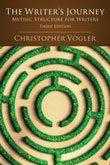
You might not recognize the cover. I didn’t at first, because it doesn’t match my copy. Of course, mine is only the second edition. This one’s the THIRD edition. Christopher Vogler’s The Writer’s Journey is like the energizer bunny–it keeps getting printed and printed and printed…

There are plenty of reasons why. First, Vogler has a lot of important things to say. His book is based on Joseph Campbell’s ideas about the hero’s journey, the common storyline in so many myths. Vogler does NOT, as some people seem to fear, advocate writing from a template, a formula. What he does instead is analyze the common elements of all stories, in a way that makes us recognize the patterns and layers we’re all struggling to find in our books and bring to the surface. I have a very specific criteria for a “good” writing book, that I find myself putting it down before I reach the end and rushing back to my story to get all the new ideas onto the page. The Writer’s Journey more than qualifies.

The other big reason is more practical. Basically, if you want to have a discussion about plot, or character, this is your starting point. As an editor, when I talked with a client about what their hero was doing, what the other characters were up to, I’d inevitably find myself talking about Vogler’s book. I’d suggest that, even before they looked at my critique, they should probably pick up a copy of The Writer’s Journey and read it through. This book is also the basis of so many brainstorming sessions I have with my critique groups, whenever we get deep into what our hero is (or isn’t!) doing.  Teachers in writing classes point to Vogler’s book, and The Writer’s Journey is referenced in more other writing books than I have time to count. You need to know what all these people are talking about.

I’ll admit that Vogler hasn’t solved the problem of the story middle for me. And, these days, I’m also pushing Les Edgerton’s book Hooked as a must-read companion to The Writer’s Journey.  Edgerton builds on Vogler’s ideas, and really hits on the kinds of beginnings we need to be writing today. Still, I find myself going back to Vogler’s book time and time again, when I’m stuck, when I’m trying to figure out WHO my hero is and needs to be, when I’m just trying to get a closer look at the layers of my story.

Whether you’re just starting on your writing path, or you’re already treading strongly along it, I recommend dropping this book into your traveling pack.