Posted in Uncategorized

I’ve Been Tagged: Picture Book Projects

Okay, I was tagged almost two weeks ago, but I’m here! Thanks to Carol Baldwin for giving me the chance to talk about my project(s) and process. And, rather than tag anyone specific in turn, I’m just throwing out an invite. If the questions in this post look fun and you’ve got a project you want to talk about, drop the link into the comments so we can all see.

What are you working on right now?

Picture books! I actually have three picture books in the works. Partially because these stories called to me, partially because I have fallen in love with all the manuscripts, and partially because I’m learning that if I want to submit a picture book to an agent, I need to have more than that one ready to go. So the MG novel is set aside for now, even though it keeps sending out little peeps to try and get my attention. I’m promising it lots of time when these other manuscripts are ready and done.

I’m not going to share details about the picture books, because by the time I’ve told you anything about them, I might as well tell you everything. And I’ll hold onto that for marketing time, when/if that comes! But I will tell you that I feel like I have tapped into several different story modes, voices, and characters for the manuscripts. When I look at them, I’m not quite sure how they all came out of my brain and fingertips, but I think some of the credit has to go to Tara Lazar and PiBoIdMo. (Holy Cow! I have to start thinking up new ideas in TWO DAYS!). Something about the speed and craziness of coming up with one or more ideas, every day for a month, seems to let loose a randomocity of ideas, at least for me. It’s a challenge, because I have to shift neurons and synapses each time I turn from one to the other of the three manuscripts, but it’s also energizing and just really, really cool.

How do picture books differ from other genres?

Okay, the original question is how does your manuscript differ from other books in its genre, so feel free to answer that one in your post. But since I’m talking about three picture books, it doesn’t quite work. So I changed it! As I’ve talked about before, I’m fairly new to picture books, so they feel very different. I have always been a novel person, from the series books I read as a kid to the years I spent reading 700-page works of Victorian fiction in college. Dickens got paid by word-count; in picture books, you are seriously encouraged to reduce your word count. Which I love. Maybe I’m coming at it wrong (but don’t tell me if I am!), but I am finding that the tighter I can make the words in a picture book, the more clear the theme/vision/main problem becomes. It’s truly like trimming away the fat, or chiseling the marble away from the statue inside. As a reader, I have always loved spare writing, and while I’m not sure I’ve achieved this in any of my novels, I’m so there with my picture books. I have one manuscript that is down to 200+ words. Some of those still need to be replaced. Some will be cut. But I’m pretty sure I won’t be adding back a whole lot more.

The other difference for me, and the real challenge, is how tricky it is to create a truly active protagonist when they are, essentially, a very small child whose life is constantly impacted by bigger, older, theoretically wiser characters. You’ve heard that we’re supposed to read what we write. Well, I spend a huge chunk of my picture-book reading time tracing the actions and the behavior of the hero, seeing what techniques and steps the author has taken to bring their protagonist to the forefront of the story and give them some control over their lives. And then I go back to my protagonists and tell them to get their act together. Please. And again and again.

Why do you write what you do?

Well, obviously because I’m loving it. But I think there are two other reasons. One, frankly, is time. And impatience. I went back to work a couple of years ago, and started feeling like a completed novel was way, way, way down the line. (For those of you starting NaNoWriMo in two days, just ignore me! Seriously. Get out there and dump it all onto the page. And have fun!) I had some picture book ideas and while it was never easy, I could see progress in a way I wasn’t able–right then–to see on my novel. It felt good to be able to take time on a weekend and see some actual changes, get some new ideas and put them into effect…on the entire manuscript.

The other reason, I think, goes back to me and my lifetime of novel reading and writing. Picture books were new. I didn’t know the structure, I didn’t know the voice, and I really, really didn’t know how to tackle that super young protagonist. I felt my brain wake up, felt the areas that had been comfortable resting in the patterns of a 200-page manuscript, sit up and stare. What is this? We want to play! Something about having to learn a new genre, a very different genre, felt like magic–neurological magic, I guess. The last thing I want my brain to do is stagnate, and I have a feeling adding picture books to my repertoire is going to help it not do that.

How does your writing process work?

Process? It’s changed so much over the years, so much with every genre/project, and so much with whatever else is happening with my life. These days, unfortunately, it seems to be a lot of bringing myself back to a project. I haven’t been as good as I’d like at keeping the writing going every day, along with regular job-work things. So there’s pretty much always a gap between the last time I wrote and the next time, and not just a gap of 24 hours. So there’s fear. There’s that feeling of not remembering quite where I was and of not automatically knowing the next step I need to be taking. The only thing I’ve found for a cure is to get to the computer. Even if I am only looking at one sentence in a manuscript and thinking about it, I make myself do that. And if I can make myself sit and look, gently think, then I almost always hear the key turn in the lock. Ideas start coming. My fingers start typing. And something changes.

Other than that, I revise and revise. My first draft, especially on a picture book, is a wild dump. I am amazed at how powerful and complete I can think an idea is until I try to write it down. If I were going to give up on a manuscript, that would be the point at which it would happen. But I’m learning (again, thanks to PiBoIdMo), that junk doesn’t stay junk. And even when it does, for a long time, that core idea is still there, and something about it is valid. So, like I said, I revise and revise and revise. And I sent the manuscripts to my critique group. Again and again and again. They are saints. And I whittle, and I trim, and I substitute, and I go on wild rampages of totally new angles. And each revision gets me closer to something right. And something done.

Any departing words of wisdom for other authors?

Nothing brilliant. Read Anne Lamott’s Bird by Bird. She will tell you about the pain and anguish and joy and delight of writing much better than I can. But basically, if you want to write, write. Somehow, make some time for it. And be incredibly patient with yourself. When something matters as much as writing does, then worry, fear, and struggle are going to come along for the ride. But so can stubbornness, determination, and moments of absolute light and inspiration.

And, something I learned for myself this past year, if you’re not happy with the project you’re working on, stop. I don’t mean worried or stressed or confused. But if every time you come to sit down with that manuscript, you’re grumpy and sad and unmotivated, take a look around. Is something else calling to you? Work on that for a few days. Do the grumpies go away? Even while the challenges hang around? Maybe that’s where you need to be. Writing is too important to be truly, steadily unhappy while we do it. Truly.

Posted in Uncategorized

Review: My Librarian Is a Camel

I have a bookmobile. It brings my books up my small mountain every two weeks, and the librarians that drive the hills and curves are wonderful. I love all librarians, but I do think there’s something special about the ones who choose to come to me. To us.

My bookmobile looks like this.

Branch Photo

Apparently, it’s going to look different very soon, since a new bookmobile is currently being displayed at all the county libraries and will start delivering books next year. I’m not sure what this one looks like. I’d be willing to bet, though, that it doesn’t look like this.

According to Margriet Ruurs, that’s because I live in the Santa Cruz mountains, not in Bulla Iftin, Kenya.

Have you checked out Joyce Moyer Hostetter and Carol Baldwin’s newsletter, Talking Story? If not, you should. They have great topics, and every month they give away some wonderful books. Including Margriet Ruurs’ My Librarian is a Camel, which I was lucky enough to win last month.

I love this book. Okay, sure, it was practically a given that I would love a book about different ways to get books to kids, but still…Ruurs did a great job. The book is broken into chapters on different communities around the world, none of which have their own brick-and-mortar libraries–communities that include beach towns in England, an archipelago in Finland, and a refugee settlement in Azerbaijan. In each chapter, you learn a bit about the geography, language, lifestyle, and “feel. of each community, and “meet” specific kids and adults who live there. The photographs, both of the people and the mobile libraries, really give a sense of how different these worlds are from the one I, at least, live in.

What I love most, though, are the stories about and the quotes from the actual librarians. AKA the Heroes. These are the people who care enough to load up the camels (and elephants), to carry boxes of books on their shoulders, for hours, in Papua New Guinea. The librarian working, through Relief International, to get books to those kids in the refugee camp, who said, “For us…the mobile library is as important as air or water.”  The gentleman in the suit jacket and rolled-up trousers, pushing the wheelbarrow of books through the surf at Blackpool Beach in England. The drivers of Dastangou (Storyteller), the bus operated by Alif Laila Bookbus Society that takes books to schoolchildren in Pakistan. The peddlers of the bicycle libraries in Surabaya, Indonesia.

I could go on. But I’m not going to. You need to read the book yourself to see all the other committed, passionate librarians and fundraisers and organizers, that believe in the dreams books can create and sustain, and who back up that belief by making these libraries happen. Go ahead, get a copy. It’ll make you remember how much and why you love books, and it’ll make you think about how important it is to share that love.

Thanks to Margriet Ruurs for writing the book, Boyds Mills Press for publishing it, and Joyce & Carol for getting a copy into my hands.

Posted in Critiquing, Guest Blogger

Carol Baldwin on (Trying to) Make a Long Story Short…plus a giveaway!

Carol Baldwin is the first in my monthly series of guest bloggers talking about critiquing. Carol’s most recent book is Teaching the Story: Fiction Writing in Grades 4-8 (Maupin House, 2008). She has coordinated an SCBWI critique group for over 15 years, blogs at www.carolbaldwinblog.blogspot.com, and is writing her first young adult novel. The three Gs in her life are gardening, grandchildren, and learning how to golf.

Read through Carol’s great post to see all the steps critiques can take you along. Take the time to leave a comment on the post. As with all the posts in this series, I’ll be picking one commenter to win a copy of my book, The Writing & Critique Group Survival Guide. Enter by Monday for a chance to win. Make sure you leave contact info in the comment, so I can get hold of you!

And…here’s Carol!

*                          *                           *

When someone asks why I decided to write about two girls in Charlotte in 1950—one white and another light-skinned black—I tell them it’s a long story. A story full of critiques, re-vision, and rewriting.

Half-Truths started as a picture book. About 15 years ago, I visited Wing Haven, a bird sanctuary in Myers Park, NC.  The garden’s history is full of stories about animals which the founder, Mrs. Clarkson, rehabilitated. When I visited I thought, Someone should write a picture book about this place! I tried, but there were too many stories to fit into (what was then the acceptable) 2000 word limit.

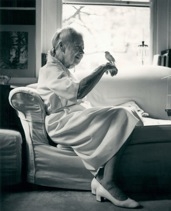
Elizabeth Clarkson with one of the birds she nursed back to health

Since the market wouldn’t support my original idea, I re-visioned the story.  The new book would be a fictionalized account of Mrs. Clarkson rehabilitating a baby robin. I created a young boy protagonist to make it a “boy book.” When I shared the idea with my son-in-law he scoffed, “Boys aren’t going to read a story about a bird! They want blood and guts!”

His off-the-cuff “critique” made me consider my audience. Maybe this was a girl story? I started playing with different ideas.

At that time, I met Joyce Hostetter and read BLUE. She repeated the advice that Carolyn Yoder gave her: “Look for the story in your own backyard.” Although I had moved to Charlotte, N.C. 22 years earlier, I began observing many instances of the same last name belonging to both blacks and whites. What was the connection?

As I looked at pictures of light-skinned African Americans and listened to local stories the seed of my story started to root.

Thad Tate was a prominent African American businessman from the 1890’s-1940’s. Picture courtesy of the Robinson-Spangler Carolina Room, Public Library of Charlotte and Mecklenburg County. I heard stories of his granddaughter passing.

Since I’m a transplanted Yankee writing a Southern story, I surfed the Internet hoping to figure out how my characters spoke “Southern.” The result was a disaster. A member of my SCBWI critique group, Miriam Franklin, read one of those first attempts and said, “No character in Myers Park talked like that!” Her critique was another wake-up call.  I didn’t know who my characters were or where they came from. Their diction should flow from characterization, not vice-versa.

My next significant critique intervention came from Harold Underdown, my critiquer  at the 2009 Highlights Writer’s Workshop. His most helpful question was simple, yet pivotal: “What does your character want?” I have repeatedly wrestled with that question, and have actually found not one–but layers of answers as I continued to write.

Carol Baldwin and Harold Underdown in Chautauqua, NY

I joyfully marked New Year 2011 by finishing my first draft. I read the entire manuscript and then buckled down to what I naively thought, was a chapter-by-chapter revision. I participated in Kidlit4Japan and won a critique from Ann Manheimer.  Among other helpful recommendations, she suggested that I didn’t open my story close enough to the inciting event. As a result, I revised the first five chapters.

Fast forward to September, 2011 and the SCBWI Carolinas conference. Mary Kate Castellani, an associate editor with Walker Books, read 10 pages and offered the biggest book-changing critique of all: since my story featured two main characters–one white and one black–I should write it from both girls’ points-of-view.

Total shock. Rewrite my entire book? Write as much from the black girl’s POV as the white girl’s? How could I, a white author, do that?

That is when I learned how a good critique enables you to re-vision your work.

I laid out my book using different colored note cards representing the alternating chapters. I suppose that means I’m a plotter; I had to visually see how to make the story work from both girls’ point-of-views. (picture of my dining room table)

The result? I’m thrilled that the finished product will be more accessible to a wider audience and am enjoying the new places my manuscript is taking me. But, my critiquing and re-vision hasn’t stopped.

My local SCBWI group reads each new chapter and provides helpful feedback.  I love their thoughts about my characters. “Kate wouldn’t act like that,” or, “Do you really think Lillie would say that?” Their comments make me see my characters through new eyes and help ensure that my characters are both consistent and original.

Revision happens on the small, microscopic level, as well as on the “big picture” level. Recently, to prepare an application for the SCBWI WIP grant, Joyce Hostetter went through my first ten pages and showed me how I could cut 400 words. Meanwhile, Rebecca Petruck looked at the big picture of these same pages and gave a cogent argument for opening the book with a different scene.  Re-vision time again!

Many years ago I created this graphic organizer “The Writing-Revising Cycle” for my book, Teaching the Story: Fiction Writing in Grades 4-8. Feel free to print out a copy and hang it near your workspace; it’s still a good reminder to me of the work I have ahead of me.