Posted in Uncategorized

Review: I DARE YOU NOT TO YAWN

I dare you not to love it. Okay, yes, that was a cheap play on the title of Hélène Boudreau and Serge Bloch’s picture book, I Dare You Not to Yawn, but it’s true. And I’m going to tell you why, or at least why I loved it.

But first, here’s your warning:

Basically, I can’t tell you why I like this book without telling you what I like. So here goes.

I’ve been wanting to read this book for a while, because I love the premise. We all know  how hard it is not to yawn once you get started, and we all know that–as Boudreau’s little hero says, “Yawns are like colds. They spread!” What I hadn’t thought about, but what Boudreau did, is that yawning could have a consequence. And the consequence she chose is what makes this book special, what makes it totally about and for children. (Okay, for me, too, but you know what I mean.)

If you yawn, AND HERE’S YOUR SPOILER, someone will decide that it’s your bedtime.  Ack! When this disaster strikes, the narrative and the illustration combine to capture the child we all know, the one that cannot believe what the adult world is handing him. Seriously?! One little yawn?! Beautiful.

And then…MORE SPOILERS! Boudreau amps up the story. She absolute rocks the concrete detail throughout the book, from the specific activities that a yawn can interrupt (“dressing up the cat”) to all the pieces that make up a single yawn (“your eyes squish tight”) to the steps along the path to lights-out time (“sleepy-time songs”).  And this is just in the first part of the book. In the second, she brings in an entirely new layer of tension: all the “threats” of bedtime become irresistible temptations: “huggable stuffed animals, soft cozy pajamas…”  So, while the little boy still doesn’t want to go to bed and still fights the yawns with all his power, we can see his resistance weakening and–as with only the best stories–we are right there with him every second.

And the ending…Ha! Got you. You thought, with all the spoilers I’ve included so far, I was going to tell you how things turn out. NOT. All I want to say is that Boudreau made the brilliant choice of letting the art carry the final moment. I am totally a word person, and the whole way through, I was thinking, how is she going to do this? What is she going to write to tie things up as neatly as she needs to. I am not usually a proponent of the 1 picture = 1,000 words theory, but in this case? Oh, yeah.

So, you know, despite all the things I did tell you about I Dare You Not to Yawn, there are so many more that I didn’t. So go out, get yourself a copy, and fall in love for yourself.
Posted in Uncategorized, Writing Books

The Writer’s Journey: Start Here

Have you read this book?


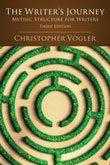
You might not recognize the cover. I didn’t at first, because it doesn’t match my copy. Of course, mine is only the second edition. This one’s the THIRD edition. Christopher Vogler’s The Writer’s Journey is like the energizer bunny–it keeps getting printed and printed and printed…

There are plenty of reasons why. First, Vogler has a lot of important things to say. His book is based on Joseph Campbell’s ideas about the hero’s journey, the common storyline in so many myths. Vogler does NOT, as some people seem to fear, advocate writing from a template, a formula. What he does instead is analyze the common elements of all stories, in a way that makes us recognize the patterns and layers we’re all struggling to find in our books and bring to the surface. I have a very specific criteria for a “good” writing book, that I find myself putting it down before I reach the end and rushing back to my story to get all the new ideas onto the page. The Writer’s Journey more than qualifies.

The other big reason is more practical. Basically, if you want to have a discussion about plot, or character, this is your starting point. As an editor, when I talked with a client about what their hero was doing, what the other characters were up to, I’d inevitably find myself talking about Vogler’s book. I’d suggest that, even before they looked at my critique, they should probably pick up a copy of The Writer’s Journey and read it through. This book is also the basis of so many brainstorming sessions I have with my critique groups, whenever we get deep into what our hero is (or isn’t!) doing.  Teachers in writing classes point to Vogler’s book, and The Writer’s Journey is referenced in more other writing books than I have time to count. You need to know what all these people are talking about.

I’ll admit that Vogler hasn’t solved the problem of the story middle for me. And, these days, I’m also pushing Les Edgerton’s book Hooked as a must-read companion to The Writer’s Journey.  Edgerton builds on Vogler’s ideas, and really hits on the kinds of beginnings we need to be writing today. Still, I find myself going back to Vogler’s book time and time again, when I’m stuck, when I’m trying to figure out WHO my hero is and needs to be, when I’m just trying to get a closer look at the layers of my story.

Whether you’re just starting on your writing path, or you’re already treading strongly along it, I recommend dropping this book into your traveling pack.