Posted in Picture Book Biographies, Picture Books

Picture Book Bios – Market Shift

Based on some comments from an agent or two, and things I’ve been hearing about a shift in the picture book biography market, I’m currently playing with a new version of my pb bio manuscript.

What I’m hearing is that agents & editors are not as interested in “cradle-to-grave” biographies–picture book bios that start their story at the subject’s birth or youth and continue through to their death or a relatively late post in their adult years. Some of these stories also have structures that can feel a bit more “this happened, then this happened,” as opposed to “because this happened, this happened.”

I’m noticing two types of bios replace the cradle-to-grave stories. Note: I’m not changing my manuscript simply because the market may be calling for it–I’m also seeing the additional power and child-engagement that these different styles can create.

One of the different styles is the story that starts later in the subject’s life, usually at the moment just before the inciting incident kicks off the big change/new direction of their life–the thing they did that the author really wants us to know about. After that point, the story tends to follow the familiar arc of the hero’s journey, but one that is built around the pursuit of this new direction.

The other type of bio I’ve found often starts at a more traditional point in the subject’s childhood. It may also follow the hero’s journey structure, although sometimes more loosely. The shift I see in these stories is that the scenes are all tightly structured around a theme–maybe a specific way the subject views the world, a skill set that directs their actions, or a passion that drives their choices.

As I’ve heard Kirsten Larson say–one common take-away of a PB bio, especially in a cradle-to-grave story, is persistence. I’m starting to see that these other types of biography can bring us closer to a more concrete kind of persistence–one particular to this individual. To me, a child reading these books has a better chance of recognizing themselves (Hey, maybe I could…) or of being drawn to something that makes them curious (What would happen if I…). With both kinds of stories, a young reader will still learn something about the subject, but I think they’ll also make a stronger personal connection with that subject. And connection is critical.

So these are the types of stories I’m looking for, and these are the types of books I picked up at my Indie Bookstore yesterday.
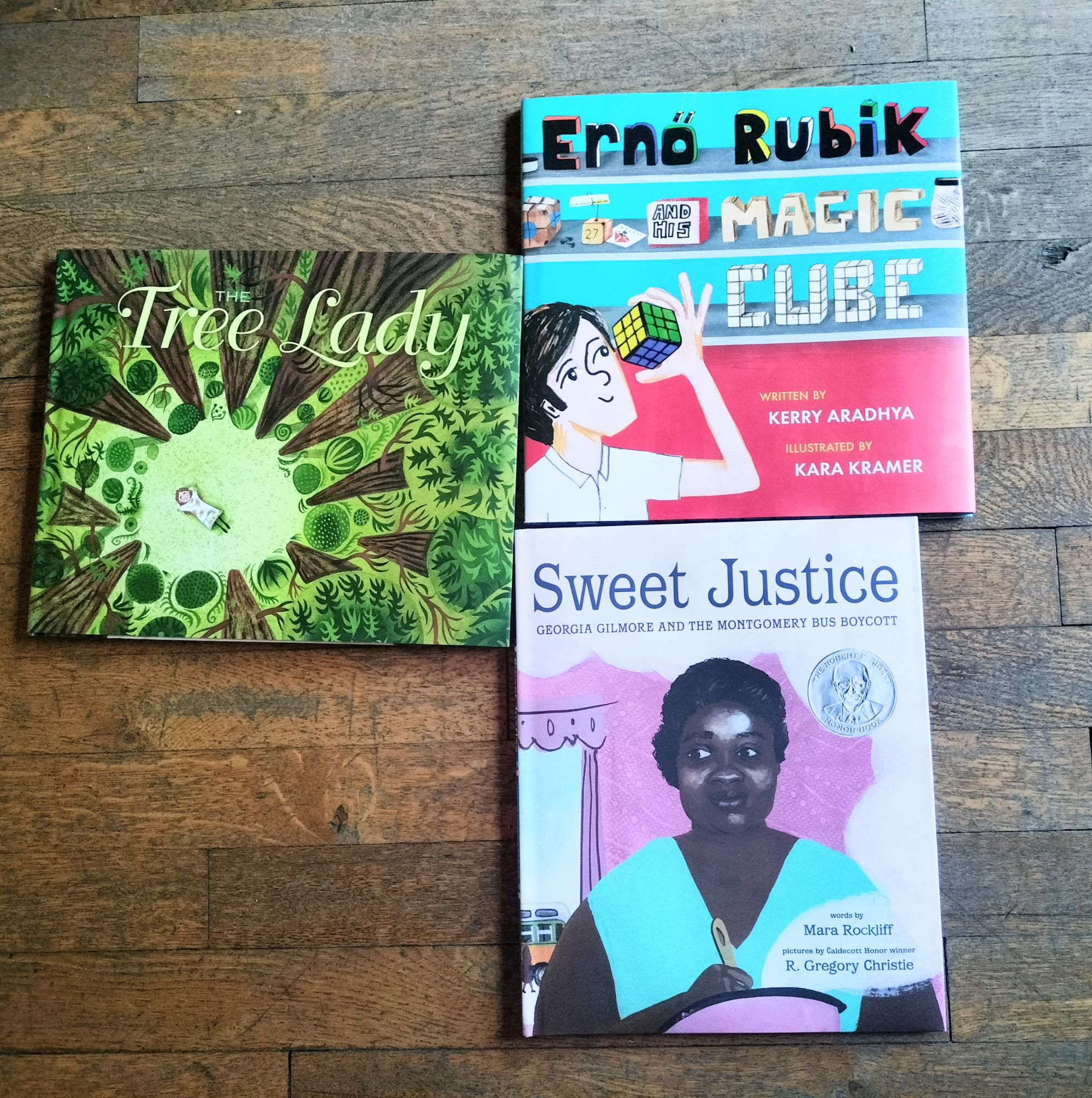
Sweet Justice: Gloria Gilmore and the Montgomery Boycott (written by Mara Rockliff; illustrated by R. Gregory Christie) fits the first type of new bio. Rather than start with Georgia Gilmore’s childhood, the story drops us in the very moment when she hears that Rosa Parks was arrested for not giving up her seat on a city bus. In the next scenes, we see Georgia stop riding the bus, participating in the growing boycott, and cooking & baking to raise funds. This is one of the most beautiful pb bios I’ve ever seen–both the wonderful writing and the absolutely gorgeous illustrations.

Both Ernö Rubik and his Magic Cube (written by Kerry Aradhya; illustrated by Kara Kramer) and The Tree Lady: The True Story of How One Tree-Loving Woman Changed a City Forever (written by H. Joseph Hopkins; illustrated by Jill McElmurry) begin in the subject’s childhood, but neither Ernö no Kate Sessions stay young for many pages. And pretty much every scene that moves the story forward connects tightly to a specific theme–for Ernö, that’s his love of puzzles; for Kate it’s her passion for trees and her use of science to find the right kind of trees to transform the then-desert of San Diego. I’m not saying we don’t get background and history of the protagonists, but the tight structure means even those passages support the theme. These are both very fun books that get us into the heads of a unique individual so we can feel what they’re doing and why.

I still have a big place in my heart for cradle-to-grave bios, and there are some amazing ones currently being published. But I know my love for this style is rooted in my own long-ago childhood, when these were the bios being published and the bios I read. Times have changed and one of the biggest and best changes is that we are now very clear we are writing our children’s stories for children. Bottom line: it’s because we care about those kids and want to give them books they will love, hopefully books that will contribute to them becoming life-long readers. And even if the reality is that grownups are the people buying the books, the kids are the people who will demand (or not!) that a book be read over and over and over again. And it’s that demand that grownups talk about with their friends and communities. Word of mouth sells books–which takes us right back to getting more good books into the hands of more children.
Posted in Book Review, Picture Book Biographies, Picture Books

PB Biographies – Game Changers: The Story of Venus and Serena Williams

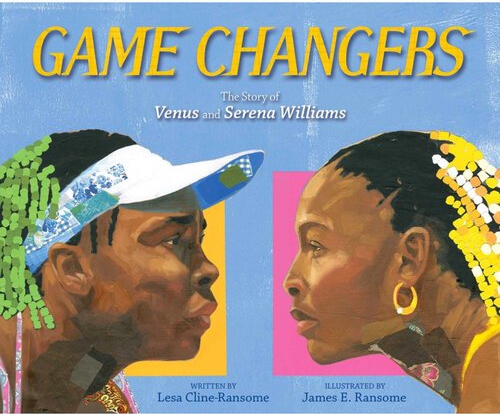
I added Lesa Cline-Ransome’s and James E. Ransome’s Game Changers: The Story of Venus and Serena Williams to my first bookstore orders of pb biographies, and I am so glad I did.

Picture book biographies of one person require the author to wander through mounds of research, sort out big stories and little stories, delve into personality, and find a way in that will engage a young reader and keep them engaged. And that’s true when you’re writing a biography of one person. I think the most amazing thing about Game Changers is the way Lesa Cline-Ransome weaves the complexities and layers of two amazing women into the book. She never drops down into over-simplification, but somehow integrates every element seamlessly into the forward-moving story.

If I had to say, in a few words, what this book is about, I’d say it’s about the love of Venus and Serena for the sport of tennis and the love Venus and Serena have for each other. Not only does Cline-Ransome achieve absolute balance between the two threads, but she manages to capture what I imagine is a truth of the Williams’ lives.

Serena and Venus Williams have shown their absolute commitment to playing their best possible game of tennis every time they step on a court. Simultaneously, each is dedicated to being their sister’s best friend and strongest supporter, even when they are standing on opposite sites of the net.

Cline-Ransome achieves the book’s balance by a sort of “take-turn” structure that, I think, intentionally mirrors the pace of two players warming up before a match. She spends a few words, a page or two, focusing in tightly on the tennis thread–the hard work that started when the women were young children, the determination with which they put in hour after hour on the court. Then she shifts to the way the sisters were constantly together, excluding their individual names from many pages and using instead the plural they. And throughout the book, she touches lightly but firmly on pieces of their story that are not easy and, often, not complimentary to the world of tennis.

The story builds with the women’s success, to a climax of three matches they played in 1998, 2000, and 2002. Venus beats Serena in the first match at the Australian open. They play doubles together in the 2000 Olympics and walked off the court with two gold medals. And in 2002, Serena beats Venus at the French open. Reading the pages feels like you’re in the stands, watching a three-set match, if an imaginary match in which the second set ends in deuce. A match where Cline-Ransome’s “ball” goes back and forth between the two woman as smoothly as one of their rallies.

Yes, I, too, can occasionally resort to sport metaphors.

At the very end (spoiler alert), Cline-Ransome brings the two loves–the loves of sport and sister–together in three incredible paragraphs.

…Venus served big for the second set and took the lead, but Serena broke serve and won. The second set was hard fought, and the sisters rallied with down-the-line combinations, skidding from sideline to baseline until the final match point, when Venus cracked the ball into the net and the moment belonged to Serena. In two sets of 7-5 and 6-3, a victorious Serena stepped out of the shadow of her sister.

Turn the page…

Venus ran off the court as the curious eyes of the crowd followed her. High into the stands Venus sprinted, snatched up her bag, and pulled out a camera.
Nothing can keep me from celebrating when my best friend wins a match,” Venus said proudly.

I closed this book with a sigh of utter satisfaction.

A note about the illustrations: I wish I knew enough to describe what
James E. Ransome has done with his art. Every page shines with beauty and energy and emotion. It’s hard for me to choose a favorite, but this one stunned me when I first saw it and continues to draw me back to look at it again and again.

Posted in Picture Book Biographies, Picture Books

PB Biographies: Evelyn the Adventurous Entomologist

I’ve been saying for a long time that, someday, I want to write picture book biographies. In a recent Duh! moment, I realized that isn’t going to happen until and unless I get serious about reading and dissecting them. So I’m starting a new series on my blog featuring picture book biographies and my thoughts about why and how they work. I’m starting the series with a book I love and that happens to be very handy, sitting right there on one of my picture book shelves. That book is Evelyn the Adventurous Entomologist: The True Story of a World-Traveling Bug Hunter, written by Christine Evans and illustrated by Yasmin Imamura.

Full disclosure, I met Christine at an SCBWI event and picked up her book to browse through it. I was already loving it when I came to these words,

Many years later, Evelyn applied to veterinary college. She longed to help sick animals.

And the next page:

However, it was the early 1900s. Women couldn’t vote. They rarely went to college. And they certainly weren’t allowed to be vets.

Then and there, I bought two copies–one for me and one for my mom. My mom also wanted to go to vet school and, in the 1950s, but was told by a school counselor that might not be possible. But vet schools had just started to admit women. My mom knew it wouldn’t be easy. But she “went anyway.”

Fifty years earlier, Evelyn Cheesman wasn’t able to vet school. But many, many other times she was told she couldn’t go somewhere, but–in a lovely repetition of phrase in Evans’ book–“…Evelyn went anyway.”

One of the things I love about this book is the way Evans doesn’t try to force the facts or her language. She uses “Evelyn went anyway” when it’s accurate–when Evelyn did go. In places where Evelyn was unable to pursue a specific dream, Evans shows us the other ways in which Evelyn persisted, pushed forward. In the book, Evelyn says yes to every opportunity and, when one isn’t presenting itself, she makes her own. She dives into everything she tries, making it her own with creativity, hard work, and–I think–a love of being in charge of her own world. By making clear the many bumps in Evelyn’s path, Evans shows us beautifully the ways in which Evelyn got past those bumps–sometimes walking around, sometimes climbing (literally), and sometimes pivoting in a new direction. But she never once stops moving forward.

Evans also does a fantastic job of weaving in the perfect amount of information about the time in which Evelyn lived. The focus is always on Evelyn–the things she chooses to do, the adventures she takes, the way she seems (to me) to always be on the lookout for something new she can learn, something new she can explore. But mixed into Evelyn’s story are bite-sized tidbits about Evelyn’s world. We don’t need this context to know that Evelyn was special, but the contrast of her actions with what she was supposed to do, allowed to do, highlights the power of her personality and the strength of her commitment to herself and her dreams.

A note about the illustrations: I really love the art in the book. The colors are all earth tones, evoking Evelyn’s love of the outdoors. Evelyn’s energy, focus, and action are brought out in every illustration of her. And somehow, as we see Evelyn across various ages, she is always Evelyn. Beautiful.

I would give this book to any child as an introduction to picture book biographies, but most especially to a child who sees the world in a slightly different way than those around them or to a child who needs to know that stubbornness can be a strength. I would also, of course, give this book to anyone (child or adult) who loves bugs.

Photo by Pixabay on Pexels.com