Posted in Book Review, Nonfiction, Picture Books, Uncategorized

Review: Just Right – Searching for the Goldilocks Planet

I have a bit of an infatuation with nonfiction picture books. Yes, I love them, but infatuation implies a sense of distance, of something out of reach. At this point, writing a nonfiction picture book feels out of my reach. In a good way–yes, someday I might write one–but for now I get to experience that feeling of awe on top of the admiration.

So I pick up nonfiction picture books here and there, let myself read and enjoy them, but I don’t buy a lot. I’m writing fiction, and I need mentor texts, so that’s usually where I spend my money.

Occasionally, though, I read a nonfiction picture book that is so incredibly well done, so gorgeous, that I need to own it. Just Right: Searching for the Goldilocks Planet, written by Curtis Manley and illustrated by Jessica Lanan, is one of these books. The writing and the art are amazing, conveying perfectly both the facts and the magic of space exploration.

Note: I apologize profusely to the author and artist for the way my phone wiggles the lines of texts and absolutely distorts the colors in the illustrations. Definitely go get your own copy so you can read and see this book for yourself. To get a much better understanding of how the story and art weave together and to see the actual physical beauty of the book, take a look at this trailer on Lanan’s website.

Manley’s writing is, like the book title, just right. He presents the information with clarity and the flow and pacing of a good story, bringing us on a journey from the discoveries of the past, to the understanding we have today, to the possibilities pf what we will learn in the future. He does a beautiful job of taking us far out into space–the definitions, the technology–then bringing us tightly back to how that all connects to Earth, to the work our scientists are doing, to how each one of us. His language ranges seamlessly from poetic to concrete and active.
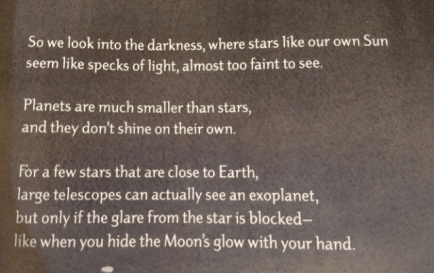
hand-text-use.png


Manley chooses to write with the second person you, and it’s wonderfully effective. After reading this page (and seeing the art below) children will run outside to put their hand up to the sun, see what happens for themselves, and let their mind roam out to the “specks of light” they’ll see in the sky that night.

Lanan has picked up on that you in her art with a beauty that, frankly, stunned me.  Here’s the illustration that accompanies the words above.

hand art brighter

Lanan’s illustrations show the story of this girl and her family on a visit to an exhibition on exoplanets, and–while we basically follow the whole family–the parents and young sibling quickly become ancillary to the girl’s experience. She is the child reader; she is who Manley is writing for. The rest of the family is interested in the exhibition; the girl is completely immersed. She explores pieces of the exhibition her family passes by; she lingers behind in rooms from which her parents are already moving on. Her fascination simultaneously leaps off the page and pulls us deeper into a connection with what she is feeling.
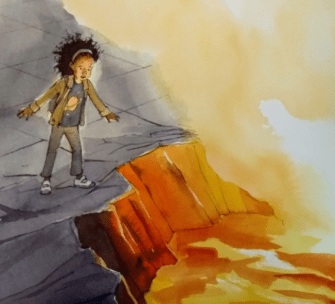
fascination

And whoever worked on the layout of the book got it “just right.” (Despite the way my phone is showing it below!)

left spread one more time

right spread really use

The words that fill the left page of this spread, which pull us out to the stars visible through only the most powerful telescopes, are balanced with the smaller chunk of text on the right–Manley even uses the words tiny and small to emphasize the comparison.  The art on the left side shows the vastness of space; the right focuses our attention on our own smallness and the immediacy of the impact this view has on the girl.

No spoilers about where this book takes you at the end, but I can tell you that I was on the edge of tears when I finished reading it for the first time.  This book needs to be in every family and in every classroom, and I hope whoever is reading it has the sense to do so outside with a clear view into the sky.
Posted in Books, History, Nonfiction, Science, Uncategorized, Women Writers

A List of Books I Couldn’t Find

Yesterday, I went book shopping. I went to one of my favorite stores, where they are wonderful and helpful and where I almost always find something I haven’t seen that looks like something I want to read. I was looking for a book to give as a gift.

But it’s not a big store, and they only have so much shelf space, and I was–for various rambling reasons (some about the giftee, some about me)–looking for a very specific type of book, one that met a list of requirements I had decided on.

Those requirements were:

1. The book had to at least look like it would be written well.

2. The book had to be nonfiction, preferably Science or History.

3. The book couldn’t be heavy or dark. One of the purposes of the gift was to serve as a distraction/escape from today’s heavy and dark.

4. If the book was a history book, it had to be about a woman or multiple women, and it had to be written by a woman. If it was a science book, it had to at least be written by a woman.

Guess which one was the stumper.

Were there history and science books about women?

Yes.

Were there history and science books by women?

Yes.

Were there history and science books about AND by women?

A few. And the ones I found didn’t meet the first three requirements. Was it a sign of the times that I got more and more frustrated at all the books I found about women that were written by men? Absolutely? Was it fair? In some ways yes; in some ways no–I had much less of a problem with finding books about men written by women (although there were a lot fewer, so…you know.) Do I think men should be able to write nonfiction about women and women should be able to write nonfiction about men. Sure. I can instantly give you examples of two excellent books that fall under that umbrella: ‘They say’: Ida B. Wells and the Reconstruction of Race by James West Davidson and Assassination Vacation by Sarah Vowell.

Still. None of this helped my frustration last night. So I did some browsing, and the giftee is going to Chrysalis: Maria Sibyalla Merian and the Secrets of Metamorphosis by Kim Todd. It’s going on my to-read list as well.

And I came across some other titles that, while I haven’t looked to see if they meet requirements 1 and 3; they do meet requirements 2 and 4. And I decided to post a list of these books, the ones I couldn’t find last night, to make me happy and–possibly–to help someone else on their search.

Science

Black Hole Blues and Other Songs from Outer Space* by Janna Levin

The Sixth Extinction: An Unnatural History* by Elizabeth Kolbert

Biomimicry: Innovation Inspired by Nature by Janine M. Benyus

Mapping the Heavens: The Radical Scientific Ideas that Reveal the Cosmos* by Priyamvada Natarajan

A Big Bang in a Little Room: The Quest to Create New Universesby Zeeya Merali

Venomous: How Earth’s Deadliest Creatures Mastered Biochemistry* by Christie Wilcox

Dark Matter and the Dinosaurs: The Astounding Interconnectedness of the Universeby Lisa Randall

Storm in a Teacup: The Physics of Everyday Lifeby Helen Czerski

Pandemic: Tracking Contagions: from Cholera to Ebola and Beyondby Sonia Shah

The Epigenetics Revolution: How Modern Biology is Rewriting Our Understanding of Genetics, Disease, and Inheritanceby Nessa Carey

Trespassing on Einstein’s Lawn: A Father, A Daughter, The Meaning of Nothing, and the Beginning of Everything by Amanda Gefter

*I found very few lists that included only women writers of science, so I want to give credit to the one excellent one I did find. These books are all from Swapna Krishna’s Bustle post, “9 Science Books Written by Women To Read When You Need A Break From Fiction.”


History

Hidden Figures by Margot Lee Shetterly  (The bookstore did have this, but I figured it was high odds the giftee would have already read it.)

Sisters in Law: How Sandra Day O’Connor and Ruth Bader Ginsberg Went to the Supreme Court and Changed the World by Linda Hirshman

Set the World on Fire: Black Nationalist Women and the Global Struggle for Freedom by Keisha N. Blain

Ada The Enchantress of Numbers: Prophet of the Computer Age by Betty A. Toole

The Witches: Suspicion, Betrayal, and Hysteria in 1692 Salem by Stacy Schiff

Flâneuse: Women Walk the City in Paris, New York, Tokyo, Venice, and London by Lauren Elkin

When Women Ruled the World: Six Queens of Egypt by Kara Cooney

Girl Sleuth: Nancy Drew and the Women Who Created Her by Melanie Rehak

Irish Nationalist Women: 1900-1918 by Senia Paseta

The Hemingses of Monticello: An American Family by Annette Gordon-Reid

Mother is a Verb: An Unconventional History by Sarah Knott

Posted in Book Review, Nonfiction, Picture Books, Uncategorized

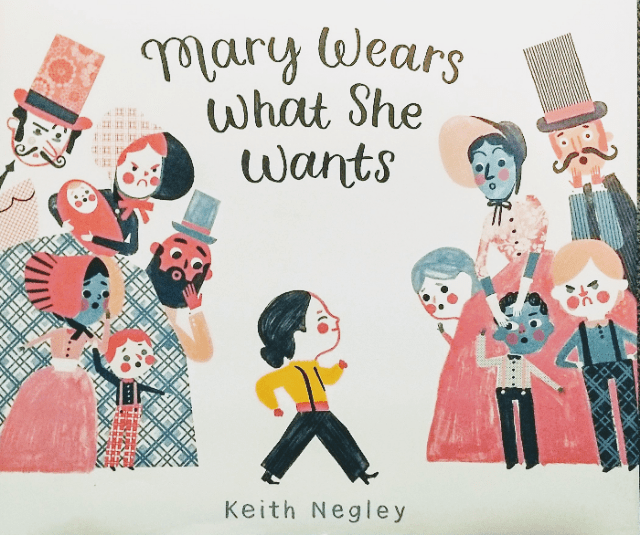
Keith Negley’s MARY WEARS WHAT SHE WANTS

I love good nonfiction picture books, but I don’t purchase a lot of them–I’m writing fiction, and so most of my book budget goes toward good examples of that genre. Every now and then, though, I come across a nonfiction book I can’t leave at the store.

Keith Negley’s Mary Wears What She Wants was one of those–telling, as it does, a snippet of the life of Mary Edwards Walker. The title caught my eye–because it focuses on the fact that Mary is doing what she wants to do, as opposed to the fact that she is wearing pants instead of dresses. As soon as I pulled the book off the shelves, the art caught and held me. Look at that cover–I loved Mary as soon as I saw it. She strides along, head held high, looking straight ahead & not giving the naysayers a speck of her attention. And you could pull me into a debate about her facial expression, but I think she’s wearing a very small smile of determination and freedom.

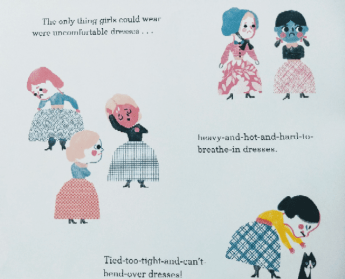
This book seems, to me, a wonderful example of words and art supporting each other. Negley is a writer-illustrator, so maybe it’s a bit easier to leave yourself room for art, but I’m guessing it’s just different. Still, however it is all working inside his head, Negley weaves together text and illustrations magically. Some places, he uses gorgeously concrete words with sparse illustrations, like this page early on, where Mary and other girls face all the problems that come with wearing a dress. (I apologize for what my phone camera does to the font–it’s nice and sharp in the book!)

Mary 3a

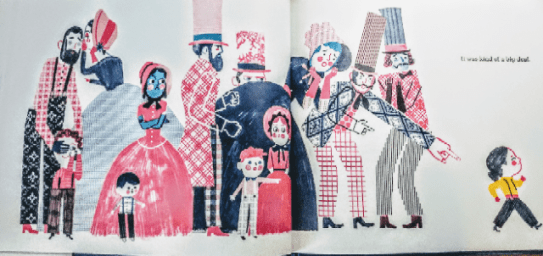
In other places, he flips the balance completely, filling a page or two with art and just a few words. The sentence on the spread below–“It was kind of a big deal.”–is essentially a mike drop (even though the story continues when you turn the page.)

mary 4

And the story has tension. Despite the look on Mary’s face–and the certainty she has about there being no reason she shouldn’t wear pants–Mary does worry and she is a bit afraid. Mary meets every obstacle head-on, with force and power. I think, though, that–as you read–it becomes clear Mary would be happier if she didn’t always have to be fighting.

Obviously, I think every child needs this book–no matter what gender they identify with, no matter if they are happy or not wearing the clothes people give them. It’s a book about crossing boundaries, opening eyes, and resetting “truths.” Mary Wears What She Wants sets as a standard the right to think for yourself and make your own choices. And shows a path for doing just that.


Posted in Educational Nonfiction, Nonfiction

Thankful Thursday: Yay for Experts

One of the things I’m getting better at as I get older is finding experts to help me along my way. Sometimes, as with my accountant, this means asking someone with a skill to do something I’m not only lousy at, but that I truly hate. At other times, it’s a matter of finding someone further along a path I actually want to go down, and getting some professional advice.

Which is what I did this month.

I’ve talked a few times about wanting to break into writing nonfiction educational books for kids. I’ve written some samples that I’m pretty happy with, but when I was getting ready to put a package together to submit, I started thinking. And what I thought was this

  • I think I can guess at how I might want to put this all together.
  • I’m pretty sure I can write a decent and basically professional cover letter.
  • I can take a stab at which samples I should submit.

And then I thought: Hey, I could get some help on this.

So I went to Mentors for Rent.

Laura Purdie Salas and Lisa Bullard have both been writing educational books for years, and they’ve started a new service where they are offering to help out us beginners…via Skype. Their prices are more than reasonable, especially when you consider you’re getting the benefit of two writers’ knowledge & experience.

I had some very specific things I wanted to accomplish, mostly around the best way to package what I have and who I am. We went back & forth a few times by email on how best to organize our time around my needs, and Laura & Lisa were more than helpful in working this out. I ended up sending them my whole package–including samples, cover letter, and resume. They spent half “our” time critiquing the pieces, then sent me back the critiques before our Skype meeting, so I could figure out what questions I had. Then we Skyped for the rest of the scheduled time.

How did it go? Beautifully. The critiques hit on some points that are really going to improve my package, and our Skype session helped me see the best way to present myself, to (hopefully!) move me and my submissions to the top of the editors’ slush piles, to show that I’m someone they definitely want to work with. Laura & Lisa helped me understand how “pushy” I can and probably should be, which is a tough point for me to get to. They talked to me about the industry and what editors are looking for and helped me realize that 1) I fit into that picture and that 2) It’s way more than okay to demonstrate that in my letter.

Was my session worth the time and money? Definitely! Laura and Lisa’s service is the perfect example of the right time to invest in productivity and efficiency, to take a “shortcut” around all that waffling we do on our own when we’re stepping into something new. Knowing I would be asking for their help got me moving to pull everything together, and getting that help brought me the focus to move forward with much more confident steps.

So, BIG thanks and an even bigger recommendation for Mentors for Rent!

Posted in Nonfiction, The Writing Path

A Little Snippet on Writing Nonfiction for Kids

News Flash: I am no expert in this genre. But it’s one I’m trying to stretch myself into, another curve I’m trying to include on my writing path. So you’re going to get bits & pieces about it here, as I work along and figure out the process.

The last few weeks I’ve been working on some samples to send out to one or more publishers, hoping what I write will click with someone there. To get started, I bought a few books of the type I’m trying to write, and I spent some time reading & analyzing, breaking down what kind of information they share and how they deliver it. Then I started writing.

I’ve got the first book nearly finished–I need to come back to it and do some last revision. This book was an animal one–fits into the science category for very young children. We’re talking a sentence or two a page–short sentences. With active verbs and strong words that, mostly, will fit into a young reader’s palette. Challenging. And fun.

The one I’m working on now is a biography, for older kids, which I have to say is my real love. This was the kind of nonfiction I devoured when I was young–the series biographies that opened a tiny window into another life, another time. The kind that had me tying grass on my father’s fruit trees to act out Luther Burbank’s grafting technique (Note that I did not become a biologist.) and “building” phonographs out of binder paper and scotch tape after reading about Thomas Edison (Note that I also did not become an engineer.). Anyway, I had recently read a wonderful grown-up biography of someone who felt like an ideal subject, and I’m now in the process of picking and choosing eentsy-weentsy, intriguing details from that book, ones that will show the big picture about this man to a young reader who, today, is a lot like I was then.

And I’m loving it.

The reading, the research, the weaving is so different from doing the same for fiction. Which, yes, I also love, but…I don’t find particularly relaxing. Researching for fiction seems to be a matter of looking for the information you already know you need–hoping it’ll fit into your plot and then, if it doesn’t, grappling with your plot again to make the reality and the story come together. Or looking and looking and not finding the details you need. Still.

With the nonfiction, I find myself reading in a more open kind of way, antennae out for the thing that makes me say, “Yes! That’ll get them!” The part of the story that is fascinating, that might tie up with something a young teen is already interested in, or that will intrigue them enough to start them thinking about something new. And then finding the word, the exactly right words, to share it with them. It feels a much more relaxed process, at least for me, more like finding the puzzle piece that really goes in that spot, less like trying to press one in that might very well belong somewhere else.

Relaxing. Some people, I know, find the constraints of word counts and vocabulary limiting and restrictive. And I can see that. I don’t know that I could do it full-time, without giving myself the room to go beyond them in my fiction. But…as another layer to my world of writing, I love this puzzle time. I guess it’s something like taking a cookie mold and a huge bowl of batter, pouring the batter into the mold and getting something like this.


With lines that clear and precise.

How about you? Is there one kind of writing that you do most of the time and another that you do less frequently? One that adds contrast and maybe, in some way, gives you a breather from the norm? Leave a comment and let us hear about it.

Posted in Nonfiction

Reading (and Writing) Nonfiction: Amy Butler Greenfield’s A PERFECT RED

Yesterday, I picked up a book I’ve been wanting to check out–Amy Butler Greenfield’s A Perfect Red: Empire, Espionage, and the Quest for the Color of Desire. I started reading, got hooked, and realized something about myself.

I now read nonfiction. For pleasure.

In the past year, between working on the nonfiction sections of The Writing & Critique Group Survival Guide and doing research for my historical YA, I seem to have undergone a transformation. I was someone who did notread nonfiction (other than memoir) by choice, who figured she’d untrained her brain by immersing herself so happily in four+ decades of novels. And then I was reading to find excerpts for my book and reading to learn more about settlement houses and the suffrage movement and…bam! I was changed.

I picked up Amy’s book for two reasons: 1)I know her from the blogs and love her posts and 2)I thought the subject sounded really interesting. In other words, I chose to read a nonfiction book that had nothing to do with my own work–just for fun.

Now, don’t get me wrong. I’m still VERY picky and get SERIOUSLY irritated with writers who drone on and on, giving me lists of dry facts and try to show me, in that long-winded academicy voice, that they’ve done their research and they are proving their thesis, so don’t argue with them, please. (Yes, pet peeve, sorry!) But I’m also finding out what makes good nonfiction, like Amy’s. Here’s what I’m seeing that makes me happy.

  • A goal for the book. No, the author doesn’t have to tell me that goal, any more than a novelist has to explain their purpose. But I’d better sense that the author had a REASON for writing this book, that they have a point to make–not just to educate me, but because they care so much about that point, find it so fascinating, that they HAVE to share.
  • A sense of conflict. In a how-to, this means that the author recognizes the problems their readers are facing; that they understand the push-pull tension of that problem and know how badly their readers want to find a solution. In history, this means finding the drama of the past, not just the information.
  • Concrete, specific details. Fiction writers struggle with summary versus scene, telling versus showing. In the nonfiction I was trying to read years ago, most of those authors lost that struggle. In good nonfiction, the author has picked just a few, perfect, strong details to pull you into their world, to make you part of it. In self-help, this may be with a well-chosen and well-drawn anecdote, or a skillfully created exercise that makes the reader feel as though that exercise is for them. For their problem. In history, this skill shows up when the author has waded through a gazillion pages of facts and pinpointed the few that will help them paint their own concise, sharp pictures.
  • The book has a hero and an antagonist. In a memoir, the hero is the author, and the antagonist may be another person, a big event in the author’s life, or the author themselves. In a how-to, the hero is the reader and the antagonist is the problem they face and need to solve. I’m only a few pages into Amy’s book, so I haven’t yet identified who’s who in the main cast, but I know they’re there. It’s too exciting a read for them not to be.
  • Tight prose. A good nonfiction writer gets me lost in their words; a bad nonfiction writer gets me lost in their sentences. I want to be drawn in. I don’t want to start a sentence and have to go back to the beginning three times to remind myself what/who the subject is and play dot-to-dot to connect it up with the rest of the phrases (often four, five, or six of them) that finally take me to the period. One of my husband’s teachers once marked his paper with this note: “This paragraph has no period.” A good nonfiction writer knows to trim, trim, trim.

Okay, you’re seeing the pattern. Nonfiction has to tell me a story, as much as any novel I will ever pick up. It has to make me want to turn each page, make me resist putting down the book at bedtime, and make me procrastinate all other tasks so I can keep reading. This is what I want to read. And, yes, the transformation is working more deeply than that–I’m wanting to write this kind of nonfiction as well. I already have an idea for a picture book about two real women who were amazing enough in their own right, that I have no wish (or need) to fictionalize them in any way. And I want to write that book up to the standards I’ve just set out, the ones Amy shows so well in her book.

I’ll leave you with a little tidbit from her introduction, just to give you the first taste that will make you want more.

It was big news, then, when Spain’s conquistadors found the Aztecs selling an extraordinary dyestuff in the great market-places of Mexico in 1519. Calling the dyestuff cochinilla, or cochineal, the conquistadors shipped it back to Europe, where it produced the brightest, strongest red the Old World had ever seen….

The history of this mad race for cochineal is a window onto another world–a world in which red was rare and precious, a source of wealth and power for those who knew its secrets. To obtain it, men sacked ships, turned spy, and courted death.

This is their story.

Adventure tale, anyone? Dig in!

Posted in Nonfiction, Voice

Voice in Nonfiction

As I was thinking about this post today, I realized I haven’t written that much specifically about nonfiction. Which is odd, since that’s the genre that’s taking up the bulk of my writing hours these days. Maybe I’m buried so deeply in it that I’m not thinking so much about it from the outside.

One thing that’s become extremely apparent to me as I write, though, is that voice is as critical (if not more) in nonfiction as in fiction.  You may not be shooting for the latest in “edginess” or a laugh-out-loud funniness, but you do have to make sure you’re capturing the reader and keeping them hooked.

Think about it this way. A writer of nonfiction, especially of a how-to or self-help book, is setting themselves up as a teacher. Now go back a bit in your memory to your school days–high school, college, grade school.

Think about the teachers with the boring voices. The monotone as they read from a text or recited a lecture from their notes. The voice that said they were up in the front of the room, yes, facing their students, but they could just as happily been talking to rows of empty desks. Got it? Visualizing it?

Okay–where did you want to be?

In a coffeehouse inhaling a big mug of caffeine. At home in bed, sleeping with your teddy bear. In Hawaii. Anywhere but in that classroom.

How much easier was it to stay awake and present for the teachers who were energetic, enthusiastic about their subject, and excited about sharing their take on it with you?

When you’re working on nonfiction, though, how do you achieve this goal? You’re not talking, you’re writing. You don’t have an audience to interact with; they’re all in your imagination. How do you translate your emotions and personality into printed pages?

I think you do it the same way you do it in fiction. Loosen up. Be more free with yourself, with your opinions, your values, and the perspective with which you approach your topic. No, don’t shove your way of doing things down your readers’ throats, as the onlyway, but make sure they know you believe in it. If you’re writing a book about caring for a pet, let your love of animals through. If your focus is accounting, put some energy into “speaking” as a knowledgeable and understanding expert, rather than as a pushy know-it-all.

Be yourself. No, don’t let all the grammar errors which we speak slide through, and don’t let yourself cross the line into gushing or scolding. But relax a bit, remember why you were excited about this project in the first place, and share that feeling with the reader.

They may still take off for Hawaii, but they’re a lot more likely to take the book along!