Posted in Book Review

Friday Five: What I Love about Linda Urban’s HOUND DOG TRUE

Quick note: If you’re interested in guest-blogging here about your critiquing experience, or your thoughts on critique groups, check out my earlier post here. It’s kind of like Wait Wait Don’t Tell Me…: You win for yourself AND another person. Okay, it’s not Carl Kasell’s voice on your answering machine, but it is a copy of The Writing & Critique Group Survival Guide!

And, now, on to the Friday Five!

Last week, I read Hound Dog True by Linda Urban.

And I’m telling you right now, if you want to read a book that is middle-grade fiction, go pick this one up. It hits all the marks–a wonderful, young hero who does not have the control/impact over her own life that a young-adult her would, but who still struggles to make the changes she needs to see happen. For today’s Friday Five, I’m doing a numbered “review” of all the things that really hit home for me about this story.

1. I love Uncle Potluck. First of all, how can you not be intrigued by someone called that, and Uncle Potluck lives up to all the humor you’d expect from hjis name. But, because Urban knows what she’s doing, he’s so much more than comic relief. He becomes Mattie’s shelter and safe place, one with just the right kind of support from which a person can push themselves out into the world to deal with things.

2. I love Mattie ‘s notebooks. So many of us writers use the convention of a journal or diary, and so many times it falls flat. Not here.  Along with, again, the humor of watching how Mattie records her janitorial notes, Urban gives us a full sense of the need and hope that Mattie gives those notes, that she gives the notebook itself. She writes these things down, because she believes they will give her a way out of a situation she dreads. From Mattie ‘s point of view, she has to get everything just right. And Urban makes us feel that desperation.

3. I love Quincy Sweet ‘s Aunt Crystal. Okay, I love Crystal, too, but it’s a Friday Five. Crystal isn’t very likeable as a person–she makes Quincy’s life too difficult for that, but, as a character? Oh, yes, I love her. Because she is exactly right. She is so absolutely different from her Quincey, and she is trying so hard to change that niece into something closer to herself. Yes,  she has good intentions; yes, it’s the only way she can see to be a good aunt, we still cringe and wince every single time she talks about the girl Quincy could be. Ouch.

4. I love the tin-can telephone through the ceiling. (If you want details, go read the book!). It is such a great carry-over from Mattie’s mom’s own childhood, something so perfect for her to try and bring into the “now” with her daughter. This telephone doesn’t work any better, technically, than the ones we all tried as kids, but the clunkiness and the continued attempts to make the connection more clear are just wonderful metaphors for the better place that Mattie and her mom are headed together. And it takes a lot for me to like a metaphor.

5. I love–and this is the big one–the way Urban so “gets” Mattie’s shyness. She absolutely understands the push-pull for the child who really, really wants to be part of “it,” whatever that it is that the other kids all belong to. It’s not a club, it’s not a social group–it’s just an ability to walk into a new situation, any situation, and have the right words, the right attitude. Oh, heck, the right anything. Mattie’s attempts to figure out words ahead of time, to picture what she might do when the time comes to do something, so resonated with me. As did the pain of all those plans, all that imagination, turning on Mattie, showing her instead all the things that she could possibly do wrong.

I was that kid. I recognized my child-self in Mattie, and I so wanted to reach out to both the character and to myself and distribute huge hugs. Hound Dog True is a wonderful story, but the real happiness I’m taking away with it is the thought of other kids, finding this book today, and not only seeing themselves in it, but also–more importantly–seeing the possibilities for hope and friendship that Mattie offers them.

Thank you, Linda.
Posted in Book Review

THE PENDERWICKS AT POINT MOUETTE: Problems That Do Matter

I just finished reading The Penderwicks at Point Mouette, by Jeanne Birdsall. I love all the Penderwick books–they take me back to reading Edward Eager’s books and Mary Nash’s Mrs. Coverlet books when I was young. They also make me think of Elizabeth Enright’s books, which I didn’t find until I was in my forties (thanks to Jen Robinson), but which have the same flavor. It’s partially the pleasure of nostalgia that makes me lose myself in Birdsall’s books, but it’s also more than that.

It’s the writing.

I have to say I think this latest book is my favorite. It’s kind of different, because the story opens with Rosalind getting ready to spend two summer weeks with a friend, separated from the rest of the family–who are all heading off to a little house in Maine. Rosalind isn’t really in the book, which is an absolutely necessary plot device to put Skye–my wonderful impatient, frustrated, girl-with-a-real-temper Skye–in charge as the OAP (Oldest Available Penderwick). A job she SO does not want.

I’m not going to go into a full review of the book–I recommend the whole series wholeheartedly, but I also think you could just pick up any one of them and fall in love, especially this one.

What I want to talk about is something I think Birdsall does especially well in the Point Mouette book–she writes a fun, charming, easy book…with stakes.

I have one of those books in a drawer–the ones we write & write on and revise & revise, then submit and, in the long run, get rejections for. I love this book, which is how I suspect most of us feel about our drawer books. But I also know what’s missing. You guessed it: stakes.

Several agents and editors were nice enough to explain that the book was perhaps too quiet, that they didn’t feel the things the characters went through mattered enough–not necessarily, I don’t think, that the events weren’t big enough, but that they weren’t getting the feel of how important these events were to the hero. As the book sits in the drawer, it also sits in the back of my mind, and every now and then–as I work on more current projects–I wonder about what it is I can and should do to revise–yet again–and amp things up for my hero.

I’m not going to get into spoilers, but Birdsall achieves just what I want and need to for my book. I don’t think anyone would call a Penderwick book heavy,–I think light is a much better and probably most often applied adjective. Light in a good way–that you smile a lot as you read her books, that you laugh out loud, that the story moves quickly (even with the nostalgic feel), and that it is a sheer, happy pleasure to be immersed in the stories.

And yet…Skye REALLY doesn’t want to be OAP. The humor around her taking on the job Rosalind has carried for five years is absolutely brilliant and wonderfully funny. Skye’s worries and fears also are woven in with humor, but at the same time, you GET why she doesn’t want this responsibility, and why it isn’t easy for her to handle. That’s real. The same with Batty’s missing Rosalind and the nighttime fears she doesn’t share with anyone except Hound, the family dog. Very sweet, very charming, and–again–very real. Batty doesn’t remember their mother; Rosalind has carried that role for as long as Batty knows. And it’s hard for her to be separated from her biggest sister. Truly hard. And we feel that. The scenes total maybe 5 or 10 pages in the entire book, but we feel what Batty’s feeling in every word.

And then the Big Thing. No, I’m not going to give away what the Big Thing is–I’m telling you, go read the books. The Big Thing doesn’t come along until very close to the end of the book (unless you’re a much smarter reader than me, which–in terms of plots & secrets–isn’t actually hard to be), but when it hits…BOOM. It is intense. And hard. And, once more, so absolutely real.

It matters. Suddenly all the light reality that has made us love these characters so much gets completely transformed into anxiety and heartache and hope. Yes, because it’s a huge deal and, yes, because the outcome could go either a good way or a bad way, but mostly, I think, because of the work Birdsall has done before. The realness she has woven into every scene, every moment, has created characters that we care about–that we sympathize and empathize with. With the perfect touch, never forgetting to charm us and make us smile, she has shown us that the things that happen in this world–small or big–matter to these people.

So, yeah, they matter to us.

Posted in Book Review, YA Historical Fiction Challenge

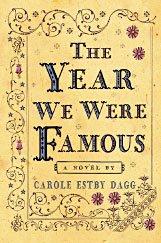
YA Historical Fiction Challenge: THE YEAR WE WERE FAMOUS

Let’s just start out with the basic statement: I loved this book.

I love the idea of two women walking cross-country from Washington to New York in 1896. I love the idea of their doing it with  no cooking utensils, plans to work for food and lodging along the way, and a bet that–if they do it–will win them $10,000 to save their farm, pay for college, and put the frosting on what may be the biggest adventure (exciting and miserable) of their lives.

I really love that it actually happened.

Okay, no, not exactly as Carole Estby Dagg has written it. The author is very clear in her notes about how much she does know about Helga and Clara (her great-grandmother and great-aunt) and what she doesn’t. Which is nice, because by the end of the book, that’s one thing I was definitely curious about.

What Dagg has done, though, and what I loved is to take the bones of a story that has obviously fascinated her for years and turned it into one that kept me reading through every page–every blister, every gully-washer, every gunshot, and every tedious (for the characters only) mile across the U.S.

In many ways, it’s just a great story told very well. Dagg uses the bet’s deadline to set up and sustain tension, as well as all the physical and emotional obstacles the two women face along the way. She explores the relationship between Helga and Clara, a relationship that only makes their trip more difficult, more challenging. She sets up a love-triangle for Clara, amazingly developed, when you figure that the two men involved never meet each other and are never physically involved in the journey for more than a few hours of time.

But what I really loved about this book was the journey. I mean, think about it. At one point in the story, Clara hits another woman with an accusation: “How many miles a day do you walk? Two miles, three?” It’s a wonderful moment, and the woman totally deserves the hit, but–hey–how many of us walk even that short distance unless it comes under the heading of Exercise?And Clara and Helga, as she says, have walked anywhere from twenty-five to fifty miles every day of their trip. In rain. In snow. In heat.

IN CORSETS.

No, I don’t want to go back, not for real. I don’t miss corsets. I don’t miss long skirts. I don’t miss working on a farm or chopping wood for a piece of bread and a cup of coffee.

Oh, I do love reading about it all, though. Especially when someone like Ms. Dagg does such a wonderful job of catching it all on the page for me–the humdrum and the amazing. The reality.