Over the weekend, I had a chance to really dig into my nonfiction project again. The deadline is coming up, and–yay!–the book is coming together. As I got into the flow, I remembered, once again, why I love this kind of work. Just a few of the reasons:
I love trivia. One of my favorite board games is Trivia Pursuit. Even when I moan and groan about the Science and Geography questions (okay, honestly, about ANY questions that aren’t about books), I love hearing the answers that I don’t know. There’s something about findout that that tiny detail of information that intrigues me. As I write this book, I get that same spark when I hit on a cool fact or tidbit in my research.
I like playing with words. On the first pass, I tend to overwrite–both on the amount of content and in terms of the reading level I’m using. That’s okay. Because I absolutely love fiddling around with my sentences to get rid of the excess material, make the wording more active, and smooth out the sentences into a simpler clarity. I’m not fond of the term wordsmithing, but it almost fits here. How about word-tuning instead?
This kind of work is about as close as I get to instant-gratification. I know there will be revisions. I’m absolutely positive my editor will have changes for me to make. Cool. BUT…as I work, I can see myself getting closer and closer to Good. My fiction projects are all just so…big. Big in length, big in concept, big in pretty much any kind of unit of measure you want to apply. Can you say….overwhelming? There’s always that sense of how much work I still have to do to see it all turn into something I’ve done well. My chapters in this book have 3-4 paragraphs. Those paragraphs have 3-4 sentences. Give me a few minutes, and I can take a rough draft of one of those paragraphs and make it sparkle! Talk about positive reinforcement.
I love my audience. I’m still not sure how much info I’m supposed to be sharing about this book’s subject matter, and, no, I’m not just trying to be mysterious! The main target audience, though, is kids who may not be the strongest readers, but who deserve to have a book with material they’re interested in, that’s presented to them in a way that makes them want to keep reading. How important is it to have books for these readers? And how cool is it that I get a chance to write one for them? Pretty much totally awesome-sauce.
It was definitely a weekend of happy writing. I hope you all had time for some of your own!
It’s been a chaotic couple of weeks. Husband is recovering well from his bike crash, and life is starting to return to normal. But with extra driving and not always getting enough sleep, the productive hours of my days have been a bit chopped up. Today, I’m at home with several uninterrupted hours for work, and the quiet and calm seem to be settling over me and waking me up in a happy way. Just a few minutes of solitary thought this morning, checking in at the Internet, and spending a little while with my current read–all this is stirring my imagination and getting me ready to work.
Things that have me thinking:
1. I have an empty house today. I love my family very, very much. And I love their company. But there is something about a quiet space that I know won’t be filled for a while that lets my brain expand. Which, ironically, is what will let me narrow my focus to my writing today.
2. Robin Brande posted on Facebook that her new book, Replay, is available FREE for Kindle today and tomorrow. Not only did this get my mind musing on what the new book is about (AWESOME opening lines: “I DIED. For forty-two seconds I died.”), but off I went thinking about how great it’ll be when I can actually read it ON my Kindle, which the guys know they’re getting me for my birthday in August. It’s a big birthday, which calls for a big gift. So I downloaded Robin’s book to my Kindle for PC account, but I think I’m going to save it for the summer and figure out how to get it from one Kindle account to another…another extra great birthday present. That’s assuming, of course, that I can wait that long!
3. I checked the movie times for The Lorax tonight, at our local theater. All three of us are huge Seuss fans, and this is a must-see. We’ve all been pretty zonked, so we may be joining the little-kid crowd at the early show tonight or tomorrow, but thinking about the movie makes me go back and remember the book and imagine forward about how the movie will be different–for better or worse. Either way, Seussalways gets me into creative mode.
4. I’m rereading a book I loved as a kid: Phyllis A. Whitney’s THE MYSTERY OF THE GULLS. I picked it up last night as a relaxing, no-stress, comfort read, and instantly I’m back in Taffy’s world, trying to help her mother save the old hotel while digging out the secret of the locked room. Who doesn’t want an island where cars can’t come, there’s a goblin wood at the top of the hill, and your bedroom has an extra little nook just perfect for a little desk and chair, just for you? So I’m back in my nook today, with my desk and chair, ready to put words on the page.
5. Time.
As I said, the past couple of weeks have been broken into a lot of little pieces. I’m pretty proud of myself for getting a lot of little things done with those pieces. But to really look at a project, to get the big picture, you need more than pieces…you need a long stretch of clarity. Today’s the day to look at my nonfiction project and start seeing what all is there, to get a sense of what I actually have and what I need to do. I’ve only been home for an hour after all the drop-offs, and I can feel my brain breathing more slowly, relaxing into the day. Which means good organizing and good writing. Hallelujah!
What’s got your imagination going this week? What helps you tune into your creative self, to relax and know that you will write, that you will be productive? Here’s hoping some of whatever that is comes your way today!
Just a quick check in and update on life over here. Last week was just a BIT crazy, what with the bike crash and all. I actually got a lot of work done by driving my husband into work then tucking myself into a spare cubicle there and opening up my laptop. Definitely more productive than I’d have been at home, where the bed would have called to me with offers of more sleep, and all my books would have been laying there just waiting to escape into.
The weekend was about recharging.
Today I’m working at home–lovely, and basically gathering up the threads that spent last week loosening and tangling. Little stuff, but pulling all the scattered feeling back into coherence and sanity and peace.
No, I don’t know if I’m using redux correctly, but it has a nice ring to it. It reflects the fact that, as I sit here getting ready to type, I feel like I already wrote this post. Probably because I did. Those of you who have read my blog since I was over at LiveJournal MAY remember about 5 years ago, I wrote about my husband crashing his bike.
Guess what happened this weekend.
Everything’s good. He’s got some broken ribs and a broken scapula, and I can tell you that getting him in and out of bed is NOT fun, but those are the small down-sides, believe me. The big gratitudes far outweight them.
Today, I am MORE than thankful that:
My husband is here.
My husband did not, this time, hit his head. If I leave you with one piece of advice today, it’s this: Skip the concussion. Seriously.
That the day he crashed was a sunny February day, so that other people were on that trail, who could call the paramedics and stay with him until he got off the hill and into the ambulance.
That Hedy Lamarr, yes, that Hedy Lamarr, invented and patented a frequency-hopping device that somehow (no, don’t ask me how) played into today’s cellphone, so that those people COULD get hold of the paramedics.
That we have a hospital in town with an ER full of wonderfully nice, helpful people who methodically take you through the steps of the process and check in with you and take care of you.
That morphine exists.
We have good health insurance. Yes, despite how I feel about the insurance industry and the “game” that is cost-negotiation, it’s an excellent thing to have.
That my marriage is so good and that I love my husband so much, that the fact that he’s here matters more than any of the stresses and inconveniences.
That my son is an incredibly mature, responsible, kind, supportive kid who gets what’s going on, helps out whenever and however he can, and pretty much takes care of me and his dad as much as we take care of him.
Congratulations to Joyce Moyer Hostetter, whose books I LOVE, for winning the giveaway at Carol Baldwin’s guest post. I’ll be sending Joyce a copy of my book, The Writing & Critique Group Survival Guide.
Carol Baldwin is the first in my monthly series of guest bloggers talking about critiquing. Carol’s most recent book is Teaching the Story: Fiction Writing in Grades 4-8 (Maupin House, 2008). She has coordinated an SCBWI critique group for over 15 years, blogs at www.carolbaldwinblog.blogspot.com, and is writing her first young adult novel. The three Gs in her life are gardening, grandchildren, and learning how to golf.
Read through Carol’s great post to see all the steps critiques can take you along. Take the time to leave a comment on the post. As with all the posts in this series, I’ll be picking one commenter to win a copy of my book, The Writing & Critique Group Survival Guide. Enter by Monday for a chance to win. Make sure you leave contact info in the comment, so I can get hold of you!
And…here’s Carol!
* * *
When someone asks why I decided to write about two girls in Charlotte in 1950—one white and another light-skinned black—I tell them it’s a long story. A story full of critiques, re-vision, and rewriting.
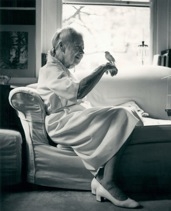
Half-Truths started as a picture book. About 15 years ago, I visited Wing Haven, a bird sanctuary in Myers Park, NC. The garden’s history is full of stories about animals which the founder, Mrs. Clarkson, rehabilitated. When I visited I thought, Someone should write a picture book about this place! I tried, but there were too many stories to fit into (what was then the acceptable) 2000 word limit.
Elizabeth Clarkson with one of the birds she nursed back to health
Since the market wouldn’t support my original idea, I re-visioned the story. The new book would be a fictionalized account of Mrs. Clarkson rehabilitating a baby robin. I created a young boy protagonist to make it a “boy book.” When I shared the idea with my son-in-law he scoffed, “Boys aren’t going to read a story about a bird! They want blood and guts!”
His off-the-cuff “critique” made me consider my audience. Maybe this was a girl story? I started playing with different ideas.
At that time, I met Joyce Hostetter and read BLUE. She repeated the advice that Carolyn Yoder gave her: “Look for the story in your own backyard.” Although I had moved to Charlotte, N.C. 22 years earlier, I began observing many instances of the same last name belonging to both blacks and whites. What was the connection?
As I looked at pictures of light-skinned African Americans and listened to local stories the seed of my story started to root.
Thad Tate was a prominent African American businessman from the 1890’s-1940’s. Picture courtesy of the Robinson-Spangler Carolina Room, Public Library of Charlotte and Mecklenburg County. I heard stories of his granddaughter passing.
Since I’m a transplanted Yankee writing a Southern story, I surfed the Internet hoping to figure out how my characters spoke “Southern.” The result was a disaster. A member of my SCBWI critique group, Miriam Franklin, read one of those first attempts and said, “No character in Myers Park talked like that!” Her critique was another wake-up call. I didn’t know who my characters were or where they came from. Their diction should flow from characterization, not vice-versa.
My next significant critique intervention came from Harold Underdown, my critiquer at the 2009 Highlights Writer’s Workshop. His most helpful question was simple, yet pivotal: “What does your character want?” I have repeatedly wrestled with that question, and have actually found not one–but layers of answers as I continued to write.
Carol Baldwin and Harold Underdown in Chautauqua, NY
I joyfully marked New Year 2011 by finishing my first draft. I read the entire manuscript and then buckled down to what I naively thought, was a chapter-by-chapter revision. I participated in Kidlit4Japan and won a critique from Ann Manheimer. Among other helpful recommendations, she suggested that I didn’t open my story close enough to the inciting event. As a result, I revised the first five chapters.
Fast forward to September, 2011 and the SCBWI Carolinas conference. Mary Kate Castellani, an associate editor with Walker Books, read 10 pages and offered the biggest book-changing critique of all: since my story featured two main characters–one white and one black–I should write it from both girls’ points-of-view.
Total shock. Rewrite my entire book? Write as much from the black girl’s POV as the white girl’s? How could I, a white author, do that?
That is when I learned how a good critique enables you to re-vision your work.
I laid out my book using different colored note cards representing the alternating chapters. I suppose that means I’m a plotter; I had to visually see how to make the story work from both girls’ point-of-views. (picture of my dining room table)
The result? I’m thrilled that the finished product will be more accessible to a wider audience and am enjoying the new places my manuscript is taking me. But, my critiquing and re-vision hasn’t stopped.
My local SCBWI group reads each new chapter and provides helpful feedback. I love their thoughts about my characters. “Kate wouldn’t act like that,” or, “Do you really think Lillie would say that?” Their comments make me see my characters through new eyes and help ensure that my characters are both consistent and original.
Revision happens on the small, microscopic level, as well as on the “big picture” level. Recently, to prepare an application for the SCBWI WIP grant, Joyce Hostetter went through my first ten pages and showed me how I could cut 400 words. Meanwhile, Rebecca Petruck looked at the big picture of these same pages and gave a cogent argument for opening the book with a different scene. Re-vision time again!
Last night, I dragged my son out of his vacation-lollygagging mode for a moment and gave him the (folded-up) names of the commenters on last week’s interview post with Kathryn Fitzmaurice. Despite the fact that the drumroll he was waiting for didn’t happen, he did choose a lucky winner.
ESTHER WANLISS…
Please send me an email at beckylevine at ymail dot com, with your snail-mail address. I’ll get Kathryn’s amazing new book, A Diamond in the Desert, out to you as soon as I can.
Boy, I had a whole different post written this morning, all about how I hadn’t made my goal of working through the antagonist’s worksheets inWriting the Breakout Novel Workbook. But then I got up early this morning, opened the second worksheet, and…bam! I still have one more worksheet to go in the character section–on combining characters (maybe I’ll finally figure out if I need the younger brother!), and then I’m done with character.
Yeah, right. Like we’re ever done with character.
But…Just to keep things moving, I’m going to do that last worksheet today. And to encourage myself, I’m designating this holiday Monday as part of the weekend, thus part of the week. Which means I will be ready to move onto the plot worksheets tomorrow. I’m SO ready for plot.
Um…again, Yeah, right. I’m not sure I’m ever ready for plot.
I’m sure I’ve whined talked before about how plot is my biggest challenge, about how I’m not particularly fond of plotting. And how much I need it, because I hate even more the feeling I get when I write without plot–like I’m wandering around in a fog, not knowing if there’s even a stepping stone anywhere around, let alone being able to tell which one I should walk on next. I like the stones laid out for me–it gives me the ability to fill in all the landscaping around them, decorate them with paint and stickers if I want, and–yes–throw some away and add some others. If I don’t have the stepping stones, it’s all just mud.
The worksheet I just finished told me to outline the antagonist’s story. Yeah. I did. Really. At least as well as I could. But it isn’t making me happy–not the outline I’ve got. It still feels nebulous and grey and blah. I’m going to let it go for now and hope that, as I work through the plot worksheets, I’ll see more of the picture and the details. And I WILL go back to that worksheet, as I get more concrete ideas, to make that storyline more solid and active.
The goal for this week, after today? It’s an easy one: Start on the plot worksheets!
Any goals for you this week? Any accomplishments you’d like a pat on the back for? Drop them into the comments below!
Before you read down to the Five, don’t forget to check out my interview with Kathryn Fitzmaurice on her wonderful new MG historical-fiction novel, A Diamond in the Desert. Leave a comment at that post to win a copy of the book!
And onto the revelations. Which aren’t necessarily HUGE revelations, but–you know–those small moments that come along as you think and write, the ones that make you say things like, “Oh!” and “Really?” and “Well, Duh!” But at least they come along.
1. Anger is so often fear externalized.
2. My MC’s mother may have been the youngest sibling in her family, not the oldest.
3. The opposite of the thing you want most can be pretty powerful in its own right. Maybe frighteningly powerful.
4. Finding pieces of yourself in a character can be shocking, informative, and–once more–frighteningly powerful. Phrase of the week?
5. Little things like a sudden car repair and a surprise afternoon of playing bocce ball in the bright sun can throw a wrench into your writing time. Happily, weekends are available to help you (still) hit those goals.
What did you learn about your WIP (and/or yourself!) this week?
You know those moments, when someone sends you a copy of their book, and you know you want to read it, but you’re thinking…what if? What if you don’t like it? What if it doesn’t grab you? What if it’s not your kind of book?
Believe me, all those bits of worry were a complete waste of time. A Diamond in the Desert is brilliant. I’ve been reading a LOT of historical fiction lately, and while much of the YA genre dispenses with most of the heavy detail and dense historical context that I’m not fond of, Kathryn goes beyond that. The book’s chapters are short, some less than a page, and the voice is light and tight, all at once. She has worked magic–created a world in which the hero is pretty much closing in on himself, with good reason, and pulling back from sharing his thoughts and feelings, and yet…it’s a world in which we fall in love with that character and his story. We know him by his reluctance to let us in. Believe me, this book will challenge all your ideas about what historical fiction is and excite you about what it can be.
And one of you will get challenged right away, because Kathryn’s book launches today, and I’m giving away a copy of A Diamond in the Desert to a commenter on this post. Just leave a comment by Monday, February 20th, and I’ll put your name in the hat. Make sure to leave contact info in the comment!
And now, read on, to see what Kathryn has to say.
BL: What made you decide to write about the Japanese internment camps and the baseball played there?
KF: The idea to write this story came when I visited my oldest son’s middle school National History Day competition. One of his friends, a girl, had built a model of the Zenimura baseball field as it sat outside the camp. I couldn’t stop looking at it. I asked her if I could interview her grandfather, who played outfield for the team. After that interview, I wanted to know everything I could about Gila River, so I contacted two other players and interviewed them, also. I thought I would write a short article about the big game, where they beat the Arizona state champions, because, honestly, the idea of a novel was overwhelming. There was so much I didn’t know, and I wasn’t Japanese. It took a long time before I came up with the courage to start writing the novel. Those months of researching everything and talking with Mr. Furukawa, who was the pitcher for the team, helped tremendously.
Mr. Tetsuo Furukawa, at age 13, after baseball practice in Gila River, Arizona
BL: Please describe your research process. Do you research and write at the same time? Is your research complete before you get to the revision stage?
KF: After I completed the interviews with the three gentlemen who were on the team, I visited the Laguna Niguel National Archives Building and asked them to order the Gila River newspaper so I could read it. Because I am not Japanese, I felt like I really needed to read all three and half years of the newspaper before writing even one word of the story. It was very intimidating to write about a culture I was not a part of. I was constantly calling Mr. Furukawa to ask him things. I would read about something in the newspaper, an event, (for example, the young girl almost drowning in the dirt canal), and call him to see if he remembered it and what it was like from his point of view. When I got through the newspapers on microfiche, I then bought many books about baseball in the 1940’s, and several about the war. I made a timeline for all three things, one for baseball, one for the war, and one for everything that had happened in Gila River that I wanted to write about. I put the most important events on sticky notes and taped them on the wall of my home office, so that the timeline stretched over four walls. I also taped up a map of the camp and photos of the main character. This took many months, but I felt like it was necessary in order to make me understand, as best as an outsider could, the time period. The only thing I really understood was the setting because I grew up outside of Phoenix. I knew the desert, I knew the way the sun looked when it set, the Gila monsters and snakes, the roadrunners. I knew how it felt to live in the climate. When I started writing the story, with each draft, I would send it to Mr. Furukawa and he would read it and make suggestions. When I was finished writing, I put everything in a folder, in order, so I could go back to it whenever I needed to see it.
BL: All of your chapters are short, many of them less than a page. I love the tightness of this structure, the feeling of scenes that are almost snapshots. Did you know right away you wanted to use this structure, or was it something you developed as you wrote and revised?
KF: This probably happened for two reasons. First, the events I was writing about were all on sticky notes, and so when I was writing, each thing felt, to me, as if it was done, as if there was nothing else to say about it. Also, the first draft was written in poems, with haiku chapter titles, but then when Jennifer Rofe (my agent) and I looked more closely at the entire manuscript, we decided this would not be what young boys would want to read, a book of poems about baseball, so I rewrote the whole manuscript into regular verse.
BL: Why did this structure feel right to you, for Tetsu’s story?
KF: I think, because I can only write from my own point of view, even after interviewing people and reading about what happened, I was not actually there, and so, writing in short snippets made it feel easier for me to understand.
BL: The history of the 1940s causes what happens to Tetsu, but you use few actual instances of outside-the-camp history in the book, and you don’t spend a lot of words on those you include. I’m thinking, for example, of Franklin Roosevelt’s death. For me, the sparseness of these “big” historical moments really brought home the camp’s isolation. How did you pick which historic events you wanted to let inside Tetsu’s immediate story?
KF: For the baseball events, I picked the ones that I thought would have mattered to a young boy who loved baseball, the World Series games, when a new baseball was invented that would travel farther, when Joe DiMaggio was drafted, things like that. For the war, I chose the things that were somehow related to the camp, Eleanor Roosevelt’s visit to the camp, what they did at the camp to celebrate the president’s birthday, things that affected them specifically. I also added a few major war events which were in the Gila River newspaper. I figured if the editors there wrote about them, they were important to the Japanese people at the camp, so I tried to include them in the story.
BL: Can you tell us a little bit about new projects you’re working on now?
KF: I just completed a contemporary fiction MG novel about a girl who tries to change her destiny. She’s named after a poet and is expected to become one, though she doesn’t like poetry at all. Molly O’Neill at HarperCollins is editing it. Our current title is Tied Up in Destiny, due out winter 2013, though that may change. I’ve started another contemporary fiction MG novel, only five pages in at the moment, which is changing everyday as I figure it out!
Thank you very much for interviewing me, Becky. I know you’re working on a YA historical fiction novel also!

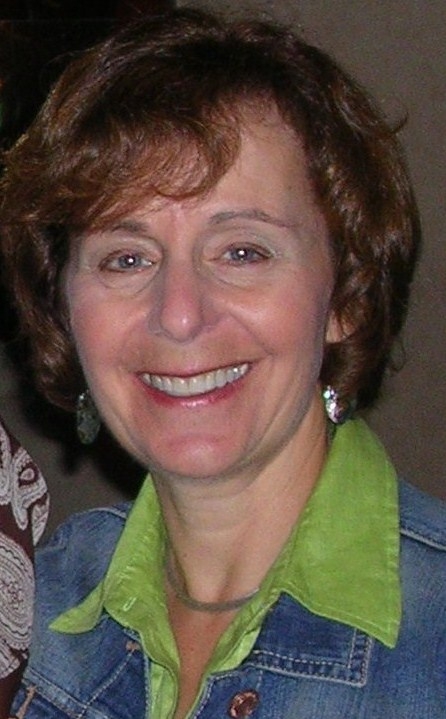





 Becky Levine