Posted in Antagonists, Conflict

Antagonists: What Have They Lost?

Okay, I admit, this feels like an odd post to be writing at the end of the year, with a new one and all its possibilities just around the corner. But I’m working on characters this week, and I’m spending quite a bit of time with my antagonists. All of whom, really, have their good sides. In fact, they’re all a little too nice at this point, and I’m digging for what they want so badly that it’s turning them against my MC.

And as I was thinking about one character’s particular want, I realized that this want–his deep, most real want–is impossible. He lost any chance of getting that want years ago–through no fault of his own. I know, storywise, that the path is not going to turn; it won’t be a surprise, happy ending for him. So…because without a goal, there is no plot, I needed to think of another want for him, less powerful maybe, but one that has filled in for the older need–one that still motivates his actions and choices in the story. A want that still makes problems for my MC.

It came to me pretty quickly. Okay, let’s face it, I was laying in bed not wanting to get up and character development is as good an excuse as any to stay warm and cozy.

The cool thing that I realized was that the new want hasn’t completely erased the old one. Oh, sure, the character is 99.9999% sure that he’ll get that old want. He knows it intellectually and at a gut level. But…he still wants it. If you said to him, what would you do to get X, he’d come up with a huge list of things he’d sacrifice. In a nano-second.

So what do you get with this character, then? You get a character who knows loss, and who will fight more strongly than ever to keep from losing more. I think  it’s this loss, this awareness of what they can’t have, that makes an antagonist so powerful in his battle. He can’t go back, can’t have that original want, but he will hold onto his “replacement” want with everything he’s got.

The character I was thinking about this morning, just to try and make things more clear, is my MC’s father. I don’t want to get too deeply into specifics, but his original want is the woman he fell in love with, his wife (the MC’s mother) as she was before something bad happened to her. He can’t have that woman–she is forever gone. She broke years ago, and she has changed permanently, but she has healed…some.  So his second want, the one he lives with now, is to keep safe the woman he does have, to stop anything from breaking her again.

Even if this means stopping his daughter.

What does this create? An antagonist in serious conflict with the hero. An antagonist who the reader will sympathize with (assuming I can actually write this!), and who will make big problems for the main character. An antagonist with power.

Take a look at your bad guy. What do they want, now, at this moment in the story. And then…what would they rather have? What have they, in essence, given up on, but still hold the tiniest bit of hope for? How many more sides do you see to this antagonist, when you add that extra piece?
Posted in Uncategorized

Winding Down at the Turning of the Year

New Year’s Day is still over a week away, but today is the solstice, and I am definitely in that gear that has me coasting gently downhill till the end of the month and year. This means that I am basically going with what the day brings, with little start-and-stop jerks as another box arrives to be opened, and I remember another small item to be wrapped. I played chauffeur for my son this morning, then ran a few errands that needed to be done before Xmas arrives. There are a few left, and I’ll fit them into the next two days. Husband did pick-up duties this evening, while I cleaned up from my meat-pie-cooking session this afternoon and swept bits of paper and ribbon off my desk.

All slow and easy.

If I were any good at geometry, I’d have the word to describe the arc of this pattern–the downward curve I’m on now, knowing that–unless you’re a delivery person or diving into stores for last-minute purchases–things are quiet and quietening all around me. When I look ahead along the arc, I know I’ll touch a happy bottom around New Years, then start the upward curve, with the momentum of this relaxation making the slope pretty easy to get up.

This year has been amazing, with all the (thankfully) usual good things compounded by writing my book and seeing it through the publishing process. Today, I heard from two friends that Amazon had shipped their copies–it’s heading out into the real world, and in January I’ll be seeing it on shelves in bookstores. Yes…amazing. It’s a bit like the gentle starts-and-stops of getting ready for Xmas–the excitement synapses just spark every now and then, catching me out of the cooking or the cleaning or the reading.

I’ve been looking at people’s photos on Facebook & Twitter of snow-covered hills and buildings. We don’t have that here; in fact, today was gray skies and drizzle that just left goopy leaf piles on the ground. Still, something about this season and this time of year brings the quiet I imagine from those photos. A quiet we all need, I think, to break patterns, shift gears, and get ready for the next year.

2010. Can you believe it? And can you even imagine what it might bring?

Posted in Uncategorized

Friday Five: My Holiday Weeks

School ends today for two weeks. Son is pretty much dancing with happiness, and I have to say–looking ahead at a pretty easy holiday, I’m enjoying the thought of some relaxing, too. Here are 5 things I’ll probably be doing in the next two weeks.

1. NOT setting the alarm. Sleeping till I wake up.

2. Going through my days relatively schedule free.

3. Making Tourtieres. This is the one recipe I inherited from my husband’s mother that I make. No there is no French-Canadian in my husband’s genetic line, but it comes via a favorite aunt-by-marriage, and it’s absolutely yummy comfort food.

4. Spending time with each of the characters in my YA, getting focused on the “I want” for each of them. I really want to start actually writing on this project in January, and I think this is the one big chunk of understanding I need to get closer to before I get back to scenes.

5. Reading, reading, reading. And, yes, reading.

For all of you who are celebrating holidays, taking time off, spending time with family and friends, NOT setting your alarms for a while, or just making any kind of pattern-shift in the next couple of weeks…enjoy!

Posted in Writing Fears

Some Thoughts on Fear

I just read two wonderful books of historical fiction:

The reading of both of these books was an absolute delight. The books move quickly, not weighed down by too much historical baggage, with the hero’s problems and needs always the main focus.  As a reader, I lost myself in both stories and found excuses to put off other work so I could keep reading and keep reading. And as a writer, I kept hearing myself in the background, saying, “Yes! This is what historical fiction should be. This is what I want to do with my story.”

Those were the ups.

The down, of course, was that other voice in the background, still mine, but the variant that isn’t so sure about things. And that voice was saying, “…if I can.”

It’s a big if.

I’m also reading Seven Steps on the Writer’s Path, by Nancy Pickard and Lynn Lott. My friend and critique partner Terri Thayer bought multiple copies of this book after hearing Nancy Pickard talk at a recent writers conferences. She wrapped them up and handed them around the table at our last meeting, because, she said, we all needed the book.

I think she’s right. So far, I’ve only read up to  Step 1, Unhappiness, which the authors identify as the stage before you get writing, when–in a not-so-bad case–you’re itching with unreleased creativity, or–in a pretty bad case, you’re depressed and curled up with misery. I don’t think I’m there right now, not full-blown, anyway, but I recognize the stage. Probably you all do. Because in this stage, whether you’re bursting with the need to write or stressing out that you might not be able to, there’s one common factor.

Fear.

These days, I’m feeling pretty good about my writing. In the “old days,” I typically had one idea at a time and, if that project was going poorly, I faced the big fear that this was all I would ever think of to write and I wouldn’t even be able to do that. For whatever reason these days, I have more ideas than I can juggle, wishing mostly for more time so I could get to all of them.

But…reading these two novels reminded me that the fear can still lurk. The fear that what I want to do with this historical fiction novel I’m working on, the story that I want to tell, may be beyond me.  I’ve looked pretty closely at this, and–honestly–I’m pretty sure this feeling is not jealousy. This is one way I’m lucky, I think–when someone creates a thing of beauty, especially out of words, it motivates and inspired ms, rather than making me feel like I should give up. Still, mixed into the pleasure and the awe is that other, less happy emotion.

I honestly know only one way of dealing with this feeling. And that is to look fully head on at the question I’m asking myself.

That question is: “What if I can’t write Caro’s story, not with the strength it deserves, the power I know a book can have? What if I am not a good enough writer?”

I don’t know the answer to that question. Perhaps that’s a good thing. 🙂 

What I do know is this: If I stop trying, if I give up, then, no, I won’t be able to write the book. If I quit, then I drop any chance of success that I might hope for.

Pickard and Lott talk about not hiding from the unhappiness; they say the only way to get through it is to recognize and speak it. I would add that there may or may not be a way to get past the fear, but there is a way not to let it beat us. And that is to choose the option of hope. Possibility. The maybe I can. To keep writing.

And, of course, to keep reading. To remind ourselves why we do this, what we are striving for.  Thanks, Joyce. Thanks, Laurie.

Posted in Blog Contest, Blogging, Blogs, Marketing, Promotion, The Writing & Critique Group Survival Guide

Marketing Monday: Setting Up a Blog Tour & Adding a New Blog Feature

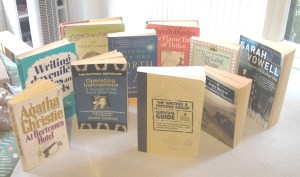
Before I get down to business today, I want to show you a few of my favorite books.

Wait, what’s that one out in front? Is it…? It is! Yes, two copies of The Writing & Critique Group Survival Guide showed up at my house this weekend. Did I mind the rain and gray skies? Not after that delivery, I didn’t!

Okay, so if the book is here, this means I should get back to my marketing to-do list and get some things checked off. The book is due out January 15th, but I’ll have some copies before then that I can, and want to, use for marketing. I’d like to set up a blog tour for January…with giveaways! I’m keeping this simple, just hoping to visit a few blogs and let people know about my book, share some thoughts about critiquing and critique groups. If you’d like your blog to be a stop on the tour, I’d love to come by. I think interviews are fun, because I can talk about what you and your blog readers want to hear, but I can also do a guest post if that’s easier for you.

If you’d like to host me at your blog, please send me an email at beckylevine@ymail.com

The other thing I’m looking to do is add a new, probably monthly, feature to my blog in 2010. I’d like to host you, if you’ve got a story about a critique group or experience to share. (Obviously, I don’t want posts that are just rants or vents, but I’m definitely open to learning-experience stories as well as the more positive kind!) And if you’ve got a book out or coming out that you’d like to promote, I’ll include pictures and links to let people know about it. You can also donate a copy of an ARC or published book, if you’d like me to run a contest.

Again, if you’d like to guest blog here with your critique story, please email me at beckylevine@ymail.com

Next post, back to our regular, random programming.

Posted in Book in a Week, First Drafts, NaNoWriMo, Revising

Let’s Talk about 1st Drafts: A (Hopefully) Gentle Post-Nano Pep Talk

A week or so ago, I blogged about progress–thinking about what people would be feeling as they came to the end of NaNo. Now that NaNo is over & authors everywhere are actually looking over what they did produce in November, I’m feeling the need to talk about things a little bit more. Actually, this post is prompted in part by the disappointment an online friend was (hopefully, not is, anymore) feeling about her 1st draft. So this may turn into a bit of a rant.

Qualifier: I very much like the idea of NaNo. I did a variant in Book in a Week a few years ago, and I was thrilled with the results–with where that week got me, in terms of understanding my story and in terms of having actual material to move forward with.

Note that I did not say I was thrilled with the draft.

That first draft was–well, let’s just call it an Anne Lamott-approved 1st draft. I sat down to read it after the week, and started scribbling notes and thoughts, and then I stopped reading. Because it was just that bad.

I did not stop revising. By maybe 1/3 of the way through, I’d seen that my hero was being a totally passive observer, letting his sidekick drive the choices and actions of the story. I didn’t have to read the whole manuscript to find out whether he continued that way; I knew he did. And I knew that, before I could do any other revising, I had to tackle this major problem.

So I wrote a second draft, in which I pushed that hero to the front. I made the story goals his goals, and I threw the obstacles in his path. Did I work on other, smaller issues as I went through all the chapters? Of course, I did–I’m human! But that was the revision focus. And when I finished that draft, I had something I thought I could work with. Something I thought I could pass through my critique group without too much humiliation and embarrassment.

What’s my point? That first draft–whether you wrote it in a week or a month–is supposed to be bad. REALLY bad. How could it be otherwise? Unless you have the brain of, I don’t know…Stephen Hawking? Albert Einstein? William Shakespeare? ______________ ? (Fill in the blank with the name of any famous author you’ve heard say they DO write a beautiful first draft!), you cannot write a manuscript that fast and THINK about it at the same time. Yes, I know, you did think. So did I during the Book in a Week process. But I thought for seconds and minutes. I did not think for hours, because I had none of those to spare. And neither did you.

What do you have, from your NaNo work? Do you have crap? If you answer anywhere near “Yes,” I want you to step away from the computer, give yourself a hug and some chocolate, and do the happy dance. Because you’re supposed to have crap. And you got it in a month–many of us take a YEAR (or more) to reach that point! You get to start turning that horrible stuff into something better 11 months ahead of schedule. Are you on Twitter? Did you see all the tweets from agents and editors, in varying degrees of tact, asking you NOT to query them about this manuscript on December 1st? The fact that you recognize how bad your first draft is proves you have the skill level and the knowledge of the craft to see that.

Okay, rant finished. But seriously, if you’re feeling disappointed or discouraged or–please, no–like you’ve failed in any way, well, just don’t!  Is there something you particularly hate about the story so far? Wonderful! Take that element and fix it. Figure out what you hate about it, why it makes you want to take the whole manuscript and use it to heat the wood-burning stove this winter, and revise around that problem. Save the AL-approved 1st draft, if you want to reassure yourself that you’re not losing any treasures (but really so you can show yourself how much BETTER that next draft is–and the next, and the next…).

I love NaNo and BIAW. I love the idea of tackling this big a project in such a short time, of riding an adrenalin wave, of producing more words and ideas than you ever thought possible. I browsed through NaNo’s website before writing this blog, and that’s really what the month is supposed to be about. I do not like all the bad feelings that come to some NaNo writers when the adrenalin leaves, and the crash comes. No matter how bad those words look on the page, you have achieved something wonderful.

Let yourself believe that.

Posted in Character, Plot, Uncategorized

Making Connections, Deepening Story

When I went away to college many, many years ago, I moved about 5 hours away from home. Not far, probably, compared to some of you, but for the shy kid I was, it was a good distance. It meant that coming home for weekends was not a given, and it meant one miserable trip that involved a city bus to a greyhound bus to another greyhound bus that made 1.32 gazillion stops (I counted!) in Los Angeles and many hours beyond that. And the return trip.

Which is why I was more than grateful that I knew someone at the school from my hometown, someone with whom I could grab an occasional ride up the state.

She was a friend of my older sister’s. She was two years older than I was and, I’d bet, pretty darned close to as shy as me. She drove a car I fell in love with–a 1960-something Mercedes Benz with seats out of a Pullman car and a steering wheel that, if you held onto it 10 & 2, you got a nice yoga stretch.  Anyway, this friend would call me up if she was going home & offer the passenger seat, and I would check with her at holidays to see if she was heading home.

Why am I going on about this? Because this was not just someone I knew, a college-mate I’d met and developed my own, one-to-one relationship with. This was my sister’s friend, the daughter of neighbors that (probably) brought one of their pets to my parents’ veterinary clinic. She was the middle sister, like me, with an older brother we all had crushes on, and a younger sister, as well. If you drew lines between all the people we both connected to, it would look like a spider web of interlacing strands. And, frankly, it was these connections that made it possible for the seriously-shy me to accept (and ask for) rides from this woman and for her to offer. We knew we had something, at least, to talk about for those hours driving along the Pacific Ocean. The connections added layers to our interactions.

Just like in a novel.

I just solved a plot problem tonight. I knew what my MC should do next, but I could see it taking her down a path that would be a problem later. Not a problem for her, but a problem for the story–this one action was going to make her step in and out of just one too many opportunities, with the bouncing out making her feel like a quitter. Which she is not. This has been a stumbling block for me every time I looked down the line at upcoming scenes. Tonight, I worked it out. If the opportunity I set up for has a connection to the next opportunity, a connection with the people involved, then she doesn’t have to quit. Instead, she’ll move forward on that path.

To be more specific, I gave one character another role–which gives that character another link to my hero. Instead of two separate people with whom my hero has to interact, on totally different planes, she now has a single person with whom she interacts on two levels. Deeper. Stronger.

When you’re working with your plot and thinking about paths for your hero, look at who’s hanging around on that path. Are they isolated from each other, or connected? Take two characters who do know each other–who else can you bring into the mix? As you connect, as you braid more lines together, what overlap do you see between worlds? What extra ripples does someone’s action start…in how many ponds? Who opens up to whom and who tells takes on who else? How much more interesting does your story become?

Try mixing things up and take a look. I predict you’ll be pleasantly surprised! 🙂

Posted in Blogs

Friday Five: Taking a Look around the Blogiverse

I feel like I’ve been doing a lot of navel-staring the last few weeks, like I’ve been a little too wrapped up in ME.  But I do love touching base with a Friday Five. So this Friday, I’m going to point you to a few other people…enjoy!

1. Start at Susan Taylor Brown’s blog. All this month, she’s posting about 31 Blogs (You Might Not Know) to highlight blogs she enjoys that may have flown under our radar. Just a nice tidbit every day, but she’s bringing lots of wondering bloggers to my attention. Susan’s posts this month and her generosity at her blog are actually my inspiration for stepping back from the mirror today–thanks, Susan!

2. Martha Alderson is The Plot Whisperer. Last year, she filled December with wonderful posts about what to do about revising the novel you “finished” during NaNo. She’s back this year with the 2nd Annual International Plot Writing Month. Posts start here.

3. You know them as The Shrinking Violets, rescuers of all introverts. Who are they behind their superhero masks & capes? Robin LaFevers and Mary Hershey, wonderful writers and bloggers. For intensive writing advice and wonderful motivation, check out Robin’s and Mary’s individual blogs.

4. Do you want to learn about the publishing industry–about what’s happening today and what may very well be happening tomorrow? Jane Friedman is publisher and editorial director of the Writer’s Digest brand community. She has two blogs (maybe more!) at There Are No Rules and Publishing Passion. Jane has strong opinions and ideas about what publishing is doing and what it should be thinking about. You may or may not agree with all she says, but she is on top of everything that’s happening today, and she does a brilliant job of sharing all her knowledge and experience with those of us struggling to figure it all out. Her posts are not to be missed.

1. If you’re a kids or YA writer, you already know Jen Robinson. And if you don’t, well, you just head over and introduce yourself to her blog now. What if you don’t write for kids and teens? Well, Are you an adult who’s been hearing about this surge in YA lit and wondering where to get started? Do you have any kids in your life who love reading, or who are struggling to find that love? Do you have a list of young ones and teens on your holiday-gift list? Do you care about literacy, about promoting reading for all ages? Jen is a passionate advocate for literacy, for bringing books into children’s lives, and for continuing to read “young” books into our adult years. She knows more about kids/YA books than anyone I know, and that’s saying a lot. Her generosity of time and energy are epic. Get her blog into your blog reader now.

There. Now you have more links to add to your already busy lives. 🙂  Happy friday & happy reading!

Posted in Historical Fiction, History

Historical Fiction: Keeping the Background from Taking Over the Foreground

I just thought of two historical novels I need to go back and reread, and they’re both by Rita Mae Brown. The first is High Hearts–a Civil War Novel, and the second is Dolley–novel about Dolley Madison. I read both these books while I was living in Charlottesville, Virginia, and both–especially High Hearts–blew me away. This was decades before I ever thought I’d be writing historical fiction myself.

And now here I am, thinking about how I want to play with/work with this genre and guessing that if I want to see some of the best possible example of how to do it right, I should open these books again. (Oh, darn. Such a chore!)

Because guess what I remember about those books? The stories.

Not the history.

Yes, of course, I read about battles in High Hearts, and I “saw” the White House burn in Dolley. Real people walked through all the pages of Dolley, and there is one scene from High Hearts that I feel pretty sure was based on a true event, because I’m not sure anyone, even Brown, could imagine that horror. (No spoilers, go read the books!)
 
Overall, though, I’m pretty sure (it’s been a couple of decades since I turned those pages) Brown placed the history of the time into the background of the books. The wars and the government officials and the soldiers and the ladies are part of the setting. And, in a way, they all weave together to create a single character you could just call Era. Or The Times. Of course those elements interact with the primary characters, of course they affect the plot. But they are not the story. The story is what Brown’s main characters–one fiction and one fictionalized–do.
 
I’m reminding myself of this as I plot. I’m focusing on my hero again, looking at her actions and her problems. I’m not shedding all the history she moves through, but I’m trying to think of her as an individual. Yes, some of her conflict is because of the times in which she lives, but it’s important that I could pick her up from those times and put her down in some other, and she’d still be who she is, down in her bones.
 
Luckily, I still have High Hearts on the shelf. Time to get another copy of Dolley. And time for you guys, whether or not you’re writing historical fiction, to check out both novels for yourself!
Posted in Character, Heroes, Plot, Scenes

What Would Caro Do?

Today, I will get closer to Caro, the hero of my YA WIP.

Well, that’s the plan.

I’m still plotting into the middle. I’d say “through” the middle, but not yet feeling that optimistic. And I’m realizing that part of the problem I’m having with the current mish-mash of scenes is that I haven’t honed in enough on my hero’s active goal. I know her emotional goals, but those don’t really drive her choices and actions–not with her knowledge, anyway. When I was plotting my mystery, I could always ask, “What would my hero do to…solve the mystery?” (And then, of course, I’d ask, what someone else could do to PREVENT his solving it!). That MC had a very concrete, active goal to work toward.

I am not going to sit and stare at my computer or out the window until I come up with the equivalent, active goal for Caro. Because, yes, I could do that until the cows came home and, frankly, had a good laugh at my expense. Instead, I’m going to take it scene by scene for a while. And I’ll look at these elements:

  • What did Caro do in the previous scene or few scenes?
  • What were the consequences of those recent actions?
  • How does she feel about what she did and about what happened?
  • Who did she set up a conflict with?
  • What other character has a strong goal at this time?
  • What story element have I not dealt with in, perhaps, too long?

And out of that, I’m going to give myself a kinder, gentler question to answer.  That question will be, “What would Caro do to…solve some problem.”

This problem may not be the one she actually needs to work on at the time. It may turn out to be a problem that, in the end, I (and Caro) decide to throw away completely. It almost certainly won’t, yet, be the problem that is her equivalent of solving a mystery.  Hopefully, though, it’ll be a problem that lets Caro and I move her plot forward and grow a deeper understanding of what it is she truly wants.

What does YOUR hero want? And what step could she (possibly!) take today to achieve that goal?