Posted in The Writing Path

Courage

It seems like, lately, I’ve been having a lot of conversations with writers–online and off–about how to deal with all the unknowns of this writing thing. In particular, Mary-Francis Makichen’s blog post “You Can’t Win if You Don’t Play” really caught me.

What unknowns am I talking about?

  • Whether your story idea is any good
  • Whether you can turn this story idea into a FINISHED book
  • If you’re even working on the right project
  • Whether that book will be good enough to get an agent or editor
  • Whether, even if that book is good enough, it will find a home
  • How long you should keep querying (see Jessica Faust’s post on this topic)

I could go on. I do believe that it isn’t only pre-published authors who deal with these questions. Yes, maybe, the belief in possibilities comes a little easier once you’ve done it before, but I don’t think it completely wipes out the worry.

You hear all sorts of ideas/opinions about how to get through or around these worries, how to keep writing despite them. Determination. Education. BIC. I’d like to add a new word to the pot.

Courage.

Yeah, I know, in some ways we have it good. We are doing something we love, playing with words, fashioning something new out of the ones we put on the page. I’m lucky–I get to spend the bulk of my day’s hours in this pursuit, sometimes in pajamas, sometimes on the couch. And, even when it’s exasperating and frustrating and confusing, there really isn’t anything else I’d pick. I think most writers feel this way.

This doesn’t mean it’s easy. One of the hardest things about writing is NOT having short-term positive feedback. Sometimes, we don’t even have long-term feedback.

It’s kind of like when Wile E. Coyote runs off the cliff. Except we’re not clueless like Wile. We actually know the cliff is there. We hope that when we step off, we’ll keep going, maybe even climb higher into the sky, but we know there’s a real risk this won’t happen. Yet we keep running.

This takes courage.

So, for today, pat yourself on the back and give yourself a treat. An extra piece of chocolate, a hot cup of tea, a new book. And then take a breath of bravery and get back to work. 🙂
Posted in Promotion, Somebody Else Says, The Writing Path, Uncategorized, Writing Fears

Somebody Else Says: Jo Knowles & Bubble Stampede

Two seemingly very different posts to link you to today. I think, though, that they’re actually pretty strongly connected by being BIG parts of the writing path.

Jo Knowles is a wonderful YA writer. Her Lessons from a Dead Girl is incredible, and Jumping off Swings (Due this August) is high on my to-read list. In her most recent blog post, she talks about how hard it can be to get seriously constructive feedback on your writing and how wonderful it is to remember what you can do with that feedback. A must-read for anyone who knows that discouraged feeling.

http://jbknowles.livejournal.com/319123.html

A year ago, Laura Purdie Salas and Fiona Bayrock created Bubble Stampede, a LiveJournal blog about their upcoming months of promoting their to-be-published books–Stampede!: Poems to Celebrate the Wild Side of School and Bubble Homes and Fish Farts . The year’s posts are definitely worth skimming, but they’ve also just posted a summation of the year-what worked, what didn’t. Lots of valuable insight.

http://community.livejournal.com/bubblestampede/13237.html

Happy Monday. I’ll be back soon with some more of my own thoughts!

Posted in Online Class, Social Networking

Online Social Networking Class

Susan Taylor Brown is teaching an online social-networking class the first week of May. I know Susan, and believe me, she knows this stuff. She’s great at helping people work through both their nervousness and the actual tools. And the cost of the class is incredibly cheap.

If you’re interested in signing up, there are a few spots left, and you can go here for more info.

Posted in Critique Groups, The Writing & Critique Group Survival Guide

Critique Partners–Why Start with One?

In The Writing & Critique Group Survival Guide, I talk about ways to find a critique group and ways to start your own. There are lots of reasons why you might build your own group–from not finding an existing group that works for you to wanting just a little bit more control over how your group is run.

If you’re setting out to grow a critique group, I really recommend starting small–with one critique partner. Why? Well, I’ll tell you.

  • It’s often easier (and faster) to find one other writer who’s looking to critique, than it is to find several all at once.
  • Building a critique group is a little bit like cooking. if you throw all the spices into the pot at once, it’s hard to tell–if the recipe doesn’t taste right–which spice might be the problem. If you get together with three or four other writers/critiquers at the same time, and the group is having some problems, it may be tricky to figure out which critiquers you fit with and which you don’t.
  • To carry on the cooking metaphor, once you’ve tossed in all those spices, it’s a little tricky to pull out the one that makes the recipe too bitter, or even too sweet. 🙂 Ditto with a critique group, if you invite several writers all at once, and one doesn’t click with another, you have some not easy choices to make and actions to take. If you and a critique partner aren’t a match, it’s simpler to back up and both start over on your hunts.
  • With one critique partner, you can test things out. You can more easily see what works for the both of you, from things as basic as what time to meet to deciding what to do when you don’t have anything to critique (Hint: You could always write!). You can set the group up so that the two of you are happy, then add another member.
  • You get a chance to find that one, at least, critique partner who is your dream. From then on, you have a core group. My “rule” is that, once you have a core group that works–whether that core is two critiquers, or three, or four–that core is what matters. If you interview a new writer and one of the core members isn’t comfortable with them, the new writer isn’t invited to join. If you add someone to the group, and one of the core members has a (consistently bad) problem with their critiques, the group talks to the new member about troubleshooting and, if necessary, asks them to leave. Again, starting with one good critique partner lets you establish this core.

Of course, the next question is, where do you find this critique partner. Well, the same places you look for a group–in writing clubs, at conferences, by posting on craigslist or at the bookstore, and online. I’m not saying it’ll be an easy search, but I do believe your writing is worth it.

Posted in Publishing, Somebody Else Says

Somebody Else Says: Interview with Jane Friedman

Just a quick post to link you to an interview that Tad Richards did with Jane Friedman, of Writer’s Digest. The topic is “Writers & the Recession,” something–as worrisome as it is–we should all be keeping up with. Jane doesn’t pull any punches about where she thinks publishing is going, and she always has something interesting to say.

The interview is here.

Posted in The Writing & Critique Group Survival Guide, Writing Projects

Spring & Writing: What’s Growing with You?

Yes, Spring is here. I know, it was official a few weeks ago, and some of you are still dealing with cold rain and snow, but the green things are trying. And out here, they’re growing and blooming.

My son’s spring break was this last week, and we took off for a couple of days of camping here and hiking here and here. It was perfect. Well, maybe not absolutely perfect for my son, who doesn’t really fitto sleep on the floor of the Vanagon anymore, but he didn’t complain, and we didn’t step on his head getting in and out, so, really, it all worked fine.

Tomorrow, school starts up again, and we head into the end of April. I hadn’t realized how much I needed a break of pretty much nothingness. Even with the sore muscles, I’m feeling seriously rested and refreshed. And ready to look at Spring with welcome. Ready to face my writing projects and say, “Bring it on!”

What will I be doing, with the sunshine bouncing off the greenery into my office window?

  • Revisions on The Writing & Critique Group Survival Guide. I’ll be getting feedback from my Writer’s Digest editor and digging back into the book. After this weekend, I feel ready.
  • Getting ready to write the first draft of my historical YA (feeble “working” title: Caro’s Story). Several writing friends are sort of getting to that place where we need to write, and we’re talking about pulling out all the stops in June and blasting through our first drafts. On one of our hikes this week, my husband and son helped me brainstorm some story problems (hey, you NEED something to talk about when you’re trying to climb 3,000 feet in 3 miles!), and, boy, their help was HUGE! I had several recordings on my cellphone with ideas about the ending AND the middle. So I’ll be more than ready to go in June. (I know, that’s officially summer, but prep will happen in May!).
  • Going back to the picture book I started this month. I did some basic plotting of the beginning and end, and wrote a few hundred words of early ideas. Next step: figure out some problems my heroes can face across the middle.
  • Start getting organized for my RESEARCH TRIP to Chicago this summer. My YA is set there in 1913. My sister lives a couple of hours south, and the plan is to take a couple of days in Chicago to hit museums, visit neighborhoods, talk to historians. We think we’re even going to go by the apartment where our grandmother lived as a little girl. I am so excited about this–it’s going to be better than the Peter Pan ride at Disneyland. And, you know, that’s the best.

It’s been a tough, long winter. Not for us, thank goodness, but for so many people all across the country, and the world. I want to face this Spring with optimism. I want to stay open to whatever new things may come along.

What about you? What projects–writing or otherwise–are you gearing up for this Spring? What’s calling to you?

Posted in Social Networking

Facebook and Twitter

Well, I’ve been tweeting for a few weeks now, and on Facebook longer than that, and I thought I’d take a few minutes and do a comparison here–at least from my perspective.

Overall, I’d say I like Facebook better. I am TOTALLY open to persuasion from Twitter-folk, (like this post from WriterMomof5) as to why I am wrong and what I’ve missed about Twitter.

Here are the pros and cons as I see them.

Twitter

Pros

  • Twitter seems to have more people. I could be wrong about this, but it seems really popular right now.
  • It’s very easy to “follow” people on Twitter–there is no approval issue, and they don’t have to follow you back. In fact, Chuck Sambuchino at Guide to Literary Agents has this post, talking about how agents may prefer Twitter for just that reason.
  • I seem to be running into more info/links about the publishing industry on Twitter than I do on Facebook. This may be coincidental, somehow connected to who I’m following, but maybe not.

Cons

  • I don’t really like the layout of Twitter. Everything shows up in one place, and I can’t easily see how one tweet follows another. I downloaded Tweetdeck, which makes it a bit better, but not completely user-friendly. Or maybe just not Becky-friendly.
  • It seems like people do more tweeting on Twitter than they do updates on Facebook. And it’s not easy for me to sort out the tweets with substance from those without. Now, I’m not complaining about the substance-less tweets; I do my own share of those and many I find fun. But I like to be able to do a quick scan and mental sort as I read.
  • People cheat. Okay, pet peeve here. But all the squawk (pardon my pun) is about the 140-character limit. As a writer, editor, and word-player I kind of like that challenge. I’m not so pleased with the people who just go ahead and spread their news over 3 or 4 tweets. Yes, I’m being petty. Or anal. Take your pick–just do it in less than 140 characters!

Facebook

Pros

  • This is completely emotional, not factual, but it feels cozier. This  may be my group of “friends,”  but maybe it’s a factor of it NOT being so easy to hook up with people. Of course, I’ve friended people that I don’t really know, and vice versa, but there’s always some reason–I can see from their other friends what genre they probably write in, or I know them through an offline friend…something like that.
  • All the replies to a status update (the equivalent of a tweet) are kept with the update. One of my in-town friends and I were just talking about this, that you can get a real mini conversation going and follow it easily, seeing everyone’s comments one after the other. It seems more fun this way.
  • Different posts and announcements look different. They’ve got little icons, etc, to differentiate–say–an update from an event. This helps with my skimming.

Cons

  • The quizzes. Facebook seems to have gone crazy with this lately. I went a little crazy with them myself, when they first showed up, and I have fun checking one out every now and then. (Did you know the female historical figure I’m the most like is Elizabeth I?!) There are just too many of them, though, and they can pretty much take over the page at any given time.
  • The gifts. It’s really sweet when someone sends me a virtual cupcake. This, too, can go quickly into overload, though, with people sending around pretend flowers or green things. Yes, I can turn mine “off,” but Facebook shows you all the things that all your friends are sending around. Again, this takes up a lot of page space.
  • This last one is just from the new Facebook. They’ve moved the birthday announcements to the bottom of the page. They used to be at the top. My guess is that they do this so you have to page down and look at the ads. (Don’t worry–I’ve tricked them. I DON’T LOOK!)

I’m wondering now, looking back at the post, if I’m whining. If you’re all thinking–then why is she out there? Well (she says with a bit of an embarrassed wince), it’s fun. Oh, yes, there’s the whole marketing thing and promotion whatchamacallit, but those are extra. I do love being connected with other writers & seeing what they’re up to (even if it IS just getting a third cup of coffee for the day).

It’s just that, you know, I want all the social networking sites to do it my way!

What about you? Are you on FB or Twitter? What’s your preference? Usually, I try and keep things mannerly here, but today is your chance to argue–convince me what I’m missing on Twitter. 🙂

Posted in First Drafts, Getting Organized, Outlining, Plot, Research, The Writing & Critique Group Survival Guide

When the Itch Hits

Do you scratch it?

I’ve been talking a lot online about the research & planning I’m doing for my YA historical novel. It’s been going great. I’m learning tons about my characters, about their wants and their conflicts, about their back-story and their future. I know there’s more I can learn.

Except I’m itching to put all this aside and get writing.

I promised told myself I would finish Donald Maass’ Writing the Breakout Novel Workbook before I started writing. I said I would do a bit of plotting before I dug in. There are at least a third of these

researchbooks

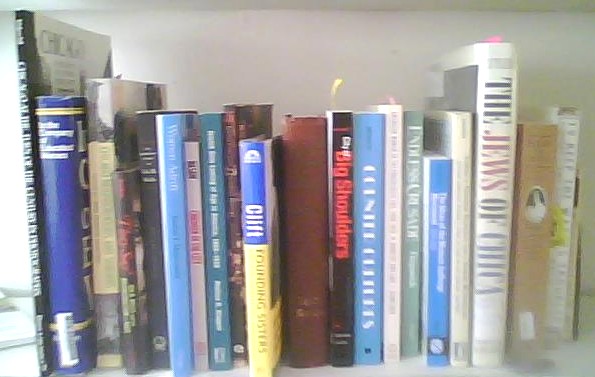
that I haven’t read yet, and more I need to add to the shelf.

I can hear you all now. “Just write it!”

And here are your very good reasons:

  • I’ll learn more about your characters as you draft their stories.
  • The plot will change no matter how much time I spend on it.
  • I’ll narrow down my research needs as I write.
  • If I do too much planning, I’m putting handcuffs and chains on my muse.

Yep. So I’m going to write.

Soon. I’m still learning from Maass, but I’m giving myself permission to go a bit more quickly through his worksheets. I’m putting a few more tags on pages that need to wait until I have a draft to revise. And I’m letting myself relax away from the research a bit, so I can keep my actual characters at the forefront of my brain, instead of too many historical details/facts. And, since I still will have revisions to do on the critique book, I’m telling myself that any plotting I do has to be fit in between those changes. I’m not allowed to put the writing off, just because the whole outline isn’t complete and comprehensible.

When? I’m thinking June. A few other writing friends have first drafts looming, and we may all hit the keyboards together.

I’ll be MORE than ready.

So when do you start? What’s your comfort zone between knowing any/all of your story and needing to get those people on the page and moving? I’d love to hear how you do the balancing act?

Posts may be a bit thin on the ground the next few days–we’re in the middle of spring break over here. I’ll be back in force next week, though, and I’d love to start doing a little more talk about critiquing and critique groups. So if there’s a topic you’re “itching” to dig into, let me know that, too!

Posted in Form, Picture Books, Plot, Structure, Uncategorized, Writing Books

Form: Learning It

Years ago, I read a writing book by Lawrence Block. I’m pretty sure it was Writing the Novel: From Plot to Print. The advice I remember most from this book was that the best way to learn plot was to go out and plot a book. One you liked. By a good writer.

At the time I was working on a mystery novel (for grown-ups), and I did dig a few of my favorite mysteries off the shelf and re-read them and look for the big plot points. I probably didn’t go as far with this as I should have, but (in forgiving hindsight to myself) that book turned out to be the one that dragged on way too long and did nothing to make me happy, and I put it in a drawer when I made the jump to kids’ fiction. Someday, who knows…

Anyway, this week, I’m reading Anastasis Suen’s Picture Writing, and she’s basically giving me the same advice. In her book, she asks writers to storyboard out a few picture books–ones with strong characters. So I went to my shelf.

And just in case any of you are anywhere near being as much of a kids’ book addict as me, I’ll show you my list, so you can ooh and get all nostalgically syrupy for a moment.

Now, obviously, when I talk about form, I’m not talking about a formula. There is no formula, as much as we would sometimes like. But there is form. There is a common structure upon which every book in a genre is built–even if doing the building means taking the familiar shape and twisting or even breaking it.

An example: Suen talks about a big story problem, then three small problems that show the big one. One of the books–Bread and Jam for Frances did have the three problems, although I had to read pretty deeply to identify them to my satisfaction. Another book, though—Miss Spiders Tea Party uses eight small problems to illustrate what’s going wrong. And they both work. Between the identification of the big problem and the ending climax & resolution, the authors give the hero a strong or increasingly bad problems to deal with.

And–here was another fun difference. The Hobans and Kirk handled the last, most critical problem in two very different ways. Remember, this is the problem just before the Climax, so it has to be big, and it has to have impact. In Frances’ story, the Hobans deliver several scenes of Frances not getting any other food than her bread & jam. The authors took their time over the first two problems, but they deliver these scenes in quick succession, not giving Frances–or us–any time to recover between them.

Kirk has taken the opposite route. He gives the first seven problems a two-page spread each (one page of verse & one full-page illustration). The last problem, though, he spreads out over eight pages (four verse and four illustrated). He’s drawing out the problem, raising and dropping Miss Spider’s hopes, and seriously increasing the tension…again, to get us to the climax.

Now, I would never say that writing a picture book is easier than writing a novel. In fact, I’m pretty sure it’s harder, & you’ll probably hear me say that plenty of times in the next year or ten.  But…it is, I think, an easier form to study in this way–simply because there are fewer words in which to hunt for the structure.

Why am I doing this? For the same reason we should all be doing it in whatever genre we’re writing. No, we’re not out to learn that mythic formula. No, we’re not out to play “Copycat the Rich & Famous.”

We’re out to learn everything we can about the form we’re writing. We’re out to make our own books in that form the best that we can.