Posted in Critiquing

Opening the Critique Discussion

One of the reasons I started this website is that there was a pretty serious curve in my own writing path this year. Up until last spring, I was writing mostly fiction and filling in gaps with freelance manuscript editing. Then I pitched a critique-book idea to an editor at Writer’s Digest and found myself with a nonfiction book contract. The Critiquer’s Survival Guide was born.

Okay, well, it won’t be born for another year, but the writing commitment it was going to take from me was definitely given a kick in the you-know-what.

Anyway, it felt like time to change the look and focus of my site, so here you go. Ta da!

While I write this book (and for quite some time, afterward, I suspect) I’ll be thinking a lot about critique groups and about the critique process–how to really dig deep into a story and provide thorough, constructive, and–yes–supportive feedback. So, one of the things I’d like to do with this website is use it as a central “location” for people to talk about this topic. I’d like for people to feel they can come here with questions, for answers, to brainstorm techniques, and to troubleshoot any problems. We’ll use the comments section a lot, I hope, and I’ll take what seem big questions and ideas and see about turning them into new posts–for new discussions!

Now, I’m going to be honest here. You know those times when you are trying to tell a story to a group of very young children? Let’s say you’re telling them about a trip you and your grandfather took to the zoo. You have this great set-up, and you’ve got some funny stuff along the way for details, and there is a whiz-bang ending that will tie it all up into a beautiful package. And what do the kids do? They (hopefully!) raise their hands, all of them, to tell you about the time they went to the zoo, and theysaw an elephant (or a zebra or a boa constrictor or an okapi), and then the parrot “messed” on their little brother’s cotton candy, and they never did get to the platypus exhibit! And maybe the kids even start pushing each other if they don’t think they’re getting their turn, and somebody throws a cookie, and someone else uses the word “stupid.”

🙂

You get the picture. Let’s keep our discussions on topic and respectful–hey, kind of like a critique group
! I want to hear any and all opinions, but I will delete comments that I think cross a line. (Don’t worry–I know that any of you who have already stopped by don’t need to hear that, but I’m sticking it in for a just-in-case, I-warned-you scenario for the future!

So what do you think? Any takers? Does this sound like a good idea to anybody but me? For this first post, is there a question you’ve had for a while about how critique groups work, or what kind might be best-suited to you? Throw a comment in, and let’s see what we all get back!
Posted in Somebody Else Says

Taking Care of Yourself

This is just a quick post to share a link I found on another writer’s blog, one I think we all need to read. It’s been a wonderful, but stressful, few weeks of work, and pampering/rewarding myself is a talent I still need to build.

Take a few minutes and see how Free2cr8 does it.

I’ll be back later in the week with some more of my own stuff. 🙂

Posted in The Writing Path

Doing it All: Keeping Your Writing Goals a Priority

I can bring home the bacon (at least from the grocery store), and I can fry it up in the pan. I can…well, never mind. You all remember the rest.

Most of us handle the daily stuff just find. What gets tricky, though, is keeping the writing, or a specific kind of writing, at the top of the to-do list. For the past few years, I’ve been handling the fiction very well. I’ve made steady progress–got a book ready for submission and started researching and brainstorming the next. I loved it.

Then I started writing nonfiction. I also love this part of my writing life. It uses a different part of my brain, it goes much more quickly than the fiction (which makes for many more instant-gratification moments), and–with it–I’m getting published. Always a plus.

When I got the contract for this latest project, The Critiquer’s Survival Guide for Writer’s Digest, I faced a realization. I might not be going back to work full-time, in an office or cubicle, from nine to five, but I was back to work. The deadline is not impossible, but it’s tight, and signing that contract was a serious (albeit ecstatically happy!) commitment.

And because of that commitment, I have a new challenge: to make time for my fiction. I refuse to push it aside, lose track of my characters, or give up the sheer joy I get from writing it.

There are many variations on my theme:

  • Full-time workers writing at the end of a long, hard day
  • Parents fitting in a few minutes of writing while a baby naps or Sesame Street is on TV
  • Journalists making space and time for that dream novel
  • Series writers scheduling time to draft (or just propose) the next book, while writing another and revising a third (Hi, Terri!)
  • Every other writer with a challenge I haven’t specifically listed here

I don’t know one writer who has it easy, who doesn’t struggle with this juggling act. LIfe happens, and–wonderful as it often is–it does give us too many reasons and excuses to turn away from our writing.

Don’t.

Here are some things I’ve been mulling on over the past couple of weeks, reminders to myself about how I canmove foward on all parts of my writing path–nonfiction and fiction. Thought I’d share.

  • Put your work on the calendar. If you schedule the time, it will come. Block out specific time slots for your writing–whatever kind you want and need to do. Work hard NOT to schedule anything that’s a conflict.
  • Write a little bit, on everything, every day that you can. Fifteen minutes may seem like nothing, but it’s more than zero (see, I can do math). One of the biggest steps you can take for your writing is to keep it in the front of your mind. Every day that you stay away from it is another chunk of time that it will take you to get back up to speed on your story.
  • Talk to other writers. I know, for some of us, sharing the details of a story before we’ve reached a certain point is hard, even scary. You don’t have to take it that far. Just have a conversation, discuss your progress or your struggle. Connect. It will remind you that you are a writer, and that will make you act like one.
  • Reward yourself. Chocolate. A new book. These days, I’m using writing as my reward. When I use my main writing hours to be productive on the nonfiction, I get to spend my evening time with the fiction. The balance of time is definitely skewed toward the nonfiction, but that’s how it needs to be right now. But this method is keeping my fiction world alive.

Finally, I’ve given myself a mantra or a visualization or a statement–whatever you like to call it. I wrote it on a small piece of paper and stuck it to the bottom of my monitor, where I can see it everytime I sit at my desk to work. Three short words. It says simply: Room for Both.

What balance are you trying to achieve on your writing path? Do you have tricks or tips, or another mantra, to share? Drop into the comments and let us know.

Posted in Character

Characters: Getting to Know Your Hero

My son’s 7th grade English class just read The Outsiders. In the back of the book were some questions S.E. Hinton had written answers to. My son doesn’t remember the specific question, but in one answer Hinton said, basically, that she knew everything about her characters before she started writing the story.

Then yesterday, I went to an SCBWI conference and heard editors and agents talk about what really “grabs” them about a submission. They didn’t really apply the label of “Character” in their talks, but here’s what I “heard.”

An editor or agent has to fall in love with your work to take it on. Really fall in love. And to do that, there has to be something “there” for them to attach to. Something very, very specific. And I took that to be something specific about your main character.

How many times, when someone asks you about your book, have you said, “Well, it’s about a woman who…” or “It’s the story of this guy who…”

I decided yesterday that our stories can’t be about “a woman” or “this guy.” Our stories have to be about Ponyboy or Jane Eyre or Anne Shirley or Sam Spade. What happened in your brain when I put the names in that sentence. You knew just who I was talking about, you recognized each character. You responded as if I was talking about a real person. Because, when you read one of the names, you instantly–I’m betting–focused in on one or more specific, concrete details about that character. You also went right back to the feeling that person raised in you when you read about them on a page.

That’s our character goal, I think. To write someone who almost literally walks off the page and grabs the reader, who says, “Here! Right here! I’m ME!” And who shows you just who that ME is.

So, for today–how far do you have to go in knowing your characters before you start to write about them? Do you do character sheets? Do you draw pictures of them or cut out photos from magazines? Do you build a collage of all the things that make up that character? Or do you just write and write and see what grows off the page, what calls to you to shape and mold and highlight as your revise.

I cannot do character sheets. I’ve tried and tried. I need to start writing about a character to learn who he/she is. In many ways, character is defined by action and reation, so–writing down hair color, or age, or even the character’s secret, never feels real to me, unless I’m playing with it on the page of a story. Also, frankly, I get bored filling out this kind of details.

There are certain questions I do need answers to, though, before I can start telling my hero’s story:

  • What does my hero want? Here, I’m talking about a concrete, specific THING, not the big, global dream ideal
  • Why does he want this thing?
  • Why doesn’t my hero already have it?
  • What does my hero plan to do to get it?
  • Who will try to stop my hero? How will they try and, most important, why will they try?
  • What about my hero will work against his getting his own goal?

Do you see all the “whys” in that list? I think this is the layer of characterization that makes our characters unique, special enough to come close to any of those I listed above, to make a big splash with an agent, an editor, and a reader.

I don’t know all the whys when I start writing. As I said, I have some idea, or I couldn’t get started. But the more I write and the more I revise, the deeper I push myself for fuller, more detailed answers. People often ask, how do you know when your story is done. There are a hundred answers, but one has to be, “When you have the answers to all your whys and, together, those answers produce a strong, cohesive, captivating character.

Here are a few links I found to show you some more thoughts on characterization:

What about you? What have you tried and what’s worked best for you?

Posted in Uncategorized, Writing Books

The Writer’s Journey: Start Here

Have you read this book?


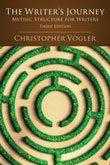
You might not recognize the cover. I didn’t at first, because it doesn’t match my copy. Of course, mine is only the second edition. This one’s the THIRD edition. Christopher Vogler’s The Writer’s Journey is like the energizer bunny–it keeps getting printed and printed and printed…

There are plenty of reasons why. First, Vogler has a lot of important things to say. His book is based on Joseph Campbell’s ideas about the hero’s journey, the common storyline in so many myths. Vogler does NOT, as some people seem to fear, advocate writing from a template, a formula. What he does instead is analyze the common elements of all stories, in a way that makes us recognize the patterns and layers we’re all struggling to find in our books and bring to the surface. I have a very specific criteria for a “good” writing book, that I find myself putting it down before I reach the end and rushing back to my story to get all the new ideas onto the page. The Writer’s Journey more than qualifies.

The other big reason is more practical. Basically, if you want to have a discussion about plot, or character, this is your starting point. As an editor, when I talked with a client about what their hero was doing, what the other characters were up to, I’d inevitably find myself talking about Vogler’s book. I’d suggest that, even before they looked at my critique, they should probably pick up a copy of The Writer’s Journey and read it through. This book is also the basis of so many brainstorming sessions I have with my critique groups, whenever we get deep into what our hero is (or isn’t!) doing.  Teachers in writing classes point to Vogler’s book, and The Writer’s Journey is referenced in more other writing books than I have time to count. You need to know what all these people are talking about.

I’ll admit that Vogler hasn’t solved the problem of the story middle for me. And, these days, I’m also pushing Les Edgerton’s book Hooked as a must-read companion to The Writer’s Journey.  Edgerton builds on Vogler’s ideas, and really hits on the kinds of beginnings we need to be writing today. Still, I find myself going back to Vogler’s book time and time again, when I’m stuck, when I’m trying to figure out WHO my hero is and needs to be, when I’m just trying to get a closer look at the layers of my story.

Whether you’re just starting on your writing path, or you’re already treading strongly along it, I recommend dropping this book into your traveling pack.

Posted in Marketing

Free Books: One Giant Step for Writerkind?

M. J. Rose has this article up on The Huffington Post. In it, she talks about the logic and marketing sense behind giving away her book The Reincarnationist for free.

I told you I wasn’t going to stay organized. From first drafts to marketing all in one week. I’ve heard this discussion before, though, and it’s an interesting one–this seemed a good time to share.

I think Rose is probably right. If you make the assumption (or goal) that you are going to write and publish more than one book in your lifetime, then you are not so much trying to market each book, as you are working to market yourself.  As Rose points out, people buy books by the authors whose other books they’ve liked. Not just “people.” We do. I do. I’m still waiting eagerly for the next Deborah Crombie or Jo Bannister mystery, and my son and I agree that the definition of optimism is hoping there’ll be a new Roald Dahl book soon (or a Jane Austen, as I once heard someone say).  

Of course, we’re talking electronic versions here, not the cost of paper and ink and binding, but still…If giving a book away for free gets readers to you, isn’t the return going to be much higher than the expenditure? Not just in people reading your book and talking about it, but in them coming back for more–your next book and your next and your next.

Like I said, I think M.J. and all the other people putting forth this argument are right. And yet…there’s a corner of my brain still shouting, “What?! Really?!” and wondering about doing this for myself.

Luckily (or unluckily!) I’m not yet at the point where I have to make this decision. I suspect, though, that sometime in the future I will find myself there, in a discussion about one of my books, not the hypothetical book of a theoretical author. It’s a step on the path that’s coming, I think, for all of us. And so it’s a step worth thinking about and listening to what others are saying.

Thanks to Jessica Faust for putting the link up on Facebook.

Posted in First Drafts

First Drafts: Fantastic or Just Fast?

Don’t expect me to stay this organized, but I thought, for today, I’d start at the beginning. The first draft. A stage that some of us love, and some of us, well…let’s just say we struggle with it.

National Novel Writing Month (NaNoWriMo) starts in ten days. Martha Alderson blogged about it this week at The Plot Whisperer— talking about “pantsers” and “plotters” and how both types of writers can make NaNoWriMo work for them.  Debbie Ridpath Ohi also put up a post about the month at Will Write for Chocolate–she’s going to do cartoons for NaNoWriMo this year. (Once again, I wish I could draw!) And if you want a serious peptalk about joining in, go over to GottaWriteGirl and scroll down to her Git Her Done! post.

What I like about these posts is that they go at this novel-in-a-month thing with some flexibility. I know lots of writers welcome NaNoWriMo with wide-open arms, but I’m also guessing there are plenty out there who would rather eat massive amounts of eggplant than try to pour out 50,000 words in 30 days.

I’ve never done NaNoWriMo myself–the timing was never right. I did, however write a Book in a Week, after hearing April Kihlstrom talk about the process. Did it work? Yes. Did I do it exactly as the instructions said? Nope. I am NOT a pantser. I need a path to follow, even if I know that path is going to change (and it will). So, in my “free” time, over a couple of weeks, I plotted–making use of Martha’s Scene Tracker, and writing a page of basic info for each scene I had planned. Then I took the week to write.  Essentially, I did Book in Three Weeks.

Guess what? I wrote 150 pages in five days. I had a book.

And then I revised.

Because, for me, this is what NaNoWriMo and Book in a Week and Karen S. Wiesner’s book First Draft in 30 Days are about. Oh, yes, they’re about the first draft, but–really–they’re about getting that draft out of the way so I can start fixing it.

I hear authors talk about writing a slow first draft, revising as they go, cleaning up the plot and the characters and the prose before they move on. I believe that, for these writers, this process works. It does not work for me.  At this point on my writing path, it doesn’t seem to matter how long I spend on the first pass at a page, or a scene, or a chapter.  I’m going to have to change it…often in very big ways.  Any extra time I send on phrasing or voice or setting–the work I do to get things “just right”–is wasted.

The truth is, you really don’t know the beginning of your story until you’ve written the last scene. Odds are, the pages you will revise just before you send a manuscript off for submission will be the first ten. When I’m first-drafting, I need to get to “The End” as quickly as possible, so that I can stand back and look at my story–my whole storyand really understand what it’s about.

Since I did BIAW, fast first drafts have become one of my soapboxes. It’s a little crude, but when I speak at conferences, I tell the writers in the room that my first draft is my “vomit” draft. In other words, I get it all out and worry about cleaning it up later. 🙂


I know this process isn’t set in stone for me. As I write more books, my attitude and the way I come at the first draft may change. But for now, I’m definitely on the side of the fast first draft.

I’ll make it fantastic in the revision.

What about you? Do you speed through the pages the first time around, or do you need to take more time, figuring out the details before you can move on? Have you done NaNoWriMo, or a variation? Are you joining the NaNoWriMo gang this year? Or have you built your own, flexible, method for getting that first pass on the page?

Join in the conversation. I’d love to hear your take on things.

Posted in The Writing Path

Welcome

Wouldn’t it be nice if we knew every step along our writing path? Not just the ones we’ve already made or the one our foot is coming down on just at this moment, but the ones yet to come?

It’d be a bit like taking your list to the grocery store–walking down the aisles, picking the right items off the shelves and putting them in your cart, checking off ingredients one by one. The whole journey would be well-planned, organized, and straightforward, and each step would bring you closer to your goal. You’d be heading toward the check-out line, you’d know exactly how to get there, and you’d succeed. Easy. You could even work it so you had a nice bar of chocolate at the end.

Unfortunately, our writing paths are a lot harder than shopping for milk and bread. Fortunately, they’re also a lot more fun and way more interesting. We do all the work we can to try and figure them out–take classes, read books, join critique groups, and write and write and write. There are steps along the path that are nothing like you’ll find at the market, when something happens that has you doing Snoopy’s happy dance in front of your computer. There are also moments that feel like you just stepped in the broken-egg mess left behind when someone dropped a carton.

At this new website & blog, I want to talk about all these steps (yes, the bad ones, too). When you visit, here are some of the topics you’ll find:

  • The BIG elements of writing–plot, characterization, voice, pacing–you name it
  • The writing process–outlining, first drafts, revising, polishing
  • The critique process–reading deeping & thoughtfully, giving and getting constructive & supportive feedback, brainstorming, revising (yes, again!)
  • Networking–getting to know other writers, and agents and editors, in person and online
  • Marketing & PR–websites, blogs, social-networking sites, book launches, workshops, signings
  • Book reviews–books about the craft and business of writing, as well as books that I just fall in love with

Today, more than ever, all these pieces are stepping stones on our writing paths. I hope you’ll stop by frequently, enjoy the posts, and leave your two cents (or three!) in the comments. Together, I believe we can make more progress than if we walk alone.

Let’s start the discussion. Leave me a comment about who supports you on your path, and how you work together. What are the benefits you gain?